Damn I just love old brick Federal houses! This home in Boxborough, MA was constructed in 1804 for Dr. Daniel Robbins, who owned a one-story wooden home on the site in 1798. As building materials were expensive at the time, Robbins likely incorporated that structure as one of the side additions to this new brick house you see here. Robbins served as a town doctor until his death in 1837, and would treat patients in his home or ride on horseback to treat sick residents nearby.
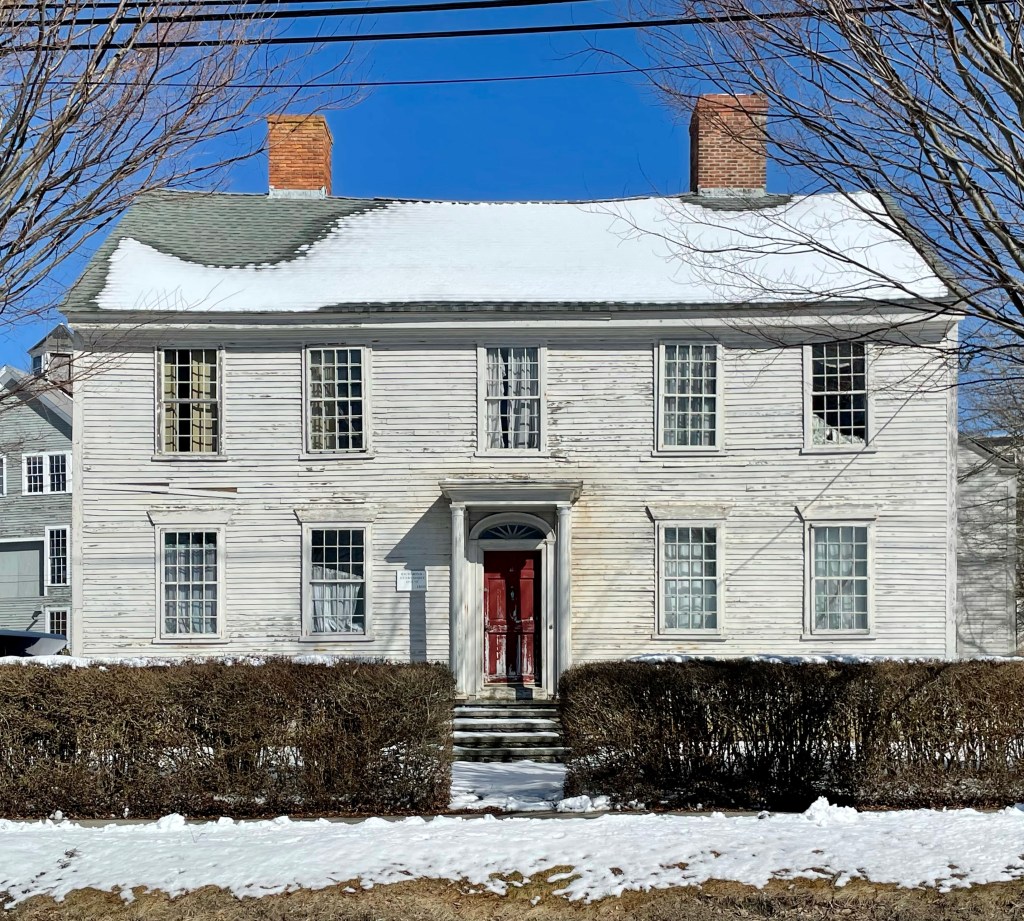
The Parsons Homestead in Rye, contains some of the most interesting early Federal-style design elements in the coastal towns of New Hampshire outside of the principal towns of Portsmouth and Exeter. When the Parsons House assumed its present appearance at the turn of the nineteenth century, Rye was a coastal farming community, but despite its rural character, the town developed distinctive preferences within the Federal style. There is no architect listed for the home, but it is highly likely a housewright took cues from William Pain’s “The Practical Builder” (1774, published in Boston in 1792). This book, inspired directly by the designs of British architect Robert Adam, allowed carpenters to take plans from one of the earliest “do-it-yourself” manuals ever published. The builders’ manuals and pattern book offered carpenters and other construction workers important resources for designs and techniques in house design and construction. Those unable to afford an architect’s services could feel confident in the good taste of their residence by selecting designs from a pattern book style in southeastern New Hampshire. Records show the land here was purchased in 1757 by Samuel Parsons (1707-1789). The property was acquired by his son Captain Joseph Parsons (1746-1832), who was a Doctor and Captain in the Revolutionary War. It is likely that he or his own son built this “modern” Federal home, and incorporated some of the old features of the family home inside.
In 1794, four men from Acton, Abel Conant, Dr. Abraham Skinner, John Robbins and Horace Tuttle, jointly purchased a $5.00 ticket in a lottery run by Harvard College to raise funds for the construction of Stoughton Hall in Harvard Yard. This house, built for Dr. Abraham Skinner, is one of the four, and is the most grand of the four. Dr. Skinner was the third physician to practice in Acton and the first to arrive from out of town. He came to Acton in 1781 from Woodstock, Connecticut, and continued in practice until his death in 1810. The Federal style home is nearly square with five bays on all sides, with the facade and rear being slightly less crowded. The main entry includes a pediment with dentils, 4-pane side lights and a 4-panel, wooden door with elongated, rectangular, top panels. A similar entry, without sidelights, centers the south elevation. Time to buy some lottery tickets!
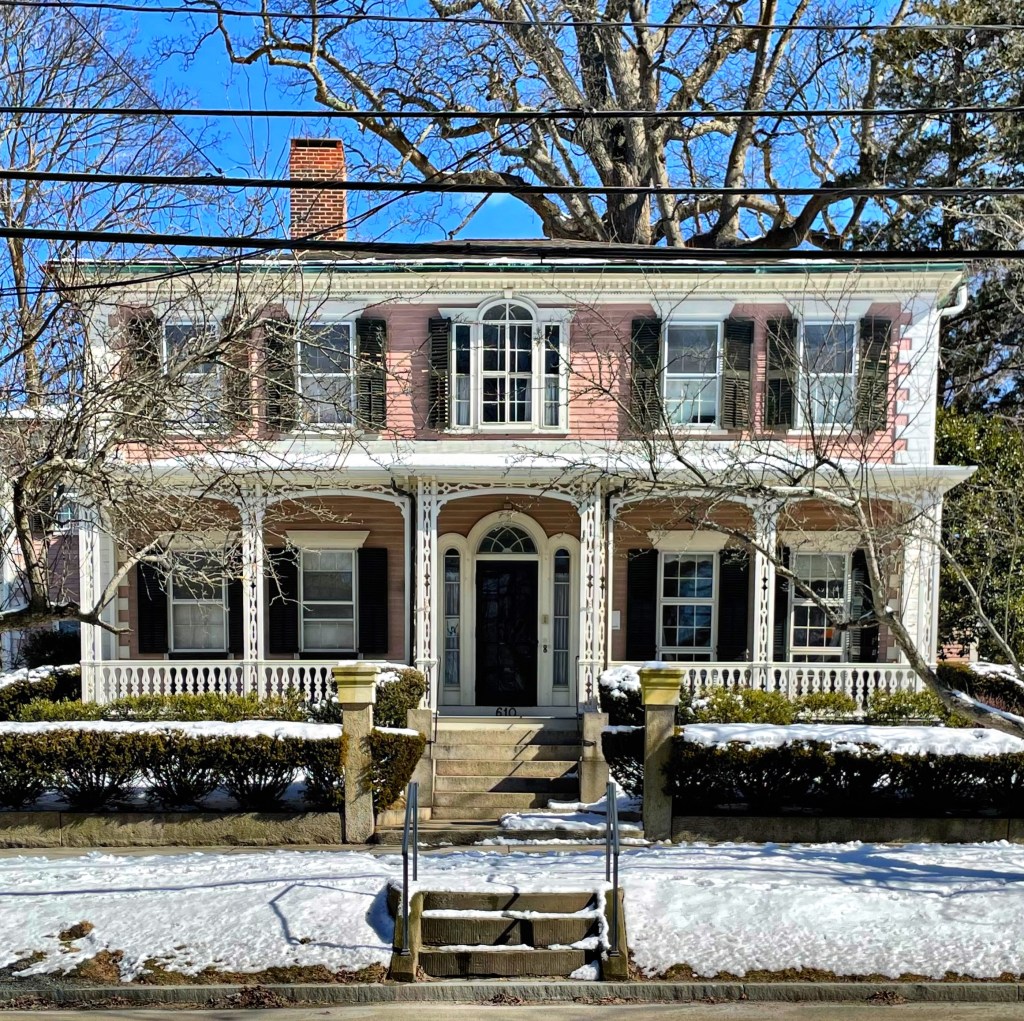
In 1809, Giles Luther built this two-story, 5-bay, hip-roof Federal house, which has been substantially enlarged and altered over the years in succeeding styles. Original detailing on the facade includes the Palladian window, modillion cornice, quoins, and wide-beaded window casings with splayed lintels. Giles Luther (1775-1841), a shipmaster, merchant, and farmer, was more importantly the first Grand Marshall of the Bristol Fourth ofJuly Parade, which is believed to be part of the oldest Fourth of July celebration in the country. In 1825 Luther’s business failed; the Commercial Bank took this house and sold it in 1828 to Jacob Babbitt. Babbitt owned part of a wharf in town and in his will of 1849, he left the “use and improvement” of this house to his son Jacob, Jr. (1809-1862). The younger Babbitt was wealthy and likely made the mid-19th century modifications to the home, including the Italianate triple-arched door and full-width porch with delicate cut-out posts and railings. The home was occupied for much of the 20th century by the Bristol Nursing Association, and sold in the 1970s to a private owner. The home was for a period ran as a bed & breakfast but appears to be back to a private residence today.
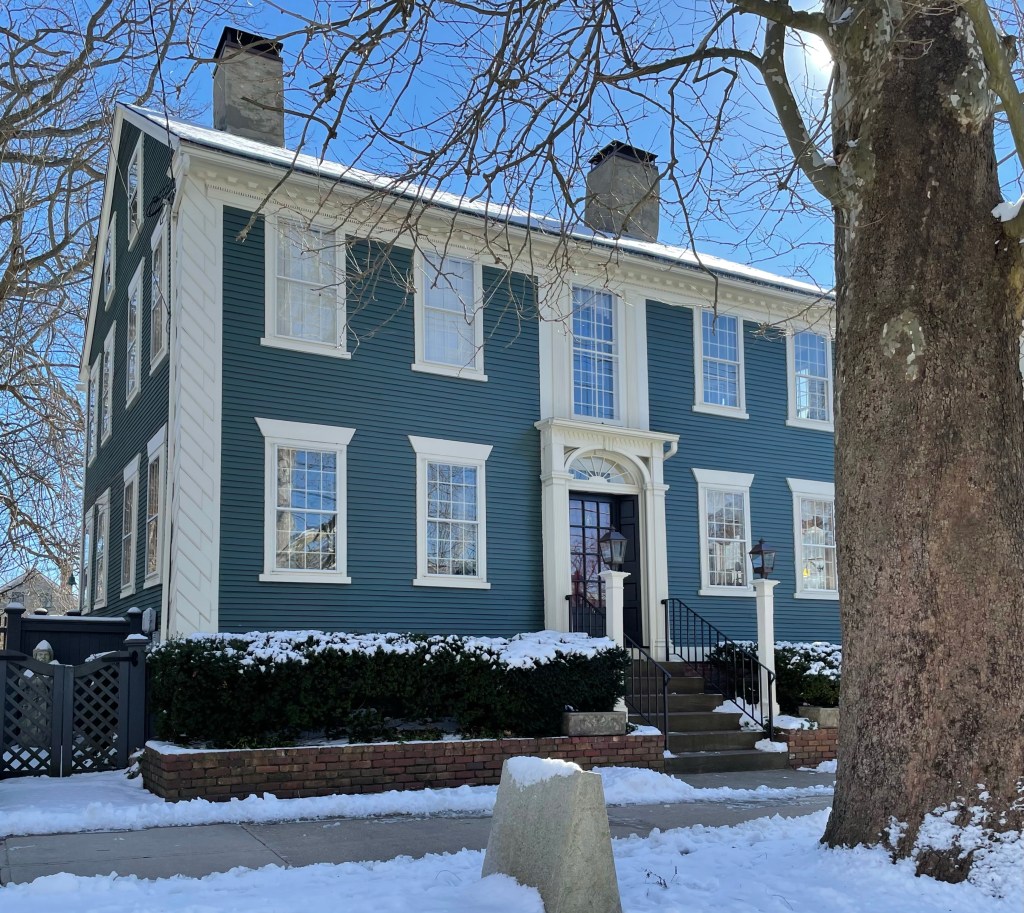
Architect Russell Warren (1783-1860), who I have featured on here numerous times, built this 2-story, 5-bay, hip-roof Federal house in Bristol, Rhode Island. This residence as interpreted by Warren as an example of the Federal style with stylistic features most notably being the angulated quoins (at the corners of the house). The house was designed for William Van Doom, a Bristol tailor of modest means. In 1814, Warren, a young and aspiring architect, saw the significant wealth in Bristol and decided to buy this home he designed. Siting himself in the vicinity of the extremely wealthy DeWolf family, he gained recognition and success by designing three expensive and elaborately crafted houses for them at this time, only Linden Place remaining. Warren lived in this house from 1814 until 1823.
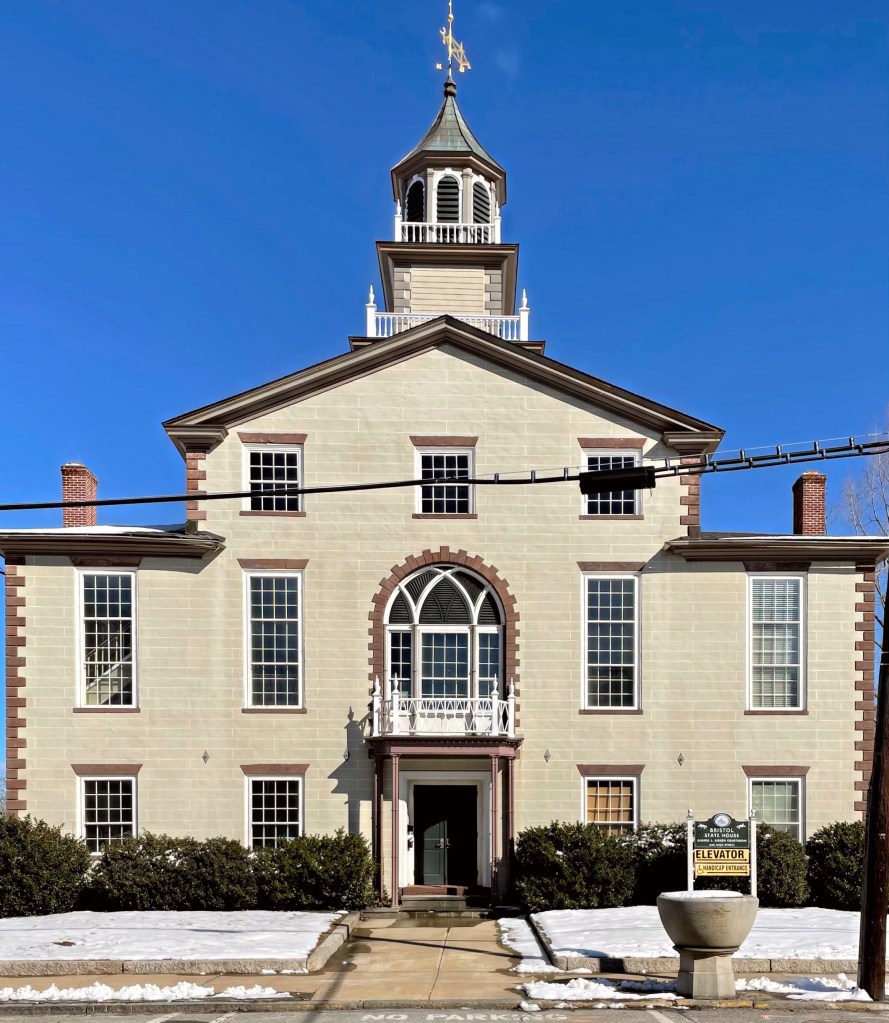
Located on the Bristol Town Green, facing the main commercial area and harbor, the old Bristol County Courthouse is a well-preserved example of a building for civic use in town, at the height of its growth. It is believed that the courthouse is the work of architect Russell Warren, who lived in a home he designed just blocks away. This Federal-style stone building is faced with brick and subsequently stuccoed, giving it the unique composition it has today. The focus of the symmetrical facade is the large central arched window with granite quoins, and Y-tracery that echos Gothic design. As part of the 1836 state Bicentennial, the stucco facing was added over the original brick facing, and the exterior was painted a Gothic Revival sand color with darker trim, replicated in a 1976 restoration. From 1819, the courthouse served as one of the five state houses used in rotation by the Rhode Island General Assembly (in 1854, the General Assembly decided to meet only in Providence or Newport). In 1853, it reverted to courthouse use, a function which ceased in the early 1980s. The Bristol County Sheriff maintained offices there until 1997, when the building was purchased from the state for $1 by the Bristol Statehouse Foundation. The nonprofit foundation has worked to restore and maintain the building. Today, the building is used for education, community programs, meetings, and events.
Located on Hope Street, just south of the downtown area of Bristol, Rhode Island, this beautiful Federal-style home overlooks the water, and once oversaw a large ship-building empire. The home was built by Lemuel Clarke Richmond (1782-1876), possibly in response to his marriage to Hannah Gorham in 1803. Richmond was a wealthy whaler who owned nearly twenty ships, including the Empress, a Bristol-built bark. The Federal style home features a five-bay facade with central entry. A modest portico surrounds the door which has a fan light transom above. Oh, and there are some gorgeous 12-over-12 windows on the home, at the ground floor the windows have flared lintels above. The home was sold by Richmond in the early 1850s and rented out to Charles and Julia Ann Herreshoff, who resided there with their eight children! It was here where sons John and Nathanael overlooked the water as young boys and became consumed by the beauty of the ships that sailed by their front yard. The brothers later ran the internationally renowned Herreshoff Manufacturing Company, which occupied land all around the home (and was featured previously). The home was acquired by the family in the 1860s, and often changed hands within the family over the next decades until it was inherited by Norman F. Herreshoff. A collector of Americana, Norman Hcrreshoff completed a series of renovations to the family home, including remodeling of the kitchen to be “old-fashioned” and replacement of the front porch with the small Ionic portico which we see today. The home is owned by the Herreshoff Marine Museum, but has seen better days.
While much of the downtown area of Bristol features early 19th century wood-frame houses, there are some substantial masonry homes providing a great layering of styles and materials in the neighborhood. This brick Federal style home was built in 1805 for William Throop Jr. (1771-1850), a stonemason and merchant, who had a shop on the DeWolf wharf in Bristol, where many slave ships set sail from. Throop himself was a descendant of William Throope, who built “Throope Place” (previously featured) on the north side of town. We understand that William Jr. likely had connections to the slave traders of Bristol based on his ties to the DeWolf Family, which is compounded by the fact his two daughters Juliana and Jane married Judge James Eppinger of Georgia. Juliana first married Eppinger in 1820, but died in 1859, and her younger sister Jane then married James Eppinger one year later. The Eppingers built a house in Bristol where they would spend time, and often brought enslaved with them to maintain their home. On October 12, 1829, Nancy Gindrat, a 22 year old slave to James and Juliana Throop Eppinger, escaped in Bristol. Eppinger frantically wrote to his father in-law William Throop and others that he would offer a large sum to anyone who could find her, though he never did. It was interesting to learn how inter-connected Rhode Island and Georgia were in the early 19th century, both bonded by the slave trade. The William Throop Jr. House remained in the family for a century until it was converted into a rooming house in the early 20th century, to house workers at the nearby industrial buildings. The home was restored and reverted back to a one-or-two-family residence in the 1970s.
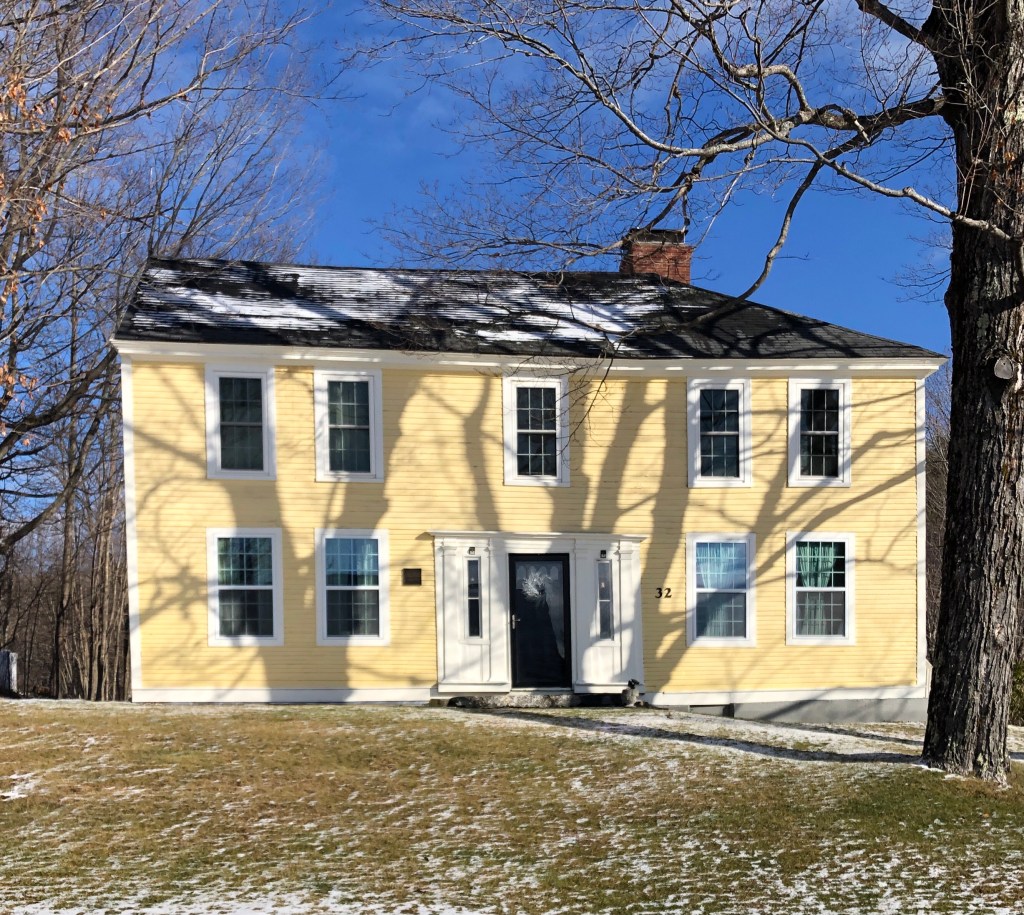
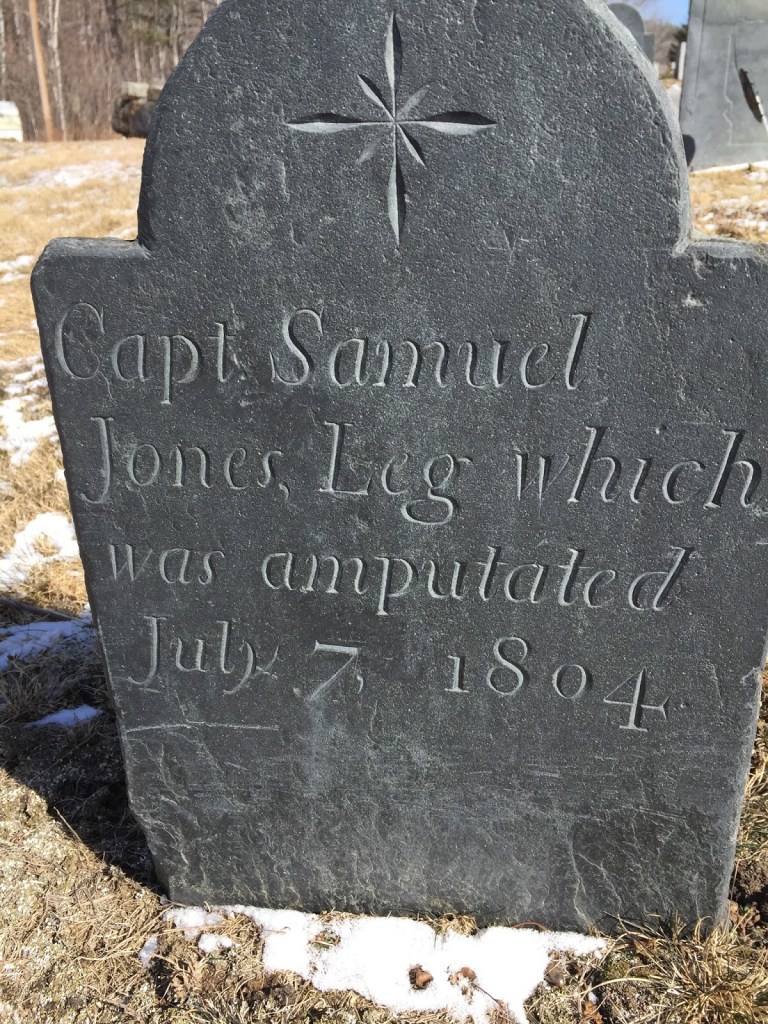
Samuel Jones Jr. was born in Hillsboro in 1777. His family was among the first to settle in that town in the 1770s. Jones married Deborah Bradford in 1799, and the couple soon settled in Washington, New Hampshire that next year. Samuel ran a tavern out of the new family house which was built around that time. When he was 27 years old, Jones was helping a friend hoist and move a building on logs, when his leg became was caught and crushed by the building. His friends brought him to his house where he laid on a table awaiting a doctor. This occurred in the days prior to knowledge of anesthesia so his friends and neighbors treated him with whisky or rum. When the leg was removed they decided it should have a “proper burial” so it still rests with its marker in the old cemetery in Washington. Samuel survived the amputation and later moved to Boston, where he worked at the Customs House and later moved to New York where the rest of his body was buried upon his death in 1851.
The South Congregational Church in Newport, NH, is located (as its name suggests) south of the commercial and civic heart of downtown Newport. The church congregation was founded in 1779 and grew substantially in the early 19th century. The church’s location, outside the present downtown, is the result of a long-running dispute within the town of where its civic heart should be located, to the north or south of the Sugar River. The consequence of this disagreement resulted in the placement of the Baptist church at the town common (north of the present-day commercial downtown), and the placement of this church here. The resulting development to the north of the river left this massive, brick Federal style church towering over the small working-class homes, with a majority of the town’s other significant Federal buildings built years later, like the Eagle Hotel and Old County Courthouse to the north of the river. The 1823 church is thought to have been designed by Elias Carter, who designed many Federal-era churches in the New England area.




 Buildings of New England