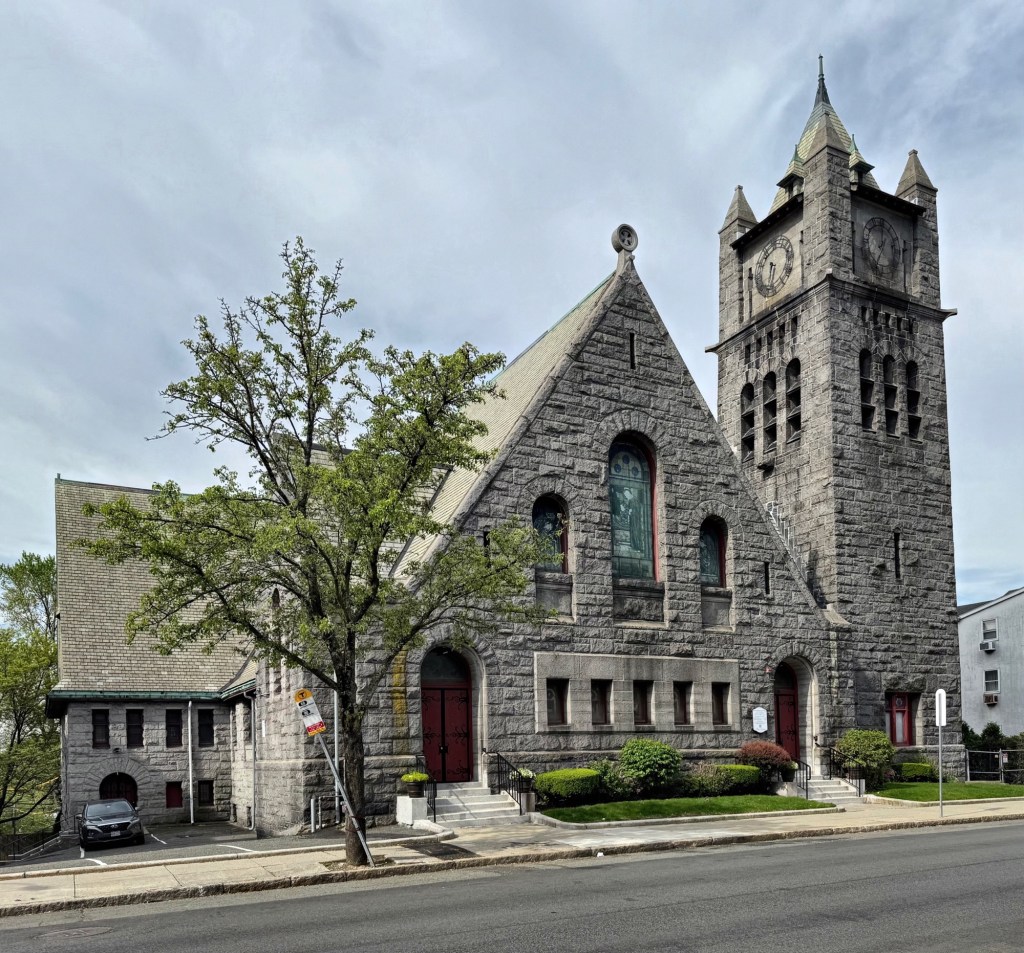
First Unitarian Church of Somerville // 1895

Located on Highland Avenue in the Central Hill section of Somerville, Massachusetts, the First Unitarian Church of Somerville is a landmark example of a church in the Romanesque Revival style. The church was built in 1895 from plans by the esteemed architectural firm of Hartwell & Richardson, and was the fourth and final building of the congregation, which was originally established in 1844. The congregation’s first church was a Gothic Revival style building designed by Richard Bond, but was destroyed by fire in 1852. A year later, the second edifice was designed and built by architect Thomas W. Silloway, which also burned in 1867. The church was replaced again by a Romanesque style structure in 1869. In the 1890s, when the City of Somerville purchased the building as part of the site for the new Somerville High School, a lot down Highland Avenue was secured and planning began for this building. The church is built of granite block with a steeply pitched gable roof, and a square tower at its right front corner. The prominent gable contains two arched entrances with a bank of five rectangular stained-glass windows below three tall round-arch stained glass windows. The congregation was dissolved in 1975 and a year later, the building was purchased by the Mission Church of Our Lord Jesus Christ, an Apostolic Pentacostalist church, who continue to use the building today.

Old Killingly High School // 1908

The Old Killingly High School is located in a densely built residential neighborhood east of downtown Danielson, a village of Killingly, Connecticut. The building has served the community for well over 100 years, but through various uses. The school was built in 1908 and enlarged with side wings in 1927. It was considered state of the art for its time, with fireproof construction, wide hallways, and large bands of windows to maximize lighting of the classrooms. Clearly showcasing the village’s wealth and hope for future prosperity. The school was even designed by Hartwell, Richardson & Driver, a leading architectural firm based in Boston, Massachusetts. The building served as the community’s high school until 1965, and as its junior high school 1966–90 until it was converted to a community center and police station for the town. The Renaissance Revival style building is a gem and while tucked away off the main street, it shines through some great maintenance and restoration from the town.

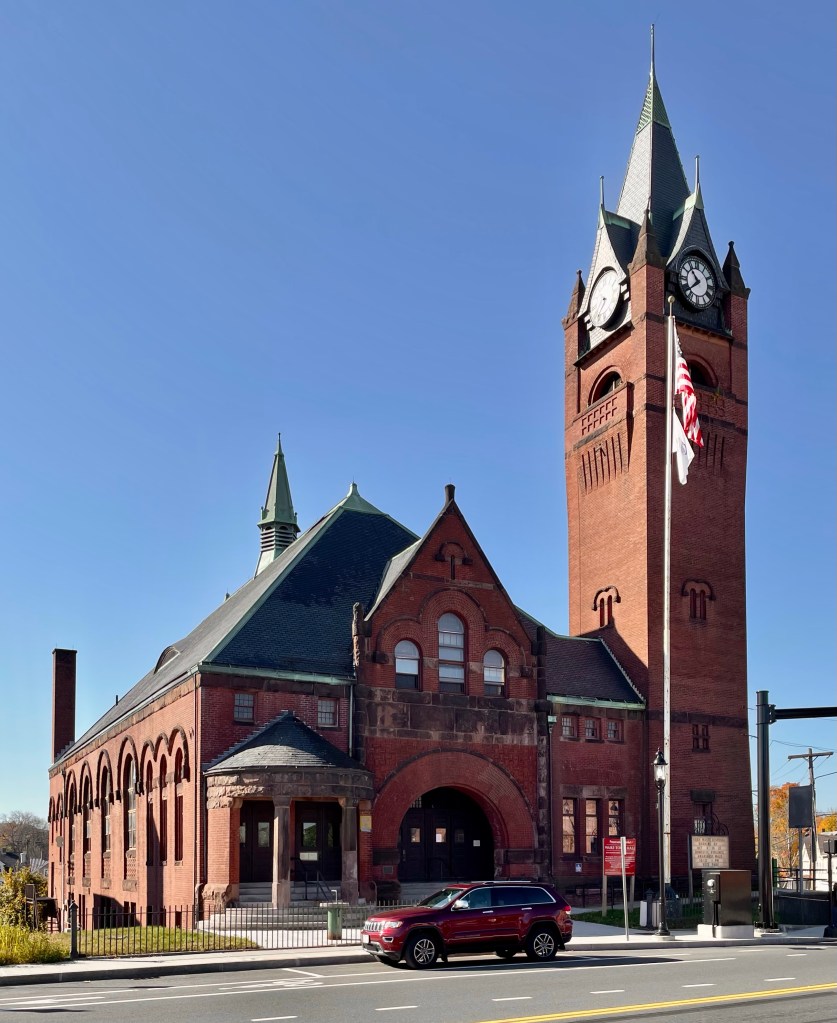
Ware Town Hall // 1885

After learning a little about some of the buildings in Dorset, Vermont, which were saved and relocated to the town from land flooded for the Quabbin Reservoir, I wanted to visit one of the surviving towns there to see it for myself. I found myself in Ware, Massachusetts, a town with a history that parallels many in central and northern Massachusetts. The town was first settled by white European colonists by 1717, and incorporated in 1775. The town was named after the English town of Ware in Hertfordshire. The Town of Ware began as a sleepy farming town with inns and taverns dotting the landscape until industrial sites were developed on the banks of the Weir River. The post Civil War era (1860s–1900s) brought a new prosperity to the now established textile mill town. “Ware Factory Village” sprang up overnight and formed the basis for new growth and development, to the east of the former town center. From this, a new Town Hall was needed, and where better to locate it, than the economic and population center of town?! The Ware Town Hall was built in 1885-1886 from plans by the prominent Boston firm of Hartwell & Richardson. Sadly, a fire gutted much of the building in 1935, but the shell remains (though needing much repair). The town, like many former industrial centers, has struggled to re-invent itself, but a growing population is a great indicator of good things to come!

Gahm House // 1907

Located in the stunning Longwood neighborhood of Brookline, MA, the Gahm House stands out not only for its size, but stunning details and architectural design. This house was designed in 1907 by the architectural firm of Hartwell, Richardson & Driver, one of the premier firms of the region at the time. Joseph and Mary Gahm hired the firm to design their new home the same year the firm designed a bottling plant (no longer extant) in South Boston for Mr. Gahm’s business. Joseph Gahm was a native of Wurtemberg, Germany, who emigrated to Boston in 1854 and initially worked as a tailor. In the early 1860s, Gahm opened a restaurant in Charlestown, by the late 1860s he added a small bottling operation to this business. The bottling business soon expanded to such an extent that he was able to give up the restaurant business and open a large bottling plant in 1888. He eventually moved operations to South Boston where there was more room for transportation and shipping capabilities. Their stuccoed house in Brookline is especially notable for the well preserved carvings at the entrance, which include: faces, floral details, lions, and owls perched atop the newel posts. What do you think of this beauty?

Ralph Waldo Emerson School // 1904

One of the few architect designed buildings in Upper Falls Village in Newton is the Ralph Waldo Emerson School built in 1904-1905. The village school in Upper Falls consistently was outgrown by the rapidly growing population in the 19th century, leading to new schools being built every couple decades. The 1846 Village School (featured previously) was outgrown and a major landowner, Otis Pettee willed a valuable piece of land to the town for the erection of a new school and firehouse, both were built that next year. By 1869, a second schoolhouse was built on the site in the fashionable Second Empire style, named the Wade School. As expected, the two adjacent school buildings were deemed obsolete and the town, inflated by the industrial wealth of Upper Falls, hired the architectural firm of Hartwell, Richardson & Driver to design a large brick schoolhouse, with a cost of $92,000. The building was occupied as a school until the 1990s until (you guessed it) the schools in the town consolidated, and the Emerson School was then converted to residential units.