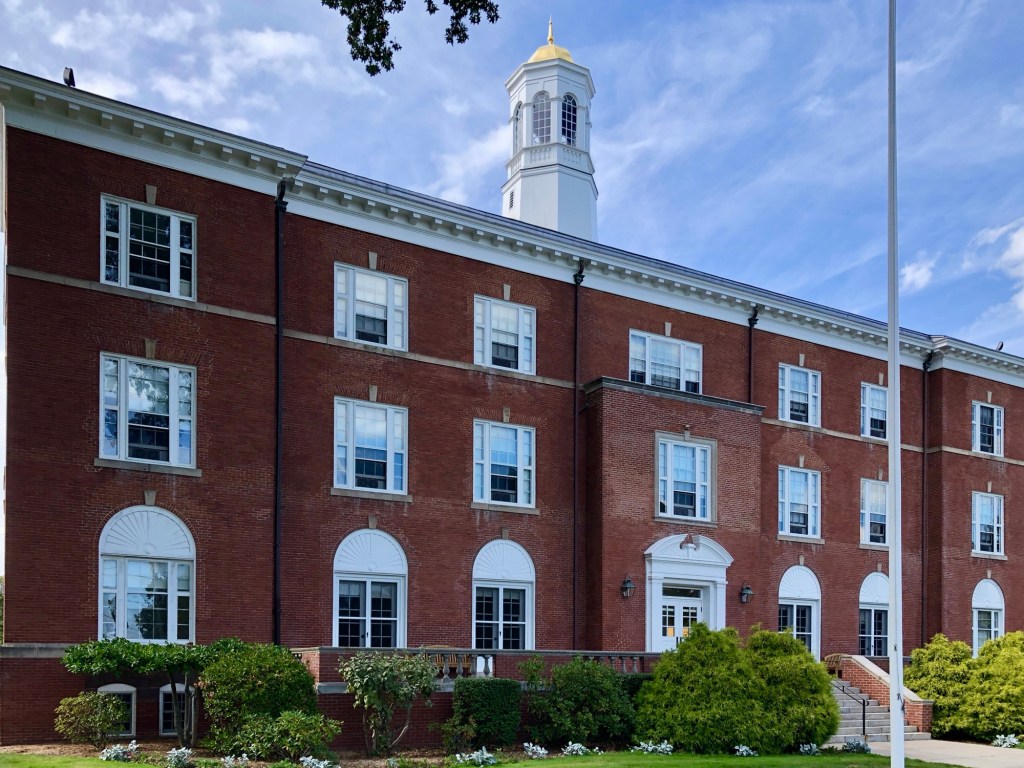
Suffield Academy – Fuller Hall // 1873 & 1953

The founding of Suffield Academy began in 1833 with the mission to educate young men for the ministry in the Baptist church. Despite its founding links to the Baptist Church, the institute quickly moved towards a non-denominational model and became the Connecticut Literary Institute. The school later rebranded as Suffield Academy serving as the only high school in town. The school received tax revenue from the community to allow boys outside the Baptist faith to study there. Later, with changing views of women’s right to education, the school allowed women into the school in 1843. Forty years later, the school constructed this building, then known as the ‘Ladies Building’, built next door to the school’s 1854 Memorial Hall. When built, the structure was Victorian Gothic and Second Empire in style but was heavily modified in 1953 in the Colonial Revival style, where the mansard roof and porch were removed and the building becoming a stripped-down version of a Colonial schoolhouse capped by a cupola on the roof.
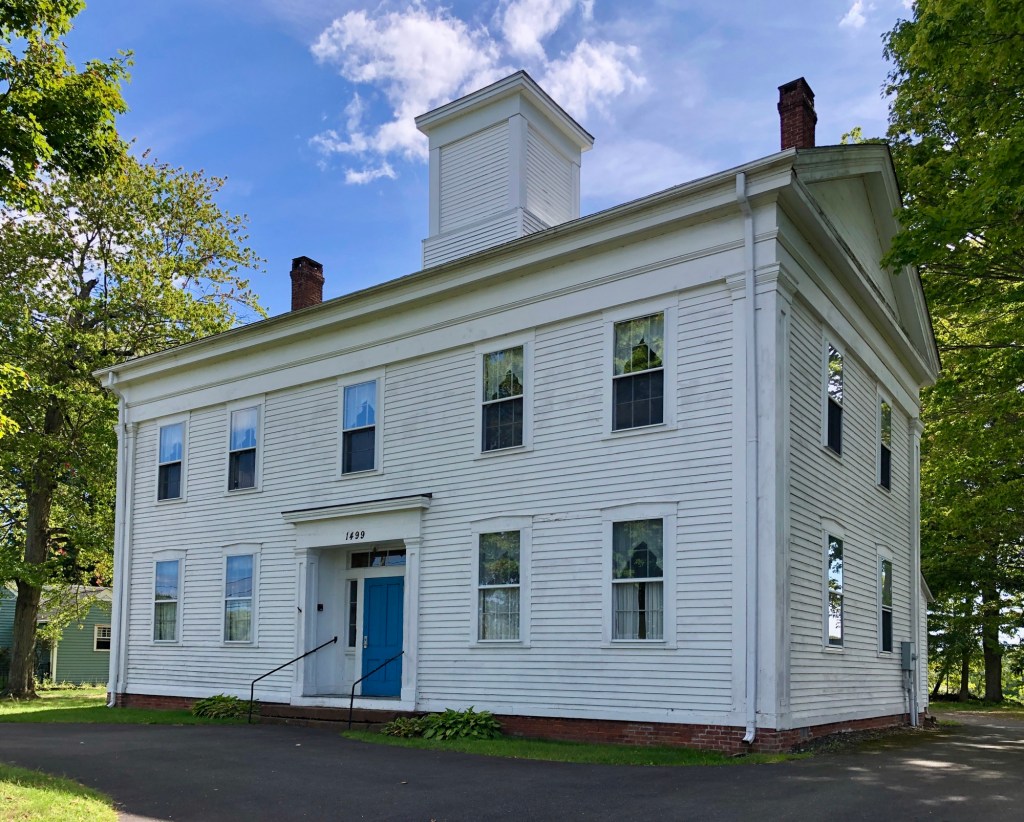
West Suffield Academy Hall // 1855

Built in 1855 as the West Suffield Village school, Academy Hall served as one of Suffield’s public school buildings until 1913, when consolidated schools were built in town. Like in many New England communities, the old, wood-frame school building was repurposed, and due to the large agricultural community in Suffield (it was a major grower and exporter of tobacco), the old Academy Hall was occupied by the local Grange club, a social organization that encouraged families to band together to promote the economic and political well-being of the community and agriculture. The handsome structure is owned by the non-profit West Suffield Village Improvement Association, and as of April 2026, the building is leased to the Suffield Historical Society, and is available for events. The structure features a Classical door surround, corner pilasters, entablature, and a large square cupola at the gable roof.

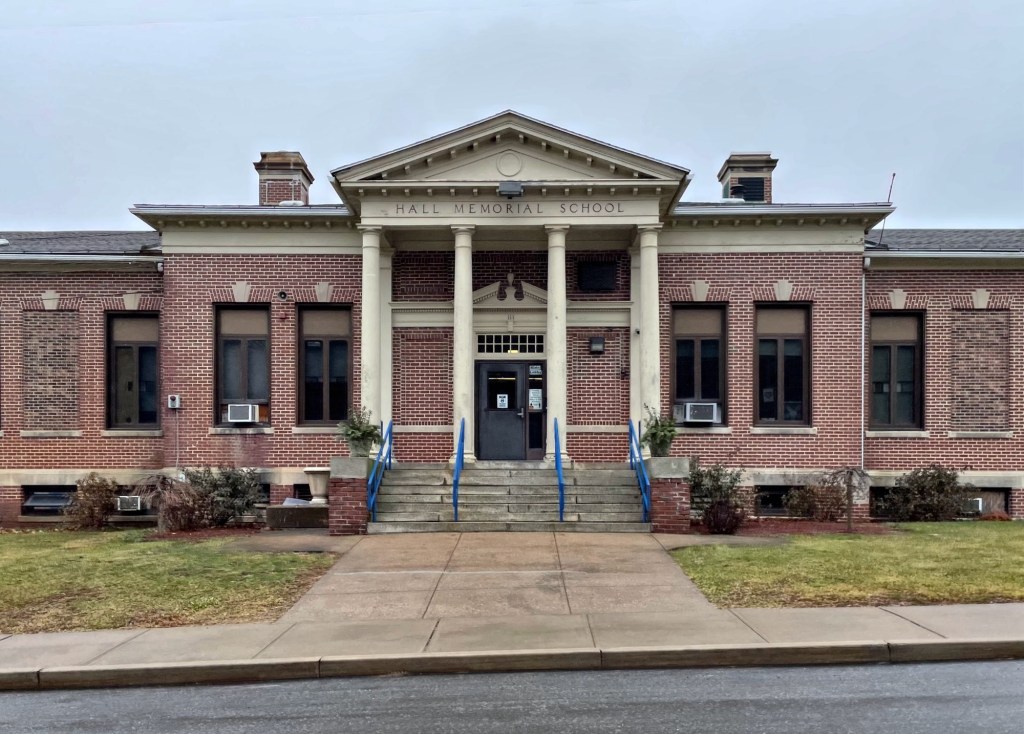
Hall Memorial School, South Willington // 1922

Located in South Willington, Connecticut, this Colonial Revival style school building was built to serve the mill village pupils, many of whom were first- and second-generation Americans who immigrated to the area to work at the local mill. In his will, William Henry Hall (1867-1922), the son of industrialist Gardiner Hall Jr., who established the business under his name, donated funds to the community to erect a new, suitable school building for the village. Beyond his work at his family’s business, William H. Hall served in the Connecticut House of Representatives in 1893–1897 and again in 1905, 1909, and 1911, and he was generous with his money throughout his life and in his will. For the Hall Memorial School, his heirs selected architect, Harry L. Sprague of Springfield, Massachusetts, who designed the one-story school built of brick and limestone trim and a tall, pedimented portico at the entry supported by four tuscan columns. The school has seen additions, but it retains much of its architectural integrity in the over 100 years of use as a public school.

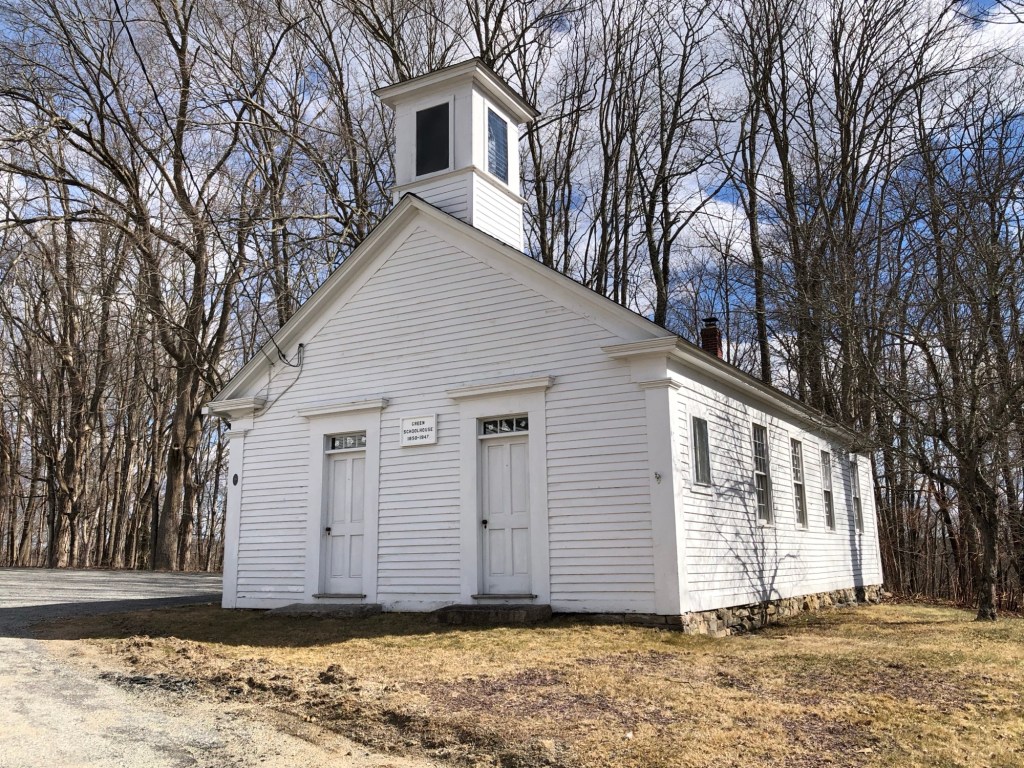
Canterbury Center District School // c.1860

The Center District Schoolhouse of Canterbury, Connecticut, sits behind the village church and is the town’s best-preserved example of a district schoolhouse. Built c.1860, the vernacular, Greek Revival one-room schoolhouse served the central village through the 19th and into the 20th centuries with its twin entry, double-hung windows to allow light and air into the classroom, and a belfry with bell to notify pupils when class was about to start. Like many similar one-room schools in rural New England, pupils attended class with neighbors and siblings in the small, intimate classroom of varied ages. 

Old Goshen Academy Building // 1824

The former Goshen Academy building is located in the central village of the rural town of Goshen, Connecticut, and it is an important vestige of early education in the small town. The Goshen Academy building was built in 1824 from funds by shareholders of the institution. The academy featured a lecture room on the second floor with smaller classrooms downstairs. The academy would eventually close, and it has been occupied by the Goshen Historical Society.

Old Killingly High School // 1908

The Old Killingly High School is located in a densely built residential neighborhood east of downtown Danielson, a village of Killingly, Connecticut. The building has served the community for well over 100 years, but through various uses. The school was built in 1908 and enlarged with side wings in 1927. It was considered state of the art for its time, with fireproof construction, wide hallways, and large bands of windows to maximize lighting of the classrooms. Clearly showcasing the village’s wealth and hope for future prosperity. The school was even designed by Hartwell, Richardson & Driver, a leading architectural firm based in Boston, Massachusetts. The building served as the community’s high school until 1965, and as its junior high school 1966–90 until it was converted to a community center and police station for the town. The Renaissance Revival style building is a gem and while tucked away off the main street, it shines through some great maintenance and restoration from the town.