Chamberlain Cottage // 1940

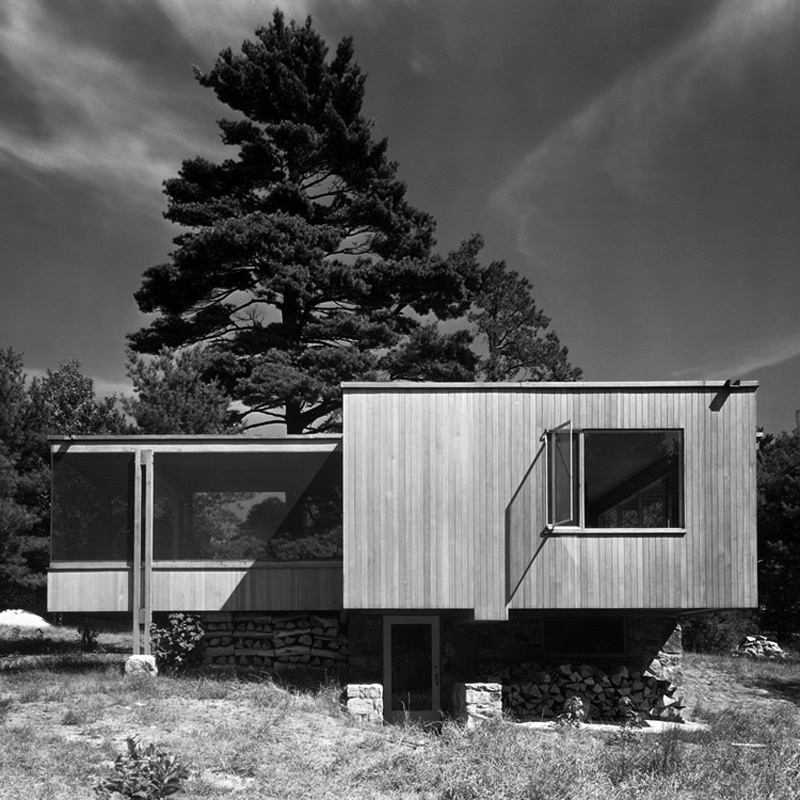
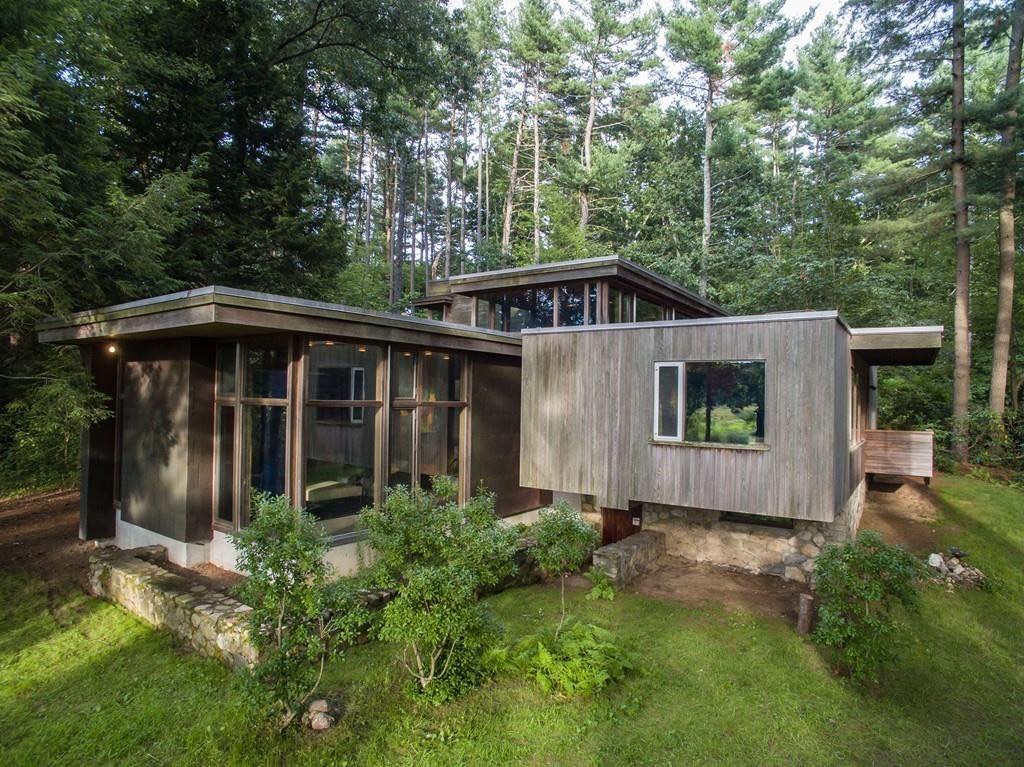
Nestled into the forests of Wayland, Massachusetts, one of the most significant examples of early Modernist architecture, the Chamberlain Cottage, represents the European Bauhaus style adapted to the American landscape and New England vernacular. Designed in 1940 and completed in 1941, the house was commissioned by Harvard Economics professor, Henry Chamberlain and his wife, Margareth, as a weekend retreat from Cambridge. Professor Chamberlain commissioned Marcel Breuer and his mentor, Walter Gropius, then Dean of the Harvard Graduate School of Design, to design a home with a specific request for a screened porch similar to Gropius’ residence in nearby Lincoln. For the Chamberlain Cottage, the design responds to the uneven terrain and the potential for river flooding by two distinct parts: a grounded stone base and a cantilevered wooden volume above. The lower stone level functioned as a foundation while providing storage for a canoe and housing a fireplace that extends vertically through the structure; with the upper wooden volume containing living spaces. Despite its compact size for weekend visits, the upper level is well planned and includes a living space, kitchen, a single bedroom, and the porch. Due to its small scale and siting, the one-bedroom cottage was not easily adaptable for modern living. After falling into disrepair in the 1980s and ’90s, the home was purchased by architects Sidney R. Bowen and Angela Watson, who expanded the structure over the course of a decade to its current size of 3,742 square feet. It has been occupied and lovingly maintained by later owners. It remains a private residence.
Frederick and Erna Gibbs House // 1936

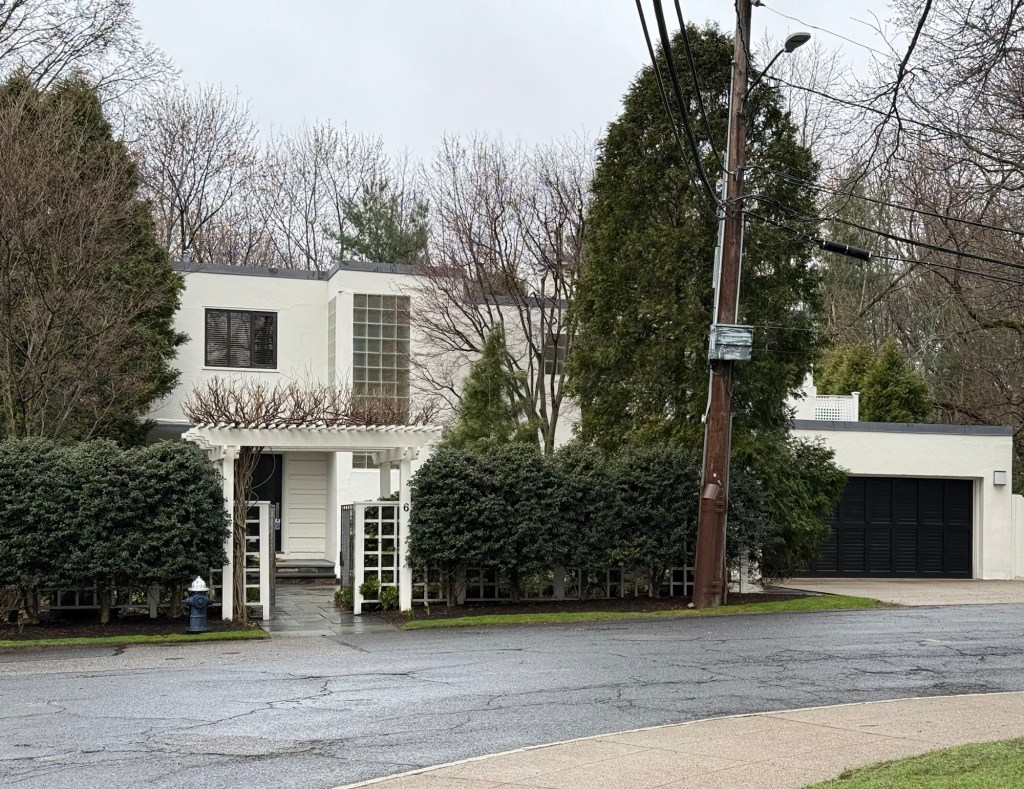
Built at a time when Colonial Revival and Tudor Revival styles dominated the suburban landscape of the Boston area and elsewhere, the Frederick and Erna Gibbs House on Chilton Street in the Cottage Farm neighborhood of Brookline, Massachusetts stands out. Built in 1936 for Frederic and Erna Gibbs, the house is said to be the first International style single-family home built in the Boston area, predating the famous Gropius House in Lincoln by a couple years. Erna Leonhardt-Gibbs (1904–1987), a German-born pioneer in the development of electroencephalography (EEG) technology, in 1930, married Frederic A. Gibbs, a neurologist, and would soon-after vacation in Germany, seeing the Modern revolution of architecture there in the interwar period. Upon returning the States, the couple hired architect Samuel Glaser, to design their dream home in the Bauhaus style. Set amongst a street of 1930s Tudor houses, the Gibbs residence stands out for its stark white stucco walls, boxy form, with elongated and block windows. While set behind a tall fence and hedge, the house is a landmark example of the style and appears much as it did when built 90 years ago.

Wolfers House // 1947

In 1947, world-famous German-born architect Walter Gropius and his architectural group, The Architects Collaborative (TAC) were commissioned to design a simple summer house for his friends Arnold Wolfers, a noted political scientist, and his wife, Doris, whose father was president of the Swiss Parliament. The site was a wild bluff on the end of Naskeag Point in Brooklin, Maine, with broad views of Blue Hill Bay and Mount Desert Island in the distance. The Wolfers’ wanted a house that was not a typical shingled house, provided sweeping views of the natural scenery, and also fit within its surroundings. Gropius nailed it with this house. As originally built, the house was comprised of a main block with large living room, kitchen, laundry room, service hall, and bathroom. A breezeway connected the house to a wing of three bedrooms along a long corridor. Walls of glass frame the waterfront side to take advantage of the views, while the street-facing facade has less glazing to provide additional privacy. After Doris Wolfers’s death in 1987, the house was purchased by an investment banker and his wife and it was listed for just the third time in over 75 years, and has maintained its architectural integrity the entire time.

George Kaplan House // 1946

The George Kaplan House, erected in 1946, is an excellent and exceptionally well preserved example of the International Style in the Boston area. The home is located on a suburban road in Oak Hill, Newton, and displays characteristics such as strong geometric forms, a flat roof, banded windows interspersed with expanses of blank walls and absence of ornament. The Kaplan House was designed by Walter Gropius‘ firm ‘The Architect’s Collaborative’ (TAC) of Cambridge, which was founded just one year prior, and this home was their first completed project. The home was built for George and Ethel Kaplan, a young couple who moved here from Brookline. Kaplan worked in design himself and manufactured shoe fabrics.

Potter House // 1949

Cape Elizabeth is full of amazing late-19th and early-20th century summer cottages, but one of the best examples of early International-style architecture can also be found here! This house was designed by Marcel Breuer, one of the most famous architects working in the International Style in the mid- 20th century. The house plays on the traditionally New England vocabulary, but Breuer, a proponent of the Bauhaus Movement, turned it on its head. The house appears to emerge from its ‘ancient’ fieldstone foundation towards the street and levitates over the hilly landscape, supported by light columns. The house originally was painted a shade of white, common in the International style, but a later owner preferred the natural wood finish. The home is one of the most significant examples of the style in New England, and an uncommon example in Maine.

Melnick House // 1935

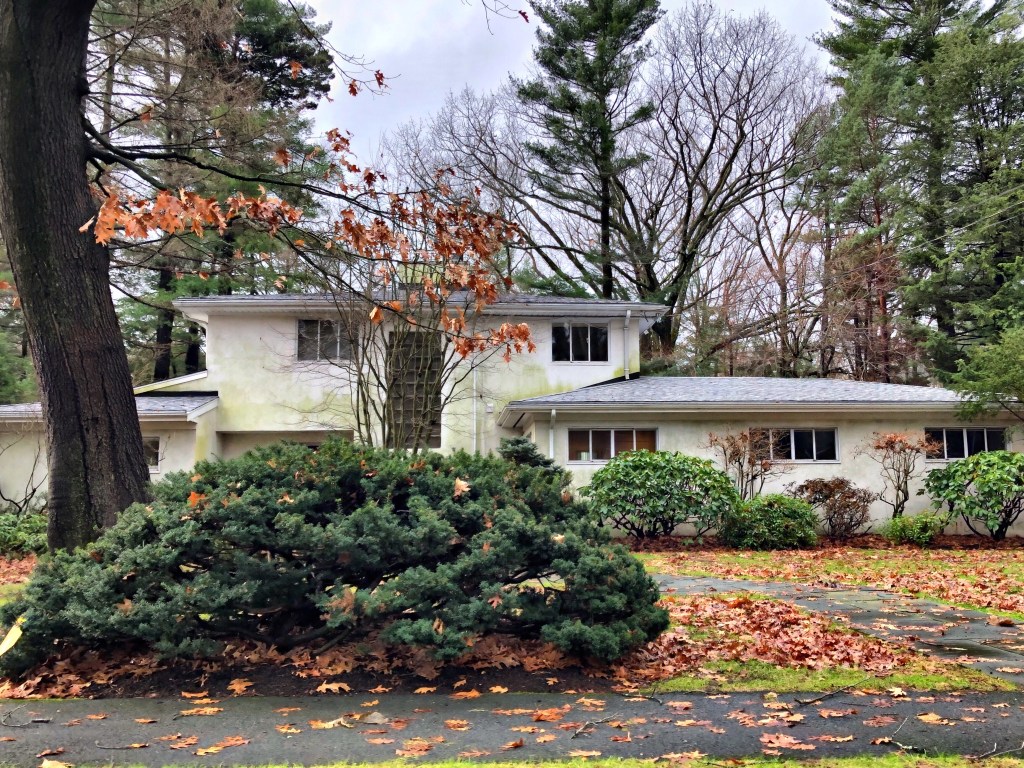
Built in 1935 (the same year as the Webber House in the last post), the Melnick House in South Brookline shows how the historically oriented designs of colonial New England converged with the Modern principles brought over from the Bauhaus movement from Germany. The 1930s were an interesting time for residential design around Boston as the two diverging styles were often located in the same neighborhoods. The Melnick House was designed by architect Samuel Glaser for Edward S. T. Melnick and his wife, Ethyle Melnick. Edward worked in Downtown Boston as the assistant division manager at Filene’s department store. Architect Samuel Glaser (1902-1983) was born in Riga, Latvia and at the age of four came to the United States with his family, settling in Brookline. He studied architecture at MIT and started his own practice in Boston a niche as a designer of moderately priced homes, particularly in the expanding suburbs where young Jewish families had begun living. The Melnick home combines the austere stucco walls and lack of applied ornament typical of late 1930s Modern architecture in the Boston area with a hipped-roof main block and flanking wings more commonly associated with traditional style houses of the same period. The home features a vertical glass block window which illuminates the interior stair hall.