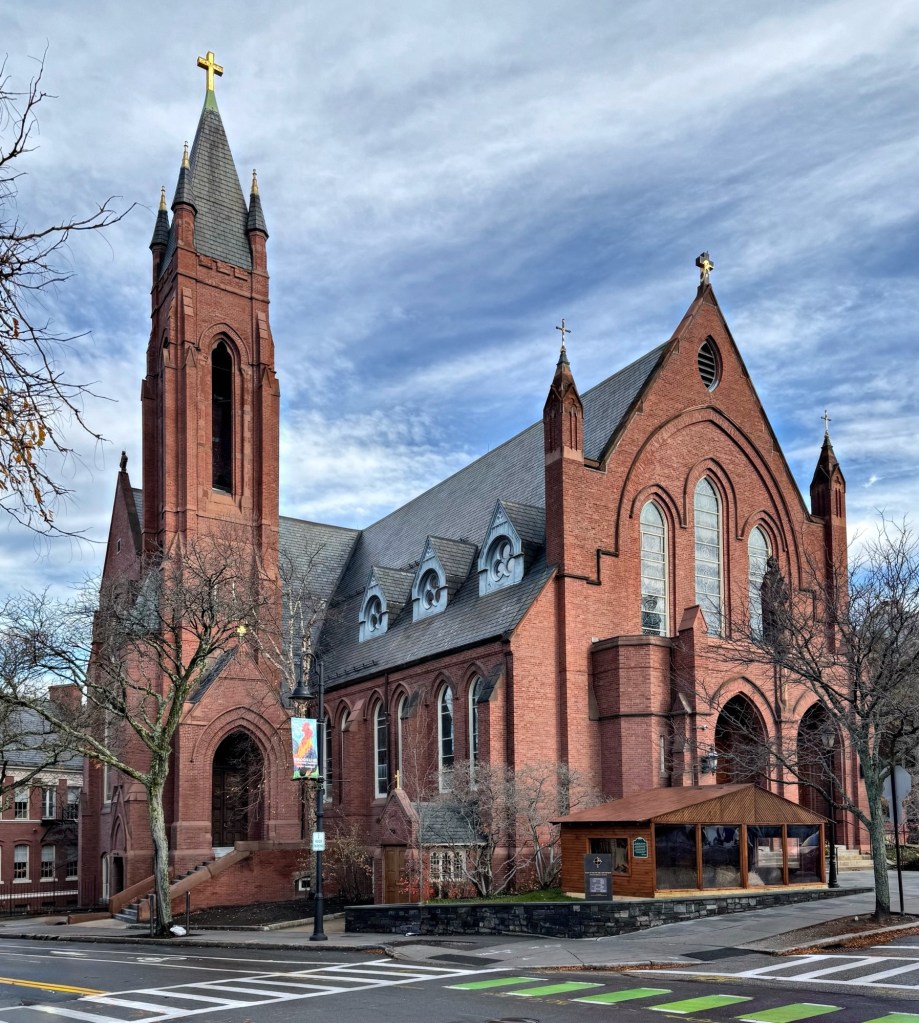
St. Mary of the Assumption Catholic Church, Brookline Village // 1880

St. Mary of the Assumption church was the first Catholic Church established in Brookline, Massachusetts, in 1852 when a congregation of Catholics began to congregate to worship together at the old Lyceum Hall. The congregation primarily consisted of Irish immigrants who settled in Brookline, where they often found work at the many large estates and building the new branch railroad in town, but desired a true house of worship close to their homes. By 1853, a modest wood-frame Gothic Revival style church was built in the Village, but was quickly outgrown. In 1873, the pastor of the congregation, Irish-born Rev. Lawrence Morris (1845-1900) began purchasing land at the corner of Harvard Street and Linden Place to establish a new church, large enough to comfortably fit the congregation and various church-related buildings. In 1880, the firm of Peabody & Stearns was hired to furnish plans for the Victorian Gothic edifice in brick and brownstone. Although the church was designed in 1880, it was not dedicated until 1886, and at this time, Pope Leo XIII sent a chalice to the Parish in honor of the completion of this church, the first in America to be named Saint Mary of the Assumption.
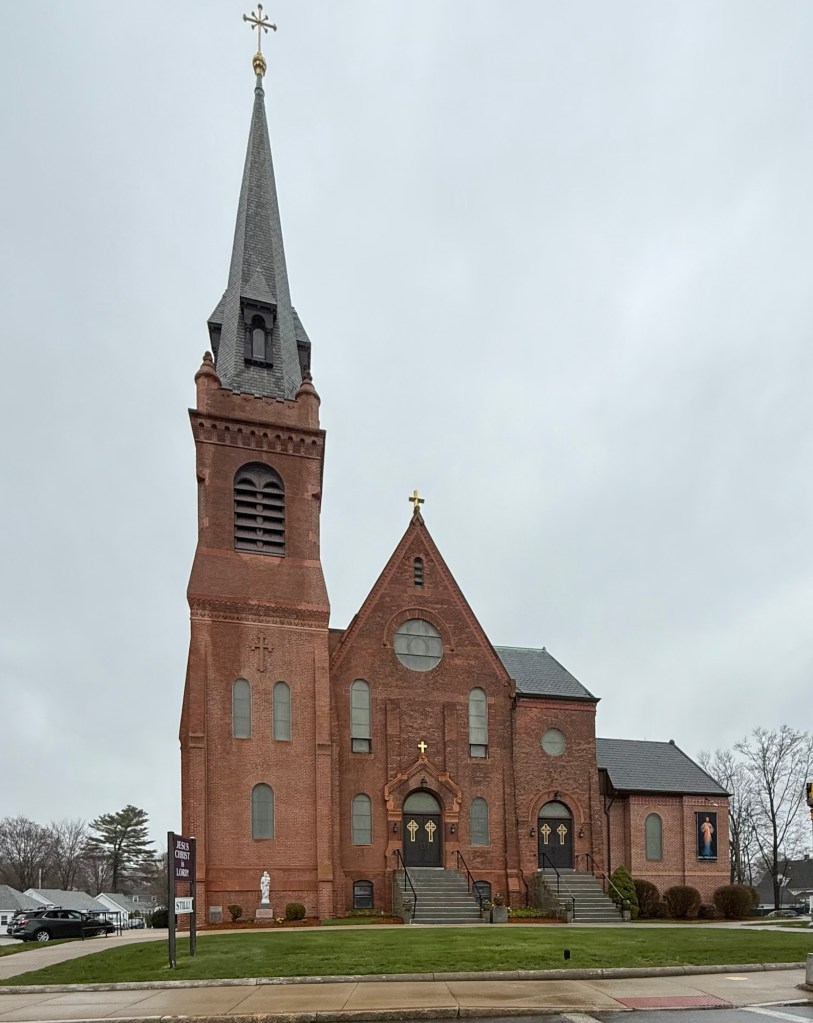
Holy Family Parish Church // 1882

In 1872, due to industrialization and increased numbers of immigrants settling in the area for work, it was decided that a new Catholic parish should be established in East Abington. Two years later, the village of East Abington incorporated as Rockland. It would be a decade later, in 1882, until the Holy Family Parish would be established, beginning planning of a true house of worship for the growing number of Catholics here. When the Holy Family Church was constructed in 1882, only a quarter of the Rockland’s approximately 4000 residents were Catholic at that time. Most of the original congregation consisted of Irish immigrants who worked in the town’s boot and shoe manufacturing industry. As the industry continued to flourish in the 1890s and 1900s, new shoe factories were built, bringing more workers to Rockland, including: Canadians, Italians, and British to the area. The town’s Catholic community grew as a result. The Victorian Gothic style Catholic church was built in 1882, with no known architect at this time. A complex of other buildings, including a school, rectory, and community center.

St. Mary’s Catholic Church, Ridgefield // 1896

Located just a block of Main Street in Ridgefield, Connecticut, St. Mary’s Catholic Church stands out as a rare example of Victorian Gothic architecture in a village full of Colonial (and Revival) and mid-19th century buildings. The first known Catholic to arrive in town was James Brophy, who’s family settled in Ridgefield in 1848. While growth of a local Catholic church in Ridgefield was slowly being established, the character of the town was changing by the second half of the 19th century, with wealthy New Yorkers building homes for vacationing in the summers. From this, many Irish Catholic immigrants were hired to work on the new estates. The first permanent Catholic church in town was built in 1867 as a modest wood frame church. As the congregation grew, a new church edifice was needed, and after a capital campaign, funds were gathered to erect a new church. Connecticut architect Joseph A. Jackson (who specialized in ecclesiastical design), was hired to furnish plans for the new church. The building exhibits eclectic architectural styles. Gothic design is seen in the pointed or lancet windows, arches and cast iron finials. The Queen Anne style is reflected in the use of textured and varied building materials, such as brick, brownstone, and shingles. And St. Mary’s most unique feature, its unusual steeple with its four turreted abutments and conical roof worked in shingles, is representative of the Shingle style.

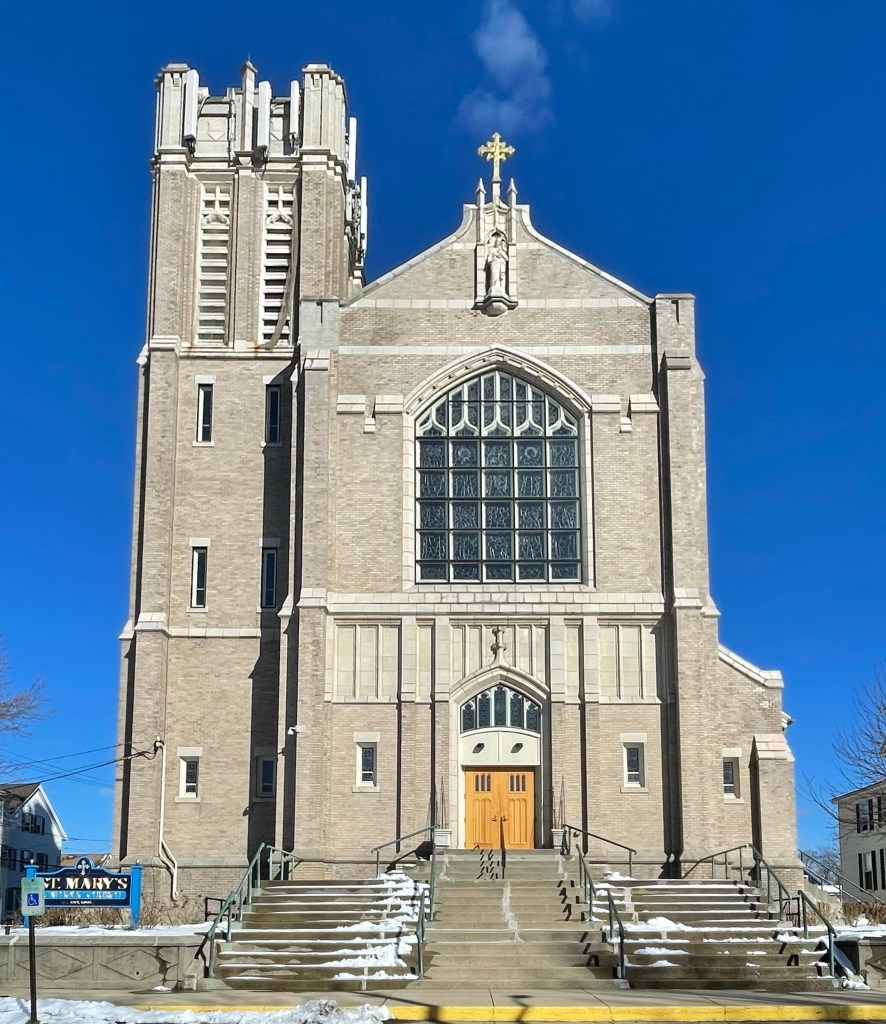
St. Mary’s Catholic Church // 1911

This 2-story Neo-Gothic Revival church constructed of buff brick and limestone, is dominated by an off-center, 4-level tower and showcases how even smaller towns in New England have some of the finest 20th century churches. In 1849 St. Mary’s parish, in nearby Warren, Rhode Island, was founded to serve residents there as well as Irish and French Canadian immigrants in Bristol, which began arriving en masse. Just years later, in 1855, the first St. Mary’s Church in Bristol, was constructed as a plain wooden structure, and operated as a mission of the Warren church. In 1874 the Bristol church became an independent parish and saw large increases to membership with more Irish families settling here. Over the next decades, the space became more cramped and a building campaign was started to get a new place of worship. The present St. Mary’s Catholic Church was built in 1911, from plans by the Providence-based architectural firm of Murphy, Hindle & Wright, who together (and separately) designed many ecclesiastical buildings, in Rhode Island and Massachusetts. The interior is even more stunning than the exterior detailing, and remains very well-preserved.