Simeon Ingraham House // 1795

Simeon Ingraham (1749-1840), a housewright (house builder) purchased a corner lot on Wickenden Street in the Fox Point area of Providence in 1795, and constructed this absolutely stunning late-Georgian home that has survived centuries of commercialization and Urban Renewal of the surrounding area. In the early decades, Simeon purchased lots nearby and built houses, selling them for profit, and repeating this until his death in 1840. Simeon left no will, and the property was eventually purchased by his eldest son, Solomon, who bought out all of his other heirs for their shares of the property. Solomon allowed his widowed stepmother to reside in the home until her death in 1851. Solomon operated a store nearby, and it was likely he who jacked up the house, adding the brick ground floor for commercial purposes in the 1850s, coinciding with the increased commercialization of Wickenden Street. When the house was raised, the former center entry (now on the second floor) was turned into a window, with the doorway placed in the new brick level. Changes like these showcase how buildings are vessels of history, informing later generations of the layers of history that our cities and towns experience over time.
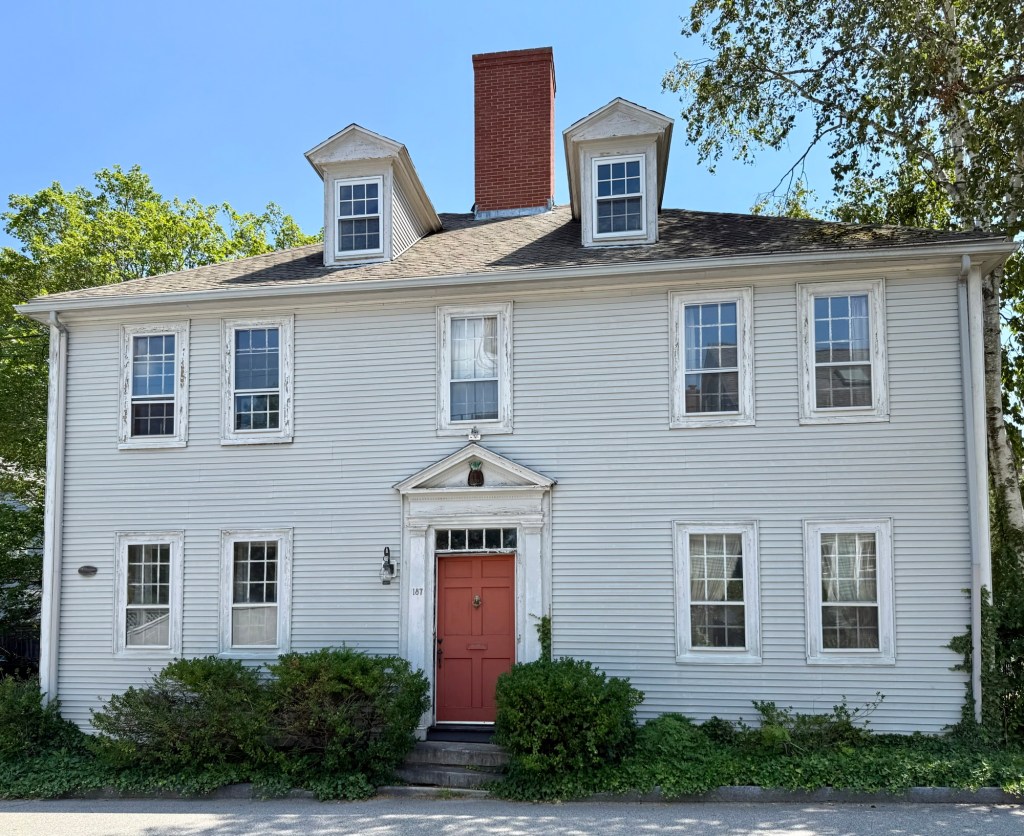
Tredick House // c.1802

The Tredick House is located at 187 Marcy Street in Portsmouth, New Hampshire and was built in 1802 for Captain Jonathan Martin Tredick (1777-1803) and his new wife, Martha Marshall on land gifted to them by Jonathan’s father, William Tredick. In a tragic shift of fortune, Captain Jonathan Tredick never got to live in his new house as he died at sea, with accounts differing, either from fever or being swept overboard. At the time, Jonathan and Martha had two children, 2 year-old Catherine Marshall Tredick (1801-1822) and newborn Jonathan Marshall Tredick (1802-1875). Martha, a sudden widow at the age of 26 with two children, was aided by her family and that of her late husband, and operated a store nearby to supplement her income until her death at home in 1872, she was 96 and never remarried. The late Georgian style house features a hipped roof with central chimney, pedimented dormers and a pedimented entry and 9-over-six sash windows on the house.

Nelson House // 1797

This residence sits on the historic Elm Street in Georgetown, Massachusetts, and is one of the best late-Georgian style dwellings in the town. The house was built in 1797 for Nathaniel Nelson (1767-1853), a banker who worked in Newburyport, just years after his marriage to Sally Chaplin. Nathaniel descended from Thomas Nelson (1615-1648), who was among the twenty families who had come to the New World in the winter of 1638 with the Puritan cleric Ezekiel Rogers (1590-1660). With Rogers most of these families settled at Rowley, incorporated in 1639 with Georgetown later setting off from Rowley, creating their own town in 1838. Nathaniel and many of his family worked as tanners, preparing the skins of animals into leather, and had shops in the area. Mr. Nelson was such an esteemed member of society, that when the War of 1812 broke out, he was asked to store money and gold from Newburyport in his basement, away from the coast, hiding it from the British forces. After successive ownership, the residence was purchased in 1936 by Everett A. and Mary A. Spaulding. A Georgetown native, Everett Augustus Spaulding made colonial revival furniture under the corporate name Spaulding Colonial Reproductions. The residence remains in spectacular condition, with its large central chimney, symmetrical façade, portico, and hipped roof punctuated by pedimented dormers.