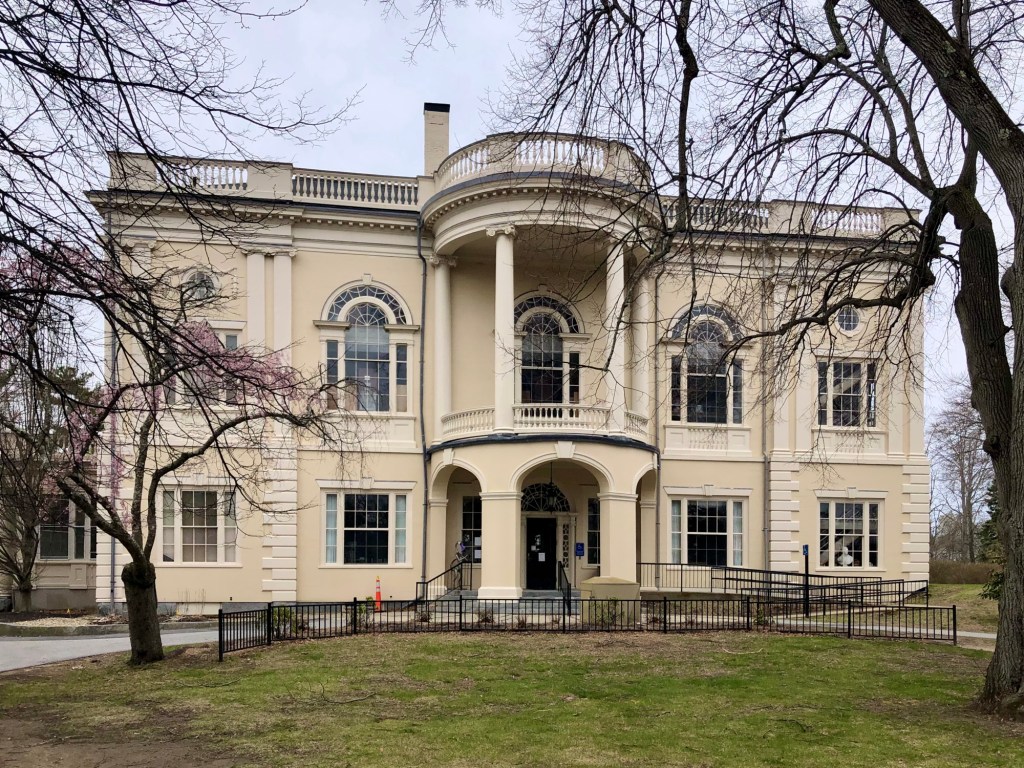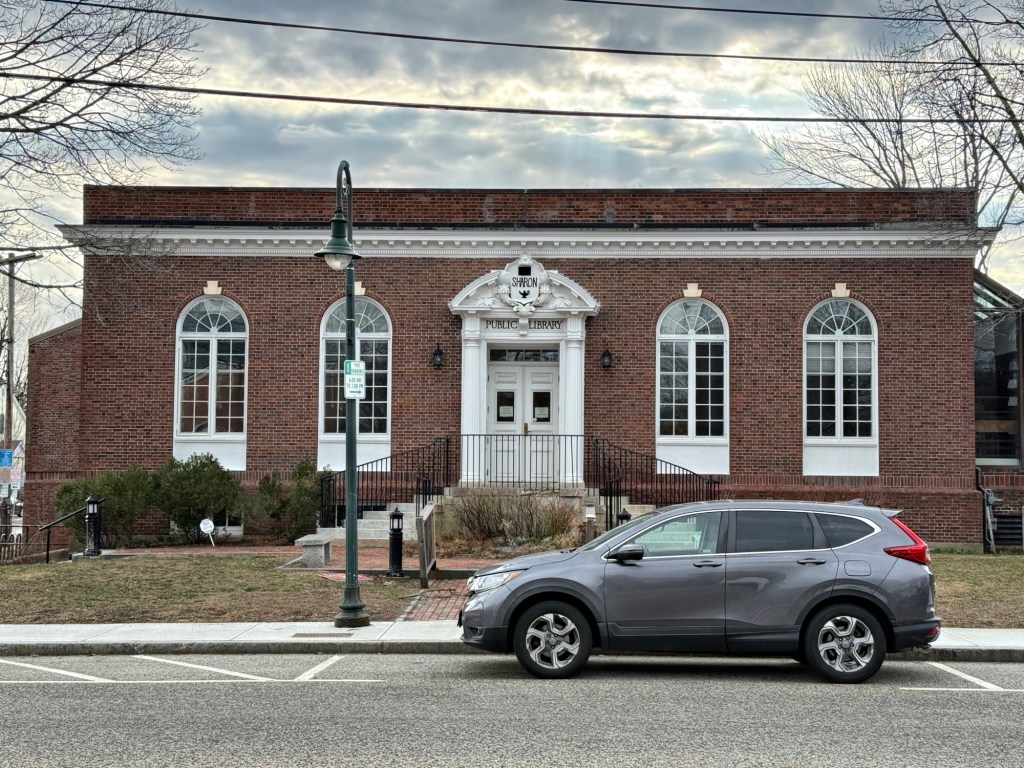
Wayland Public Library // 1900

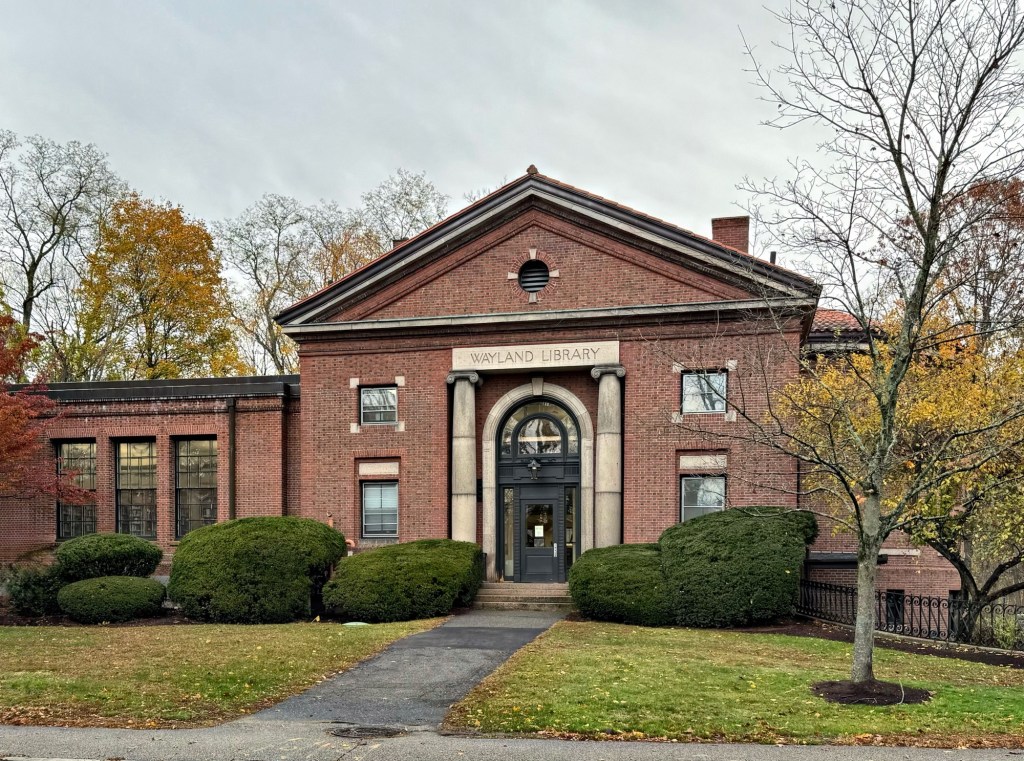
The Wayland Public Library is not only significant architecturally, but also historically as it was founded in 1848, with some claiming that it is the second free public library established in the United States. The first physical space for the Wayland Public Library was established in 1850 using a small room in the Town House. The Town House was outgrown and replaced in the 1870s by a large, Victorian Town Hall (razed in 1957) with designated space in the building for the expanded town library. As Wayland became an affluent Boston suburb in the late 19th century, wealthy resident, Warren Gould Roby (1834-1897), who lived just north of the town hall, donated land and $25,000 to the town for the purpose of constructing a library
that would be as fireproof as possible. Designed by architect, Samuel Mead of the firm, Cabot, Everett & Mead, the handsome building is said to have been inspired by Mead’s travels to Italy where he gained an interest in Roman architecture and Renaissance art. The influence is seen on the exterior with the Romanesque Revival style and on the interior with an ornate frieze around the rotunda. The building was expanded in 1988 by Tappe Associates and remains one of the great early 20th century libraries in New England.


Bolton Public Library // 1903

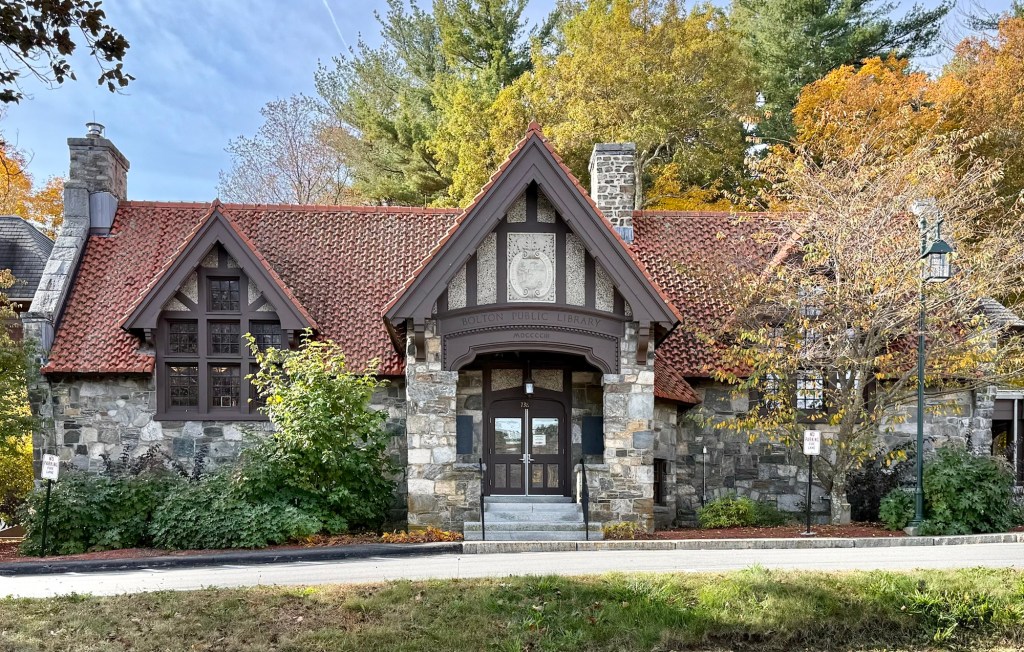
The Bolton Public Library was established in 1859, when the town’s library collection was housed on a few shelves in the Selectmen’s room at the Town Hall. In the following decades it became clear to the community that a purpose-built library building should be constructed in town to house the growing collections there. At the time when wealthy benefactors donated funds for public libraries in towns and cities across New England, sisters Emma and Anna Whitney gifted their hometown of Bolton, $10,000 to build a dedicated library building in memory of their father, Captain Joseph Whitney in 1901. Completed in 1903, the Bolton Public Library was designed by the architectural firm Stone, Carpenter & Willson and built of local Bolton fieldstone in the Tudor Revival style. Of particular architectural merit is the red tile roof and three gabled bays with carved stucco and woodwork within half-timbered frames. The library was added onto in 2010 from plans by Lerner Ladds & Bartels Architects, who replicated key materials and forms so the new wing feels coherent with the original yet clearly differentiated.

Thayer Memorial Library // 1868

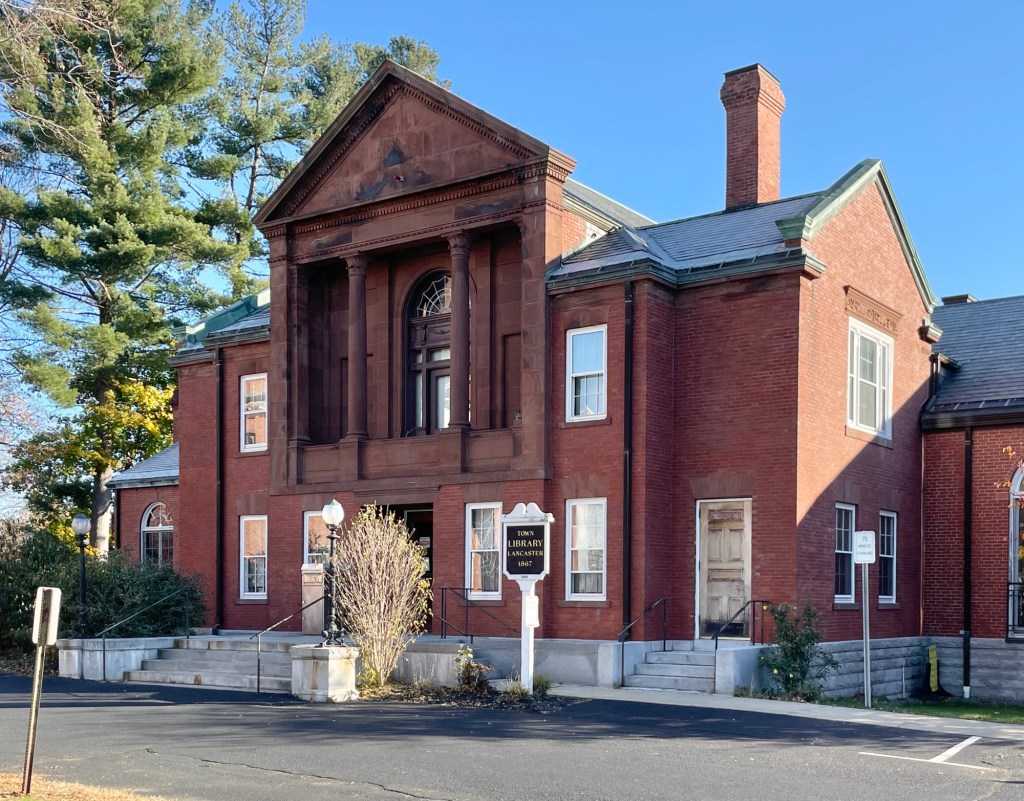
One of the four stately brick buildings framing the Lancaster Town Common in Lancaster, Massachusetts, is this brick and brownstone building, the historic town library. The story of the town’s first purpose-built library building began in 1866, when wealthy resident, Nathaniel Thayer offered $5,000 to the town for the erection of a new library in his hometown. Quickly, a committee of residents, led by Mr. Thayer, worked to acquire land from the First Church of Christ in Lancaster and hire architects Ryder & Harris of Boston to furnish plans for the new building, which was set to be a library and Memorial Hall dedicated to the 39 Lancaster men who died fighting in the Civil War. Nathaniel Thayer ultimately donated two-thirds of the final cost of the building, believed to be nearly $30,000, in addition to his already established $5,000 for books. The building was updated later with the addition of a children’s room in 1929, a gift of Mrs. Bayard Thayer in memory of her son, another Nathaniel Thayer. The Classical/Renaissance Revival style building stands out for its unique central brownstone pedimented bay with engaged columns and balcony over the main entrance. 

Thayer Bird Museum // 1903

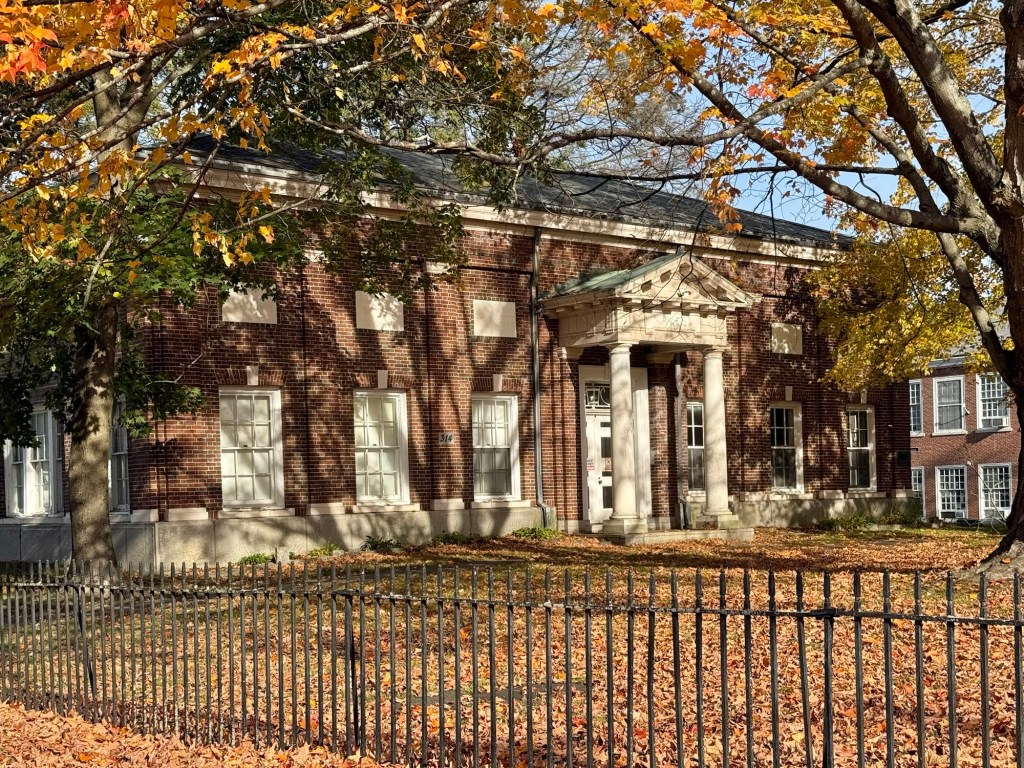
John Eliot Thayer (1862–1933) was an amateur ornithologist and member of the wealthy Thayer Family in Lancaster, Massachusetts. Due to his family’s business dealings, John Thayer was able to turn his passion, studying birds, into one of the largest collections of stuffed birds, eggs and nests for professionals all over the country to study. John began collecting and housed his collections were in several wooden buildings close to his home in Lancaster, but when these became unsafe and crowded he built this beautiful brick building in 1903 in South Lancaster opening it to the public as a museum a year later. The Boston architectural firm of Winslow & Bigelow designed the Colonial Revival style building, with the Guastavino Fireproof Construction Company providing plans for interior spaces and likely engineering inside. Many of the leading ornithologists of the time visited the Thayer Museum and it was estimated that more than ten thousand visitors came to the museum in the first six years.  In 1974, the building was sold to the now defunct Atlantic Union College and reopened as the Mabel Bartlett Art Gallery. Much of the Thayer collection was donated to the Museum of Comparative Zoology at Mr. Thayer’s alma mater, Harvard University. Since the Atlantic Union College closed in 2018, this important building has been closed, hopefully to see reuse in the eventual redevelopment of the campus.

Frederic C. Adams Library // 1898

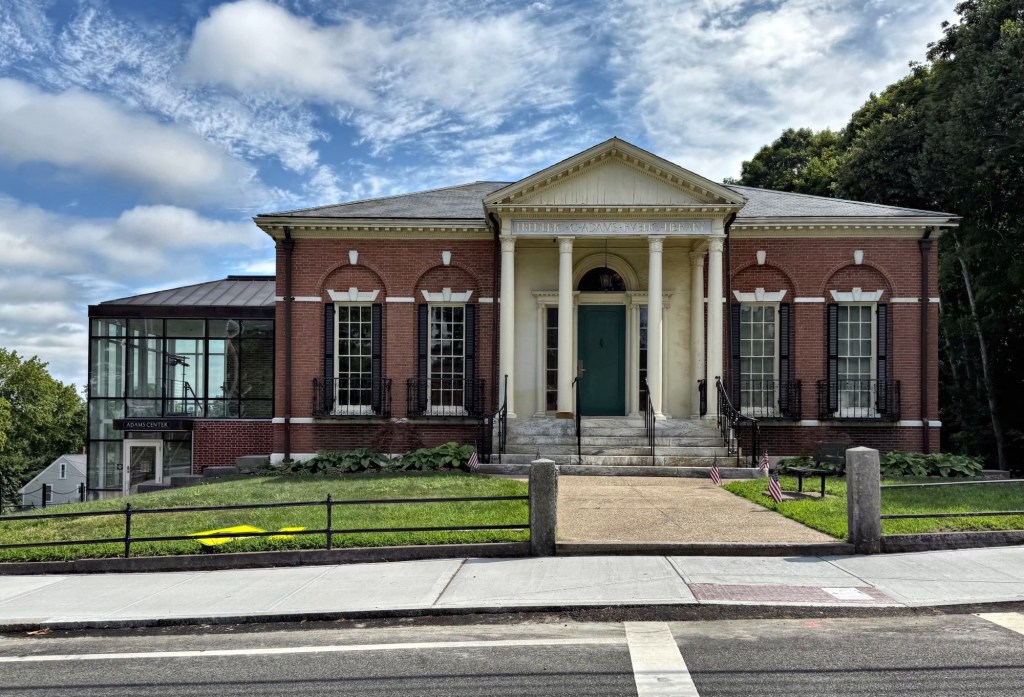
Built in 1898 in the heart of Kingston’s village center, the Frederic C. Adams Library was designed by renowned architect Joseph Everett Chandler and is one of the finest Colonial Revival style libraries in New England. Chandler, famed for his dedication to historic forms, created a one-and-a-half-story masonry gem, complete with a gabled roof, dentilled cornice, and a grand four-column Corinthian portico at the entry. The building’s story began with a bequest from Frederic  C. Adams, a Kingston native whose $5,000 gift in 1874 helped break ground on a dedicated library. Its elegant Colonial Revival look recessed panel windows, stone keystones, and symbolic half-round arches, echoes America’s early architectural traditions with a refined late‑19th‑century flourish. The library was eventually outgrown, and relocated across the street, to a contemporary building. After an award‑winning restoration, the building reopened in 2012 as the Adams Center, now housing Kingston’s Local History Collections in a climate‑controlled room and hosting community events upstairs. The Contemporary addition, paired with the restoration work all by Spencer Preservation Group, blends old with new in a pleasing way. 

Westborough Public Library // 1908

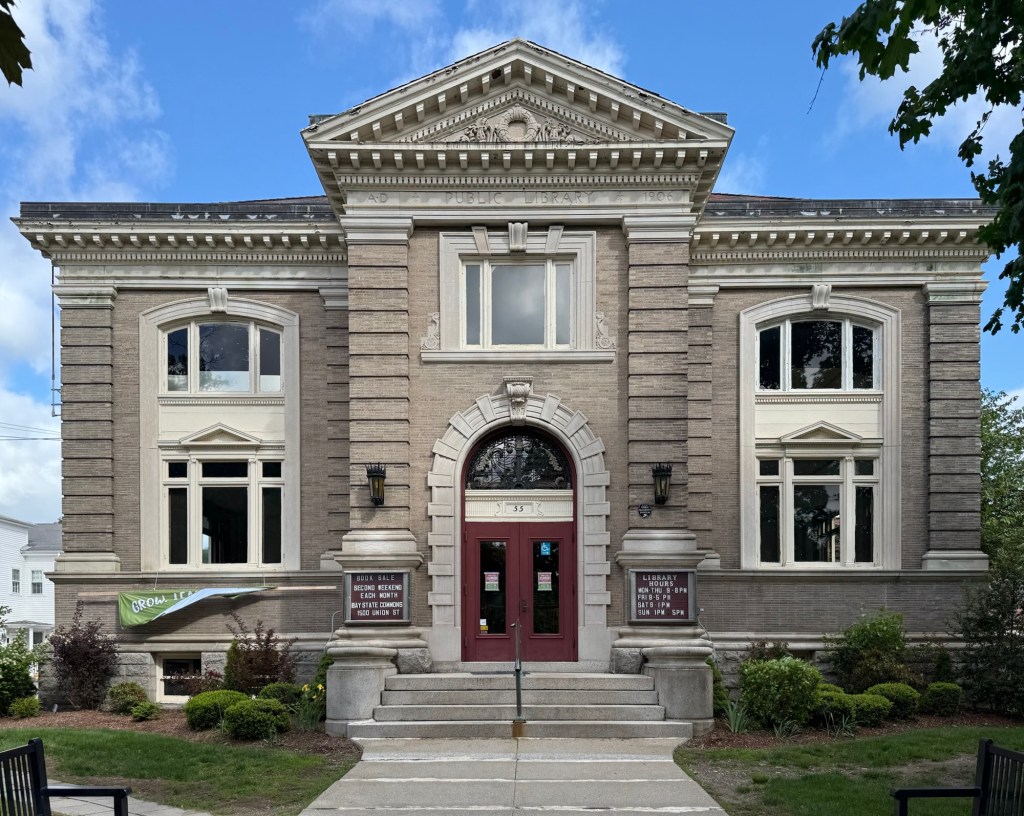
The Westborough Public Library is a handsome, two-story, masonry building with additions to showcase the growth and importance of the library to the community. This building was constructed in 1908, replacing a small space in the first floor of the old Town Hall (since demolished) as the community’s first purpose-built library. The structure was designed by architect Penn Varney, who specialized in civic buildings in New England. The Classical Revival style building is constructed of buff brick with stone trimmings. Of particular note, the quoined arched entry and pediment with central wreath motif, add much to the design. The library was eventually outgrown, and in 1980, an addition was added to the rear, in a style taking cues from the main building, but clearly of its time. The Town of Westborough about to undergo a restoration and renovation to the library, including a new roof, HVAC systems, interior renovations and the restoration of the 1908 windows.

Rockland Memorial Library // 1903

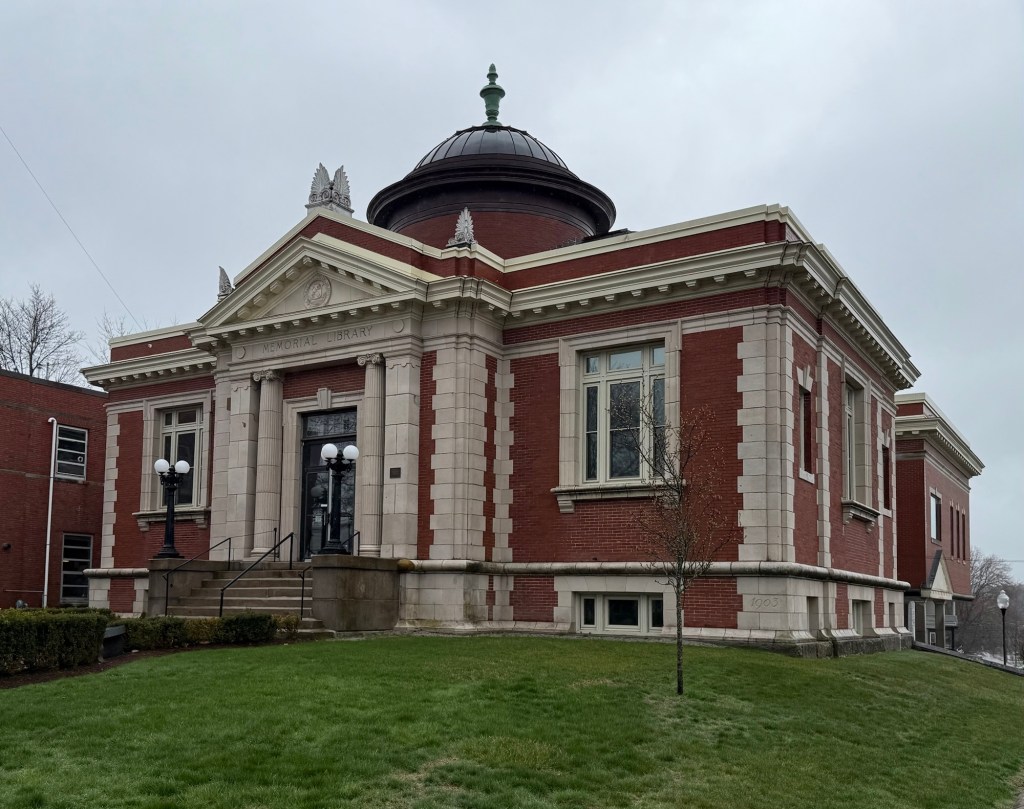
The Rockland Memorial Library in Rockland, Massachusetts is one of the most architecturally and historically significant buildings in the town. The Classical Revival style library was built in 1903 and is the Town of Rockland’s first purpose-built library structure. When Rockland separated from adjacent Abington in 1874, much of the collection became housed in a commercial building, which was consumed by fire in 1890, taking much of the collections with it. Although funds were raised soon after the fire for a permanent home for the library, its construction was made possible by a grant of $12,500 from Andrew Carnegie in 1902, as part of his nationwide gift to cities and towns for libraries. The handsome structure is constructed of brick, granite, and terra cotta, and was designed by the Boston-based architectural firm of McLean & Wright. The most interesting features of the building include the rooftop dome containing skylights and capped by a finial and the projecting entrance with pediment, quoins, and engaged Ionic columns.

Peabody Institute Library of Danvers // 1892

In 1856, George Peabody, an American banker and philanthropist, donated funds for a library for Danvers, Massachusetts. The original library was housed in the Town Hall until land was acquired on land that is today known as Peabody Park. In 1866, Peabody deeded the town additional funds for a purpose-built library building, similar to that of Peabody, Massachusetts (which separated from Danvers in 1855). A Gothic style library was built on this site from plans by architect Gridley J. F. Bryant with the purpose “for the promotion of knowledge and morality in the Town of Danvers.” On July 2, 1890, a massive fire destroyed the Danvers library, but many of the collections and volumes were saved by townspeople. Through insurance funds and additional money by trustees, it was decided to rebuild the library on the same site, retaining the architectural firm of Little & Browne, (whose chief draftsman, Lester S. Couch, was a Danvers resident) to design the new building. The present Georgian/Classical Revival structure was completed in 1892 and is one of the finest library buildings in New England.  

Ashby Public Library // 1902

The Ashby Public Library in Ashby, Massachusetts, was built in 1902, completely funded by a donation from Edwin Chapman (1841-1915) who lived across the street from the new library. Mr. Chapman was raised in Ashby and became a wealthy Boston-area merchant in the meat trade by the late 19th century. Before this library was built, the town’s library collection was housed in the Wyman Tavern. The building was designed by architect Henry M. Francis in the Neoclassical style with Romanesque detail in brick and brownstone to make the building fireproof. The library was added onto in the rear in 2006 by The Galante Architecture Studio, which is recessed and mostly visible from the rear parking area. The addition is Modern in style to distinguish itself from the main library building.