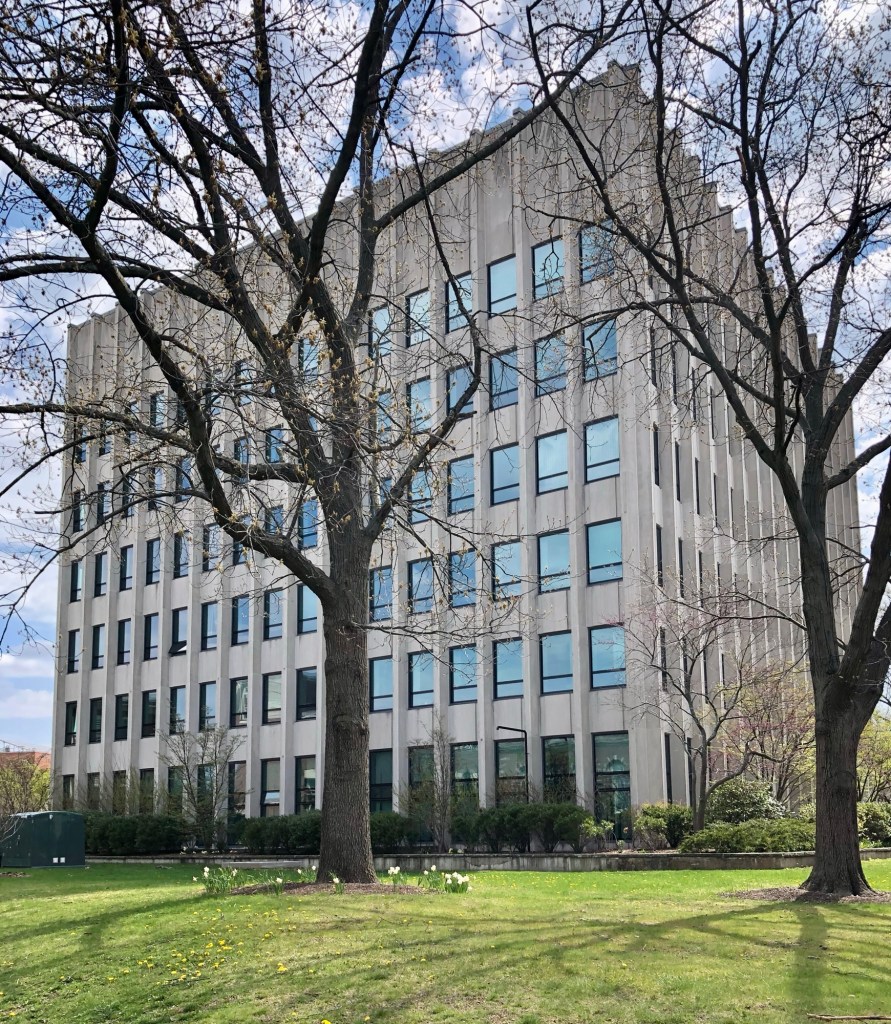
The modernist Brookline Town Hall building stands in stark contrast to the many historic buildings in Brookline Village, and even more-so from the town’s third Town Hall, a Victorian Gothic design by architect Samuel J. F. Thayer. Completed in 1965 as a six-story municipal “skyscraper”, the structure was designed by Anderson, Beckwith, and Haible, architects who specialized in sleek, clean, Modernist designs, primarily in office parks and college campuses. The unadorned box is broken up only by the rows of identical windows and slightly projecting fins, which break up the bays in their own monotony. Like many such municipal and office buildings of the time, the structure is set back from the street and surrounded by landscaping, with surface parking behind. While the building was lauded when it opened in 1965, tastes shifted and like in many communities, a majority of the public (and likely the employees who work here) would have preferred its predecessor.
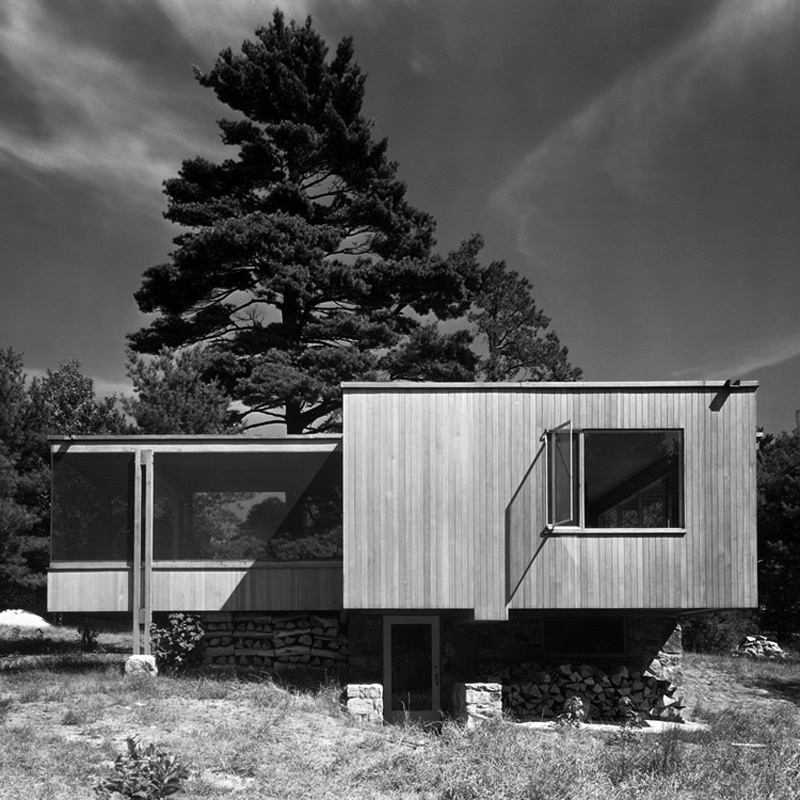
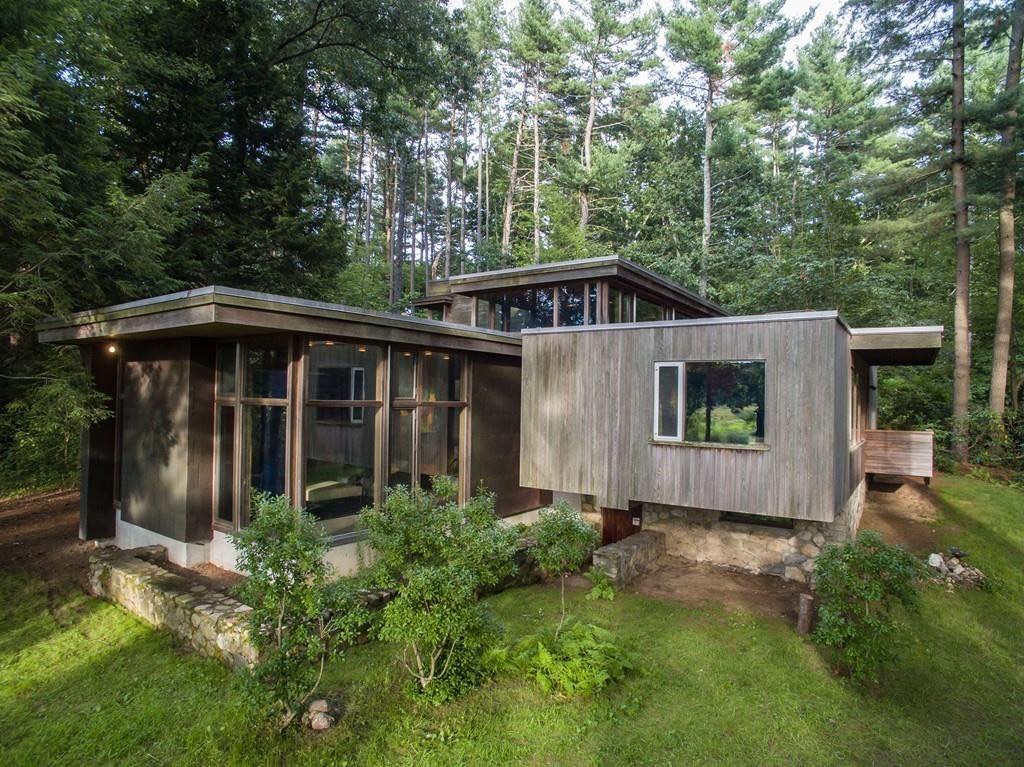
Nestled into the forests of Wayland, Massachusetts, one of the most significant examples of early Modernist architecture, the Chamberlain Cottage, represents the European Bauhaus style adapted to the American landscape and New England vernacular. Designed in 1940 and completed in 1941, the house was commissioned by Harvard Economics professor, Henry Chamberlain and his wife, Margareth, as a weekend retreat from Cambridge. Professor Chamberlain commissioned Marcel Breuer and his mentor, Walter Gropius, then Dean of the Harvard Graduate School of Design, to design a home with a specific request for a screened porch similar to Gropius’ residence in nearby Lincoln. For the Chamberlain Cottage, the design responds to the uneven terrain and the potential for river flooding by two distinct parts: a grounded stone base and a cantilevered wooden volume above. The lower stone level functioned as a foundation while providing storage for a canoe and housing a fireplace that extends vertically through the structure; with the upper wooden volume containing living spaces. Despite its compact size for weekend visits, the upper level is well planned and includes a living space, kitchen, a single bedroom, and the porch. Due to its small scale and siting, the one-bedroom cottage was not easily adaptable for modern living. After falling into disrepair in the 1980s and ’90s, the home was purchased by architects Sidney R. Bowen and Angela Watson, who expanded the structure over the course of a decade to its current size of 3,742 square feet. It has been occupied and lovingly maintained by later owners. It remains a private residence.
Located just north of and in stark contrast to the ornate Neo-Gothic 1932 Administration Building of Elms College, the school’s main library building showcases how much architecture styles changed in just 40 years. The college’s library was long in the main Administration building, but was outgrown in the latter half of the 20th century. The two-story steel and cast-concrete library building was built in 1973 with exterior details in red brick and concrete, a nod to the historic materials of the older campus buildings. Unapologetically Modern, and somewhat Brutalist, the building has complex geometry of sunken voids and solid sections, broken up by a horizontal band of windows with concrete fins to mitigate sunlight. The building was designed by Boston architects, Carroll & Greenfield, and recently celebrated its 50th anniversary.
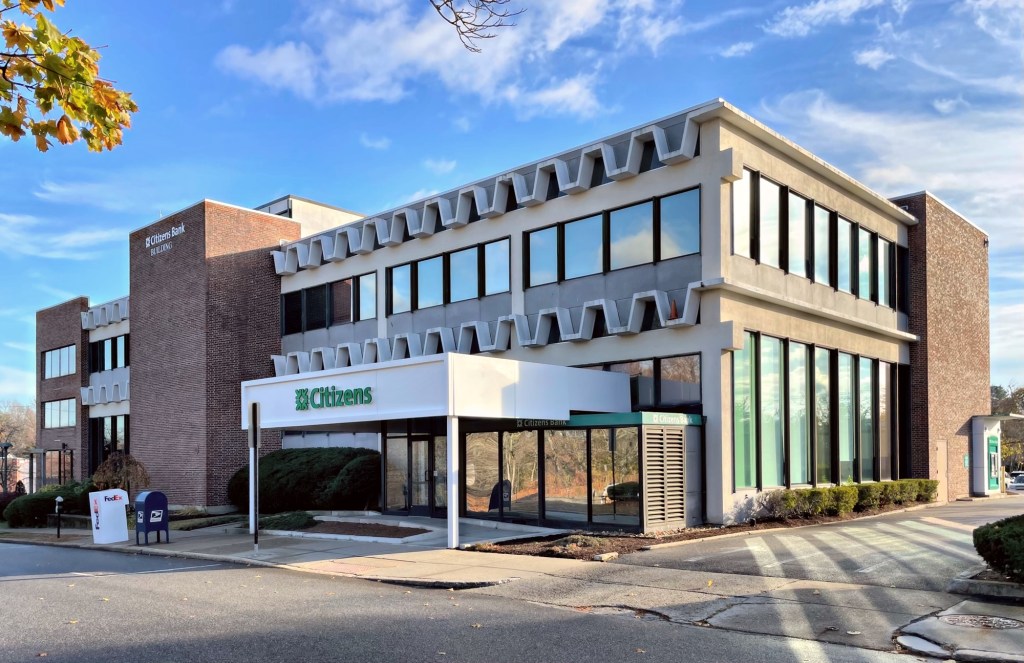
Opened in 1962 as the Newton Savings Bank, this unique Mid-20th century Modern banking structure showcases the forms and materials not conceived in previous decades. The building is located on the Newton Centre Green, adjacent to the former Newton Centre Methodist Episcopal Church, and provides a sharp contrast between the stone building in the Romanesque style and more contemporary forms. The bank was designed by Bastille and Halsey Associates, established in 1953 by partners, Robert Adams Bastille and William Ashbaugh Halsey. Now occupied by a Citizens Bank with professional offices also inside, the building exhibits precast concrete “zipper” banding between floors that are broken up by solid brick masses in the facade. What do you think of these corporate modern buildings?
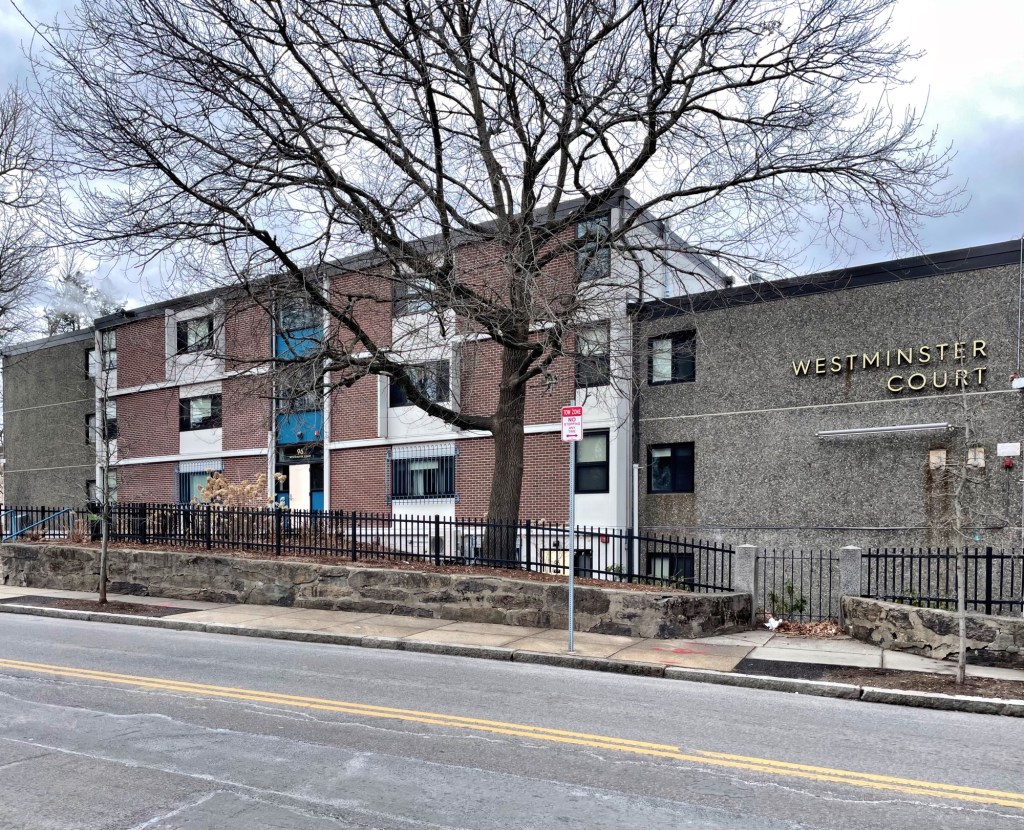
As populations boomed in the decades following the conclusion of WWII and suburbs drew wealthier residents to single-family neighborhoods, city governments were desperate to keep tax dollars in city limits. As a result, many cities instituted a policy called Urban Renewal, where neighborhoods (often with higher percentages of minority or immigrant populations) and historic housing were demolished as a form of “slum clearance” and modern housing centered around the automobile sprouted up in their place. The Washington Park section of Roxbury in Boston was one of the hardest-hit neighborhoods in the 1960s as part of a series of neighborhood plans by the Boston Redevelopment Authority. This housing development, called Westminster Court, was developed on one of the new Urban Renewal parcels in Washington Park. Designed by famed modernist architect Carl Koch, the Mid-Century Modern buildings were constructed in modular units to cut costs and expedite construction time. The buildings utilize precast frames with contrasting exterior panels of brick, exposed aggregate concrete, and aluminum. While many dislike these buildings, it is important to understand the history behind them and how they are part of the complex history of many cities.
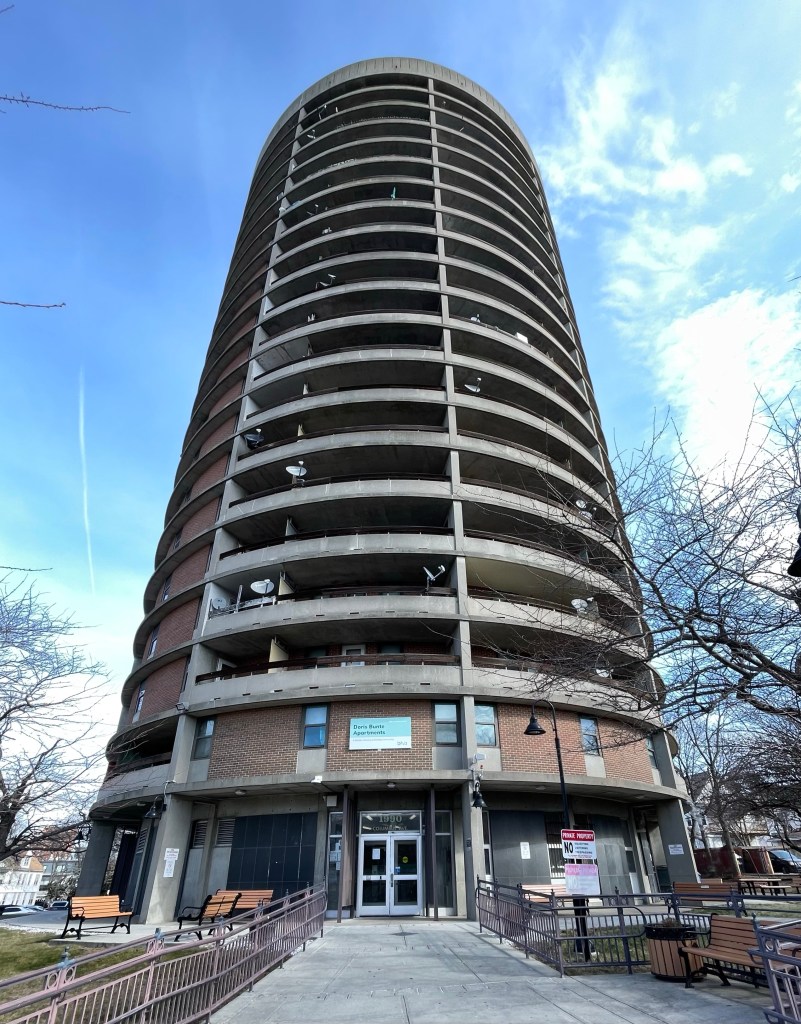
In the second half of the 20th century, parts of Boston saw disinvestment by private property owners as well as local and state government. With people leaving Boston for the suburbs, the hemorrhaging of tax revenue led urban planners to go big and institute ‘Urban Renewal‘ policies and planning to demolish what they believed to be substandard housing and invest in Modern apartments and car-oriented developments. The triangular shaped new community was as comprehensive as any urban renewal district in the region; indeed of the ten General Neighborhood Renewal Plans created by the BRA in 1961, Washington Park was the most self contained Urban Renewal District in the city. It included new police and fire stations, a courthouse, two public libraries, a shopping mall, a health center, elementary school and five garden style housing developments totaling almost 2000 apartments or townhouses. At its completion in 1975, $70.4 million had been invested to build the new community of which $31. 3 million came from the federal government. Part of this massive undertaking was the construction of elderly housing, which resulted in this 20-story cylindrical tower at the southernmost edge of the Urban Renewal area. The tower was constructed between 1967 and 1970 and was designed by Boston-based architectural firm Richmond & Goldberg, led by Isidor Richmond and Carney Goldberg. Apartments were “integrated” with with 70% Black and 30% White residents, all with private balconies and an emergency pull-chain system in kitchens and bedrooms for the elderly residents. As far as mid-century apartment towers go, this one is pretty interesting and unique. The building was renovated a few years ago and renamed the Doris Bunte Apartments. In 1969, Buntè was nominated to the Boston Housing Authority board, making her the first female public housing tenant to serve. In 1972, she was elected to the Massachusetts House of Representatives, becoming the first woman of color to serve in the Massachusetts legislature, and the first female to serve in the House leadership in 68 years. While there, Buntè helped found the Black Legislative Caucus and the Caucus of Women Legislators.
Welcome to Everett, Massachusetts, a diverse, vibrant community of roughly 50,000 residents just north of Boston. Present-day Everett was originally part of Charlestown, which separated and became Malden. In 1870, the Town of Everett separated from Malden and was so-named after former Charlestown resident Edward Everett (1794-1865) who served as U.S. Representative, Senator, the 15thGovernor of Massachusetts, U.S. Secretary of State and as President of Harvard University. From 1894, the Town (later City) Hall was located in the Hapgood Building, but was outgrown after WWII. In 1960, ground was broken for a new, Modern City Hall for Everett, with Harold Michael Turiello (1910-2001) of Revere, as architect. Everett City Hall (love it or hate it) is a testament to Mid-Century Modern/International style design with curtain wall construction originally included bright blue panels which were recently replaced with a bland white panel color.


 Buildings of New England