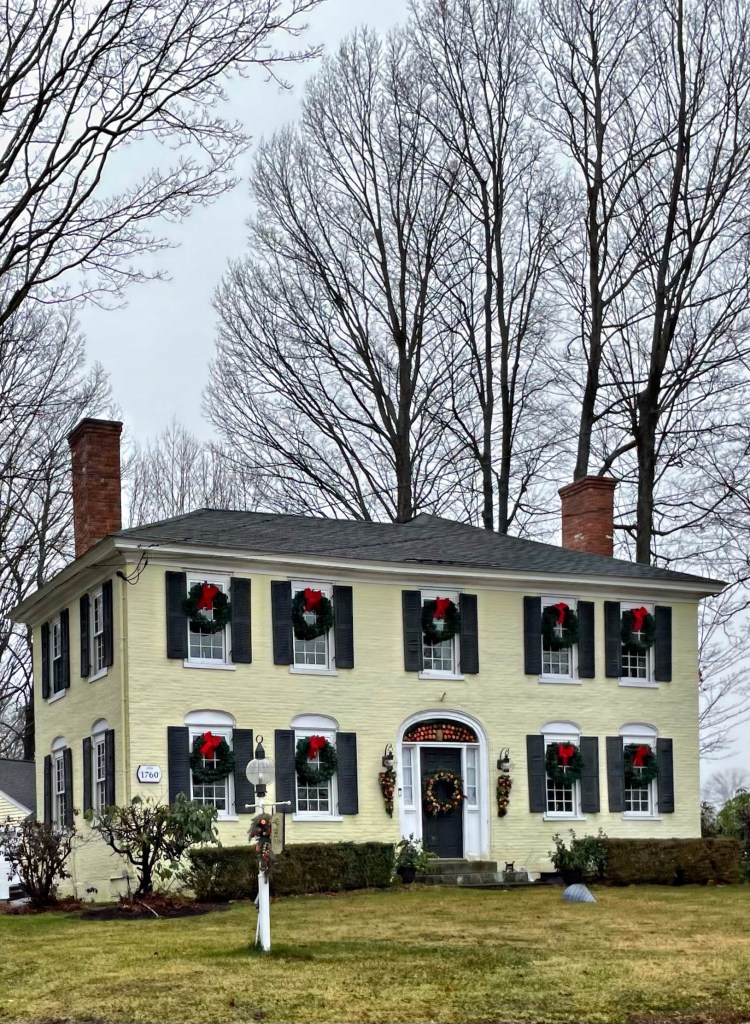
This historic house in West Millbury, Massachusetts, began in the end of the 18th century as a one-and-a-half-story wood-frame farmhouse. By 1810, the home was rotated 90 degrees and a more substantial, two-story brick house was constructed facing the street. The Federal style home was owned by Thaddeus Hall (1779-1855), and after his death, it was owned by his son, Orson Eddy Hall, who possibly rented the property for income while he resided in New Orleans and ran the iconic St. Charles Hotel there. The property was later acquired by Willard Balcom and remained in the family. Oh what I wouldn’t do to see the paint come off this old brick house!!
This farmhouse is unreal… Located on a rural back road in Millbury, I came across this rambling old Cape house with a stone wall and everything! The home appears to have been built in the late 18th or early 19th century, possibly as a half-cape (with the door and two windows to the right) for Emery Bond, or possibly his father, Oliver Bond. The home (like many Cape houses) was added onto as the family grew and finances could necessitate a more substantial house. It likely added the two bays to the left of the front door next, then bumping out the sides by the 20th century to give it the present, elongated appearance. It’s not often that a once-modest Cape house stops me in my tracks!
Backroads in New England are just amazing! When driving through Millbury on my way to visit one of the finest examples of Federal style architecture in the state, I stumbled upon this gorgeous rural Federal style farmhouse, and had to snap a picture! Millbury is best-known as a mill town (hence the name), but you can find dozens of rural farms dispersed between the mill villages in the township. The Blackstone River cuts through the town, and during the Industrial Revolution, it provided much of the water power to the town’s many textile mills and factories. Like many former mill towns, the shifting of the economy away from manufacturing towards the service sector, harmed the economy of Millbury in the 20th century. Many mills were abandoned and demolished, others adaptively reused. Before we get to some industrial history, I wanted to share this charming farmhouse. This home was built for Nymphas Longley upon the time of his 1819 marriage to the love of his life, Nancy Bond. They ran a farm on over 80 acres, with Nymphas also serving as a town selectman, an overseer of the poor, and led recruitment efforts in town at the start of the Civil War. Like many farms, this one saw suburban development take some of the former land, but this home still sits on over 9 acres, not bad for being so close to Worcester!


 Buildings of New England