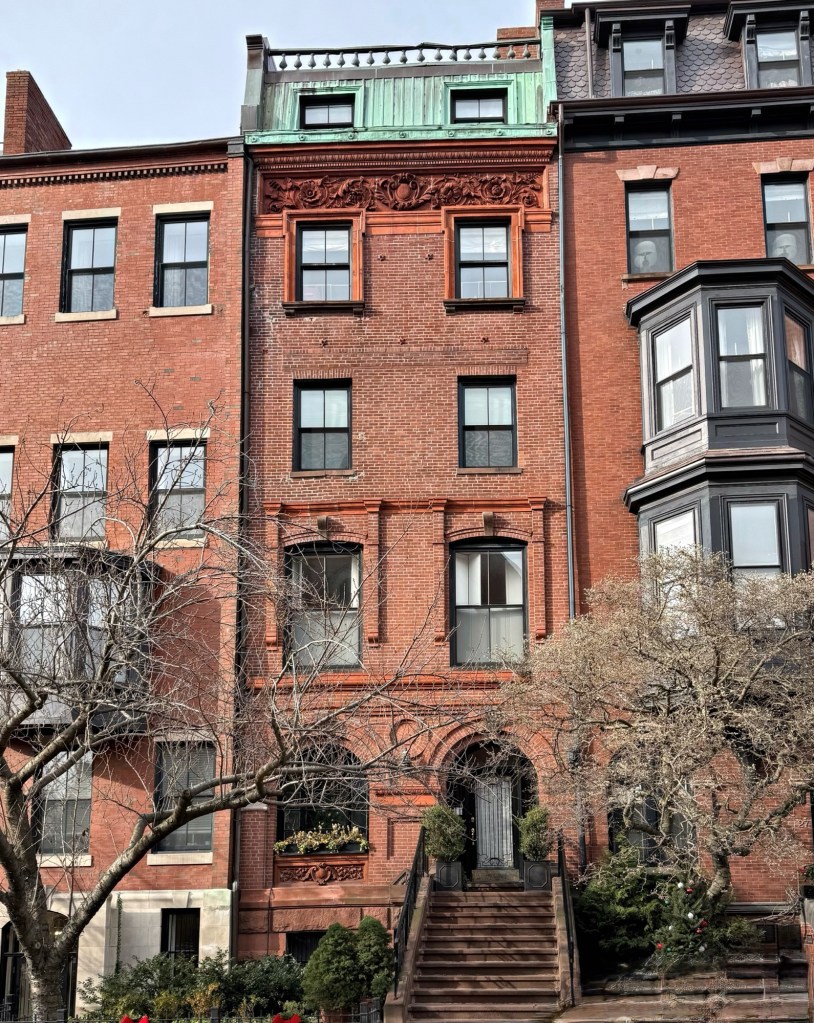
Faulkner-Hayden House // 1881

This unique house at 29 Brimmer Street in Boston’s Beacon Hill, was completed in 1881 is architecturally distinctive compared to the early 19th century homes that the neighborhood is known for. The five-story residence has a raised entrance up a flight of steps set within an arched opening. To the side, an arched window frames the facade and has an ornate terracotta panel as a base. More terracotta ornament can be found at the second floor and under the cornice as a thick band frieze with a copper-clad mansard roof above. The single-family residence was built in 1881 for Charles Faulkner (1811-1885), a commission merchant, for his daughter, Ann Ruth Faulkner the year of her marriage to Charles Rowley Hayden. Mr. Hayden was a musician and vocalist. For the new wedding gift, Faulkner hired the esteemed architectural firm of Bradlee & Winslow prepare the designs. The former Faulkner-Hayden House today contains five condominiums.
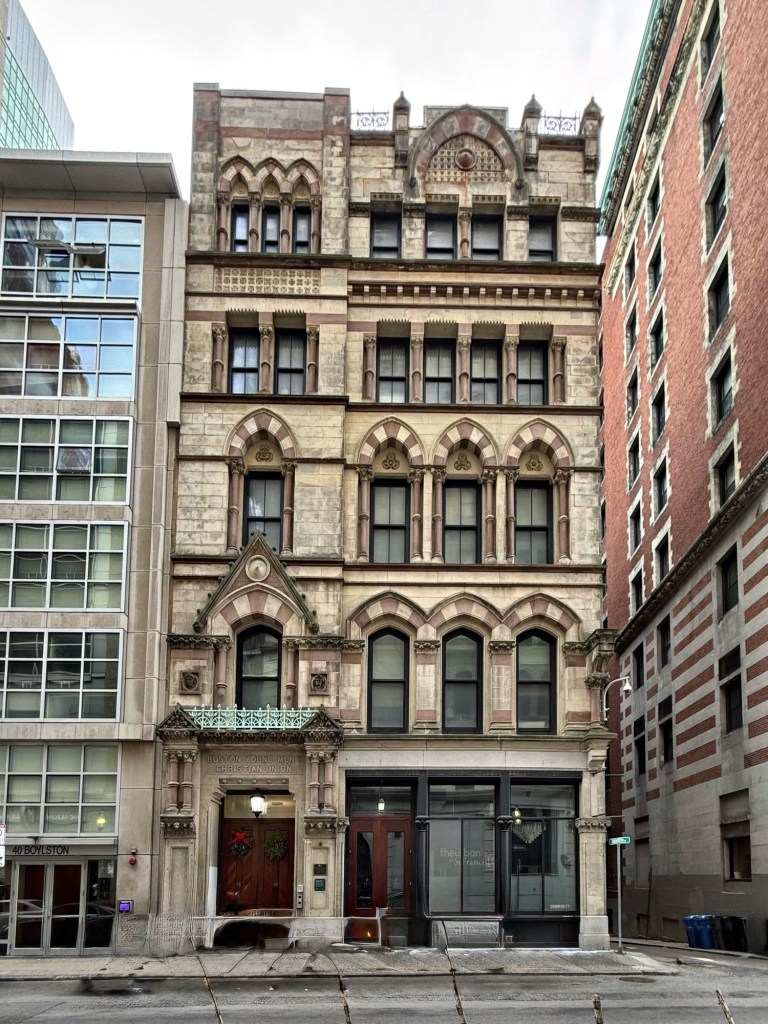


Boston Young Men’s Christian Union Building // 1875

The Boston Young Men’s Christian Union was founded in 1851 by a group of Harvard students as a biblical and christian literature discussion group, which incorporated the following year. First located on School Street, the organization’s activities were to provide a focal point for the intellectual, religious, and social life of primarily middle-class, well-educated Christians. The organization grew to the point that a new building was needed, and in 1873, a site on Boylston Street was acquired as a perfect central location for the group. Architect Nathaniel J. Bradlee of Bradlee and Winslow was hired to design the structure, principally because Mr. Bradlee by then a prominent architect and public figure, was also a life member of the Union and the brother of one of its founders. The building was completed in 1875 and included ground floor retail with an auditorium, gymnasium, library, social and game rooms, and offices for the Union above and behind. Designed in the High Victorian/Ruskinian Gothic style, derived from a mixture of English, Italian, French, and some German Gothic precedents, the style emphasized complicated, asymmetrical massing, polychromy, ornate details, and lancet or Gothic arched openings, in this building a sandstone facade was used. The building became a City of Boston Landmark in 1977. In 2016, the building was converted to an affordable housing development by The Architectural Team Inc., and called “The Union”. The development provides 46 units of affordable housing, including 25 targeted to those who have experienced homelessness. What a great rebirth of the building. Historic Preservation and Affordable Housing can work together and create great projects.