Frank A. Ferris House // 1890

Located north of downtown Oak Bluffs, this oceanfront summer estate exemplifies the grandeur of Martha’s Vineyard at the end of the 18th century. This home was built in 1890 for Frank A. Ferris, a Manhattan meat dealer who processed and shipped his product to wealthy customers, markets, luxury hotels and restaurants all over the east coast. His processing plant on Mott Street in Manhattan remains an excellent example of Romanesque Revival architecture in the city. He lived at 5 Russell Terrace in Montclair, NJ, and in summers, stayed in this waterfront mansion overlooking the Atlantic. His summer home is a great blending of the Queen Anne and Shingle styles, both very common at the time.

Oak Bluffs Town Hall & Fire Station // 1882

Located at the heart of Oak Bluffs, this modest, wood-frame building has held some of the most important civic and cultural uses on the island. Built in 1882, the growing town of Cottage City (later renamed Oak Bluffs), which separated from Edgartown, needed a new town hall and fire station with the rapid development caused by summer visitors and increased year-round residents. After WWII, the property was renovated and expanded to allow space for a small police department in the building as well. In 1966, a new town hall was built across from the ferry pier at the waterfront, and the town soon after sold the former, outdated building, and two years later, it was purchased by The Cottagers, Inc. The Cottagers, Inc., is a philanthropic organization founded in 1955 by a group of African-American women who owned cottages or homes on Martha’s Vineyard. The social group provided a safe space for the growing Black community who lived on and visited Martha’s Vineyard. The building remains as an iconic landmark not only for its historical use and architecture, but as a symbol of the diversity and the black community in the small island town.

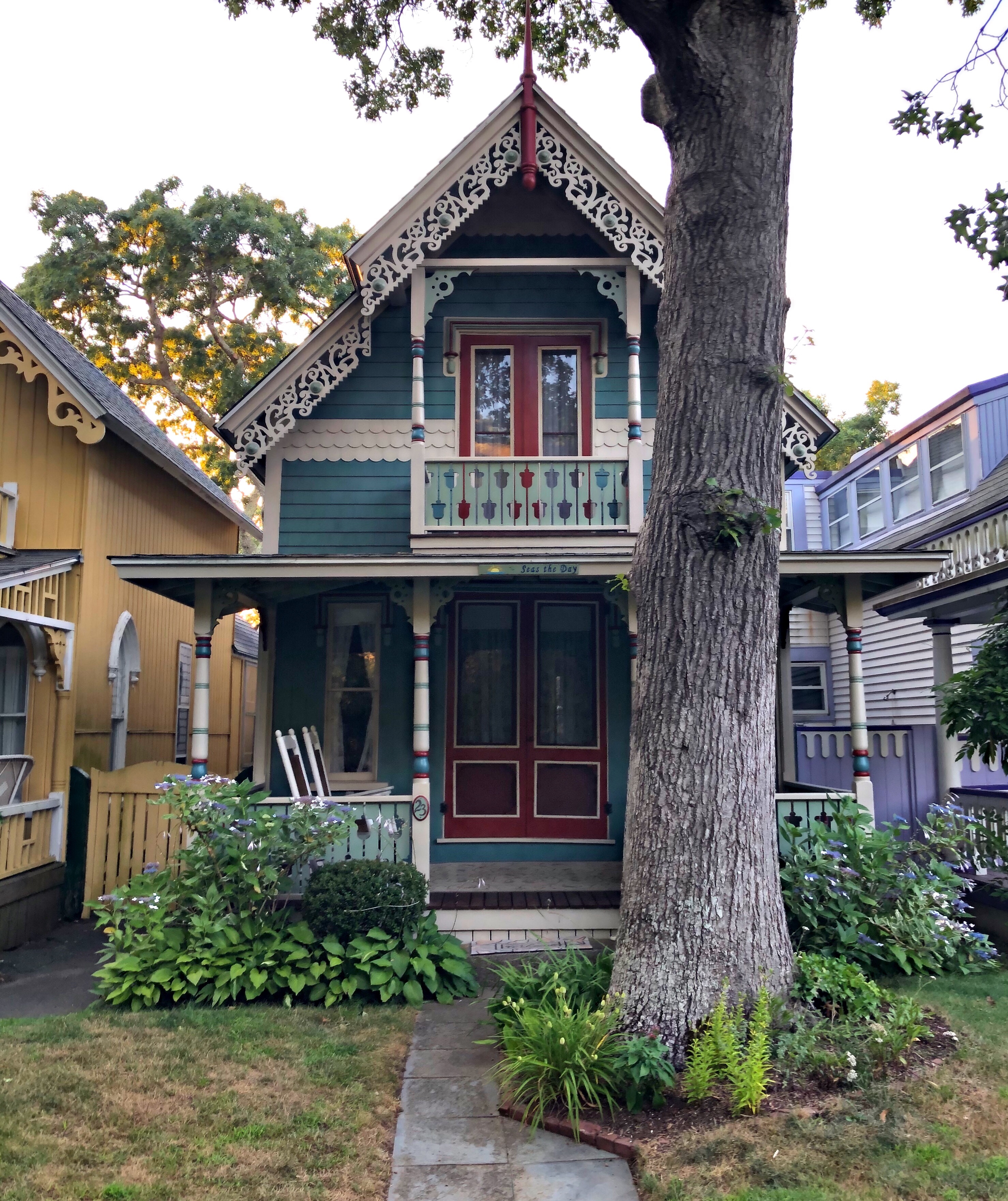
“Seas the Day” Cottage // 1875

This quaint little summer cottage in Wesleyan Grove was built in 1875 for Hanson Arnold, a merchant and methodist from Woonsocket, R.I. The home is typical of many other summer cottages in Oak Bluffs on Martha’s Vineyard, with its delicate stick work, turned posts, full-length porch, and second story balcony with pierced bargeboards. The home was at one point named “Seas the Day”, a trend of naming the cottages occurred sometime in the 20th century by families who summered on the island, many incorporating the family’s name somehow. The home was restored recently with all new detailing and a reversion back to the original porch configuration.

Riday-Evans Cottage // c.1880

This cottage on Ocean Ave in Oak Bluffs was built before 1880 for J.F. Riday, a manager at the American Mail and Export Journal at the Wesleyan Building on Bromfield Street in Boston. The quaint cottage was photographed shortly after it was built with Riday and two women (one likely being his wife) posing on the front porch overlooking the ocean. By the early 20th century, the home was owned by George and Corielle Evans, a couple from Mexico. They likely modified the home with the shingled siding and front porch with sheltered balcony above, while the original lancet windows and doors remained.

Jones Cottage // 1876

This charming little cottage in Oak Bluffs was built in 1876 for Charles N. Jones, a resident of Medford, MA who had a home built there in 1872. His family’s summer cottage on Martha’s Vineyard was designed by the Ripley Brothers, Alonzo and Walter, carpenters who lived in town and designed and built many of the charming little summer homes there. The home features a wrap-around porch, a covered balcony at the second floor, and pierced board balustrade and cornerboards. Oh, and the paint scheme is perfect!