This charming Federal style saltbox house was built around the turn of the 19th century for Moses Howard, a “shipmaster” who moved to Kennebunkport from Cohasset, Massachusetts in 1793. The house here is clapboard with a symmetrical facade and central chimney. A saltbox roof extends off the rear of the house. Moses Howard did not stay in Kennebunkport for long as he moved to Portland by 1812. The house was lovingly maintained for the next 200+years.
In 1802, a young sea captain, Laban Coleman purchased this house on Orange Street on Nantucket within a year of his marriage to Jane Carman. Historians estimate the date of construction of the house to be from sometime between 1729 and 1750, but it could date closer to the time that Coleman purchased the house from a joiner, Elisha Raymond, who possibly built the house. I particularly love the simple door with transom above and the narrow, second-story stairhall window. What do you like the most about this Nantucket home?
Welcome to Southport, one of the most walkable and charming seaside villages in all of Connecticut, and it’s also in Fairfield! Southport became a leading coastal port on Long Island Sound, its ships carrying produce and goods back and forth to New York City. Sea captains houses, historic banks, and stunning churches line the streets in the village and are all in a great state of preservation. This is because much of the old village area is part of a local historic district, first established in 1967, where buildings from three centuries are protected for future generations. This house was built in East Haven, Connecticut by Samuel Bradley in 1715. The saltbox house is evocative of many early Colonial homes of Connecticut built at the time with a large central chimney and symmetrical facade. The house remained in the family until the mid-1940s when it was purchased, disassembled, shipped and reconstructed on this site on Harbor Road in Southport.
According to local historians, this historic saltbox house was built around 1690 by John Smith, a volunteer Sargent in the Fairfield Trainband (a band of citizens trained as soldiers to supplement the regular army) or Militia. The position involved training, strategizing, storing military weaponry of the town, and being responsible for the preparedness of the community in the event of an attack by Native tribes, Dutch, or French forces. The house was later renovated in the Colonial Revival style, but has since been restored closer to its original design as an early First Period saltbox.
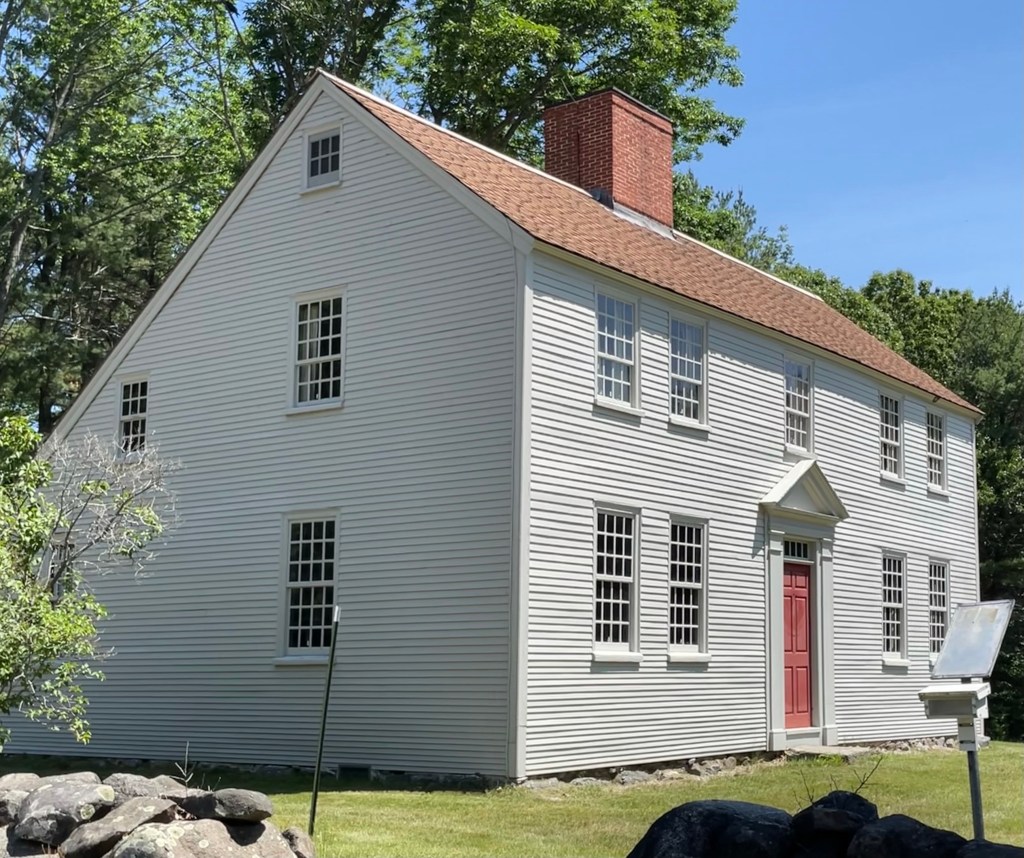
The Old Parsonage in Newington, NH, is a rare survivor from the 1700s in the tiny town. It is one of few extant “saltbox” houses to be found in the New Hampshire seacoast. Like most houses of this type, the parsonage has a lean-to that was added a few years after the house was built. Like the nearby meeting house, the parsonage has long been inextricably connected to the public life and the identity of Newington. Unlike the much-altered meeting house, the parsonage retains the appearance of the 1700s and has been extremely well-preserved, giving a glimpse into 18th century life in Newington. The parsonage is estimated to have been constructed in 1725 when Richard Pomeroy, the first Sexton of the church, sold the property here for 19 pounds, with no mention of a dwelling. It was acquired by a John Knight (1685-1765). After his death, the dwelling was sold to the Town of Newington and restored to be used as a parsonage.
This saltbox house was built by 1750 for David Ogden at the time of his marriage to Jane Sturges. For the next 125 years it was home for the Ogden family in the farming and coastal shipping town of Fairfield. The home was sold out of the family in 1839 to Henry W. Banks, who continued to farm on the nearly 75 acres of farmland. By the 1920s, the home was suffering from deferred maintenance and was at risk of demolition. Luckily, Annie Burr Jennings (1855-1939), a philanthropist who was born into a wealthy family, sought to give back to her town. Jennings was instrumental in establishing and supporting a number of important community institutions, including the Fairfield Historical Society (now the Fairfield Museum) and the Fairfield Public Library. In 1931, she purchased the old Ogden Farmhouse from absentee owners and helped fund its restoration. The early saltbox vernacular Georgian home today is maintained by the Fairfield Museum and the Greenfield Hill Village Improvement Society.