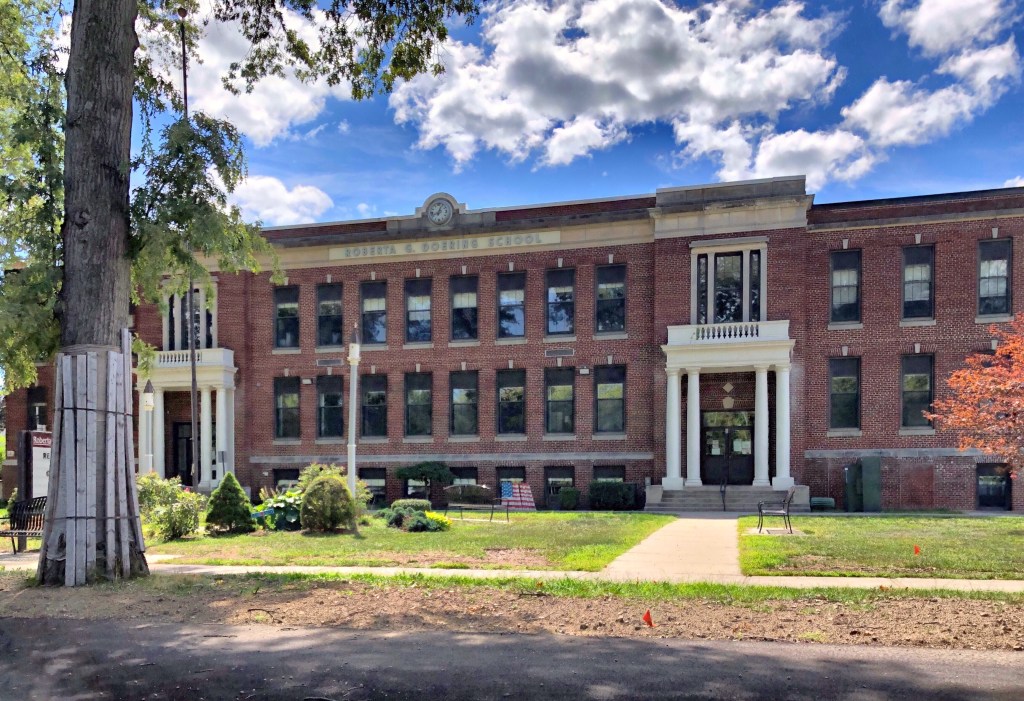
In the 1930s, America was in the throes of the Great Depression, and towns and cities struggled to provide services for the ever-growing populations, all the while suffering from lower tax revenues. The New Deal was enacted as a result, which provided a series of programs, public work projects, financial reforms, and regulations enacted by President Franklin D. Roosevelt between 1933 and 1939. One of these programs was the Public Works Administration (PWA), which funded and built large-scale public works projects such as dams, bridges, hospitals, and schools, to provide jobs and bolster local economies. In Newton, the developing Oak Hill Village required a new public school, and the town received funding for the Oak Hill Middle School in 1935. Architects Densmore, LeClear, and Robbins were hired to provide designs for a new school, and builders completed the building the next year. The Georgian Revival building is constructed with red brick with cast stone trim. The 16-over-16 windows and cupola also work to showcase the beauty of the design.
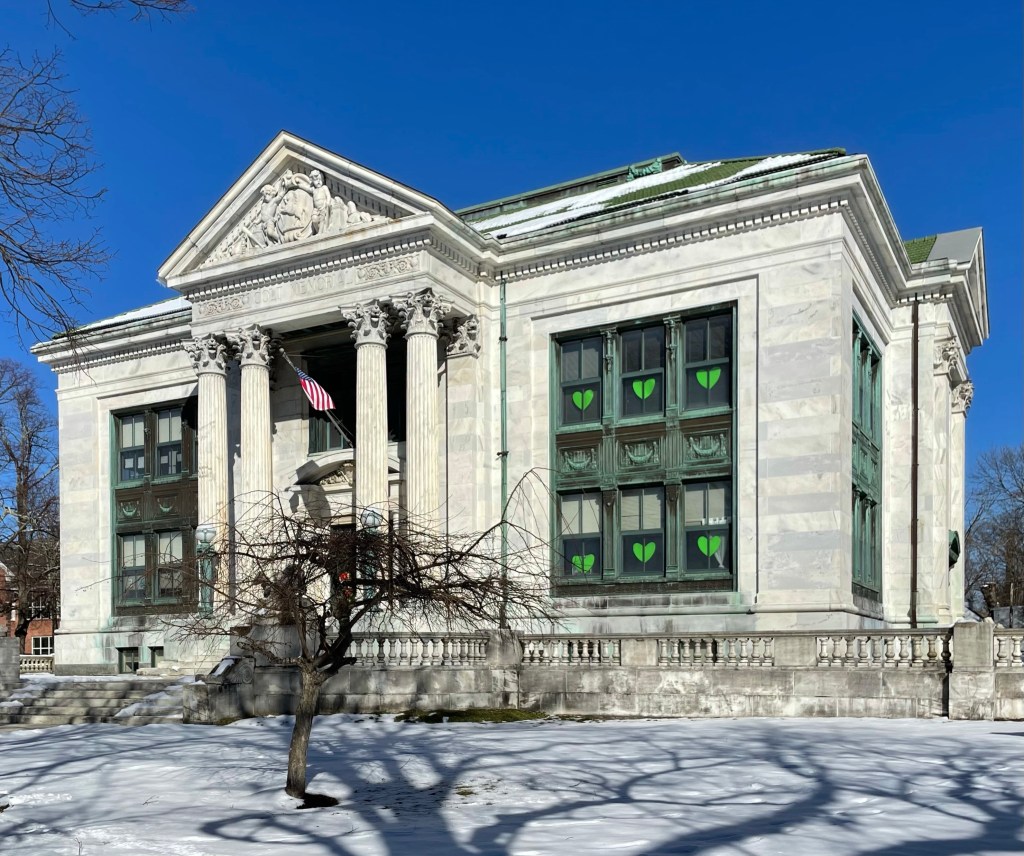
Similar to Burnside Memorial Hall nearby, this school building in Bristol was also constructed as a memorial, in the form of an architectural statement-piece. The school building was gifted to the town of Bristol by Samuel P. Colt, who resided in a mansion nearby, Linden Place, and also owned a massive country estate in town, where his prized cows were cultivated. The school building was funded as a gift in memory of his mother Theodora DeWolf Colt and showcases his everlasting love for her. Designed by Cooper & Bailey of Boston, this monumental, 2-story, hip-roof Renaissance Revival structure was built of white marble with 2-story, cast-bronze window bays. The symmetrical facade has a central Corinthian portico with fluted columns and a pediment containing cherubs around the Colt family crest. The school was used as the town high school until the 1960s when it was outgrown, the building has since been used as an elementary school, the nicest one I have ever seen!
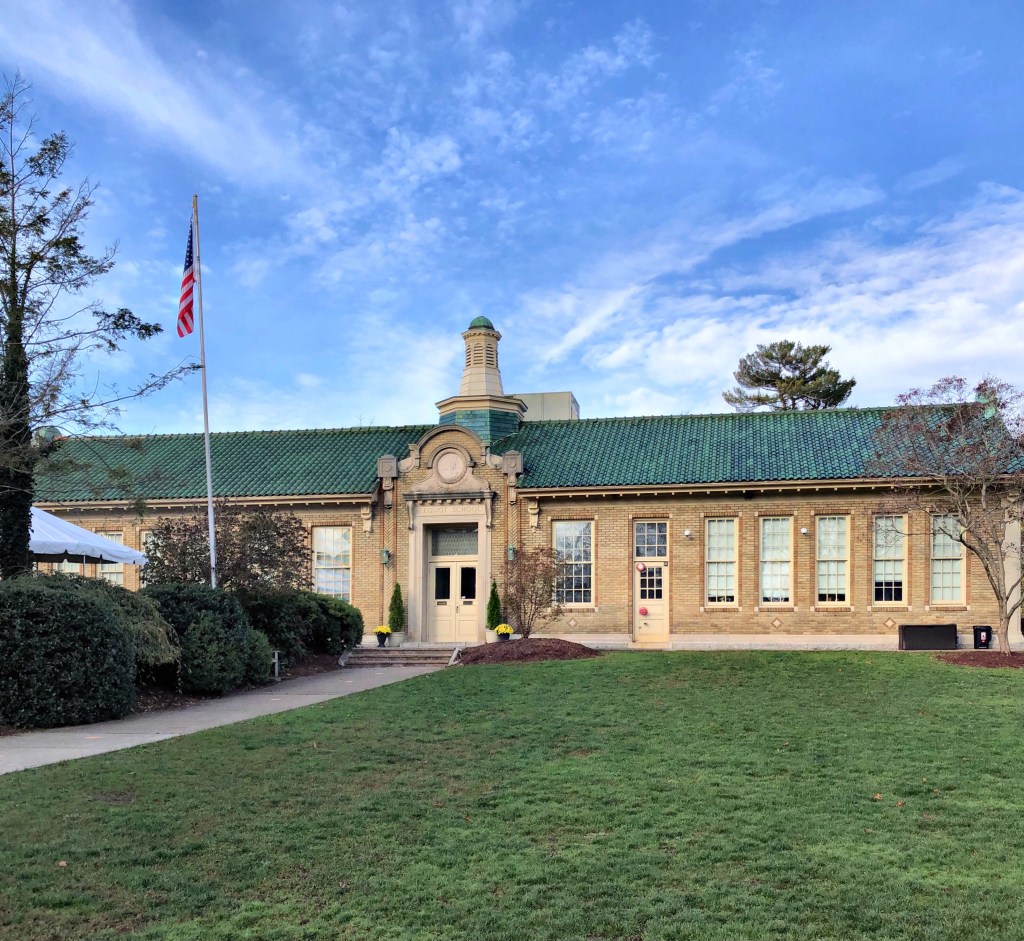
The Pequot School in Fairfield was built in 1917-18 and is one of only a few institutional buildings erected in the Southport area during the early twentieth century. The school, designed by architect William H. McLean, replaced an earlier school on the site which was built in 1854. The 1854 wood-frame school building was outgrown in the early 20th century and the school board voted to demolish the old building and replace with a larger, modern school. The school is a unique design in the Classical Revival realm, but capped with a cupola and stunning green tile roof. The school closed in 1972, and the historic Pequot School building was acquired by the Southport Conservancy as a treasured landmark. It was occupied by the town until 1985 when it was occupied by the Southport School.
I’m starting to see a trend in Easton, almost everything is named after the Ames Family! In 1893, Oliver Ames (1831-1895), a grandson of shovel company founder Oliver Ames and son of Oakes Ames, offered to fund the construction of a new high school building if the town would pay the cost of building its foundation and grading the site. While governor of the Commonwealth of Massachusetts (1887-90), Ames had hired Boston architect Carl Fehmer as consulting architect to the State for the extension to the Massachusetts State House, and it was Fehmer who secured the design contract for the new school in Easton. The refined Colonial Revival school building features a central pavilion with an entrance set within an ornate stone architrave with a Classical entablature with central pediment. The school was outgrown in 1957 and became the town’s middle school, outgrown again in the 1990s. The town sold the school to a developer with preservation restrictions and it is now used as apartments!
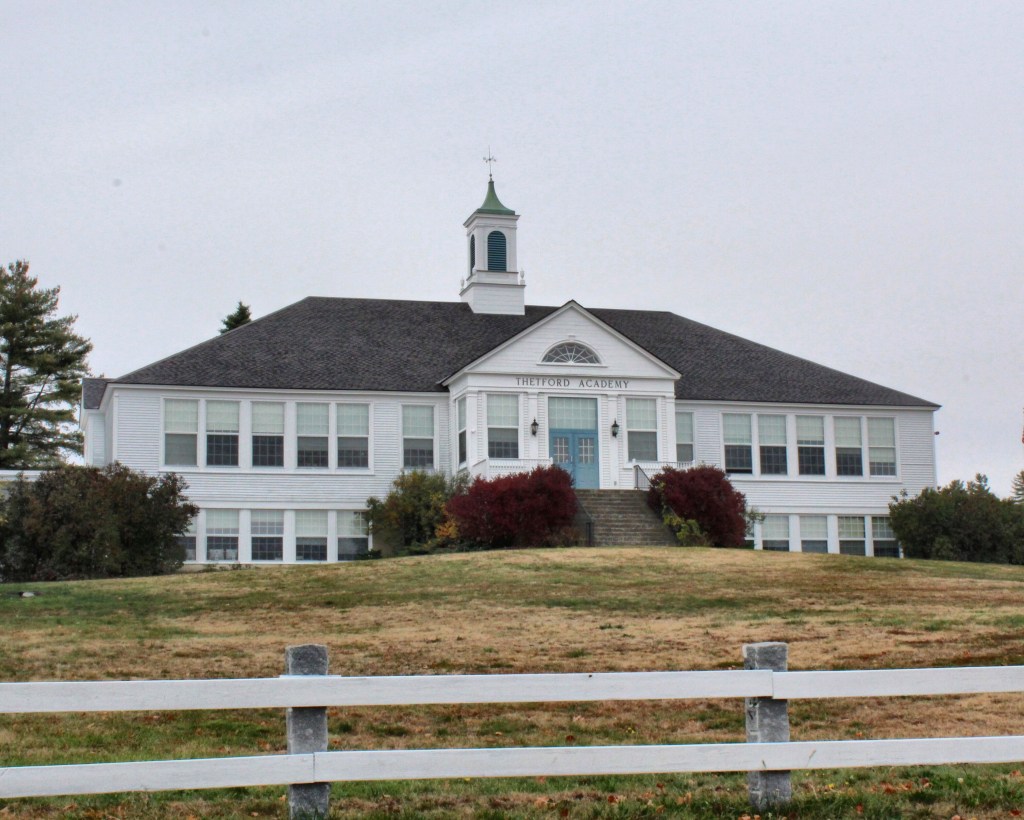
Thetford Academy opened in February 1819, after the constitution of Vermont called for free elementary schools in each town, a school in each county for studies above the elementary level, and one university for the state. These schools prepared students in classical languages, mathematics, “natural philosophy,” and the arts for entrance into colleges and universities, and careers in ministry, law, medicine, and teaching. By the time Thetford Academy was founded, girls were being admitted to some academies (usually in the summer term) for studies which were advanced beyond the common schools, but which were not intended to prepare for college. Thetford Academy admitted both boys and girls from its founding. The school thrived beginning on it’s first day of classes, growing almost annually with new buildings constructed to house new classrooms and dormitories.
The first academic building, erected in 1818 by Fitch, was crowned by a bell tower and featured separate entries for boys and girls. It was destroyed by fire on November 14, 1942. Fueled by high winds, the fire also destroyed the girls’ dormitory and the library. Undeterred, the school rebuilt nearby beginning with this Colonial Revival building, known as the White Building. Later buildings were added to create the campus we see today.
Initially established as the Connecticut Literary Institute (the school was renamed Suffield School in 1916 and then Suffield Academy in 1937), the mission of this school with Baptist roots was to educate young men for the ministry. As the Connecticut Literary Institute was the only high school in Suffield, the town tax dollars paid for local students to attend. Although town and local Baptists served a major role in getting the school underway, the founders soon moved away from a denominational focus. Built for the Institute in 1854, this large brick academic building was designed in the Italianate style with brackets and decorative brickwork at the cornice. In 1950, the school “Colonialized” the campus beginning with the Memorial Building, removing the Victorian flair for a more traditional Colonial Revival appearance. They also did the same with Fuller Hall next door.
This stunning High School building in Agawam was built in 1921 as the town’s first high school. William Pynchon purchased land on both sides of the Connecticut River from the local Pocomtuc Indians known as Agawam, which included present-day Springfield, Chicopee, Longmeadow, and West Springfield, Massachusetts. The purchase price for the Agawam portion was 10 coats, 10 hoes, 10 hatchets, 10 knives, and 10 fathoms of wampum. Agawam and West Springfield split in 1800, with Agawam incorporating as a town on in 1855. The town stayed fairly rural until the 20th century with the proliferation of the personal automobile and suburbanization from the industrial and urban center of Springfield. This increase required a new, modern high school to be constructed in town. The building was converted to a middle school in 1972.
In most Massachusetts cities and towns, habitual truants (children who stayed away from school) and juvenile delinquents had normally been committed to local almshouses and prisons. By 1873, state law updated policies to “humanize” the children and guide them on a better path. Habitual truants (age seven to fourteen), habitual absentees (age seven to sixteen), and habitual school offenders could be committed to a county truant school for a term of up to two years. At least one of these types of schools were found in each of Massachusetts’ counties, which seemed to get more crowded every passing decade. In the early 20th century, the outlook on shaping children’s growth changed and to reflect this, the truancy schools were renamed “Training Schools”.
The former Hampden County Truancy School in Springfield was outgrown and outdated. The county petitioned the state for a new school on open land, and a site was acquired in nearby Agawam. The choice of location was intended to provide a rural farm environment and to avoid the temptations of the city. The isolated location, surrounded by farmland, ensured that students could not easily walk away from the school to rejoin their friends and families. Despite the remote location, the Hampden County Commissioners report of 1918 noted that 36 boys still ran away from the training school a total of 69 times and that 5 were still at large at the end of the year.
Starting in the 1940s, the County Training Schools were seen as a waste of taxpayer money and many staff at these institutions were under-educated themselves to deal with emotional or social issues that some of the children exhibited. Many county schools were closed, with the Hampden County Training School closing in 1972.
The school building and grounds sat vacant for over a decade until funding was released to renovate the building for use as a police academy training center in 1984. The exterior of the building remained relatively unchanged during this time, and many of the original classroom spaces were left as found. The building served in this capacity for over twenty years until it was closed in 2005. In 2017, Soldier On, a private nonprofit organization that provides housing and supportive services for military veterans, rehabilitated the former school and now provides 51 permanent housing units here. The property was listed on the National Register of Historic Places (a report where much of this information came from) and was rehabilitated using Federal Tax Credits.
The Classical Revival-style Hampden County Training School was designed by the prolific Holyoke-based architect George Perkins Bissell Alderman. Alderman was well known throughout western Massachusetts and Connecticut for his monumental, classically derived designs for residences, schools, commercial blocks, civic buildings, and churches.
Located in Agawam Center this interesting architectural example of a late-Tudor Revival school building really caught my eye. The building replaced a 1870s town hall and two-room schoolhouse which were both outgrown as Agawam’s population increased due to the proximity of nearby Springfield. The architect was Paul B. Johnson, who was based out of West Springfield and ran a small architectural office there. He attended Cornell and MIT for architectural training and worked primarily around Springfield. The school building is constructed of a deep red brick, laid in varied relief for a rough faced surface and a cast stone Tudor arch around the main entrance for contrast. The school was later renamed after Benjamin Phelps, the first superintendent of schools in Agawam.
The Eliot School is a descendant of the first Eliot School in the North End, which opened in 1713 on the present North Bennet Street. Aside from Boston Latin, Eliot School is the oldest public school in Boston. Originally known as the North Latin School, it was renamed in 1821 likely after the former pastor of New North Congregational Church, Rev. Andrew Eliot. Constructed as an elementary school in 1931, this building occupies the site of the former Freeman School, one of the smaller 19th-century school buildings in the North End. This school building was designed in the Art Deco style by Cambridge-based architect Charles Greco. The building features decorative use of brick with stone incised pilasters and highly ornamental lintels over each entry, incorporating the name of the school, carved foliate designs and shields, and the 1931 construction date.





 Buildings of New England