Built in 1857 as the Landgrove Methodist Church, this absolutely charming church sits in the middle of Landgrove, a town with a population of just 177. The town’s small population acquired funds to erect a church in their town, opting to not make the trip by horseback or foot to the churches in surrounding towns. The vernacular Greek Revival building was likely constructed by the members of the congregation and possibly the work of a local builder. Methodists commissioned the 30 × 40–foot building to attract a regular circuit rider, and by 1870 it had become a Union church with other denominations. There is something so enchanting about these old white churches in small New England towns!
Sitting on the banks of Utley Brook, which meanders through the Clarksville village in Landgrove, Vermont, you will find this gorgeous Cape home in a perfect yellow color (seemingly to blend in with the turning leaves every Fall). The home dates to the early 19th century, possibly earlier, and was owned by the Harlow Family, who operated a saw mill across the street. The house was listed for sale in 2019 and is absolutely stunning inside and out!
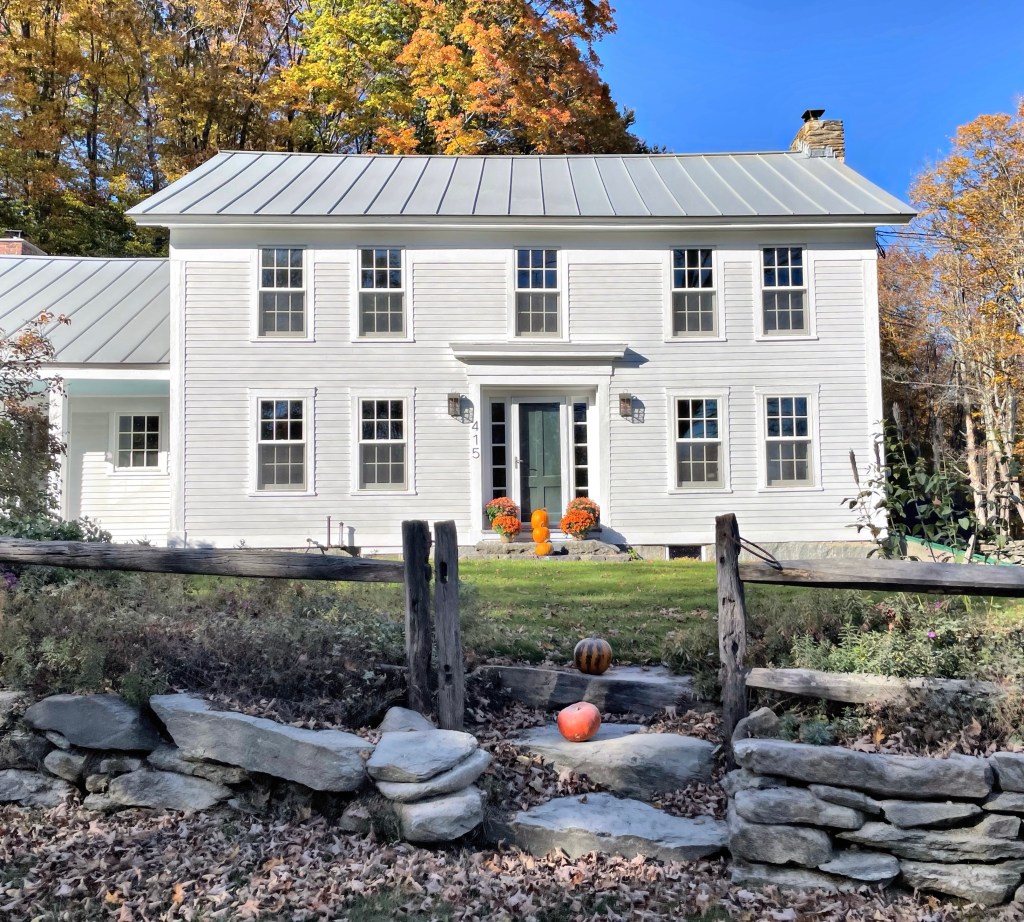
Landgrove, like many other rural towns of Vermont, has seen a lot of investment from out-of-state residents who pick up historic farm properties and renovate them. This is a great thing for many, as with investment comes tax-dollars and preservation of these historic buildings. On the other side, it prices out many who have grown up in these rural towns. Many villages and regions in Vermont have strict zoning which limits density, to maintain the character and charm of these back roads. Another Catch-22, as more housing (especially multi-family) means lower costs for limited available housing, but it can adversely impact what makes these rural towns so enchanting. Anyways, here is a beautifully restored Federal house!
In the early years of the establishment of the settlement of Landgrove Vermont, Joshua Dale 1765-1845) moved to the newly incorporated town and built this large farmhouse on the south-facing slope of a mountain. With strong ties to nearby Weston, he tried to make a life in the new town of Landgrove, serving as a selectman, but he and his family moved back just four years later. The property was purchased by Obadiah Pease (1766-1830) who lived here with his wife Achsah and their seven children. The farm was eventually willed to their son Elihu, who did very well farming the property during his ownership (1830-1857). In 1842, he was the third-richest man in town at just 39 years old. From 1855 to 1857 he farmed only half the farm and a Shrewsbury man, Dexter R. Way, farmed the rest. At age 54, Elihu sold his farm to Dexter Way and left Landgrove to Wisconsin. After successive ownership, the farm was bought in 1933 by Nelson and Elizabeth Bigelow, for $1,500! The property included 200 acres of land, a dilapidated farmhouse and two decrepit barns. For the following seven years the land was gradually brought under control and the house restored, but the barns were unsalvageable. This homestead is a lasting example as to what a little faith and hard-work can accomplish, bringing what is seen as a tear-down up to one of the nicest homes in the area!
I stumbled upon this Greek Revival farmhouse located on one of many dirt roads in Landgrove, Vermont and had to snap a few photos! I couldn’t find much on the history of the house besides the fact it was listed on an 1869 atlas as the property of an “I. Cory”. The five-bay farmhouse has an elaborate door treatment and bold corner pilasters all perched behind a historic stone wall. The house telescoped outward with additions, eventually connecting it to what is now a garage. This farmhouse purchased in the 20th century by John A. Brown, who worked as Dean of Students at Princeton University.
Before driving down the winding dirt roads of Landgrove, Vermont, I had never even heard of the town, let alone what I would find. It is always a treat to explore a rural Vermont town, not knowing what lies beyond each hill and bend in the road. Landgrove was chartered in 1780 and is one of the least-populated towns in New England at just 177. The town’s founding occured in the spring of 1767, when Captain William Utley (1724-1790) and his 16-year-old son Asa, traveled from Connecticut to what is now Springfield VT, across a newly created road to the frontier town of Chester. Upon arriving, they spent the rest of the year cutting a road from Chester to the West River. He thought that he arrived in the Town of Bromley, one of the New Hampshire Land Grants. After building his cabin, settling here with his family, he realized he was in unincorporated land between other grants. He petitioned for a new town and it was accepted after the Revolution. The town grew slowly with farms sprouting up along the countryside, never expanding beyond 355 people. This old schoolhouse was constructed, likely around the turn of the 20th century at the geographic center of town after the town consolidated their school districts. When the town’s population shrunk further, Landgrove’s school district merged with nearby Londonderry and Weston. This former school was converted to town offices.
The oldest portion of this beautiful brick farmhouse in Cavendish, Vermont, its rear ell which was built about 1796 by Aaron Parker Jr., the son of one of Cavendish’s early settlers. Aaron married Susan Sherman in 1796 and likely had a home built here where they could start their family. Sometime in the 1810s, Aaron built the brick main block to which it is now attached. The blind arches and simple transom window above the door were common in brick Federal homes in this region at the time. The Federal style really took off in popularity in New England after the 1797 architectural pattern book, “Country Builder’s Assistant” by Asher Benjamin, who was a resident of nearby Windsor, VT. This home remained in the Parker family until the Great Depression, when it was sold off. The home remains extremely well preserved and is a great example of a rural Federal-period farmhouse in Central Vermont.
As Cavendish and other rural towns of Vermont became summer destinations for the rich of the urban centers of the northeast, large estates began to sprout up, replacing old family homesteads. Allen Miller Fletcher was born in Indianapolis, Indiana, the grandnephew of Josiah Fletcher, one of the original settlers of Cavendish in September 1853. He was the son of a successful banker and became a banker himself, building homes in Indianapolis and New York City. In 1881, he built a summer home in his ancestral home of Cavendish, taking the train up to relax and breathe in the clean air. While living most of the year in New York, Fletcher became involved in Vermont politics, winning the Republican nomination to serve in both the Vermont House of Representatives and the Vermont Senate in the early 1900s. During his time as a Vermont state senator, Fletcher commissioned architect Samuel Francis Page of the Boston-based firm, Fehmer and Page, to bring his vision to life. Page used English Cotswold-style architecture for his inspiration, and when completed in 1906, the home was the first in Vermont to be fully wired for electricity and equipped with an elevator! Fletcher also hiredFrederick Law Olmsted Jr. to design the landscaping on the property. Fletcher would spend the rest of his life at his country mansion, going on to work as the Governor of Vermont from 1912 to 1915. Today, Fletcher’s beautiful mansion now lives as a magnificent holiday retreat known as the Castle Hill Resort & Spa.
In the early 1780s, Leonard Proctor and Salmon Dutton and their families, moved from Massachusetts and settled in present-day Cavendish, Vermont and gave their names to the two major settlements on the Black River, Proctorsville and Duttonsville. Leonard Proctor was born in Westford, Massachusetts and fought in the Revolutionary War at a young age. He settled in Cavendish in 1782 and built a modest house/tavern, and underwent developing the village in his name, Proctorsville. By the early 1800s, Leonard was a highly esteemed member of town and had the funds to erect the finest Federal style manse in the village, to showcase the stability and wealth of his community. The home exhibits scalloped cornice moldings and the carved wood flowering vines springing from urns on the upper pilasters that have a folk/Federal quality that stands out as a very unique design detail. Carved Adamesque bell flowers that flank the door suggest Asher Benjamin’s Windsor influence. Elliptical sunbursts above the pilasters, elaborate guilloche friezes, and the broad semielliptical attic light have a later Federal character. It is possible that Leonard had this house built, and it was “modernized” by one of his heirs.
By the late 1800s, Vermonters had left the state in high numbers as agriculture began to sharply decline as a career path in New England, with many leaving to urban centers and manufacturing towns. Vermont politicians responded to the de-population with initiatives to encourage the redevelopment of existing farms by seasonal residents with money who could summer there to escape the hustle and bustle (and dirty air) of urban centers. Towns threw events like “Old Home” days with activities to entice affluent family members to return home and bring their money with them. After 1850, railroads made it easier for urban families to trade the heat and congestion of the city for the beauty of Vermont. One of these wealthy expats was James Hale Bates (1826-1901), who was born in Cavendish, Vermont, and moved to New York and worked in advertising, operating a major firm there. He retired in 1895, after the completion of Brook Farm one year earlier, a gentleman’s farm that he had built in his ancestral hometown of Cavendish. This massive Colonial Revival mansion was the centerpiece among sweeping fields and orchards contained by rustic stone walls. It is believed that Vermont architect, Clinton Smith, designed the estate house and many of the out-buildings on the site from the carriage and cow barns to the caretaker’s house and creamery. In recent years, the estate was operated as a vineyard, but it appears to be closed now. This is one of the hidden gems of Vermont and one of the most stunning Colonial Revival homes I have seen!