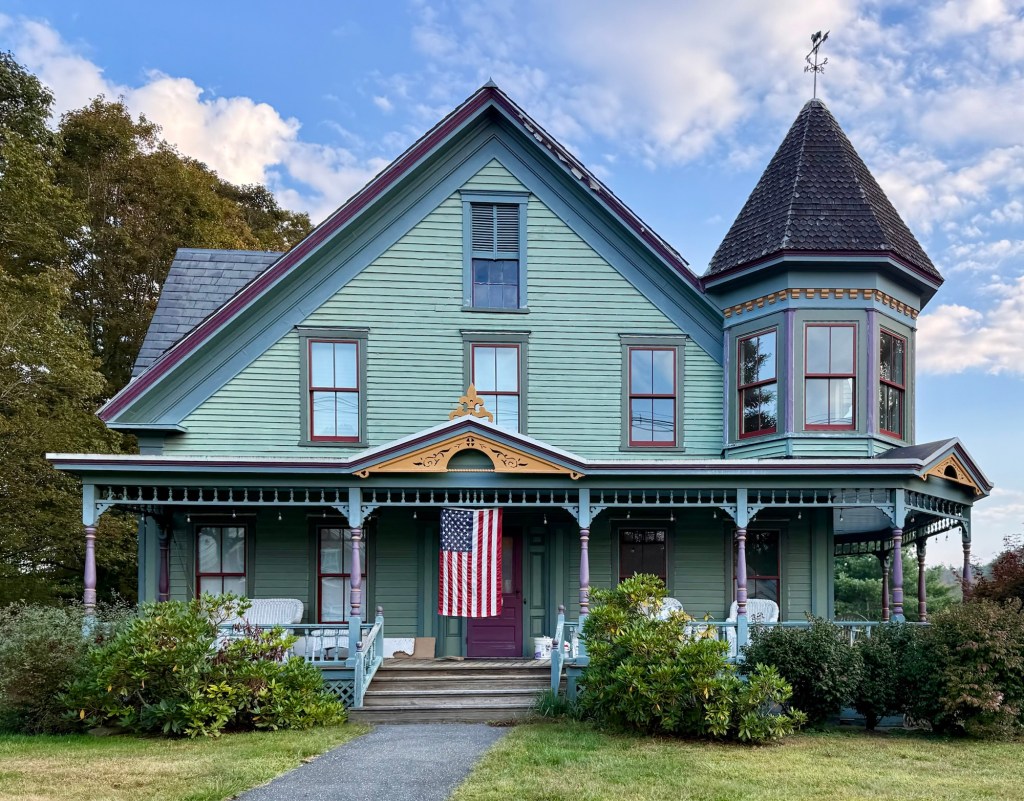
Robbins House // c.1850

Originally built in the 1840s or 1850s, this stunning house on Main Street in Chester, Vermont, was “Victorianized” in the late 19th century through applied ornament, a tower, and porches. Historic maps show that this house was owned by Cyrus Robbins and his wife, who likely had the residence built in a vernacular example of the Greek Revival style, with a 2 1/2-story form with gable roof oriented towards the street. The corner pilasters remain as do the original facade windows with five on the first floor, three on the second, and a single window in the upper floor. By the late 1800s, the house was modernized with the addition of the wrap-around porch with decorative spindles and ornament and the octagonal turret with wood shingle conical roof. Today, the house is painted colors to highlight the Queen Anne appearance and details.
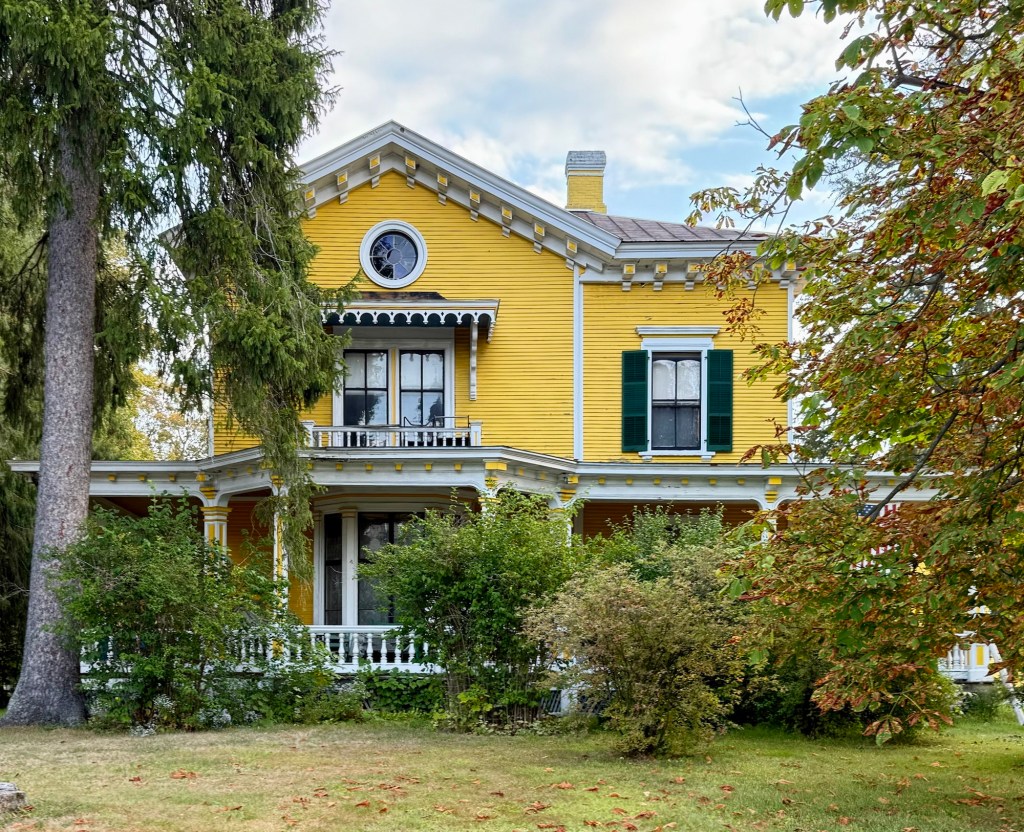
Frederick Fullerton House // 1861

This distinctive Italianate Villa style house in the charming village of Chester, Vermont, was built in 1861 for wealthy merchant, Frederick Fullerton (1817-1869). Mr. Fullerton worked in his family’s mercantile business in Chester, and was involved with cotton manufacture in Springfield and with the Cavendish woolen mill managed by his older brother, Henry, who built an equally distinctive residence in Cavendish called “Glimmerstone“. Basically cubic with asymmetrical gabled corner pavilions, the Fullerton House is an excellent example of an Italianate Villa with bracketed cornice, two-over-two sash windows, a wrap-around porch, and second floor balcony with a bracket-supported hood with decorative valance and an oculus window above. The residence is said to have been designed by architect, William P. Wentworth, who designed the St. Luke’s Episcopal Church across Main Street a decade later.

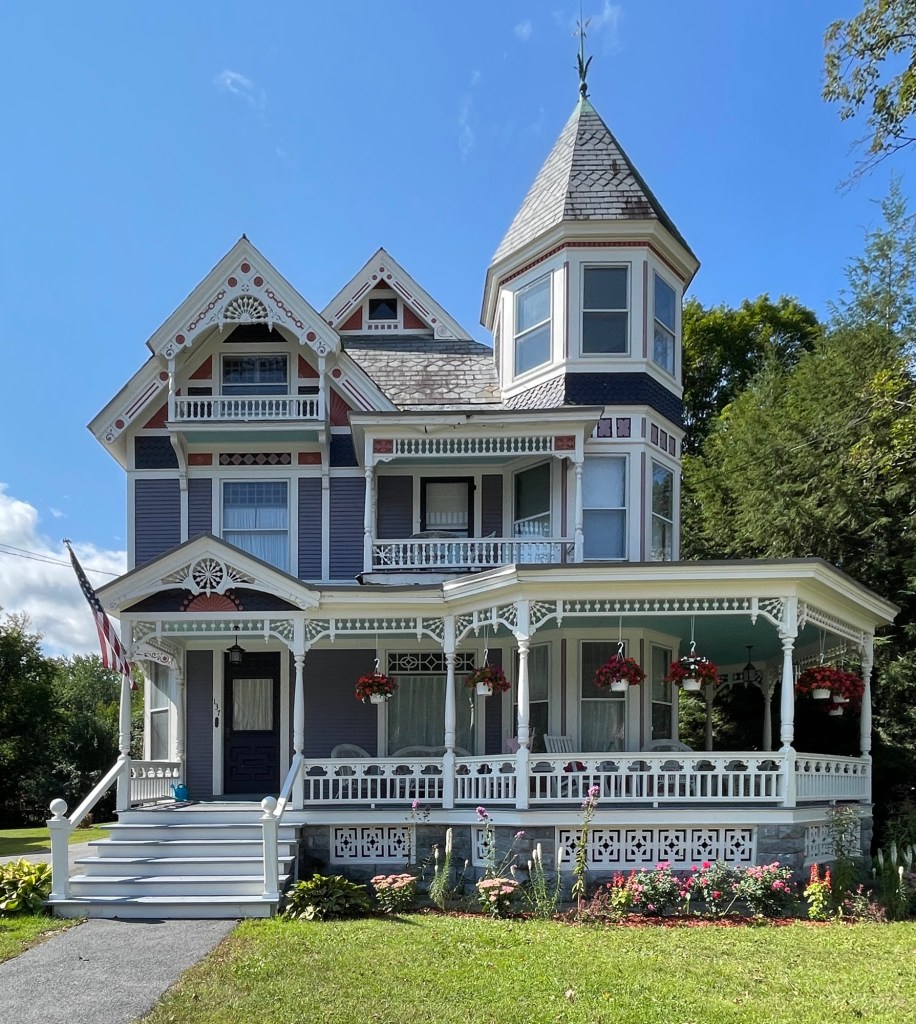
William Pollard House // 1899

This high-style and ornamental house in Chester, Vermont, ranks among the state’s best examples of the Queen Anne style. The residence was constructed in 1899 for William Pollard (1854-1941), a local businessman who owned a shirtwaist manufactory in town with his brother, who lived next door. The painted-lady Victorian house features an asymmetrical plan highlighted by a three-story octagonal corner tower that is surrounded by a wrap-around porch with a delicate spindled frieze. The use of accent colors in the paint scheme further highlight the millwork details on the residence, which have all been preserved for well over a century. 

Highgate Manor // c.1870

Henry Baxter (1821-1897), a doctor and owner of a local mill and multiple area farms, built one of the most remarkable Second Empire style houses in New England, and it can be found in the small town of Highgate, Vermont! Dr. Baxter was said to have acquired an earlier Federal period house on the site in the 1860s and began planning a high-style Mansard estate here for his family. The earlier Federal house was incorporated as a rear ell and the new Second Empire mansion was built in front. Architecturally, the house stands out for its bellcast mansard slate roof topped by a square belvedere with arched windows and heavy scrolled brackets. His patented medicine, Dr. Baxter’s Mandrake Bitters, was sold throughout Vermont in the late 19th century and afforded him the wealth to erect this stately home. There are many unsubstantiated claims of Dr. Baxter “performing experiments on his children” for the sake of people to state that the house is haunted, but this appears to be lore in poor taste. It is said that the house was also a stop on the Underground Railroad, but that appears unproven as well. After Dr. Baxter’s death in 1897, the property became a lodge and restaurant. A basement bar was built and during prohibition, was said to have hosted the likes of Al Capone. Today, Highgate Manor, with its larger-than-life lore, remains one of New England’s most important and high-style Second Empire houses in one of the most unlikely places. It goes to show that it is worth exploring all of New England!