Tower Cottage // c.1880

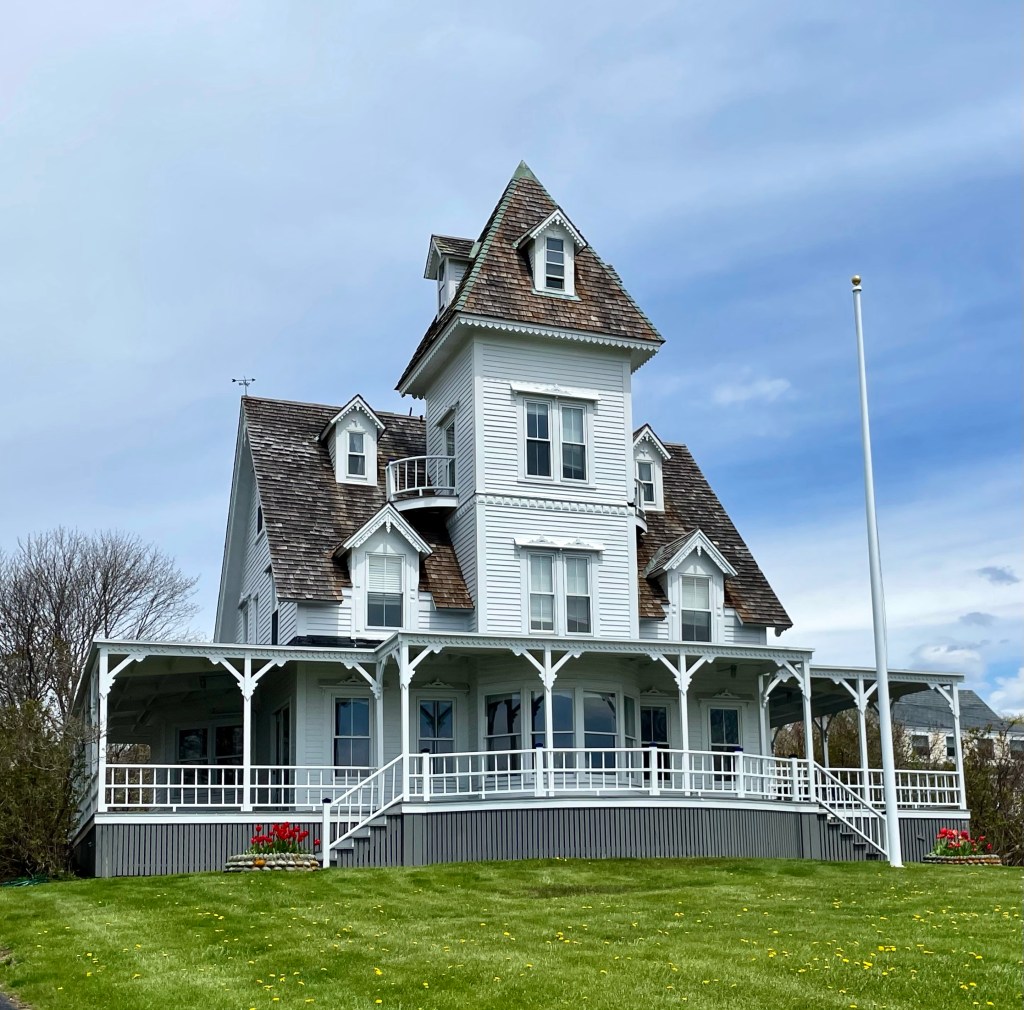
Located in the Foss Beach section of Rye, NH, this Victorian summer cottage stands out among the later new construction of lesser detailed and quality late 20th century homes seen here lately. The home, known as “Tower Cottage” was built at the end of the 19th century and exhibits Victorian Gothic elements with a massive center tower. The steep wood shingle roof is punctuated by two rows of delicate dormers which add detail and views to the ocean. The massive wrap-around porch is also a must for such a prime location fronting the Atlantic Ocean!

Lougee Cottage // c.1880

This house was built and first occupied by George G. Lougee, owner and proprietor of the Sea View House Hotel (demolished) across the street. Before building his own hotel, Lougee was a clerk at the Atlantic House, another summer resort. Lougee eventually worked his way up and ended up managing that hotel. Lougee’s success managing the Atlantic and later, the Farragut, enabled him to pursue his own enterprise and build his Sea View Hotel. When Lougee sold the Sea View hotel, he also sold this house with it. His former Stick style home was then converted to additional rooms at the hotel until it closed in the 20th century.

Jones & Wetherbee Houses // 1873

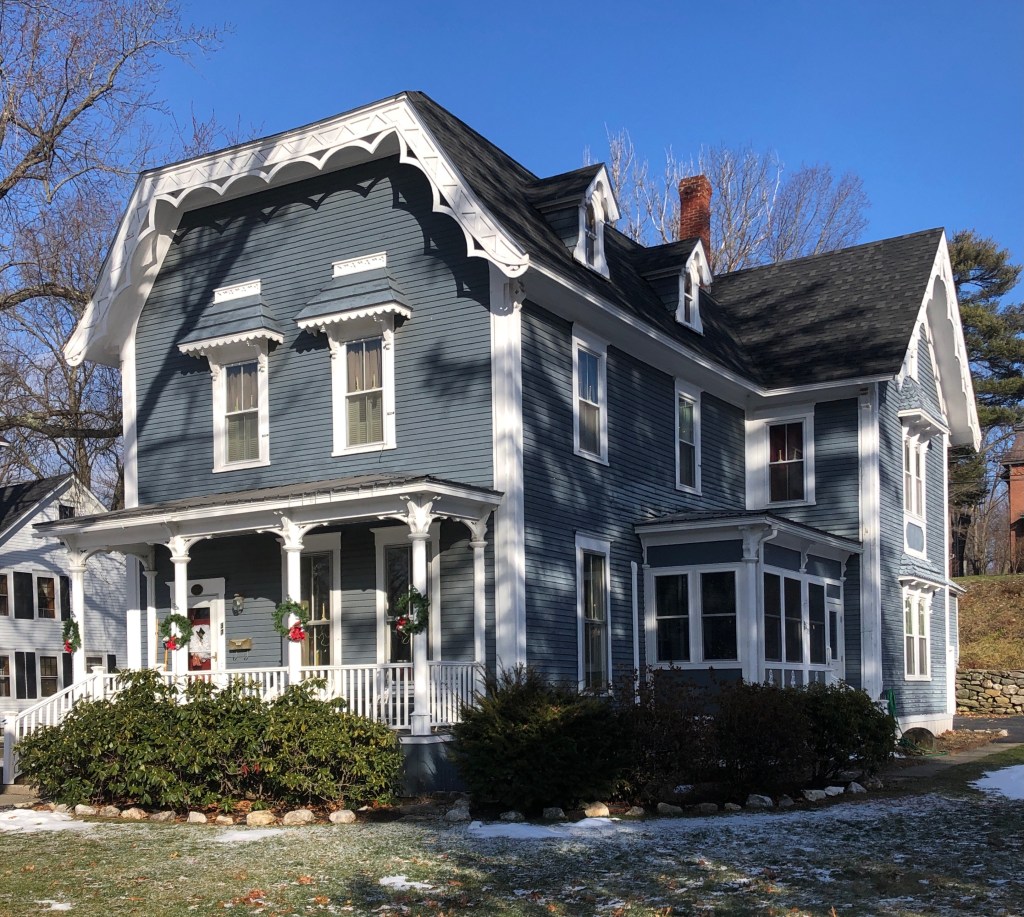
In 1873 Elnathan Jones, Jr.(1829-1904) purchased house plans from a friend in Groton, adapted the plans, and built these two houses, in Acton. One home for himself, and one for his business partner Jonathan Wetherbee (1832 1926). Also near these two houses is the Tuttle House (featured last), in a different style. All three of these men were family by marriage, and ran businesses in the village of South Acton. The Jones and Wetherbee houses were built as sister houses, identical; but over the years, the Jones House has seen some unsympathetic alterations which diminish its architectural significance. The Wetherbee House (yellow) retains its original detailing and corner, towered mansard roof.

Hiram P. Dinsmore House // 1894

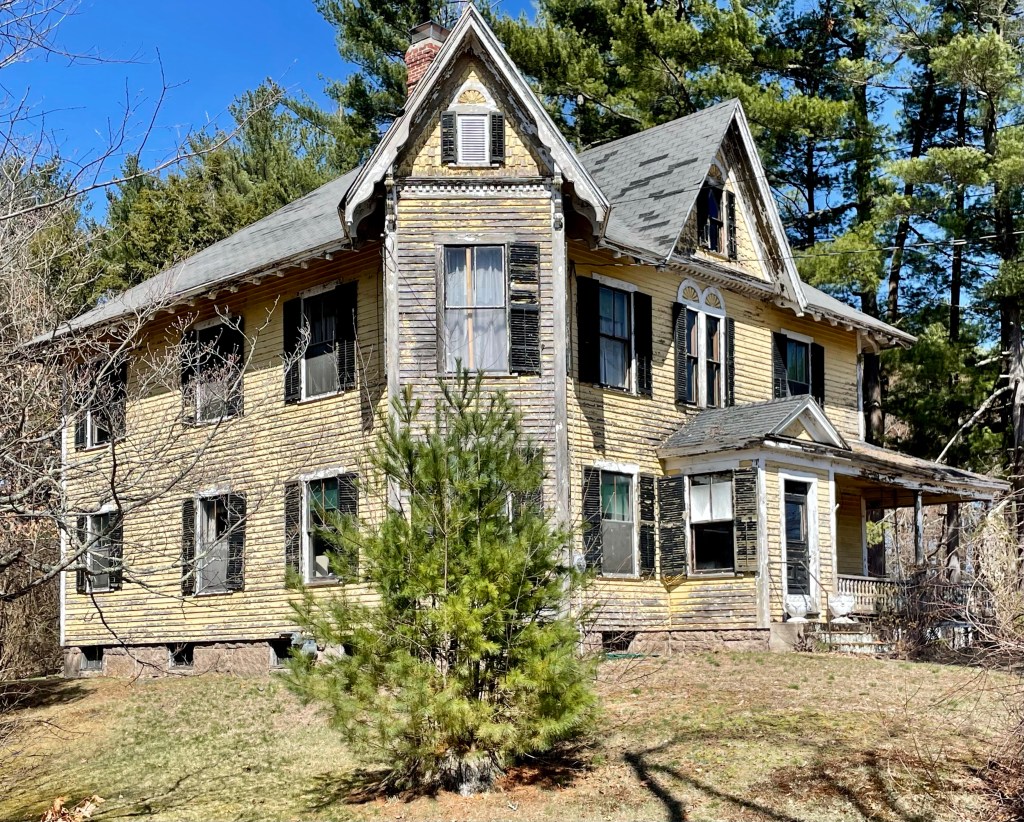
In 1894, Hiram P. Dinsmore, a clerk at the nearby Tewksbury Almshouse, purchased land not too far from his work to build a home for his family. The well-designed late-Victorian home features a wrap-around porch, a corner tower, twin sunburst or flower motifs, and the use of shingle and clapboard siding, all hallmarks of the Queen Anne style. After Hiram’s death, his wife and children lived in the home, and it was later willed to his daughter Beatrice and her husband, both of whom worked at the Tewksbury Almshouse (since renamed Tewksbury Hospital). The home has seen some deterioration with large sections of siding completely open to the elements unobscured by paint and a sagging porch roof. Hope to see this beauty restored.

“Seven Oaks” // 1873

When strolling around Bristol, Rhode Island, you are overloaded with gorgeous early 19th century house styles, primarily in the Federal and Greek Revival styles. Among these, one house (or should I say mansion) stands out as a flamboyant Victorian Gothic showpiece at the southern end of the downtown area. Built in 1873 for Augustus O. Bourn (1834-1925), the founder of the National Rubber Company (and from 1883 to 1885 governor of Rhode Island), “Seven Oaks” could go toe-to-toe with any house in the state. Bourn’s architect was James Renwick of New York, one of the most celebrated architects of his time. Before designing Seven Oaks, Renwick’s resume included: Smithsonian Institution Building, Washington, D.C.; St. Patrick’s Cathedral, New York City; and the Renwick Gallery, Washington, D.C.. Seven Oaks is a large, hip-and-cross-gable-roof Victorian Gothic mansion constructed of stone, with multiple towers and a slate roof capped with iron cresting.

Parmelee House // c.1879

Located on the east side of the Town Common in Newport, NH, the Parmelee house stands out as a unique vernacular Stick style home. The home was built for Joseph Warren Parmelee (1818-1892), the grandson of original settlers of town, Captain Ezra Parmelee and Sybil Hill. He began his adult life as a merchant in Newport, before moving south to Charlestown, South Carolina in 1847. Joseph was forced back north at the beginning of the Civil War, and he lived in New York City until he finally relocated back to his hometown in 1879, which is likely when he built this home for his family. Upon returning, he became active in town affairs, and also pursued interests in history and poetry, creating a book of poems from his home. The Parmelee house retains much of its original detailing from the decorative bargeboards at the gable ends, large eyebrow window hoods at the second floor, and the interesting trapezoidal roof, possibly a vernacular nod to a mansard roof.

John Hoyt Perry House // c.1875

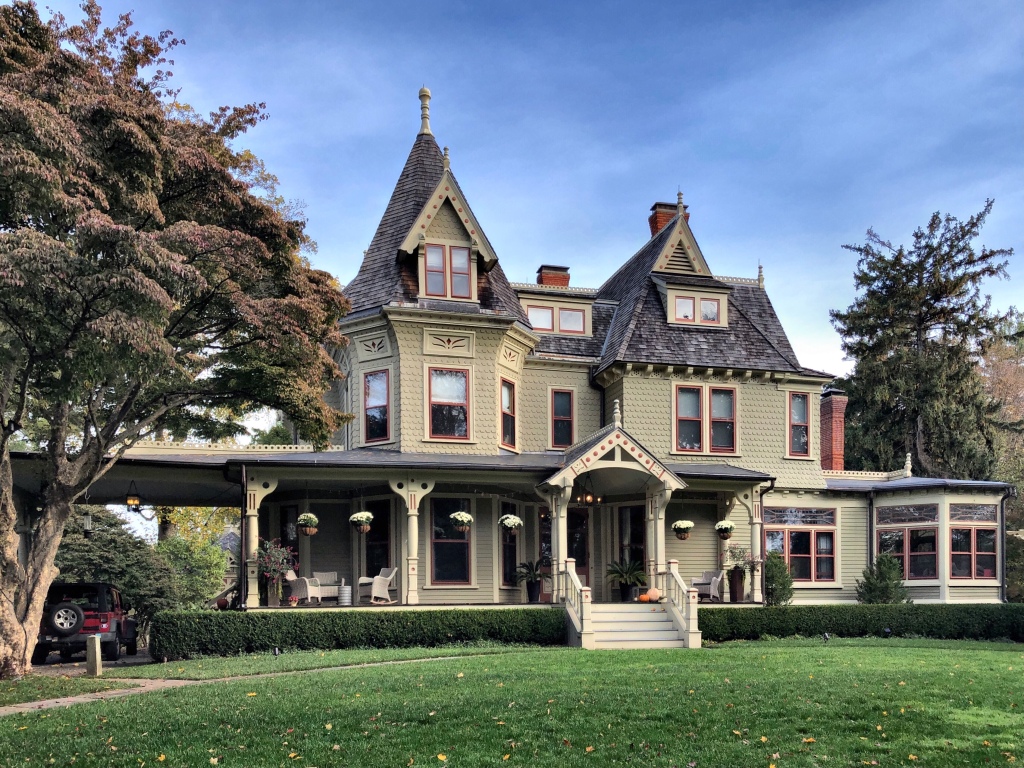
John Hoyt Perry was born in Southport in 1848, and graduated at Yale in 1870. He received his professional education at Columbia Law School and was admitted to the bar in Bridgeport, CT in 1872. He had an active law career in Connecticut, later working as a judge. He served Southport in the House of Representatives throughout much of the end of the 19th century. In 1913 he was elected to the Connecticut Senate and served as the minority leader. He served as counsel for the United States in arbitration proceedings with Chile in 1902, and as counsel for the town of Fairfield. This home in Southport was constructed for him, likely around 1875 after he accepted his position as a head attorney at a major firm nearby. The home can be classified as a blending of Stick style and Queen Anne Victorian design with the asymmetrical form, tower, large porch with projecting porte-cochere, shingle siding, and bargeboards.

Moses Bulkley House // 1861

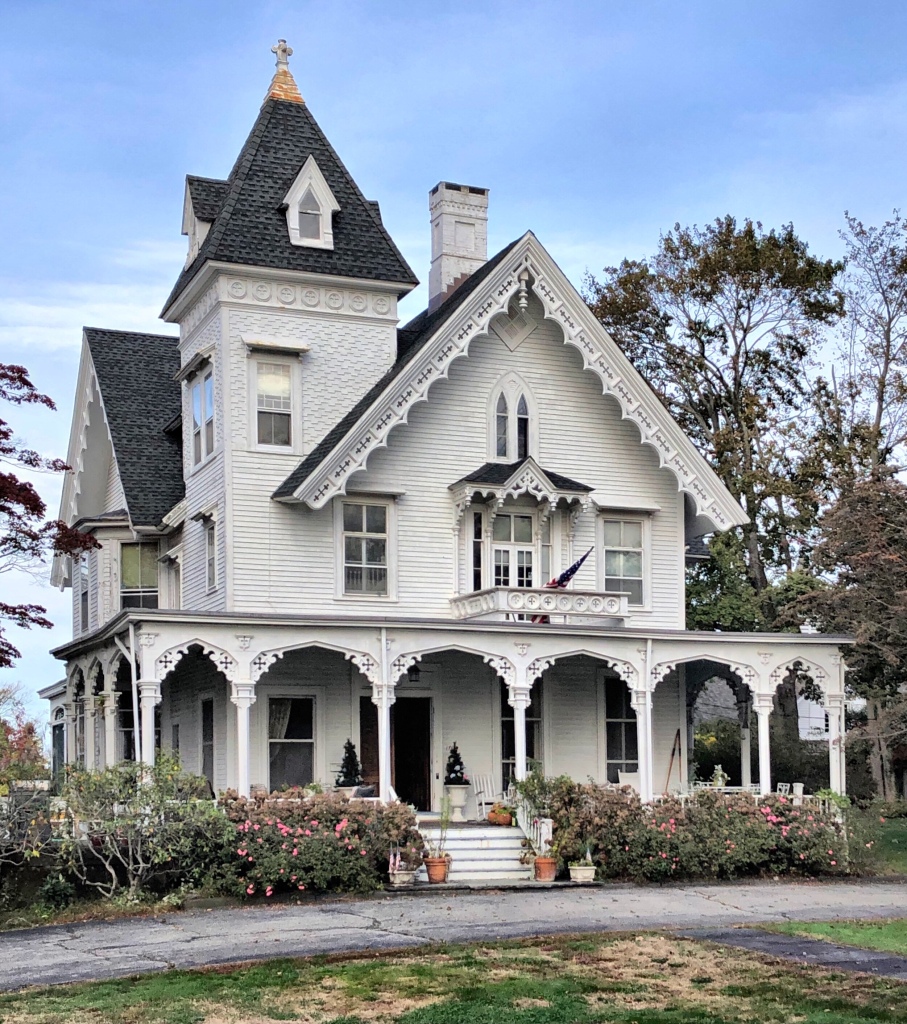
Constructed in 1861, this Victorian Gothic mansion in Southport, Connecticut, stands out amongst the many Classically inspired homes nearby. Designed by Bridgeport architects Lambert & Bunnell for Moses Bulkley (1796-1868), the house is designed on a cruciform plan, synonymous with the Gothic style. Expansive pointed gables trimmed with a gingerbread bargeboards, pointed arched windows, ogee arches trimmed with jigsaw tracery on the verandah, and a tall square tower topped with a steeply-pitched pyramidal roof are all seen in this beauty. If only it had a historically appropriate paint scheme to really make those details pop!

Samuel Allen Nichols House // 1848

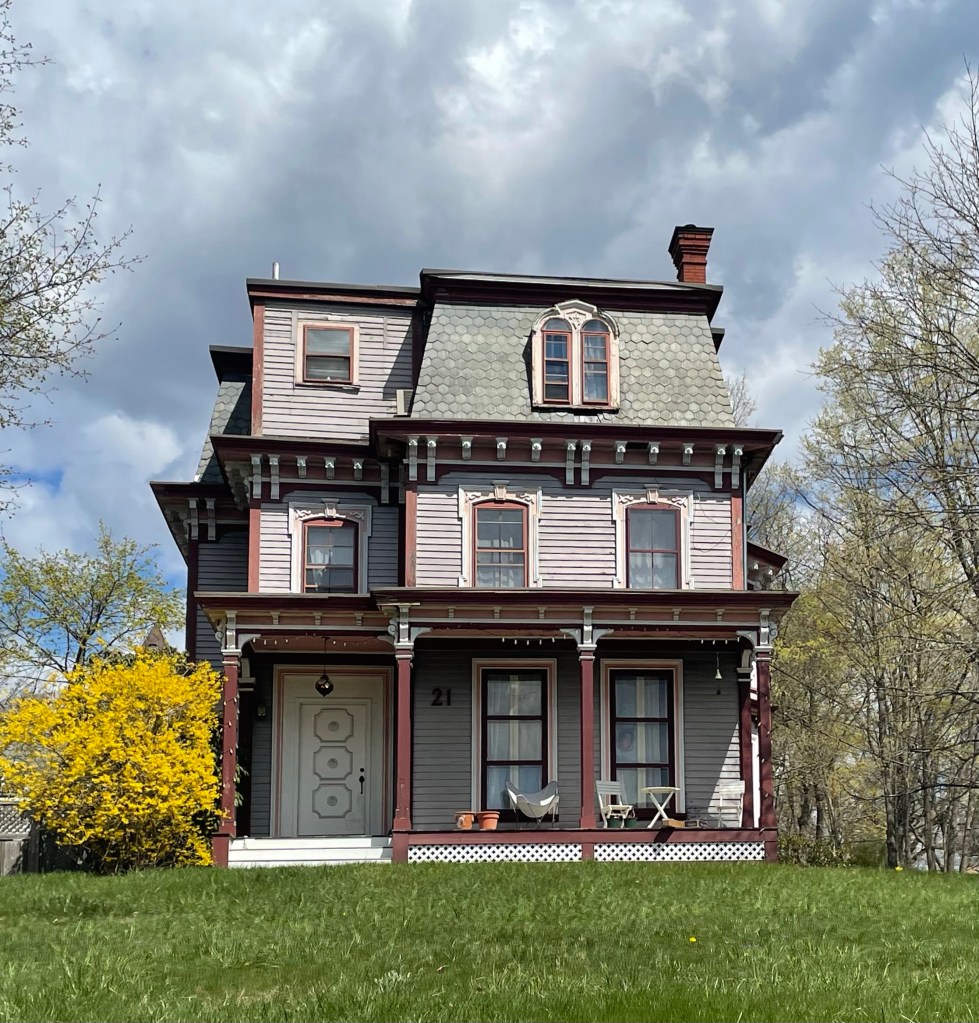
Samuel Allen Nichols (1790-1864) was born in Fairfield, Connecticut to a large family. He began his adult career as a farmer, but shifted towards the merchant trade after seeing how the village of Southport began to see massive wealth accumulating. He ran a store in the town and later became involved in local politics serving as the clerk from 1847-1863. A year after he accepted this position, he had this home built on Harbor Road. The 1848 home was Gothic Revival in style with gabled dormers, lancet windows, and decorative bargeboard. Nichols died in 1864 and the home was likely willed to one of his five living children. The home was renovated around 1871 with a Second Empire style Mansard roof and square belvedere to overlook the Southport Harbor. Since then, much of the detailing has been removed, but the home remains as a gorgeous home, changed over time to keep up with the changing architectural tastes of the 19th century.

Mary Pomeroy House // 1868

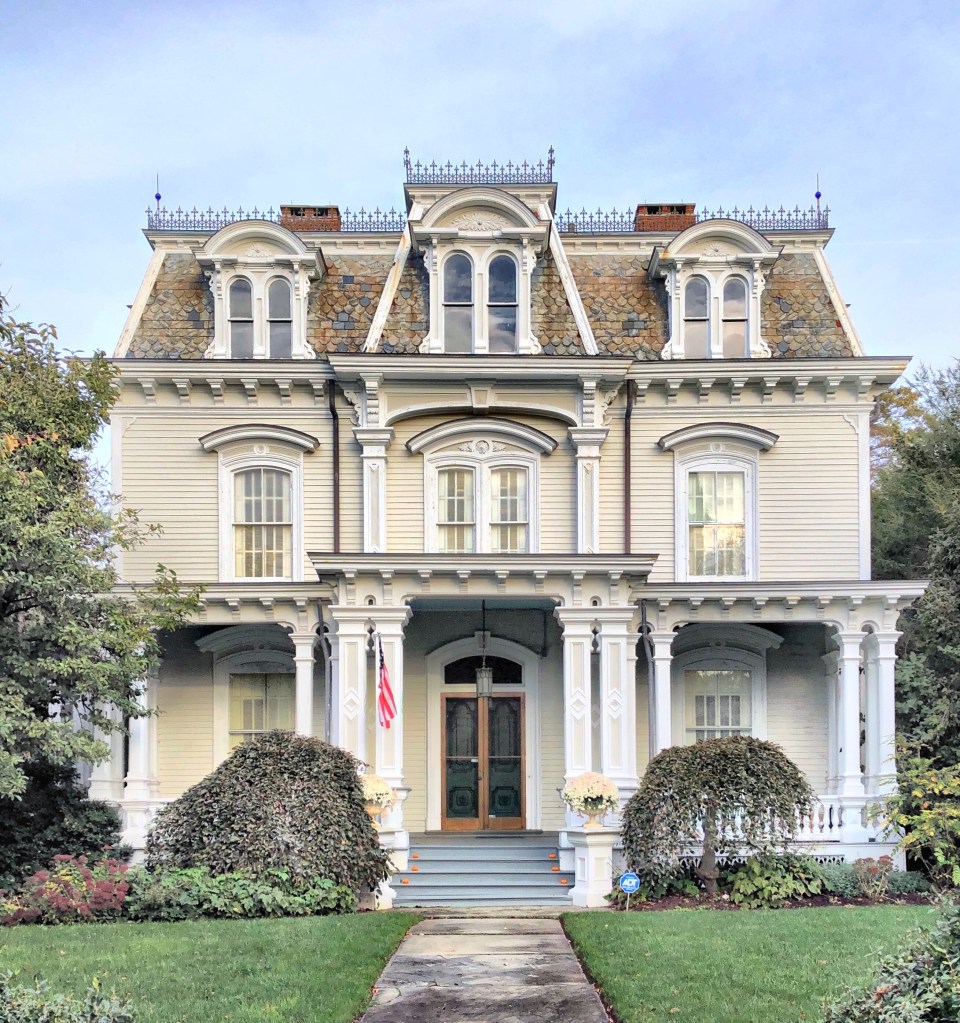
Mrs. Mary Pomeroy, the widow of one of Southport’s industrious and wealthy shipping merchants, Benjamin Pomeroy, built this large residence for herself and her daughters, soon after her husband’s death. Mr. Pomeroy was a merchant who also served as a Senator. In 1866 with ailing health, he took a doctor on a private ship to try various remedies in the West Indies, to no avail, he died at 48 years old. Ms. Pomeroy appears to have taken the money her and her husband had saved and built a large mansion to cement her position in town as the most eligible bachelorette in town. While she never remarried, she sure showed the town what good taste looks like! The facade of the Pomeroy house is symmetrical with a projecting three-story central pavilion, all surmounted by a mansard roof with cresting. Rounded dormers with twin round-headed windows pierce the roof’s multicolored slate surface, making this Second Empire house one of the nicest in a town full of historic homes!