For middle-class families in North Adams, some residents could afford to move out of workers housing but not yet afford single-family homes, the best option was for apartments. Seeing the demand for this housing type increase with the booming industrial development in town, businessman and real estate developer, Martin Crafts Jewett developed some of his land with a luxurious apartment building. This six-unit building has beautiful poly-chrome brickwork and corbeled chimneys, mansard roof with wall dormers, and flared turrets, typical of its architect, Marcus F. Cummings who also designed the Blackinton Mansion (now North Adams Public Library).
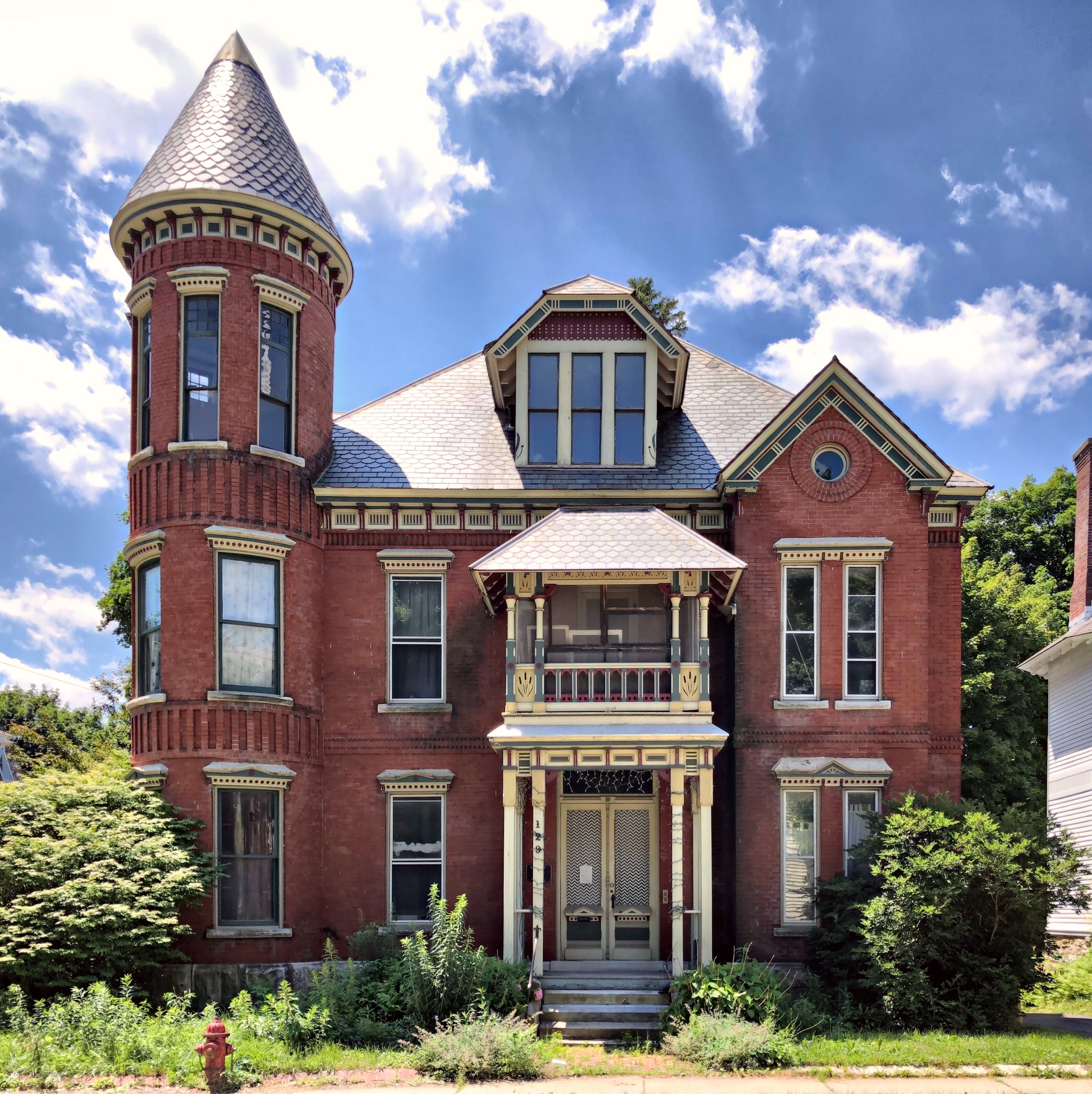
Built in 1881 for William Henry Whitman, this stunning Victorian house remains one of the better-preserved in the town of North Adams. William Whitman was a successful shoe manufacturer in town that lived modestly until his late 40s when he had this home built. The brick home is trimmed with freestone and features a very prominent three-story corner tower with conical roof. The house is a blending of the Stick and Queen Anne styles, under the umbrella of the ‘Victorian’ classification.
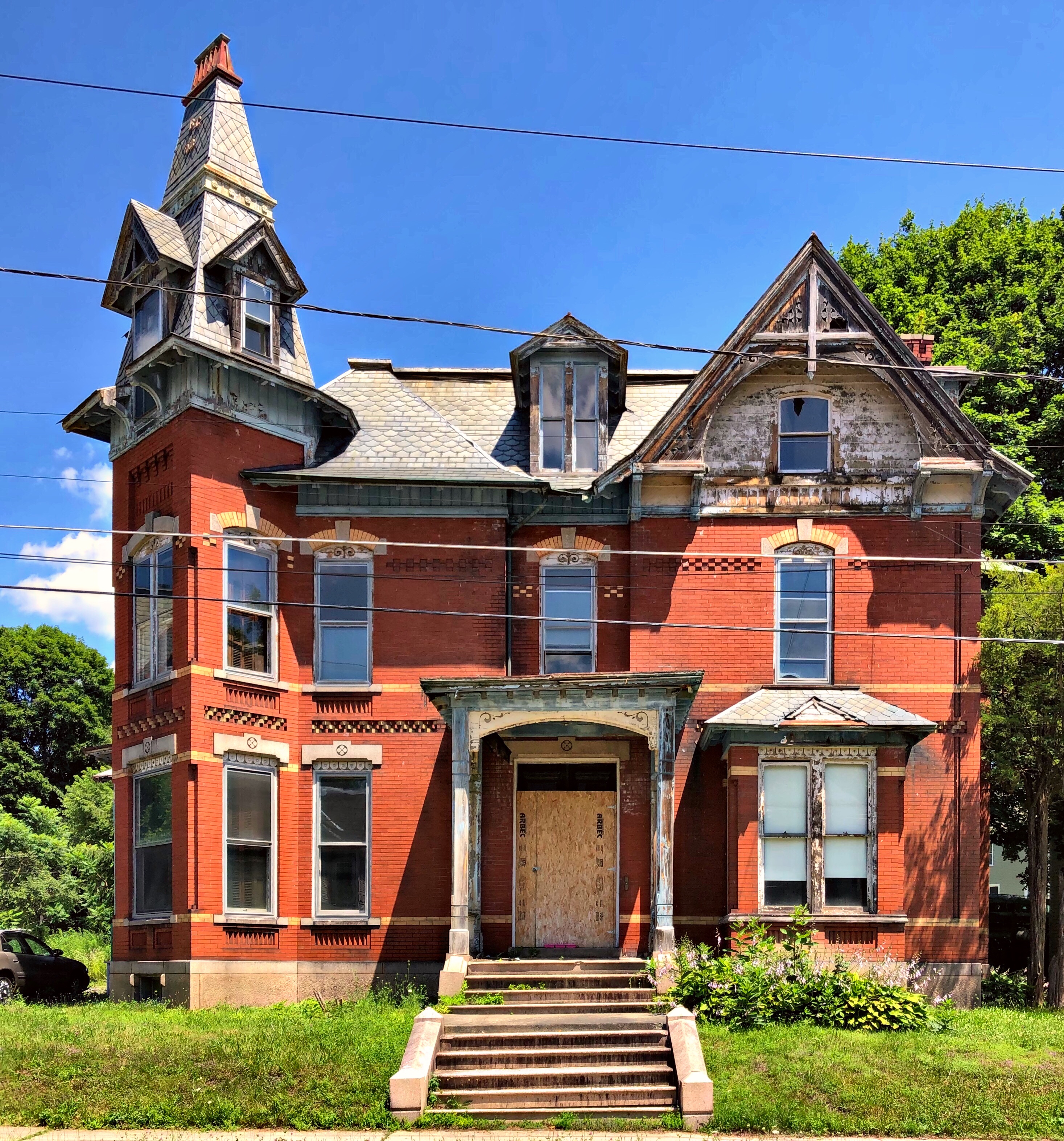
This house was built in 1882 for Frank Walker, a merchant who owned a feed and grain store in Downtown North Adams, Massachusetts. The Stick and Queen Anne style home was designed by architect Marcus F. Cummings, who also designed the Blackinton Mansion. The brick and freestone home was converted to multi-family sometime in the mid-20th-century due to the changing demographics of the town. Since then, the home has seen weathering and deferred maintenance, but retains much of its original detailing and character.
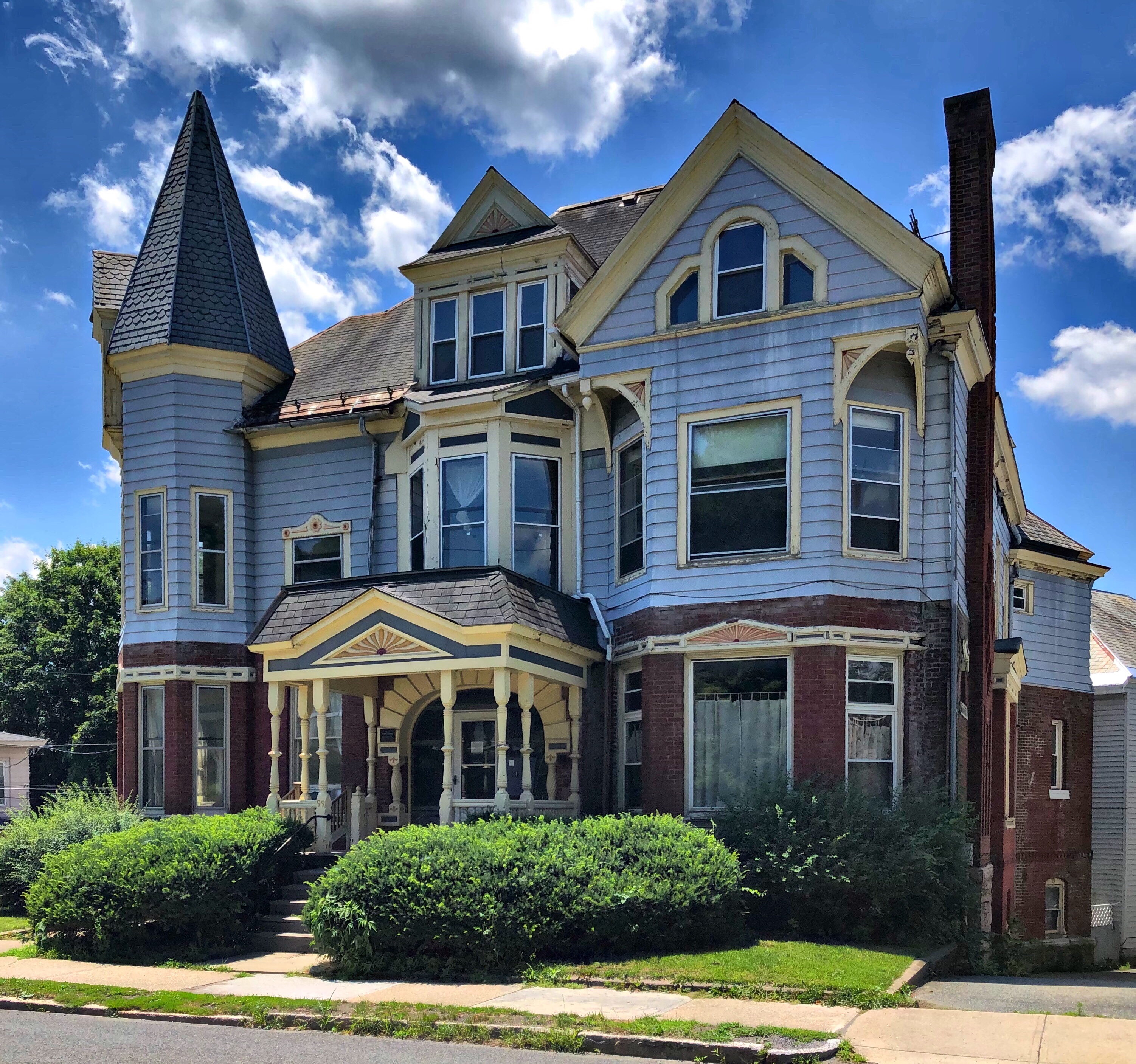
Edmund Burke Penniman (1841-1929) was born in North Adams, a son of Mr. and Mrs. Edmund B. Penniman. His father an established lawyer, and mother died, leaving the young boy with a sizable estate. Just before the Civil War broke out, he developed a mill, which had to shut down when the war began. After the war, the company had no orders to fill and they sold the property. Penniman became treasurer for the North Adams Manufacturing Company, and later served as President of the Hoosac Savings Bank. He and his family resided in this Stick style home until his wife’s death in 1909. The home features a brick ground floor and clapboards (now aluminum) above. The Victorian home has a rusticated arched entryway protected by a projecting porch with stickwork. A large corner tower gives the house a large street presence.
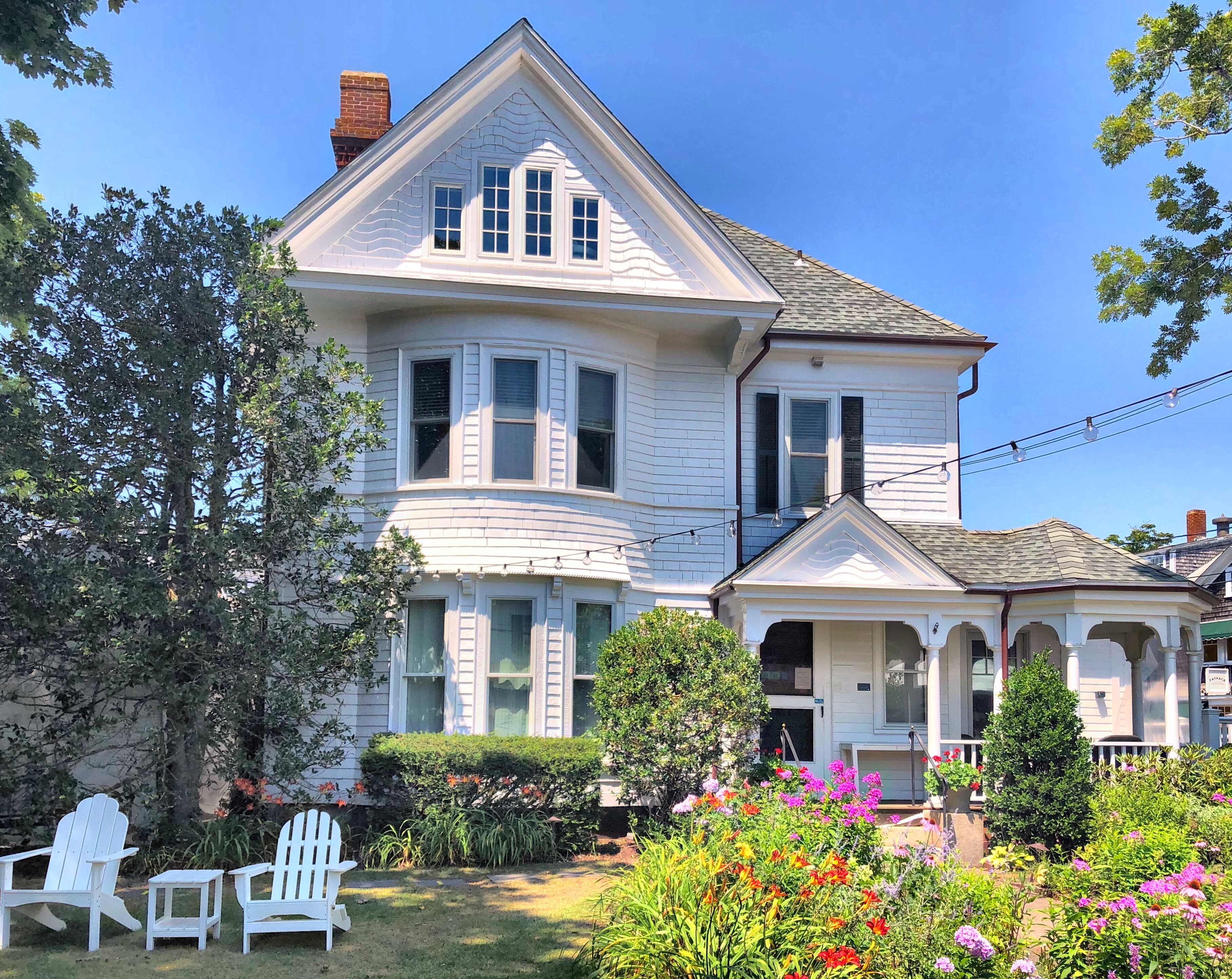
Standing out amongst the Federal and Greek Revival homes in Edgartown, this Victorian home was constructed in 1892 by Captain Charles W. Fisher (1835-1905) for his new wife. The Fisher family includes many members who were active in the local whaling industry. Fisher is said to have caught the largest sperm whale on record in 1884 and apparently loved being on the open ocean. The next year he married Parnell Pease and she sailed with him to the Pacific on a whaling voyage, lasting five years! At the time of their marriage, Fisher was in his 50s and his new wife in her 20s. Upon their return, Fisher built his wife this “modern style house on the pretentious side with Victorian ornamentation.” Unfortunately, his wife preferred her former house, which was a block a way and obscured any views of the water. Tradition states that apparently, Mrs. Fisher had seen enough of the water during her voyage, as her diary on the five year trip detailed her many unfortunate bouts with sea-sickness, a stay on an island, and dangerous storms.
Sited prominently on Ocean Park in Oak Bluffs, the Corbin-Norton House overlooks the Nantucket Sound with no buildings obscuring the gorgeous sunrises. When the home was originally built in 1891, it belonged to Philip Corbin, a manufacturer of household hardware and locks from New Britain. Conn., who got his start as a locksmith apprentice and grew his business until it employed 15,000 people. Corbin summered on Martha’s Vineyard and saw the shift from Cottage City, a Methodist-oriented summer resort town to Oak Bluffs, an exclusive summer colony. The house was built by Eli A. Leighton, a carpenter from Oak Bluffs whose descendants still live on the Island. The house remained in the Corbin family for some 40 years, after which it changed hands a number of times, at one point, housing a doctor’s office. By that time, nearly all of the historic character had been stripped of the home with replacement vinyl windows, removed trim and finials, and a monochrome color scheme. In 1991, when Peter Norton, the computer software magnate, and his wife, Eileen, decided to buy the old Corbin house for a reported $350,000, it was begging for someone with the resources to restore it. The restoration would take three years to complete, and Mr. Norton commissioned a team of consultants, architects and contractors to do the job. They meticulously restored the home, only to have the misfortune of a fire which destroyed the home. Norton funded the replica which was completed soon after, and passers-by wouldn’t be able to tell the difference!
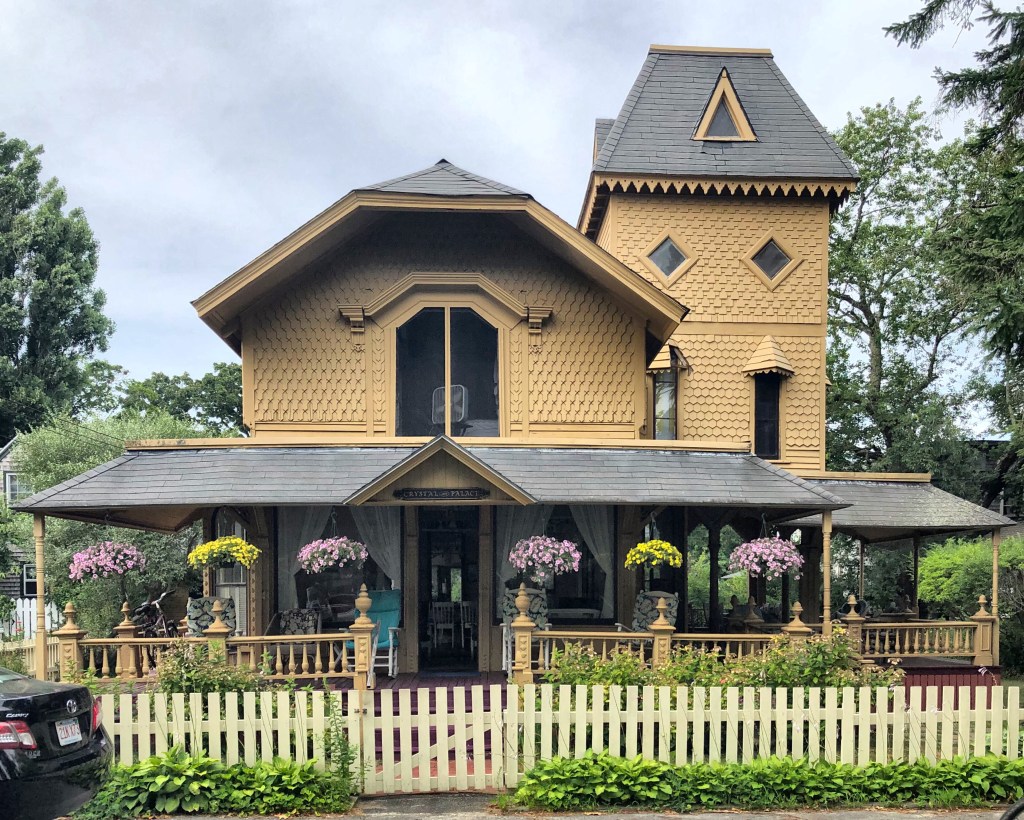
The Crystal Palace cottage Pequot Avenue in Oak Bluffs was built by Henry Clark, a local builder of many summer homes on the island of Martha’s Vineyard. The cottage is a charming blend of Stick, Shingle, and Queen Anne styles, which works perfectly. The wrap-around porch is supported by turned posts with a balustrade capped by urns, the square tower has two elongated windows with eyebrow lintels resembling a face with bushy eyebrows. Oh the charm of Oak Bluffs, architectural eccentricity on every street!
The Chapel in the Pines church had its origins in the growing desire by many late-19th century New Englanders to move away from the strictures of fundamentalist religion. A Universalist Society was formed in Eastham on the Cape for the erection of a new place of worship. Local families and esteemed citizens pooled resources and constructed the building themselves over five months, under the direction of an Elkany Hopkins (though sources state he died in 1885). The Victorian Gothic church has a certain flair with the turned posts at the entry, bell tower, and roof cresting. After serving various congregations and uses (including as the First Encounter Coffeehouse a renowned venue for folk and acoustic music since 1974), the building was purchased by the Nauset Fellowship. In 2017 and 2018, the Chapel underwent a renovation with money raised from the community along with two grants from the Town of Eastham’s Community Preservation Act funds.



 Buildings of New England