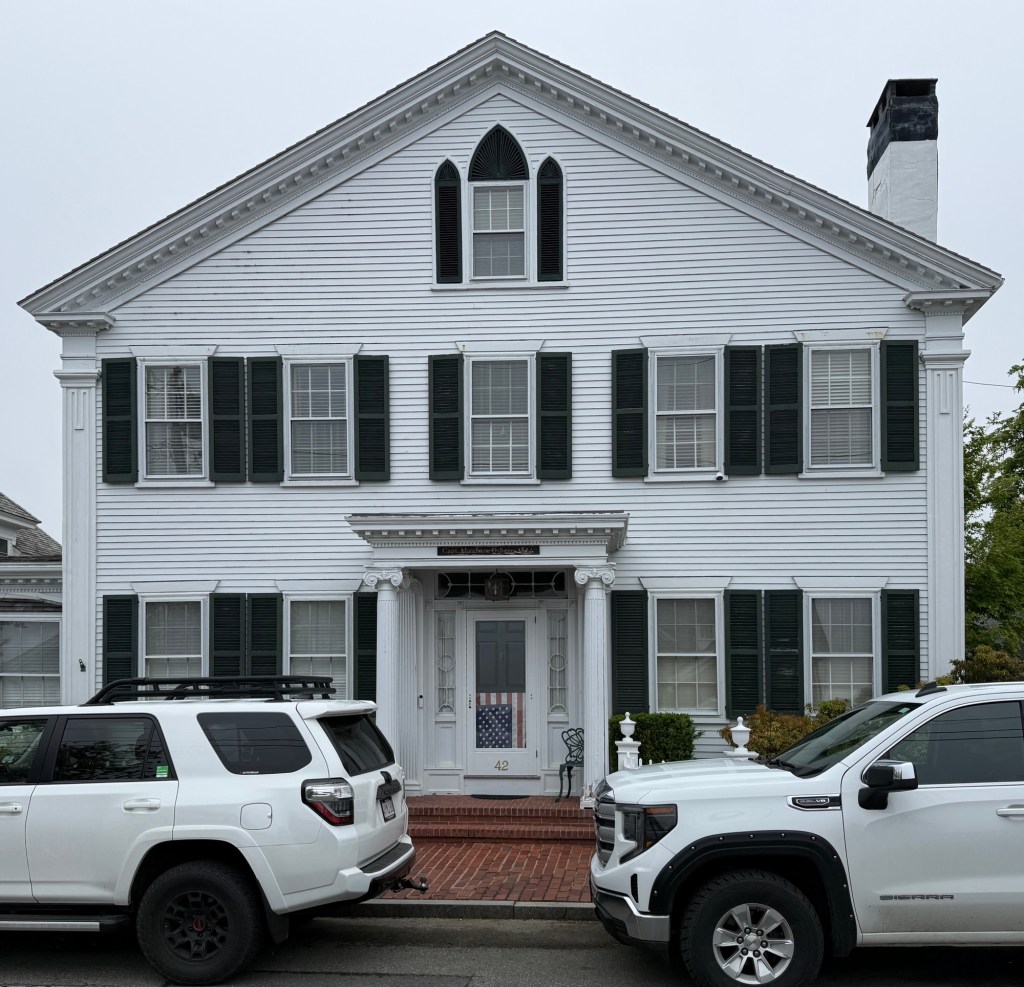
Captain Abraham Osborn House // 1834

Built in 1834, this early Greek Revival house with Gothic Revival detailing, sits on Edgartown’s South Water Street, a notable street lined by large mansions built for early whaling captains on Martha’s Vineyard. The residence was built for Abraham Osborn (1798-1865), a whaling captain, soon after his marriage to Eliza Norton. Captain Abraham Osborn owned several whaling ships based out of Martha’s Vineyard and New Bedford, and one of these large vessels, the Ocmulgee, came to an untimely end early in the Civil War. When captaining the ship in September 1862, the Ocmulgee was approached by a ship flying British flags. When it got within speaking range, the British flags were replaced by Confederate colors and the rebel captain took over the ship, which contained 250 barrels of whale oil. The Confederates detained the ships officers and Captain Osborn in chains bringing them aboard their ship, the Alabama, which was known for stealthy operations to damage the economy of the Northern states. The rebels torched the Ocmulgee, forcing Captain Osborn and his crew to watch their profits burn up and sink into the ocean. The crew was detained for a few days and ultimately released near the Fayal Islands where they received help. Captain Osborn returned home and would die just three years later. The Osborn house was later inherited by his son, Abraham Jr., a retired sea captain himself, who eventually converted the large family home into a hotel called Ocean View. A famous guest at his hotel was Alexander Graham Bell, who was on island to study the extensive deafness prevalence for those on the Island. The house has since been converted back to a single-family residence and maintains its stunning Greek Revival entry portico and tripartite window in the gable with shuttered lancet openings.
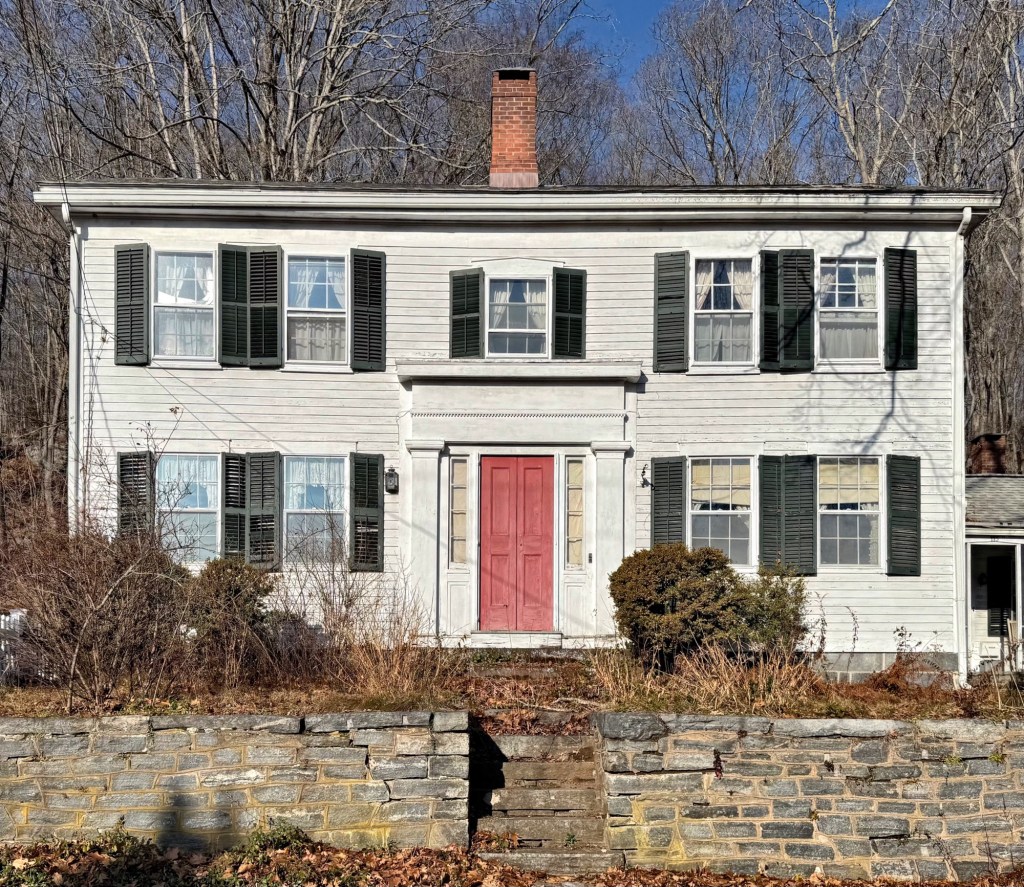
Captain John N. Saunders House // c.1835

In around 1835, this stately Greek Revival style residence was built on Kirtland Street in the town of Deep River, Connecticut. With a symmetrical five-bay facade dominated by a classic Greek doorway with Doric pilasters supporting a broad entablature with smaller window above, the house is evocative of many residences built in New England in the 1830s and 40s by well-to-do merchants and industrialists. This house was seemingly built for Captain John Nelson Saunders (1815-1899) a year or so prior to his marriage to Ann Peters (1815-1904) in 1836. Captain Saunders was listed in the census as a ship master and sailor who likely utilized his property’s access to the Connecticut River just a short walk away. The Saunders House and its lovely stone retaining wall are preserved and tell the story of the town of Deep River’s maritime industry. 

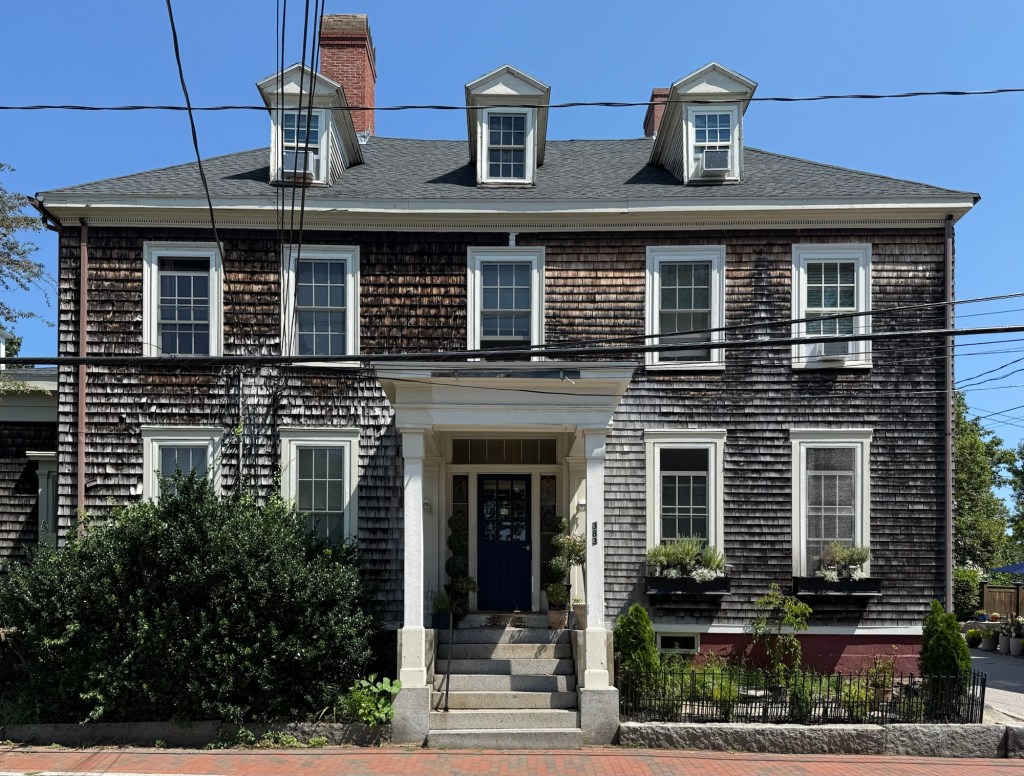
Capt. Charles Blunt House // c.1795

Master mariner Charles E. Blunt Sr. (1768-1823) built this large Federal period home on Pleasant Street in Portsmouth, New Hampshire near the turn of the 19th century for his bride, Abigail Laighton, and their new family. Charles Blunt was a wealthy sea captain who would be out at sea for months at a time, trading in the west indies. On a voyage near Havana Cuba in March, 1823, his vessel was boarded in the night by two piratical boats, with six men each, and Captain Charles Blunt was brutally murdered and thrown overboard. The ship’s cook was stabbed, and fed to the hogs on the brig, with the remainder of the crew maltreated and the goods plundered. The Captain Blunt House follows a symmetrical, five-bay, center entrance form, with cedar shake shingles, three pedimented dormers and large portico over the door.

Captain Fisher House // 1892

Standing out amongst the Federal and Greek Revival homes in Edgartown, this Victorian home was constructed in 1892 by Captain Charles W. Fisher (1835-1905) for his new wife. The Fisher family includes many members who were active in the local whaling industry. Fisher is said to have caught the largest sperm whale on record in 1884 and apparently loved being on the open ocean. The next year he married Parnell Pease and she sailed with him to the Pacific on a whaling voyage, lasting five years! At the time of their marriage, Fisher was in his 50s and his new wife in her 20s. Upon their return, Fisher built his wife this “modern style house on the pretentious side with Victorian ornamentation.” Unfortunately, his wife preferred her former house, which was a block a way and obscured any views of the water. Tradition states that apparently, Mrs. Fisher had seen enough of the water during her voyage, as her diary on the five year trip detailed her many unfortunate bouts with sea-sickness, a stay on an island, and dangerous storms.