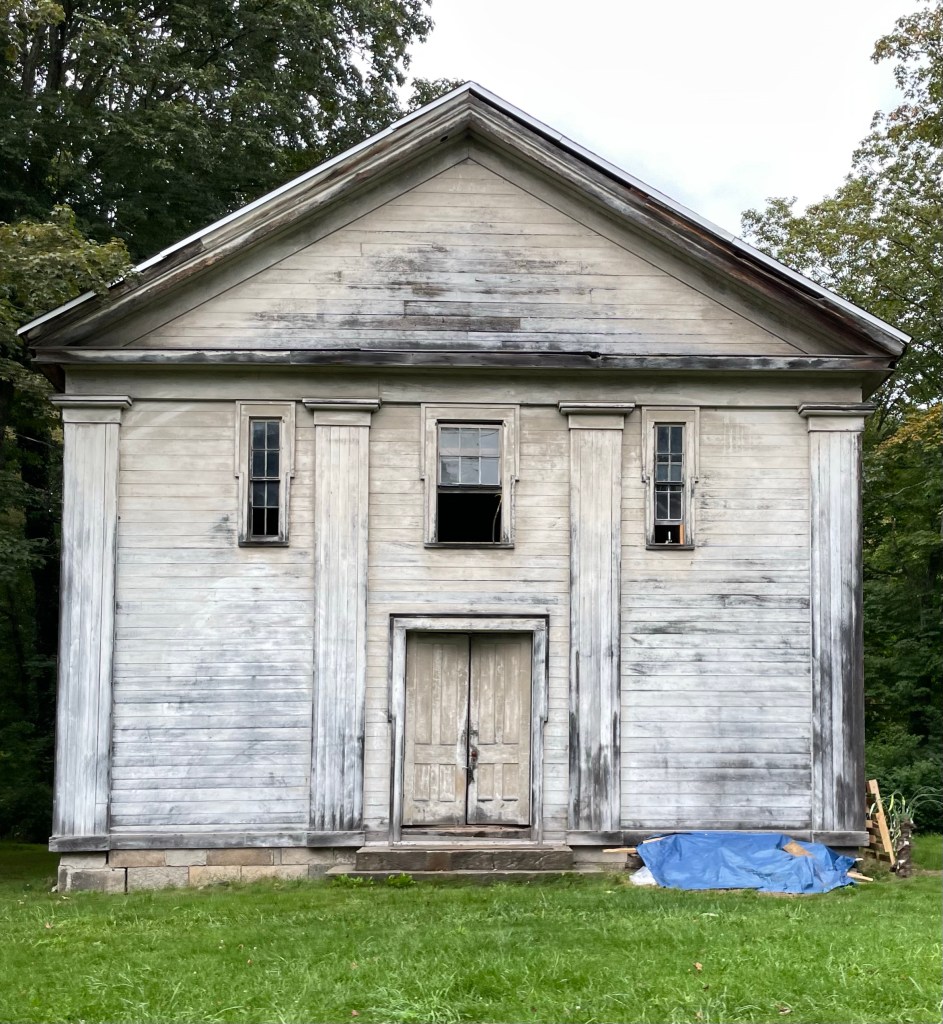
South Britain Methodist Episcopal Church // 1839

Constructed in 1839 by the Methodist Society of South Britain, Connecticut, this dilapidated old church has classic Greek Revival features including a flush sided facade divided into bays by Doric pilasters, a central double-leaf four-panel door, and high narrow windows. The church sits in the South Britain National Register District, which sadly does not provide any tangible protections for the building, which has been decaying for years. The square belfry was removed (or collapsed) a couple years ago and I would imagine there is some water damage from openings in the roof. What would you like to see this old church converted into?

Mitchell Mansion // 1828

Built in 1828 and used for years as a “house of public entertainment” for Mitchell Simeon Mitchell, this stunning home in Southbury, Connecticut has historically been known as the Mitchell Mansion. The Mansion House displays sophisticated Greek Revival features, including its temple shape, the restrained Grecian doorway, an inset Ionic-columned portico and a cornice with continuous modillions. The quality of the exterior is matched by its interior detailing, with a semicircular staircase and, at one time, a large ballroom. Records found in the house indicate that one of the carpenters was James English, later to become Governor of Connecticut. During the middle of the 19th century the property was owned by noted New York furniture maker Duncan Phyfe.

White Oak Schoolhouse // 1840

When the first white settlers of present-day Southbury, Connecticut, traveled up the Housatonic on rafts in 1673, they spent their first night under a white oak tree in what is now Settlers Park. That section of Southbury became known as White Oak for this early history. As this part of town developed and the population grew, another schoolhouse was needed. In around 1840, this Greek Revival style school building was constructed and has stood proudly on Main Street in the nearly 200 years since. The school now shares the same lot as the Reverend Graham House and has most recently been occupied as an antiques store.

United Church of Christ Southbury // 1844

Originally, the parishioners living in present-day Southbury would travel to Woodbury Center to attend church services. This changed after the Southbury parish was incorporated in 1731, voting to erect a church a year later. Founded in 1732, the Southbury Congregational Church was dwelled in several sites until the third church was built on the present site in 1844. This Greek Revival style church features Doric pilasters and Ionic columns at the recessed portico with a large pediment above with ornate scroll carvings around the clock. The church remains well-preserved and a visual landmark on the Main street.

Tranquility Farm – Farmhouse and Barn // c.1840

Tranquillity Farm, spanning the rolling hills around Lake Quassapaug in Middlebury Connecticut, was originally a 303-acre model/gentleman’s farm developed by John Howard Whittemore, a successful industrial-era businessman in Naugatuck, and his wife Julia Spencer Whittemore. Whittemore was a major figure in Naugatuck, sponsoring a series of commissions of McKim, Mead & White for buildings in the city center. For his country farm estate, he again commissioned McKim, Mead & White to design a new country house, a farm superintendent’s house, boat house on the lake, and other outbuildings for a working farm. An older farm was purchased, which included a modest Greek Revival style farmhouse dating to the early-mid 19th century (seen here) and a large wooden barn. Both of these were kept and incorporated into the estate near the southern entrance to the property, possibly to harken visitors back to the charm of rural living. The sweeping landscape, featuring miles of distinctive stone walls lining the roads and crisscrossing the fields, was designed by Charles Eliot and completed by Warren H. Manning – both protégée of Olmsted.

Former Middlebury Methodist Church // 1832

The oldest extant church building in Middlebury, Connecticut is a church that no longer is, the former Middlebury Methodist Church. Built in 1832, this building sits across from the Town Hall and Congregational Church and together, they form the eastern edge of the town green. The building is a more refined example of the Greek Revival style with paired entrances, corner pilasters, and a pediment facing the street with blind fan within. By the early 20th century, the church had a dwindling membership and sold the building in 1923 to the Westover School which opened just over a decade earlier. The building was used as a library for the school for some time and still is under the ownership of the esteemed private institution to this day, who maintain the former church very well.

Middlebury Congregational Church // 1935

Located next door to the Middlebury Town Hall, the Middlebury Congregational Church has a very similar history to its Classically inspired counterpart. The congregational church here was established in 1791, less than a year after a separate Middlebury ecclesiastical society was granted and the first church here was erected in 1794. Decades later, a more traditional and larger church was desired by the congregation, so they had a Greek Revival style church built in 1839. Nearly 100 years later, the church (and adjacent original town hall building) burned in a large fire in April 1935. Undeterred, the congregation hired architect Elbert G. Richmond, AIA (1886-1965), who as a young man worked in the New Haven office of J. Frederick Kelly, Connecticut’s first and most famous restoration architect. The present building is a near-replica of the mid-19th century church building, and even has a bell that was recast from pieces of the old bell that crashed through the building during the earlier fire. Talk about rebirth!

Henry Perry House // 1832

The Henry Perry house was erected in 1832, and is one of the two Greek Revival style structures in Southport which was designed with a five-columned front portico. The other, the Francis D. Perry House, was his brother’s and was built that same year. The house is a temple-front with a fan-light in the pediment and large sidelights and transom at the entry.

William W. Wakeman Mansion // c.1833

William Webb Wakeman was born in Southport, Connecticut on June 19, 1799, the son of Jesup Wakeman, an eminent citizen of the community. As a young man, William worked with his father in his commercial and trade enterprises. He acquired his own vessel early in his career, and gradually accumulated a line of trade vessels, sailing to New York, Savannah, Georgia and Galveston, Texas. By mid-century he was involved in the East Indian and China trade under the firm name of Wakeman, Dimon & Co. He built and owned a line of steamships during the late 50s, and was commissioned by the Federal government during the Civil War to transport troops and equipment. His massive Greek Revival mansion was built around 1833 on one of the largest house lots in the village, perched high on a hill overlooking the harbor. The three-bayed facade is framed by a two-story portico. Supported by four fluted columns, the capitals and entablature are similar to the “composed” order of Minard Lafever and the “composite” order of Asher Benjamin, popularized in the 1830s and 40s in their pattern books for architects and builders. After William died in 1869, it was likely his widow, Mary Catherine (who lived to be 99 years old, outliving all of her six children) who enlarged the home with massive two-story ells.

Oliver Perry House // 1843

This imposing Greek Revival house is located in Southport and is one of a handful of the stunning Classically designed mansions near the waterfront. The house was built in 1843 for Oliver Perry a Yale Law School graduate who did not work in law, but became a successful merchant and businessman instead. Oliver H. Perry established his fortune as a shipowner and a merchant and was Treasurer and Director of the Southport National Bank. He was active in civic affairs and served as speaker of the house of the Connecticut General Assembly and commissioner to survey and settle the border dispute between Connecticut and New York. His Southport house is a stunning example of the Greek Revival style in the temple form with a two-story projecting pedimented portico supported by four Doric columns.