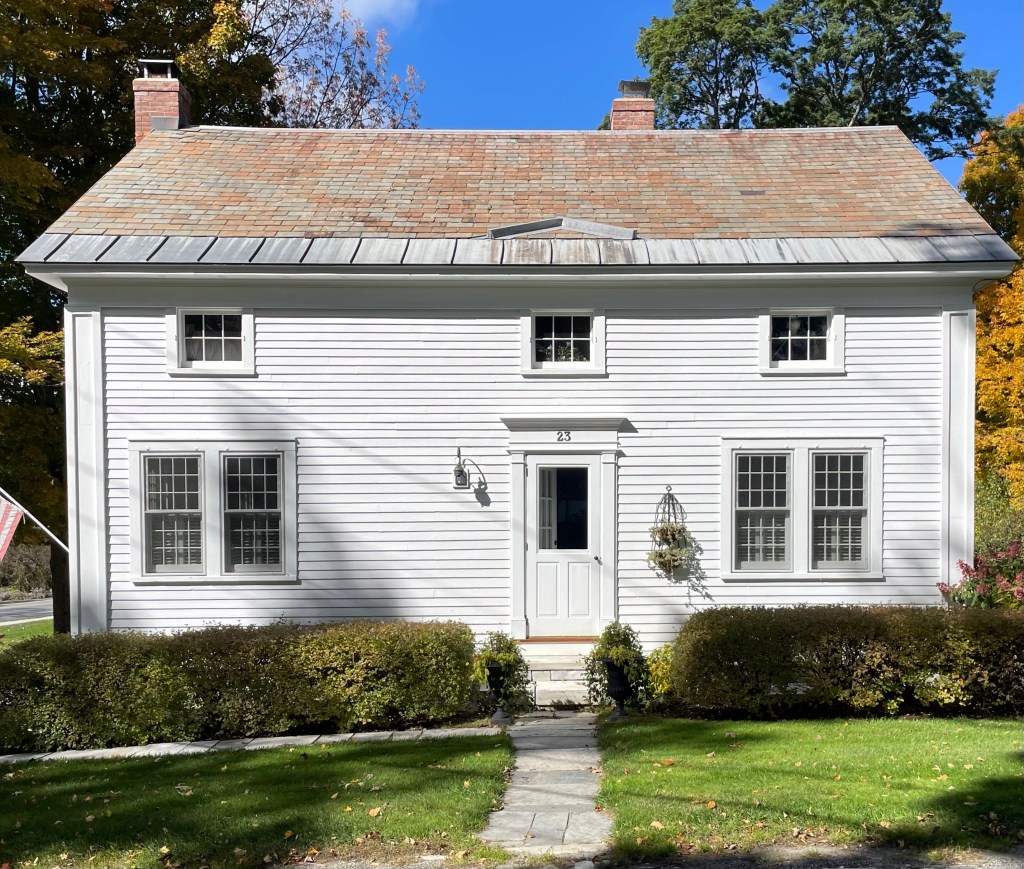
Just five years after the Congregational Church of Peru was built, the congregation acquired land and built this home as a parsonage for their pastor. The parsonage was designed in the Greek Revival style similar to the church. The home sits amongst beautiful, mature trees and exhibits the best in Classical design with bold corner and entry pilasters and a five bay symmetrical facade. They sure don’t make them like they used to!
The centerpiece of the Village of Peru, Vermont is the Congregational Church, a stunning edifice and example of Greek Revival architecture in the small town. Construction on the church began on the Fourth of July in 1845, with contractor and resident J.J. Hapgood utilizing much of the timbers of the former church building in the new church. Since the interior of the old church had been left natural, they decided that wood in the new building should be left unpainted as well. The bell was financed by contributions, most particularly by J.J. Hapgood. In 1853, a tornado swept through Peru, damaging the west end of the church and moving it from the foundation, it survived. The church remains a center of Village life in Peru and is well-maintained by the congregation.
Built in 1857 as the Landgrove Methodist Church, this absolutely charming church sits in the middle of Landgrove, a town with a population of just 177. The town’s small population acquired funds to erect a church in their town, opting to not make the trip by horseback or foot to the churches in surrounding towns. The vernacular Greek Revival building was likely constructed by the members of the congregation and possibly the work of a local builder. Methodists commissioned the 30 × 40–foot building to attract a regular circuit rider, and by 1870 it had become a Union church with other denominations. There is something so enchanting about these old white churches in small New England towns!
I stumbled upon this Greek Revival farmhouse located on one of many dirt roads in Landgrove, Vermont and had to snap a few photos! I couldn’t find much on the history of the house besides the fact it was listed on an 1869 atlas as the property of an “I. Cory”. The five-bay farmhouse has an elaborate door treatment and bold corner pilasters all perched behind a historic stone wall. The house telescoped outward with additions, eventually connecting it to what is now a garage. This farmhouse purchased in the 20th century by John A. Brown, who worked as Dean of Students at Princeton University.
In 1807 Hezekiah Doane(1768-1834), a shipwright, purchased land on Main Street in Barnstable Village, building a family home. The house was built in the Federal period, likely with a side gable or hipped roof. Hezekiah and his small family lived here until his death in 1834. After successive ownership, the property was purchased in 1846 by sea captain Heman Foster (1812-1867). Foster renovated the house, raising the roof and adding the Greek Revival detailing with the pedimented roof and pilasters, and the gothic lancet window in the gable for some Gothic Revival flair.
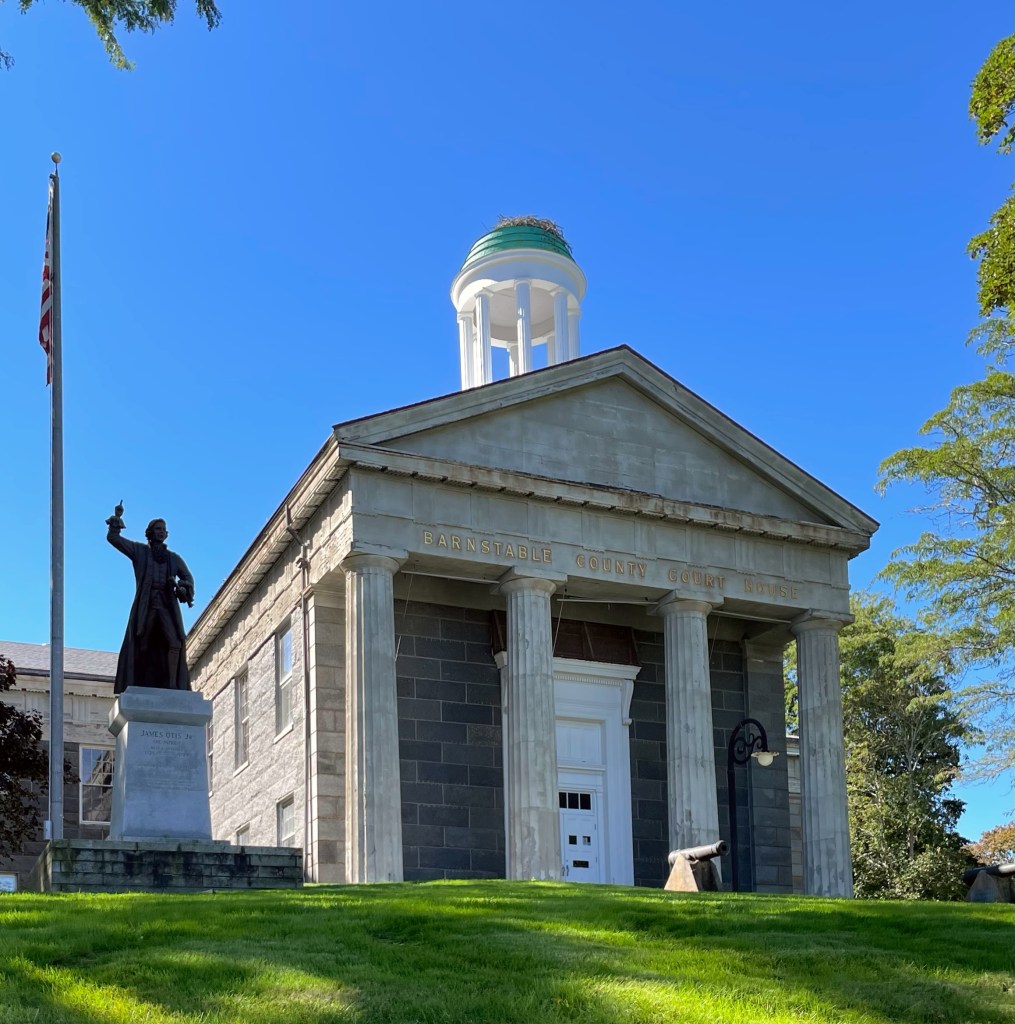
Perched atop a hill in Barnstable Village, the old town center of the historic Cape Cod town, the Barnstable County Courthouse sits proudly as a well-preserved example of the Greek Revival architectural style in a civic building. The building was constructed in 1831 from plans by renowned architect Alexander Parris, who designed the iconic Quincy Market in Boston just years earlier in the same style. Due to its highly visible location along the Old King’s Highway and public function, the courthouse was likely instrumental in popularizing the Greek Revival style on the Cape. The building was constructed of Quincy granite with a portico and fluted Doric columns made of wood fashioned to look like stone (which fooled me from the street). The building has been expanded five times between 1879 and 1971, with each addition made cognizant of the architectural significance of the building. At the front of the building, two bronze statues of Mercy Otis Warren and James Otis, Jr frame the building. The Barnstable Superior Court is located in the building today.
Just steps from the iconic Louisburg Square in Boston’s exclusive Beacon Hill neighborhood, a man named Joshua Bennett in 1834, purchased two recently completed townhouses built by housewrights Samuel H. Mitchell and Loring Dunbar. Joshua Holden Bennett (1792-1865) was born in Billerica, Massachusetts and split his time between his hometown and Boston. Bennett and his family owned the two identical bowfront houses until about 1930, likely renting them out to middle-upper class families. The home on the right (pictured) was later purchased by Benjamin B. Gillette an organist at a local church. After WWII, property values in Beacon Hill began to falter and this property and its neighbor became lodging houses of rented rooms to a more wealthy clientele than those on the North Slope of the hill. The home last sold in 1989 for $753,000 and is estimated at a value today at over $4,000,000!
From about 1670 to 1801, the villagers of Hurley were associated with the Kingston Reformed Church, about three miles away. In those years, the minister of the Kingston Church met with the Hurley parishioners at least once every six weeks and conducted a Sunday service in one of the local homes. In 1801, they grew tired of not having their own place of worship, and they petitioned to establish their own church in Hurley, and succeeded. The original church building was a large, single room, stone building that seated over 250 people on the main floor and in three galleries around the side and back walls. A tall steeple atop the building boasted a large brass globe surmounted by a wrought iron weathervane in the shape of a crowing rooster. A large crack in the building was unrepairable and the structure began to shift, leading to its replacement with the current building in 1854. The old white church has been occupied by the congregation ever since.
When Dutch and German colonists began to settle along the Hudson River Valley, they brought with them their own religious beliefs and desire for community in a new home. In the Village of Woodstock in Ulster County in 1799, the Dutch settlers began meeting in homes to worship establishing a church. By 1805, they petitioned the denomination for an organized church and purchased land, which is now known as the Village Green. In the heart of Woodstock, they built the first church structure. In 1844, that building was torn down for a new, Greek Revival place of worship on the outskirts of the Green. Architecturally, the church exhibits a prominent temple front with pedimented gable and Doric portico capped by an octagonal steeple. Inside, the sanctuary is lined on the walls and ceiling with decorative, pressed tin, which is apparently from the mid-19th century. The church remains very active in local and current events.
My favorite of all workers cottages/houses in Newton’s Lower Falls village is this home, a c.1840 dwelling which is a vernacular Greek Revival style home with excellent proportions and design. Toward the middle of the 19th-century, the Newton Lower Falls Village developed into a premier paper-manufacturing center of eastern Massachusetts, largely due to the water power supplied by the Charles River. One of the most successful paper mills in the area was owned by Lemuel Crehore (1791-1868), who with his success, built workers cottages for his employees and their families! This home was occupied by Nathaniel Wales and his wife Abigail (Jackson). Nathaniel was from Watertown and came to Newton to work in the paper industry. He left and went to Canada in 1802 to create a paper mill there, soon after returning to marry Abigail. The home features a full-length front porch with tapered columns, pilasters at the entry, and Victorian-era windows in a 2-over-2 configuration.