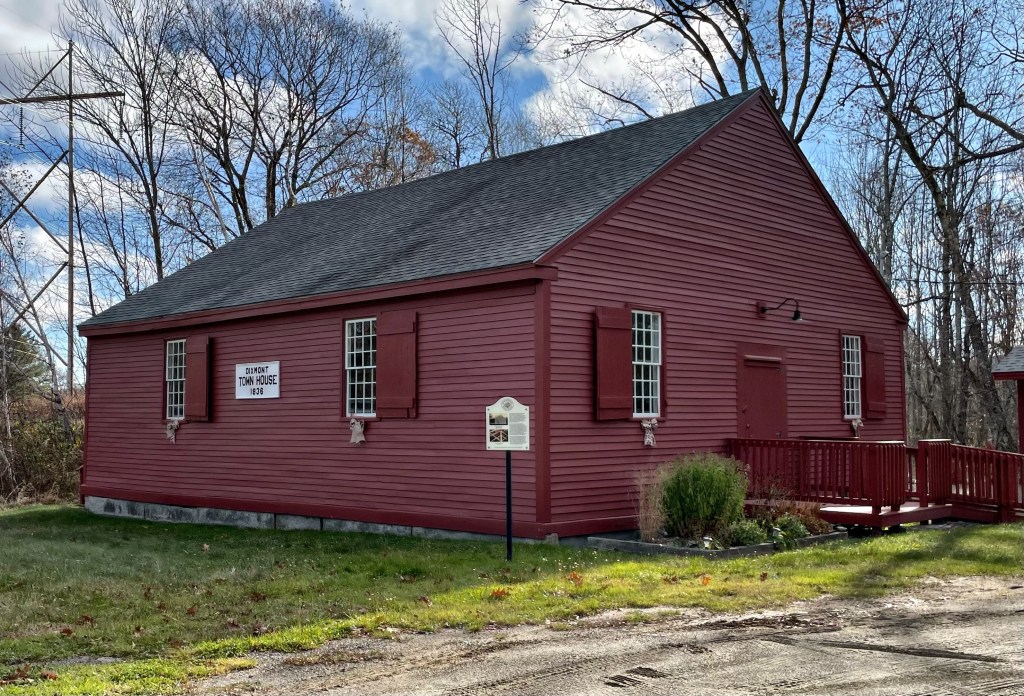
Dixmont Town House // c.1836

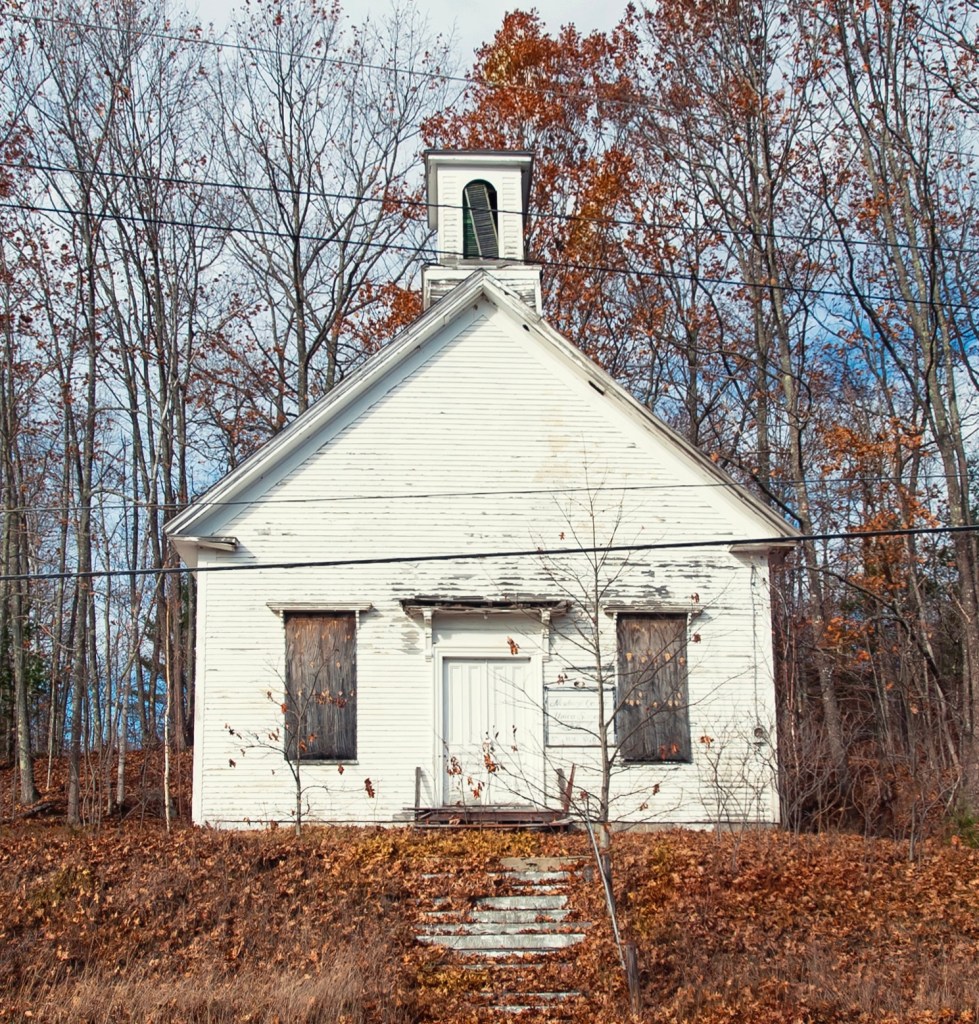
Dixmont, a small rural town in central Maine was originally originally a land grant by the Commonwealth of Massachusetts (of which Maine was then a part) to Bowdoin College, which sold the first settlers their land for profit to build on their campus. As a result, the town was originally called “Collegetown”, which was obviously short-lived. Dr. Elijah Dix (1747-1809) of Boston, who never lived there but took an interest in its settlement, encouraged others to settle there, and when the town was officially incorporated in 1807, it named itself after Dix, as Dixmont. A “malignant fever” broke out among the settlers in the early years, also killing Elijah Dix while in Dixmont on a trip there in 1809, he was buried in the Dixmont Corner Cemetery. Elijah was the grandfather of reformer and nurse Dorothea Dix. The early settlers had this Town House built in the center of the township around 1836 as a vernacular structure. The building (like many early town houses) was used for both secular and religious purposes. This small structure is one of the oldest surviving town houses in the state and served as the town government center until 1952 when it hosted its last town meeting. It was restored in the early 2000s and looks great!

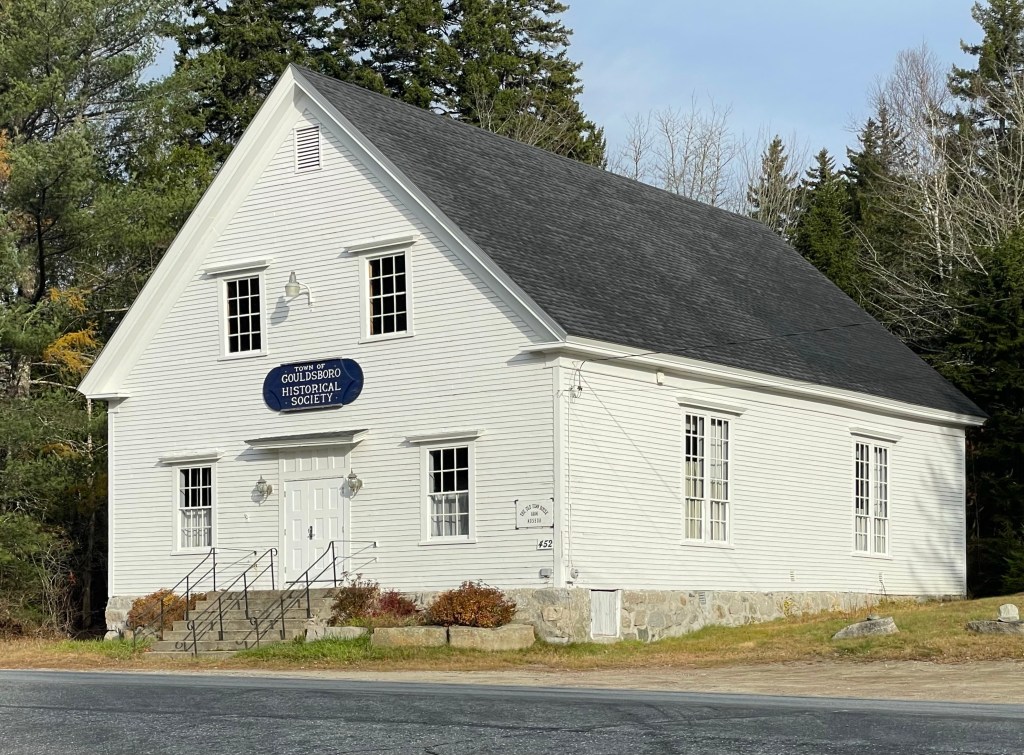
Gouldsboro Townhouse // 1884

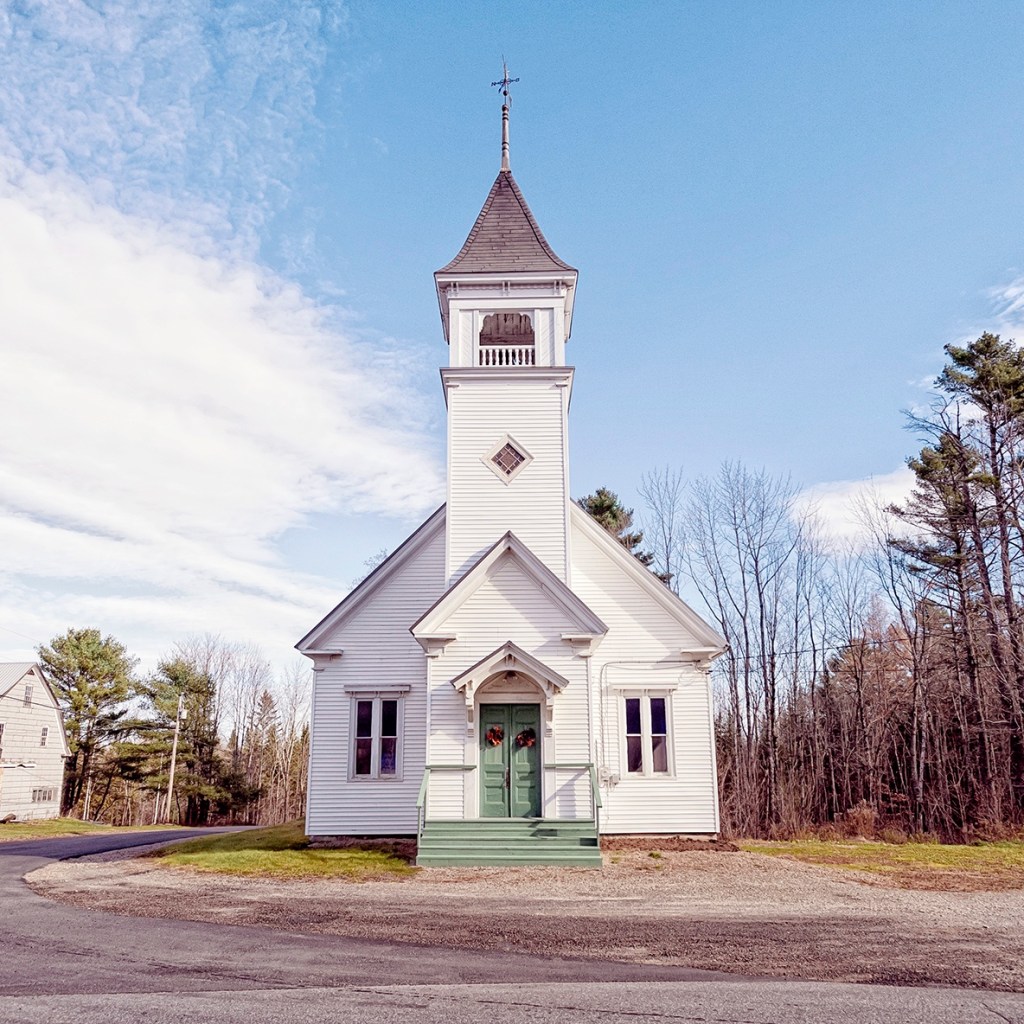
Welcome to Gouldsboro, Maine! The town is a charming community made up of many small fishing villages and neighborhoods dotting the rugged Maine coastline. Land in what was then part of Massachusetts, was given to Colonel Nathan Jones, Francis Shaw and Robert Gould in 1764 by the General Court of the Commonwealth of Massachusetts. Francis Shaw and Robert Gould were both merchants from Boston. Francis Shaw had worked hard to develop Gouldsboro, and reportedly died broke because of it, and his son Robert Gould Shaw returned to his parents’ native Boston. Development in the area was slow and never really took-off due to the distance from Boston, but fishing, mills, and villages were built and remain to this day. Now, much of the area is home to summer residents flocking to the area from urban areas. This building was Gouldsboro’s second townhouse. It was constructed in 1884, soon after the first townhouse burned a year prior. The structure was used for town meetings and elections until 1983. It is now owned by the Gouldsboro Historical Society. It is a late, vernacular example of a Greek Revival townhouse.

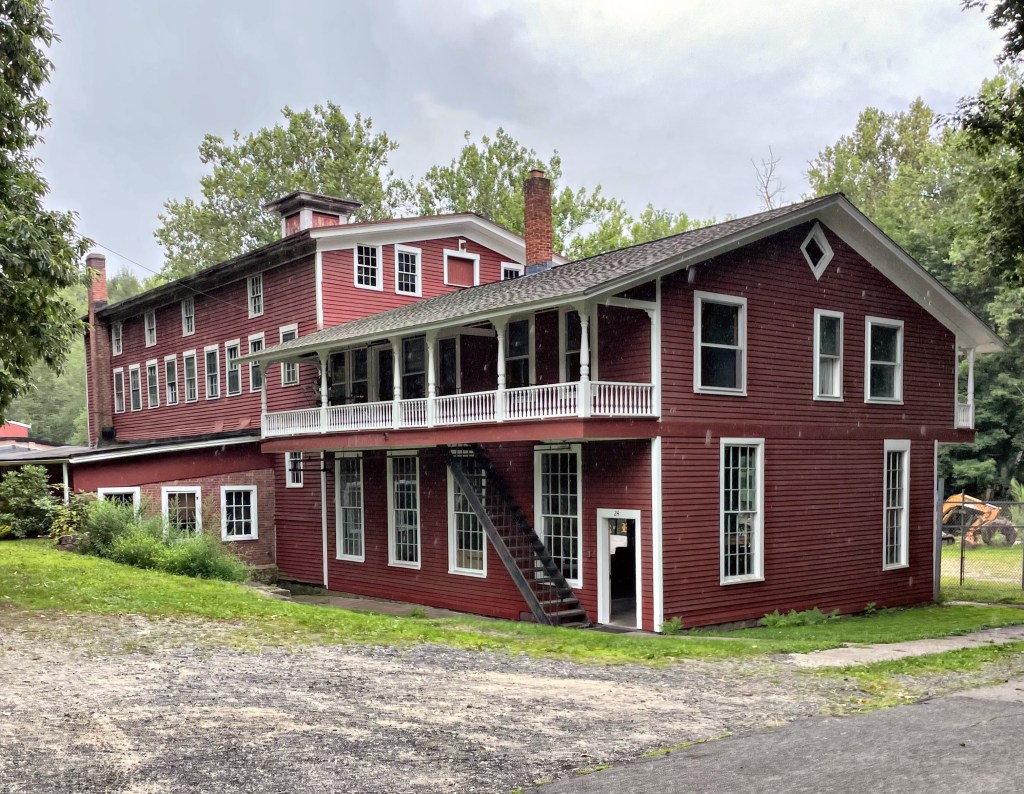
Hawkins Company Factory // 1866

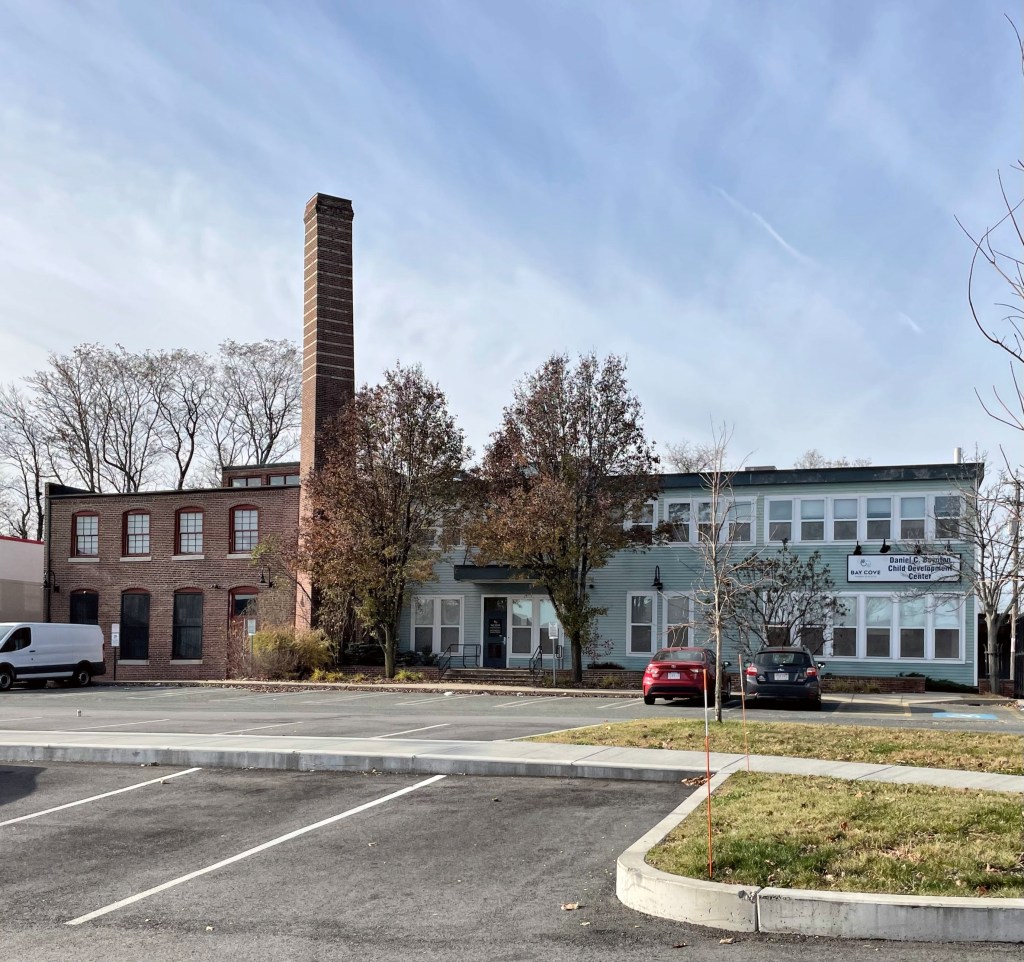
The Hawkins Company was originally organized by Ira L. Hawkins for the manufacture of tacks, buttons, and other metal specialties. The firm appears to have begun operations in Waterbury, Connecticut around 1890 acquired control of the former Blake, Lamb and Company, an animal trap manufacturer established in Waterbury during the mid-19th century. In 1899, Hawkins purchased this four-story woolen mill located in the South Britain section of Southbury that had formerly been operated by the Bradley and Hoyt Company. All of the Hawkins Company’s operations were moved to this plant c. 1900. Production of animal traps quickly became the primary focus of the Hawkins Company and the former Bradley and Hoyt Company mill was enlarged in several phases in order to accommodate demand. The Hawkins Company eventually closed its doors during the late 1960s. The building has been recently painted and maintained well, but it is unclear to me what it is used for, anyone know more?

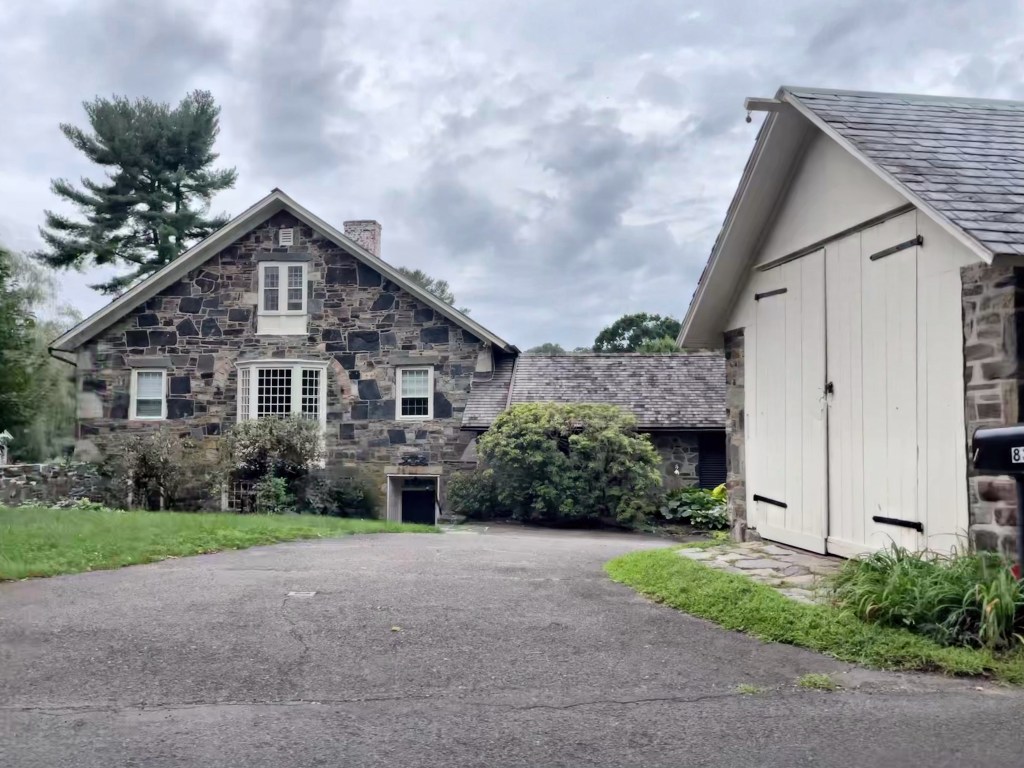
St. Sergius Chapel // 1932

Formerly known as “Churaevka,” the community known today as Russian Village in Southbury, Connecticut, was established in 1925 as an artistic community for Russians who fled to America after the Russian Revolution of 1917. The village was created by two Russian writers, Count Ilya Tolstoy, the son of Leo Tolstoy (the author of War and Peace and Anna Karenina), and the famous Siberian novelist George Grebenstchikoff. Although Tolstoy was first to discover the area while visiting his translator in Southbury, it was Grebenstchikoff who dreamed of establishing a cultural center and planned to create a rural community of cottages where Russian writers, artists, musicians and scientists could live and flourish statestide. The village was named after a mythical Siberian village mentioned in the works of Grebenstchikoff and the centerpiece is this chapel, St. Sergius Chapel, which was built in 1932-33 from plans by Nicholas Roerich. The small square-plan chapel was likely built of stone gathered from the neighborhood.

Benjamin Osborn House // c.1808

This charming cottage shows that you do not need a stately or elaborate house to have some serious curb appeal and house envy. This is the Benjamin Osborn House, located in Southbury Connecticut. The house was built in the early 20th century for newlyweds Benjamin B. Osborn and Sarah Stiles, who married in 1808. As a gift to the couple, Sarah’s father Ephraim Stiles, who lived in a house across the street, seemingly deeded a portion of his property for his daughter and son-in-law to build their family. Tragically, Sarah died one year later, possibly during childbirth. Benjamin would marry another of Ephraim’s daughters soon after… messy. The home is a four-bay Cape, with its off-center entrance sheltered by a Colonial Revival hip-roofed portico supported by Tuscan columns.

Frederic Bronson Barn // c.1895

Not many buildings in Greenfield Hill, Fairfield, Connecticut showcase the neighborhood’s transition from farming community to affluent suburb quite as well as this stone barn turned house on Hillside Road. The stone barn was constructed around c.1895 for Frederic Bronson Jr. (1851-1900) a prominent New York attorney and treasurer of the New York Life and Trust Company which was founded by his grandfather, Isaac Bronson. In about 1892, Frederic demolished his ancestral home and hired architect Richard Morris Hunt to design a new country estate for his family. The house was called Verna and is also located in Fairfield. Today Verna is known best as the Fairfield County Day School. As with many wealthy men of the Gilded Age, Frederic wanted his rural retreat to also work as a gentleman’s farm, where he could have staff farm and tend to livestock on the expansive rolling hills bounded by historic stone walls. He appears to have had this barn built for his livestock shortly after the main house, Verna was completed nearby. Bronson died in 1900 and some of the property was later sold off. This property was acquired by a Charles Stillman in 1941 and it is likely him that converted the barn into a charming residence.

Green Mountain Hall // c.1860

This simple Greek Revival style country church in Whitingham, Vermont is similar in form to the Methodist Church (last post) with a gable front double entry, large full pediment, corner pilasters, and centered two-tiered steeple. Also like the Community Church nextdoor, this was built circa 1860 as a church, but for the Universalist Unitarians in town. In 1892, the church was transferred to the Green Mountain Club, giving it the informal name “Green Mountain Hall,” and in 1905 the Town of Whitingham took it over. The building was used for dances, meetings, social gatherings, and other events until the Whitingham Historical Society took it over in a lease in 1971 to develop into a museum. The well-preserved vernacular building with its c.1920 front porch is a great representation of Vermont architecture, reuse for new uses and update. No waste, and a whole lot of charm!

Whitingham Community Church // 1862

This simple, Greek Revival, frame church has a prominent pediment, corner pilasters, and two part steeple. It is built into a steep bank at the side of the road as it curves and descends into Whitingham Village, making it one of the most visible buildings in town. This church was originally built in 1862 by the Methodists who moved their congregation from their old and deteriorated church in the original Whitingham settlement on Town Hill. By the 1870s, the Methodist congregation was in decline. The Baptist congregation started holding meeting at this church regularly in Sadawga Village in 1879 and then purchased it. They made repairs and alterations in 1881. In historic photographs c. 1890- 1920s, the church’s steeple had third and fourth sections consisting of a narrow octagonal section topped by a small bell shaped dome. By the 1940s photographs show these had been removed. The building now serves as the Whitingham Community Church. My friends who tag along with me on visits throughout New England always say that every town has at least one old, white church. They aren’t wrong!

Abraham Chase House // c.1860

One of the cutest old houses in Whitingham Village in Vermont is the Abraham F. Chase House, just a stone’s throw from the country store and post office. Abraham Chase was a dealer in dry goods, groceries, boots, shoes, and hardware in this village, possibly from half of this building. The vernacular one-story clapboarded frame house has some Gothic details like the rear steep double gable wall dormer. I am actually a huge fan of the green doors and newer stone porch wall, they really make this cottage pop!

Wheeler-Jillson Store // c.1905

To me, Vermont is synonymous with Vernacular architecture. The state obviously has high-style and architect-designed buildings all over, but the character of the state (to me) is based around local builders, local materials, and local traditions. The patchwork of towns and villages in Vermont all have one thing in common, at least one general store. These buildings serve as an informal meeting place or community center where residents and visitors alike can hear the local gossip and events taking place. The general store in Whitingham, Vermont is located in the middle of the village, perfect for stopping in. The building was constructed in the first decade of the 20th century, replacing a former hotel/tavern on the site. The late-folk Victorian style store exhibits some decorative columns and storefronts, likely produced at one of the working lumber mills in town at the time. The store was originally built by Arthur and Carl Wheeler as the “Wheeler Brothers Store” but after 15 years changed hands and became the “F.W. Jillson & Son Store”. Since then, the Jillson’s opened up an antique store in the building which serves as a multi-use facility (collectively as a country store). Keep it local Vermont!