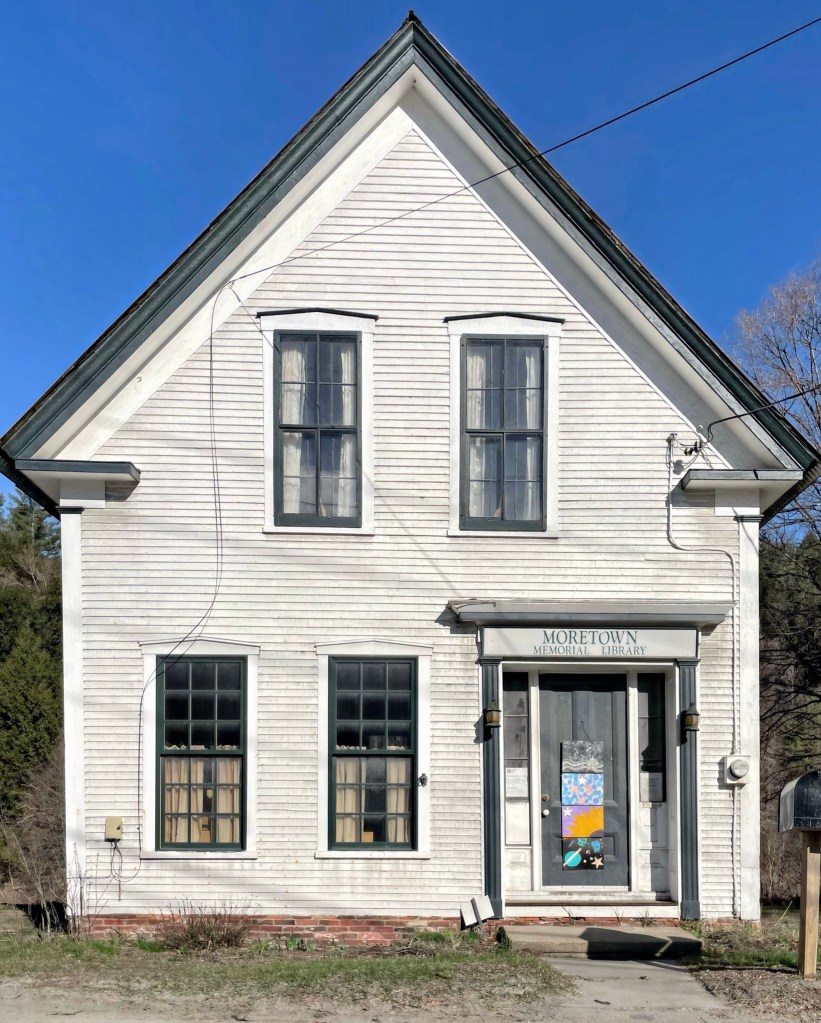
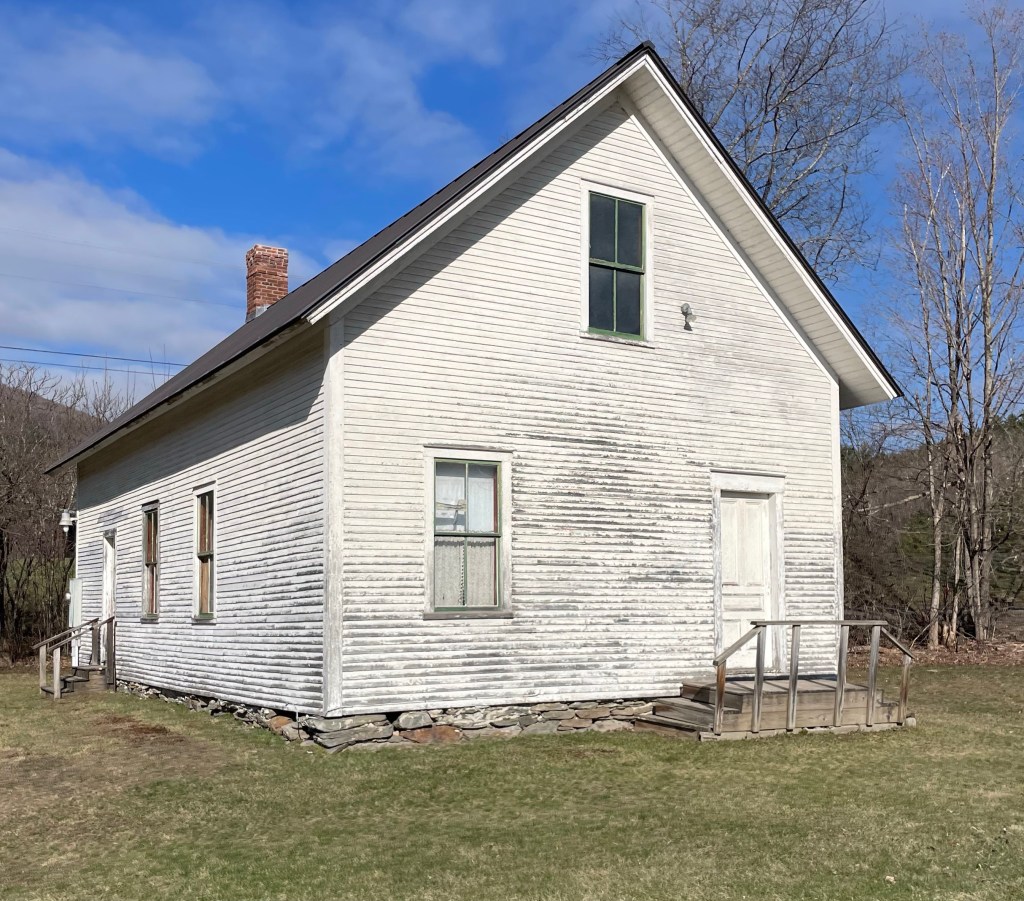
Moretown Public Library // c.1845

This 1840s Greek Revival home turned library, sits on the main street in the charming rural town of Moretown, Vermont. The quaint village never had a public library, but that changed starting in 1904, when residents and the town established a fund for purchasing books for the town’s citizens. In 1923, the library trustees purchased this residence which would serve as a stand-alone library for the village. Resident Lilla Haylett was instrumental in the accession and conversion of the home for use as a library from the estate of Ellen J. Palmer, who lived there until her death in 1923. The opening and celebration was short-lived however, as in 1927, elevated levels of the Mad River flooded much of the town. Water levels were well over the first floor of the building and nearly all books were lost. The Moretown Memorial Library was nearly lost, but the town rebuilt over years. The library remains today as a testament to the desire for learning and it serves as a landmark for the charming rural village.

Belding Homestead // c.1820

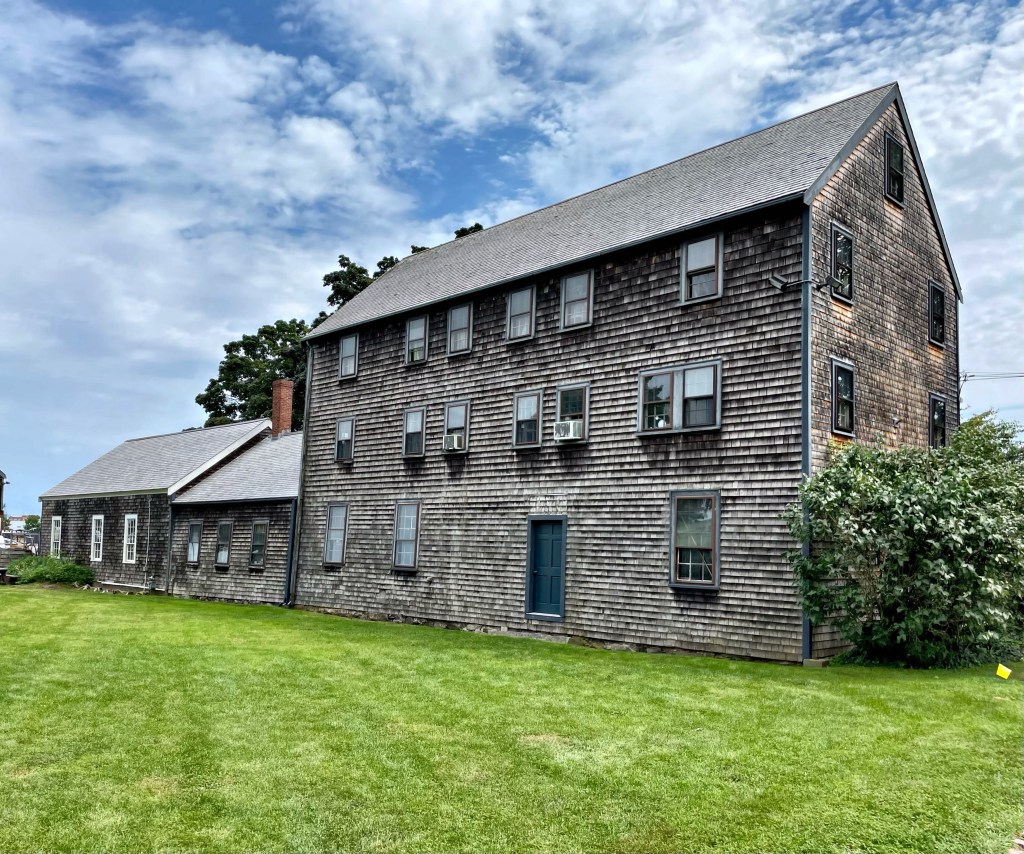
David Belding (1785-1860) was born in Swanzey, NH and at 25 years old, moved to Moretown, Vermont in 1810, marrying an eighteen-year-old Florinda Freeman a year later. The couple built a farmhouse on the outskirts of town near a brook. David worked as a farmer and would later officiate as a justice of the peace, the town lister, selectman, and represented the town in the State Legislature for two terms. From his enhanced wealth, David appears to have expanded his farmhouse in the 1820s or 30s with this vernacular Federal and Greek Revival style residence. The Belding Homestead would remain in the family for decades and eventually became the Belding House Bed & Breakfast.

Moretown Town Hall // 1835

The township of Moretown, Vermont was chartered on June 7, 1763 by Governor Benning Wentworth of New Hampshire. The original charter contained approximately 23,040 acres of land to be divided into about 65 shares of proprietors. Active settlement did not occur until after the Revolutionary War with early buildings constructed on the Winooski River (the northern boundary of the town) and subsequent development along the Mad River (which cuts through the middle of town). Saw and grist mills were built and the town developed as a rural farming and industrial community on the rivers. The Moretown Town Hall was erected in 1835 in the Greek Revival style. It has a pedimented portico with Doric columns that support a large pedimented gable peak in imitation of a Greek temple. Like most buildings in the Mad River Valley, the building is unapologetically Vernacular which means it relies on local materials, local builders, and not on architect-designed finishes. This is an aspect of Vermont architecture that makes the state so charming.

South Duxbury Church and Hall // 1855

This is the first church ever built in Duxbury, Vermont. On December 18, 1854, at the South Duxbury schoolhouse, representatives from six denominations in the newly formed town, gathered to form the First Union Society of Duxbury. The participants were: the Congregationalists, Universalists, Free Will Baptists, Protestant Methodists, Episcopalian Methodists, and the Adventists. Twenty-five names appear on the original subscription list, indicating the pledged money or materials that each would contribute to the construction of the church. Samuel Cook Turner was contracted to build the church, with pews inside purchased by individual families to help fund the construction. The building is vernacular and modest due to the rural character of the congregations and town’s location, but it has a more Classically inspired door enframement. In 1890, funds were gathered for a church hall, which sits nextdoor. The meeting hall would serve as the meeting space for a temperance organization known as the “Independent Order of the Good Templar”. The church hall appears to have some deferred maintenance, but both buildings together share an early history of a rural and often overlooked small Vermont town.

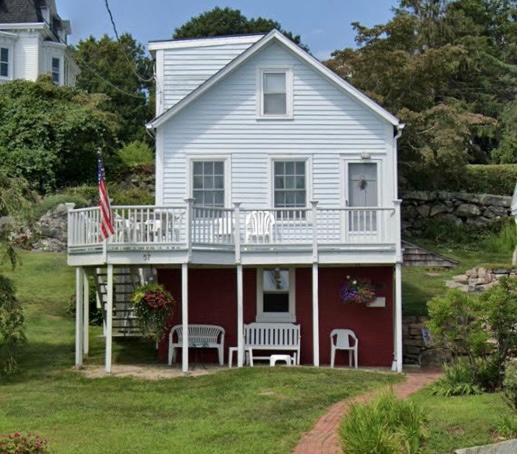
The Floats // 1900

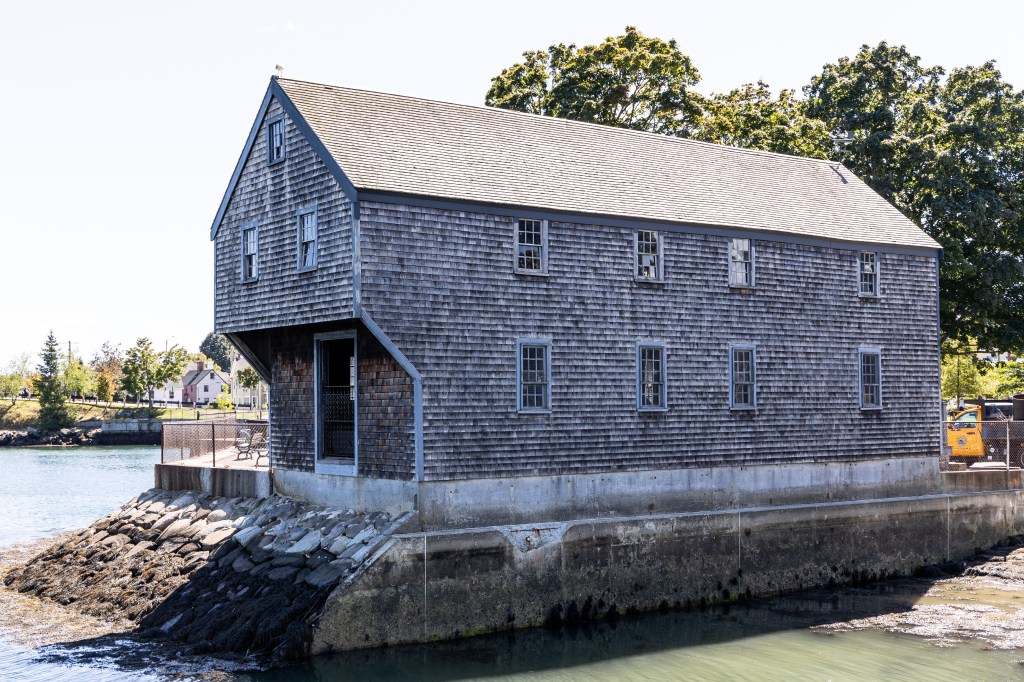
Newton Booth Tarkington (1869–1946) was an American author best known for his novels The Magnificent Ambersons (1918) and Alice Adams (1921). He is one of only four novelists to win the Pulitzer Prize for Fiction and was considered the greatest living American author in much of the 1910s and 1920s. While he was born and grew up in Indiana, “Booth” eventually fell in love with the coast of Maine, and built a home in the charming village of Kennebunkport. In Kennebunkport, he was well known as a sailor, and his schooner, the Regina, survived him. Regina was moored next to Tarkington’s boathouse this building, which was named “The Floats” which he also used as his studio. The building was constructed in 1900 as a shop to build ships. He purchased the building, preserving it for generations to come. After his death, the boathouse and studio were converted into the Kennebunkport Maritime Museum. The building appears to now be a private residence, perched above the harbor. How charming!

Lars Thorsen House // c.1850

I love that when walking around towns and cities in New England, I find charming old buildings and snap a photo only to learn later on that they were the home of someone amazing later on! New England is full of amazing stories! This charming cottage in Noank, CT, dates to around 1850 and measures just 16 x 22 feet and is set on a full-height raised brick foundation just steps from the harbor. Upon further research, it was uncovered that this cottage was the home of Norweigan artist Lars Thorsen (1876-1952) and his family since 1923, he added the shed dormer for his art studio. Thorsen was born in Stavanger, Norway, and was fascinated by ships as a boy. He first went to sea as a cabin boy at age 14, and crewed on both sailing and steam-powered ships. By 1903 he had made at five trips around Cape Horn, and crewed on the Columbia, an America’s Cup yacht designed by Nathaniel G. Herreshoff. A year later, Thorsen happened to sail into Noank, and chose to settle down there. Thorsen became known for his marine paintings of coastal areas and ships and painted murals for the WPA and other commissions.

Katherine Forrest Home and Studio // c.1860

This vernacular cottage in Noank was built in phases (and likely added onto from other historic buildings) since 1860. While the building dates to the 1860s, its significance derives from a later owner, Ms. Katherine Forrest. Katherine Forrest (1883­-1952) was a graphic designer and part of the Arts & Crafts movement of the early 1900s. She specialized in textile design and printmaking. Forrest came to Noank in 1914 and purchased her house in 1926. She was locally known by the nickname ‘Speedy’ and was remembered for dying textiles in a bathtub outside the house. The building’s vernacular character and its significance as a locally historic site as part of the village’s rebirth as an artist colony in the 20th century showcases how even smaller, unpretentious buildings in New England can tell a story.

J. B. Mulvey Triple Decker // 1904

Across the street from the Lannin Triple Deckers (last post) this large triple decker (and the others in the row) was built in 1904 for developer John B. Mulvey. Mr. Mulvey was born in Ireland and migrated to Boston at the age of 16. He climbed his way up the ladder and worked as a builder and developer, largely in Boston-area suburbs and neighborhoods. At the turn of the century, these triple deckers (also known as three deckers) proliferated throughout the Boston suburbs around train stations providing affordable flats to residents. Many were built and rented out by developers, but eventually, owners would live in one unit and rent the other flats for additional income, providing upward mobility and equity, largely benefiting immigrant communities. This high-style example is very well maintained and is a more uncommon double-three decker.

Joseph J. Lannin Triple Deckers // c.1910

In 1892, Thomas Minton who lived nearby Forest Hills Cemetery in the Jamaica Plain neighborhood of Boston, was hired by landowners Brown and Weld to subdivide their land for house lots near the Forest Hills station. Three residential streets were laid out, terminating at the edge of Forest Hills Cemetery for residential lots. Much of the parcels were developed within ten years of the platting of the site, with some vacant lots of more difficult land to develop. Some parcels included massive outcroppings of stone which made building difficult and thus, more expensive to develop. Savvy developer Joseph John Lannin (1866-1928) purchased these lots from Edwin Weld and hired a local architect to design matching triple-deckers on the ledge. Lannin was orphaned at the age of 14, and migrated from Quebec to Boston, where he found work as a hotel bellboy. He soon learned about real estate and the commodities market by listening to conversations of the wealthy patrons at his hotel and solicited advice from those who were willing to share their insights with him. He began investing in real estate and made a small fortune in Boston and New York City. In 1913, Lannin and a group of investors purchased 50% of the Boston Red Sox baseball team and a year later, he became the sole owner of the Red Sox. In 1914, he purchased the rights to bring Babe Ruth to Boston. The team went on to win the World Series in 1915 and 1916.

Coolidge Cheese Factory // 1890

Does it get more Vermont than a cheese factory?! The Coolidge Cheese Factory in Plymouth Notch, Vermont was built in 1890 by Col. John Coolidge (President Calvin Coolidge‘s father), James S. Brown, and two other local farmers so that they would have a convenient market processing milk produced by their farms into cheese. The vernacular building was a short walk from the original Coolidge home and is evocative of many such buildings in rural Vermont. The cheese factory continued to operate until the 1930’s. The factory was renovated in the early 1970s in honor of President Coolidge’s 100th birthday and now produces cheese according to the original formula. The cheese would make a great Christmas gift!