Methodist Camp Meeting Association Office // 1859

Located at the center of the Wesleyan Grove, – the Martha’s Vineyard Camp Meeting Association – this Italianate building has long served as a hub of the active summer community. The building was constructed in 1859, before any cottages were built in the newly formed summer colony. The office building was not only the headquarters for the Camp Meeting Association, it also served as a storage space for the baggage of the many who stayed in tents, many who didn’t have the means to purchase or rent a cottage. The building even was home to the associations’ post office. It now houses the Association director’s offices and contains the lease holders records back to 1864, a great way to learn about the diverse groups of people who visited and worshiped in this camp.

Riday-Evans Cottage // c.1880

This cottage on Ocean Ave in Oak Bluffs was built before 1880 for J.F. Riday, a manager at the American Mail and Export Journal at the Wesleyan Building on Bromfield Street in Boston. The quaint cottage was photographed shortly after it was built with Riday and two women (one likely being his wife) posing on the front porch overlooking the ocean. By the early 20th century, the home was owned by George and Corielle Evans, a couple from Mexico. They likely modified the home with the shingled siding and front porch with sheltered balcony above, while the original lancet windows and doors remained.

Jones Cottage // 1876

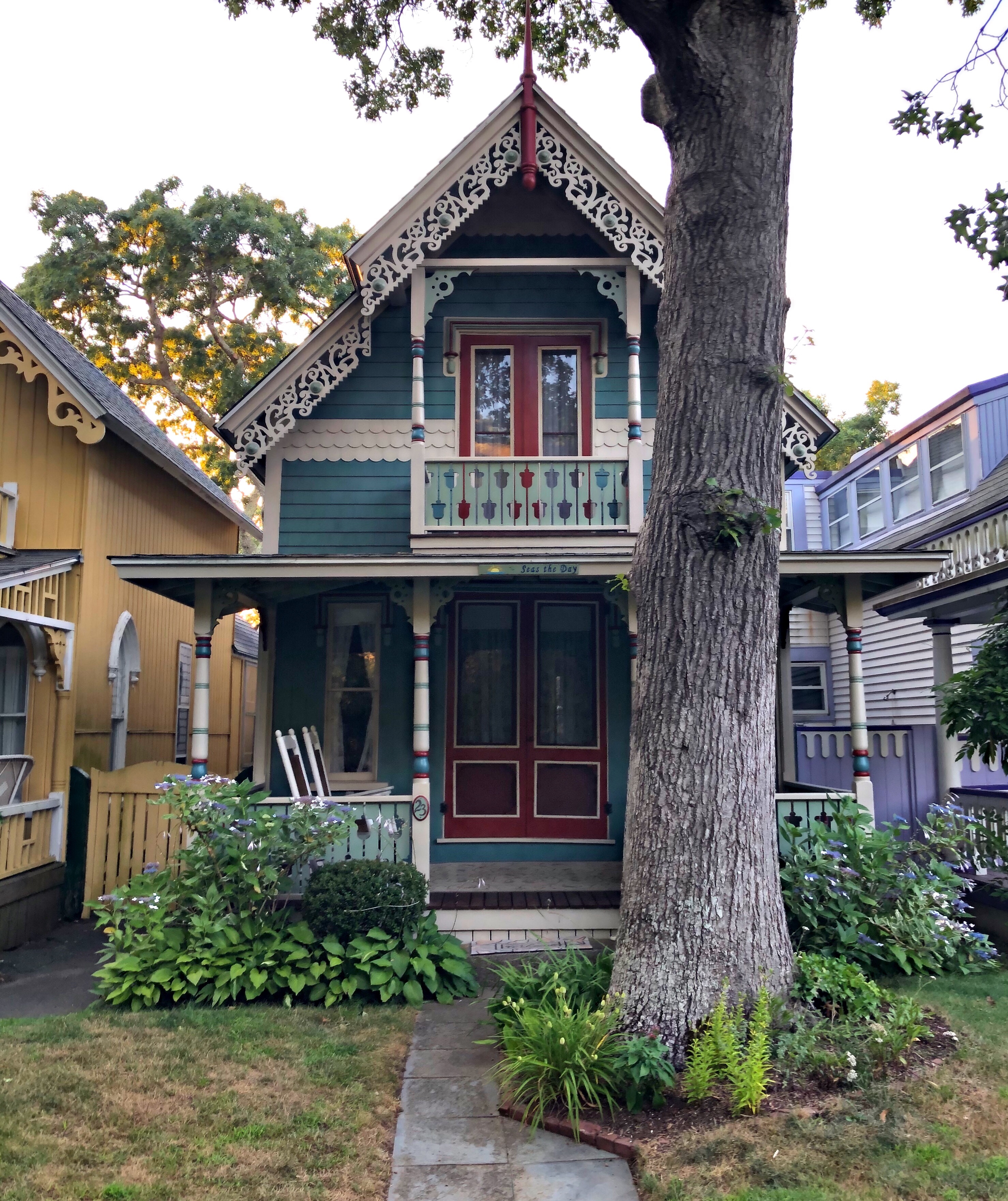
This charming little cottage in Oak Bluffs was built in 1876 for Charles N. Jones, a resident of Medford, MA who had a home built there in 1872. His family’s summer cottage on Martha’s Vineyard was designed by the Ripley Brothers, Alonzo and Walter, carpenters who lived in town and designed and built many of the charming little summer homes there. The home features a wrap-around porch, a covered balcony at the second floor, and pierced board balustrade and cornerboards. Oh, and the paint scheme is perfect!

Aunt Georgia’s House // c.1880

Located on the iconic Circuit Street in Oak Bluffs, this Eclectic Victorian cottage has a storied past related to Black history on the island. Even though Oak Bluffs was a relatively safe place for African Americans to be, there were still limits on their rights. In some parts of Oak Bluffs there were laws that said that certain property could only be owned by whites. The island became a vacation spot for thousands every summer in the 19th century and seeing a lack of options for Black travelers, Mrs. Georgia O’Brien and Ms. Louisa Izett began to operate an inn for people of color. The inn was one of two such residences in Oak Bluffs and has since been listed on the African American Heritage Trail of Martha’s Vineyard. The home has since been named the Tivoli Inn and retains much of the original gingerbread trim. In recent years, Martha’s Vineyard was given the nickname, “The Black Hamptons,” due to its popularity as a place for wealthy African-Americans to vacation, it remains a very diverse island in summer months.

Governor Oliver Ames Summer House // 1878

This stunning Victorian home in Oak Bluffs on Martha’s Vineyard was built in 1878 as a summer home for Oliver Ames (1831-1895), a businessman, investor and Governor of Massachusetts. Oliver Ames was the son of Oakes Ames, who is credited by many historians as being the single most important influence in the building of the Union Pacific portion of the transcontinental railroad. After his father’s death in 1873, Oliver Ames became the executor of his father’s vast estate and business dealings, and spent vast sums of money on properties in the places he lived including North Easton, MA, Boston and Martha’s Vineyard. He summered at this large home fronting the ocean in Cottage City, then a part of Edgartown. He decided to run for state senate in 1879, after he was unsuccessful in securing passage for the separation of the Martha’s Vineyard community of Cottage City, where he owned a summer house, from Edgartown. Winning election, he saw through the incorporation of the town (now known as Oak Bluffs). Ames served as the Governor of Massachusetts between 1887 and 1890, and continued to summer in his beachfront home during that time. The eclectic Victorian home blends many popular styles at the time from the Shingle style with the continuous shingle siding, the Stick style with the delicate stick-work at the veranda, to Queen Anne with its asymmetric massing and square tower.