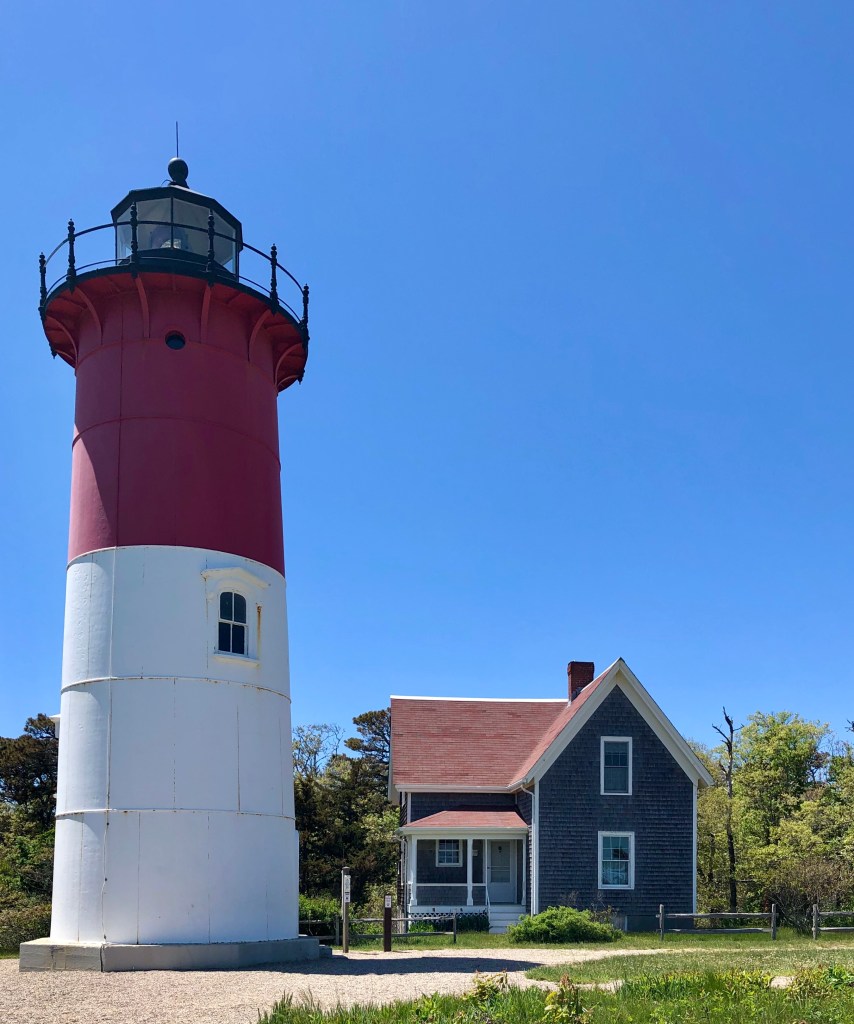
Nauset Light and Keepers House // 1877

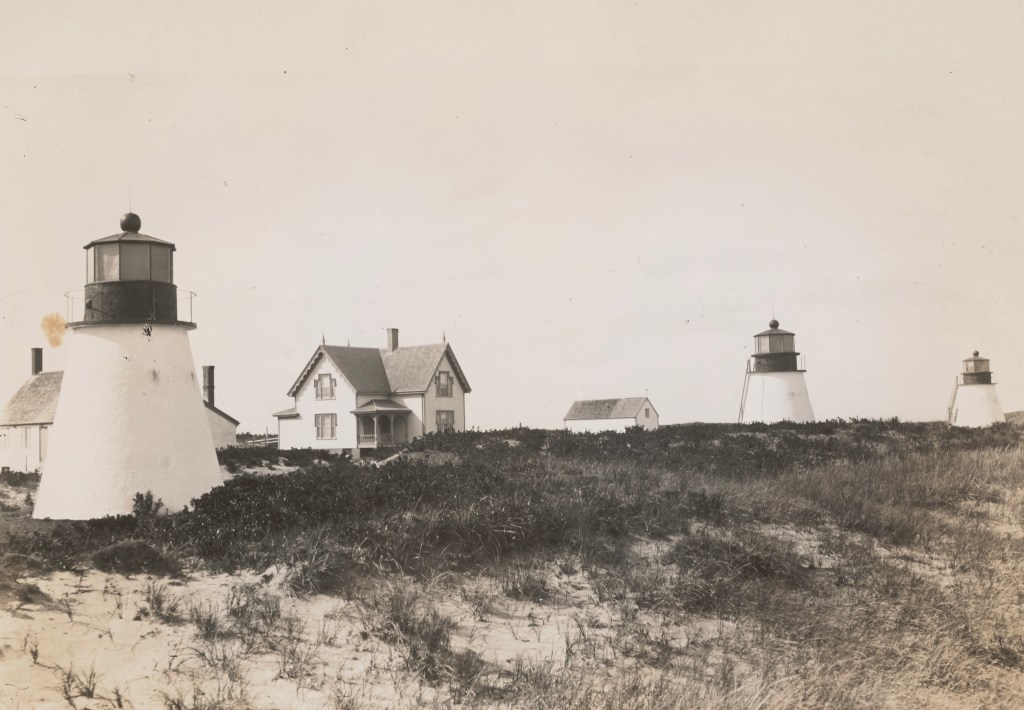
In 1838, three brick lighthouses served as aids to navigation off the Nauset Beach shores in Eastham on Cape Cod; these lights were replaced by three wooden towers in 1892. From 1911 to 1923, only one of these Beacons were used, as technology had evolved sufficiently enough to install a revolving light. Nauset was thus distinguished from the single light of Highland to the north in Truro and the twin lights of Chatham to the south. The forty-eight-foot-tall, brick-lined, cast-iron Chatham tower, originally built in 1877, was dismantled, hauled up the cape, and rebuilt atop a cement foundation 200 feet from the cliff’s edge at Nauset Beach. To provide accommodations for the keepers of the relocated cast-iron tower, the 1876 dwelling built for the Three Sisters was relocated farther away from the edge of the bluff. The cliff continued to fall into the sea over time and the lighthouse and dwelling were moved again in the 1990s. Both structures are owned and maintained by the Nauset Light Preservation Society.

Learn more on the history of the site in the Three Sisters Lighthouse post.

Chapel in the Pines // 1889

The Chapel in the Pines church had its origins in the growing desire by many late-19th century New Englanders to move away from the strictures of fundamentalist religion. A Universalist Society was formed in Eastham on the Cape for the erection of a new place of worship. Local families and esteemed citizens pooled resources and constructed the building themselves over five months, under the direction of an Elkany Hopkins (though sources state he died in 1885). The Victorian Gothic church has a certain flair with the turned posts at the entry, bell tower, and roof cresting. After serving various congregations and uses (including as the First Encounter Coffeehouse a renowned venue for folk and acoustic music since 1974), the building was purchased by the Nauset Fellowship. In 2017 and 2018, the Chapel underwent a renovation with money raised from the community along with two grants from the Town of Eastham’s Community Preservation Act funds.

Three Sisters Lighthouses // 1892

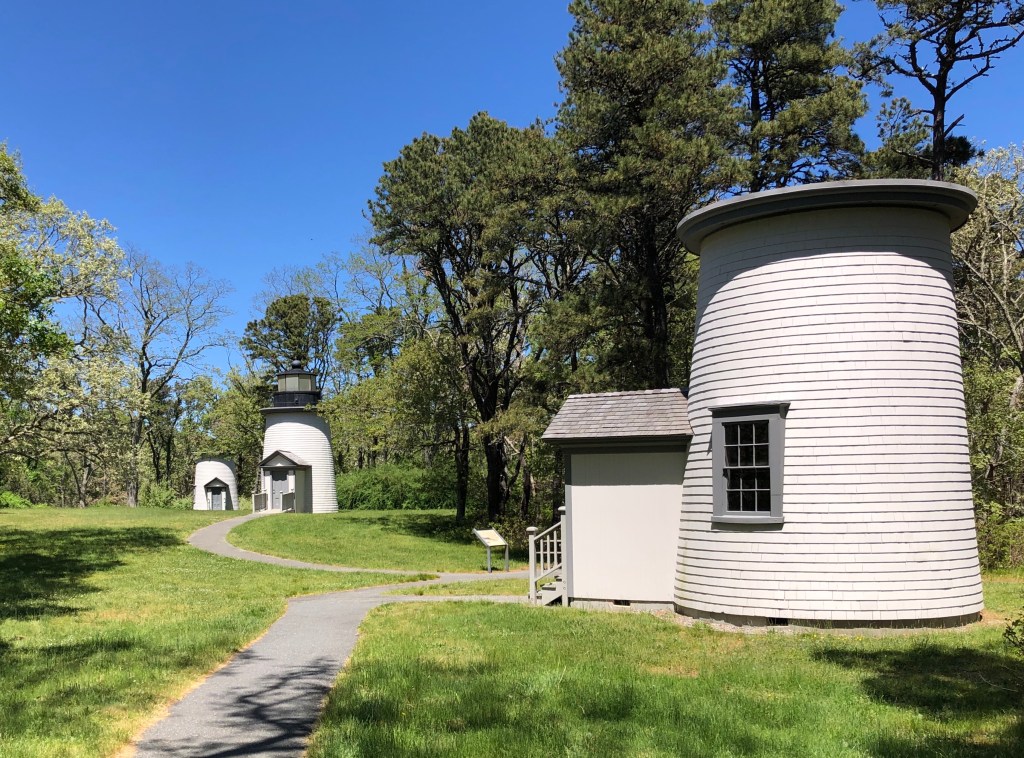
The first lighthouse station for Eastham, known as the Nauset Beach Light Station (nicknamed The Three Sisters), was completed in 1838. The name Nauset, which came from a local Native American tribe, formerly referred to the fifteen-mile stretch of Cape Cod from what is now Brewster almost to modern-day Truro. The lighthouse station actually consisted of a group of three lights atop 15-foot high brick towers located on a bluff looking over the Atlantic. Even though there were three lighthouses, the station was staffed by only one keeper up until 1867, when the position of assistant keeper was added. The assistant lived with the head keeper and his family in the station’s one dwelling (talk about cozy)!. The Lighthouse Board in 1873 noted the inadequacy of these accommodations in a report stating, “The dwelling-house should be enlarged, or a small cottage built for the accommodation of the assistant keeper, as the building now occupied is entirely too small”. Congress allocated $5,000 in 1875 for a keeper’s dwelling at Nauset Beach, which was erected in 1876.

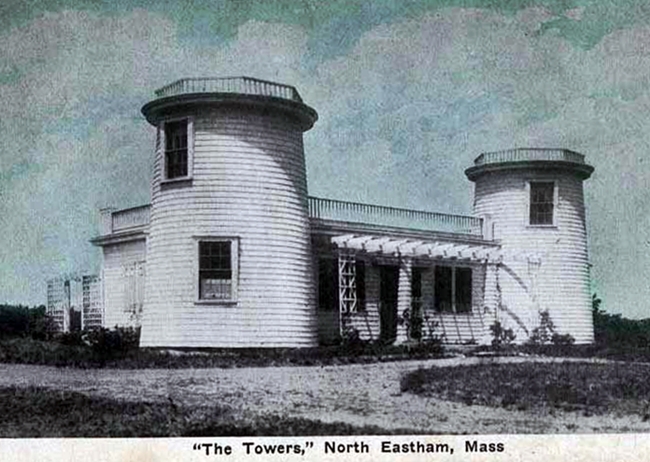
After the relentless Atlantic Ocean brought the three brick towers to the brink of disaster due to the eroding land under them, in 1892, three new towers were constructed thirty feet west of the originals along with a brick oil house. The replacements were constructed of wood so they could be readily moved if the need occurred again. By 1911, it was determined that there was a need for only one lighthouse (as three could get confusing), and two of the three lighthouses were auctioned off, the third was attached to the keeper’s house. The two towers (minus their lanterns) were sold in 1918 to the Cummings family of Eastham for $3.50. The family moved the two towers to a nearby location and joined them together as a summer cottage called “The Towers” on Cable Road. In 1923, the smaller wooden lighthouse was retired and replaced with the current Nauset Light. In 1983 after much uncertainty as to their future, the National Park Service united the Three Sisters in a park, just west of their original location for history geeks like us to enjoy!

Preserved Gardner Farmhouse // ca.1820-2024

UPDATE: The Preserved Gardner House was demolished in 2024 by the Town of Swansea.

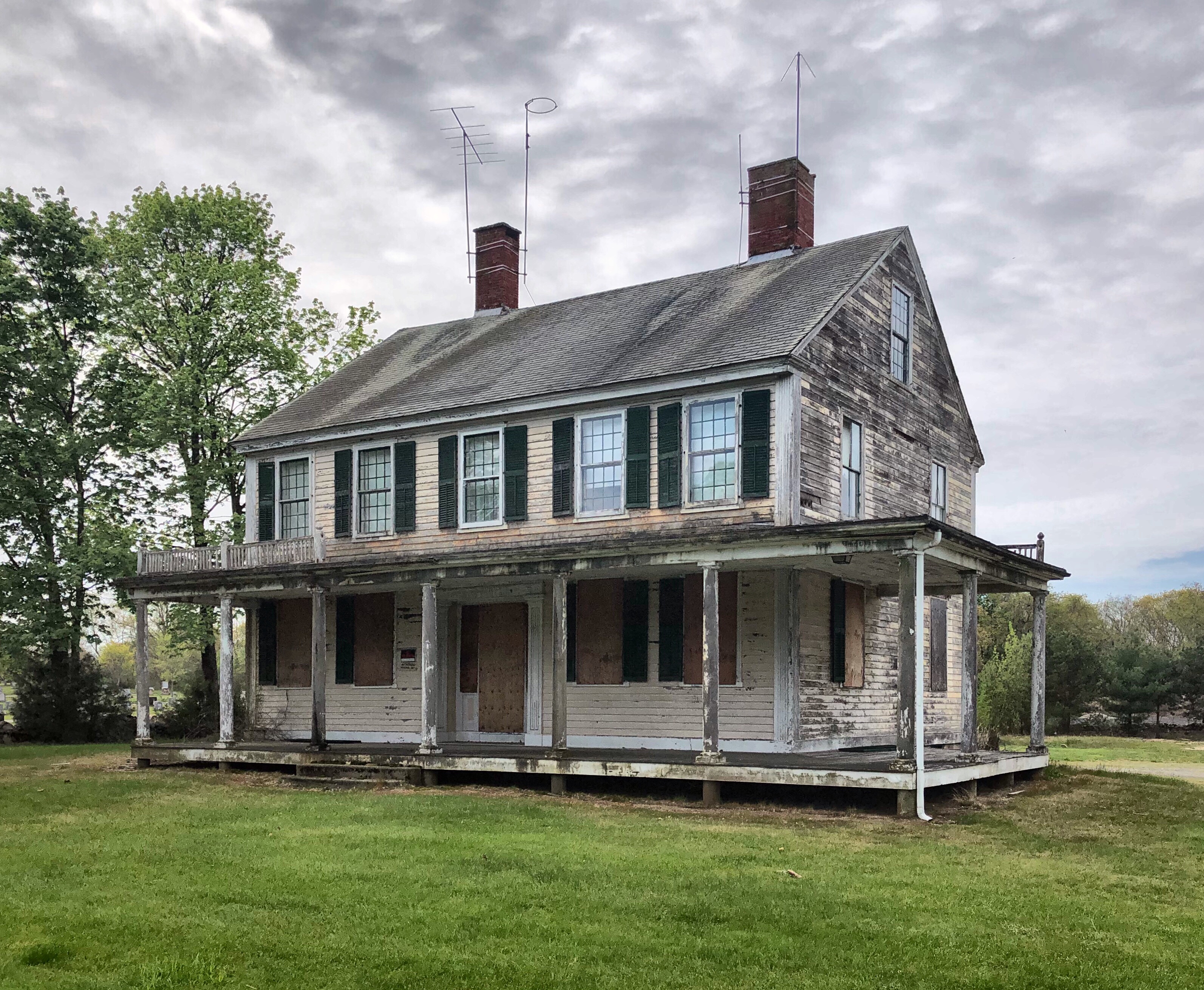
This old farmhouse in Swansea, MA, was built by 1820 for Preserved Gardner (1795-1873), one of five sons of Peleg Gardner, who owned much of Gardners Point. Preserved lived in the home until his death in 1873, and the home and acres of farmland were willed to his only son to live past childhood, Ira Gardner (1836-1901). Ira donated a large tract of land adjacent to the farmhouse to the town in 1882 for a cemetery, in which his father was buried. Later, the farm was purchased by Thomas D. Covel a bank president of Fall River who operated it as a gentleman’s farm and made the house his summer home. A ‘gentleman farmer‘ utilized their farms for pleasure rather than for sustenance or profit. After WWII, the land was purchased by the town to be used as a park and the property is still owned by the town. The Federal home with its veranda that wraps around the side has been neglected by the town for decades while the parks adjacent are maintained adequately.

The town has weighed various options for the home ranging from demolishing it, to preserving the front facade and converting it to a garage and storage shed (with a small museum on the second floor). I hate that idea personally. This seems like an ideal candidate for the town to allow a private individual or developer to move the home and restore it back to its original grandeur. Thoughts?

Hotel Touraine // 1897

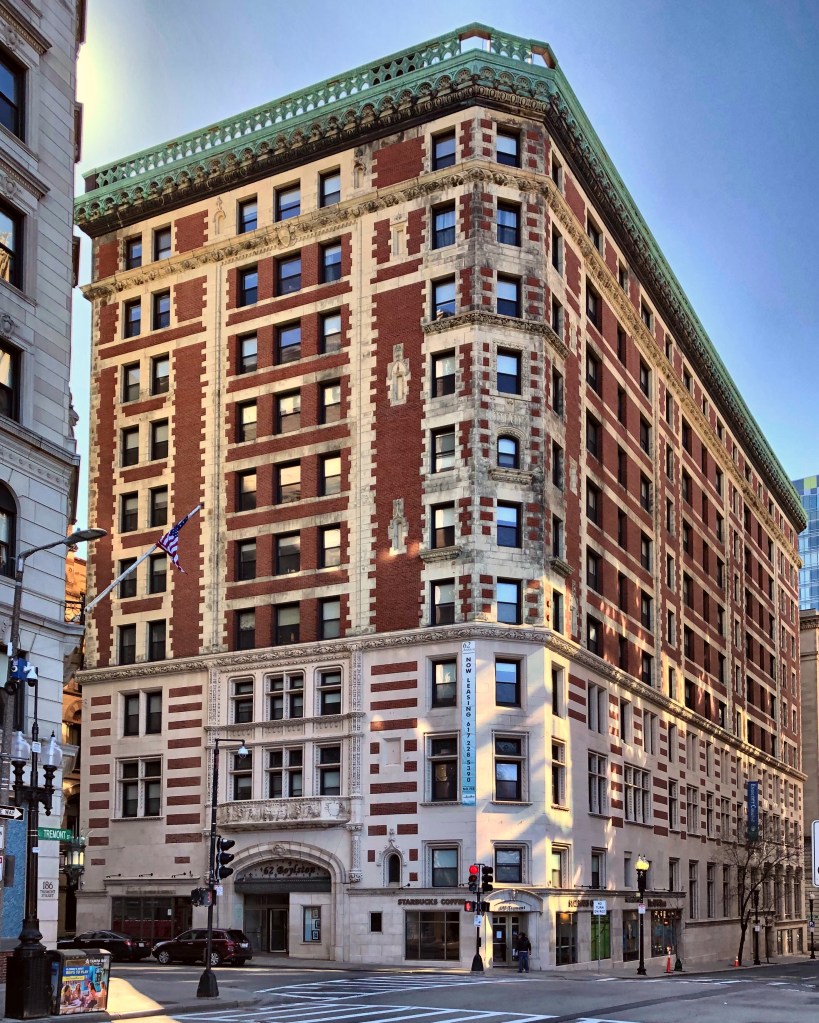
The Hotel Touraine at the corner of Boylston and Tremont Streets in Boston was built in 1897 as one of the most luxurious hotels in the city. Designed by the local firm of Winslow and Wetherell, the Jacobean Revival style building commands the well-trafficked corner opposite the Boston Common. Early articles described the hotel as “a large and sumptuously equipped house, with internal decorations in the style of the Chateau de Blois (a French chateau). Winslow and Wetherell appeared to have been inspired by the Louis XII wing of the Chateau, as many design elements of the hotel closely resemble it. The hotel was advertised as having 350 rooms valued at $2 a night up to $3 a night for a room with a private bath. Separate men and women’s parlors, a library, and elevator service made the hotel desirable for the upper-class Bostonians and visitors to the bustling Downtown area. The hotel’s rich clientele eventually began frequenting the larger hotels near Copley Square and the stature of the Touraine slipped with a changing Downtown character. By the 1960s, the hotel closed and was converted to apartments.

About Me

For those of you who follow me on Instagram or are just joining here, I wanted to share a little bit about myself..


I started on the mission to explore the New England area in 2018 with the aim to highlight the varied architecture, history and sites that make the region so special. My goal (a near impossible one) is to explore every city, town and village in the region. I grew up in the area and after beginning to work in the field, really wanted to showcase the history behind these picturesque places to light in a manageable format.

I started by Instagram in 2018 and have been shocked at the numbers of architecture nerds like myself! This blog is to pick up and continue the posts from Instagram. To see past posts, click on the Instagram link on the sidebar and scroll through!


Come along for this journey with me!