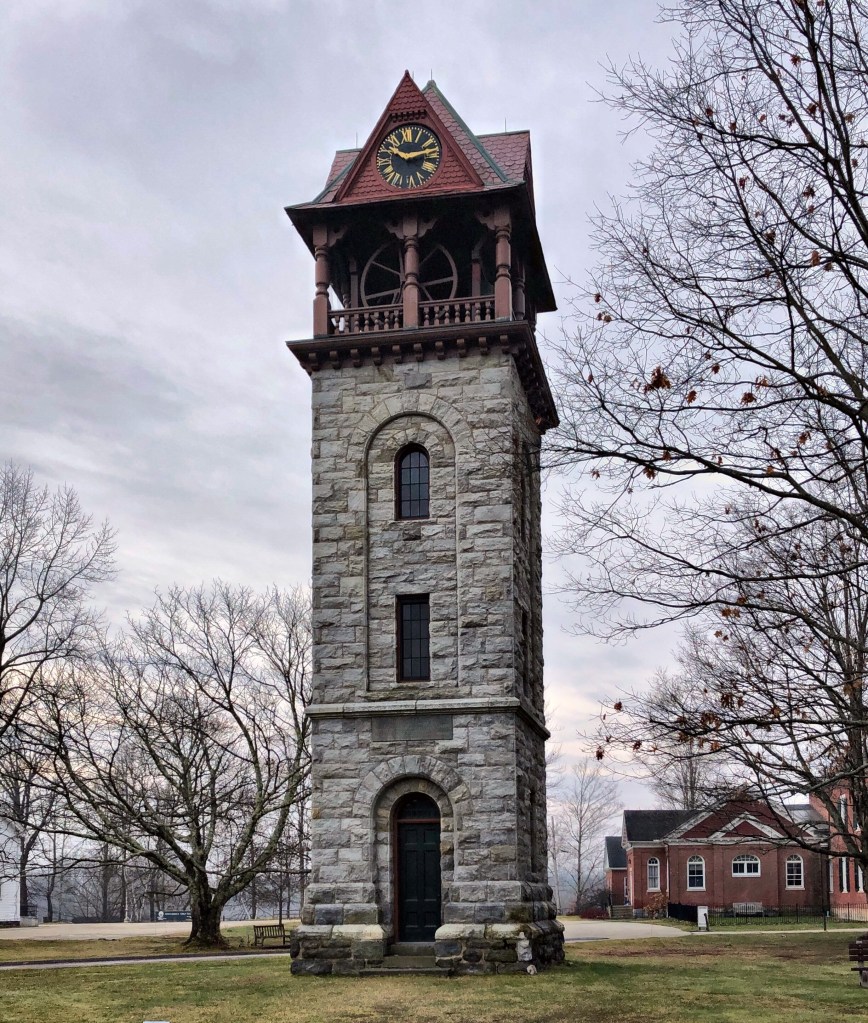
Located in front of the old Town Hall and Congregational Church in Stockbridge, this tall carillon (bell tower), was gifted to the town by David Dudley Field, Jr. in memory of his grandchildren. His one condition was the chimes were to be rung everyday at 5:30 p.m. between, “apple blossom time and the first frost on the pumpkin”. The tower has a stone base and wooden belfry surmounted by a pyramidal roof with clocks on all four sides. The tower remains a gift, not only to the memory of his grandchildren, but to passersby who are lucky enough to hear the bells toll.
All I want for Christmas is a brick Federal house! This home in Stockbridge, Massachusetts was constructed in 1830 by Thomas Carter (1777-1863) and his wife Anna. The couple farmed the property and had eleven children (plus two who died in childbirth). According to a family history, the lime for the mortar on the home was burned in a kiln on the property by Thomas. The ancestral home remained in the family for generations, including by John Calvin Calhoun Carter, a town selectman, who added a full-length porch on the home in the mid-late 19th century (since removed). The home’s rural charm remains even-though it sits on a busy road in the Berkshires.
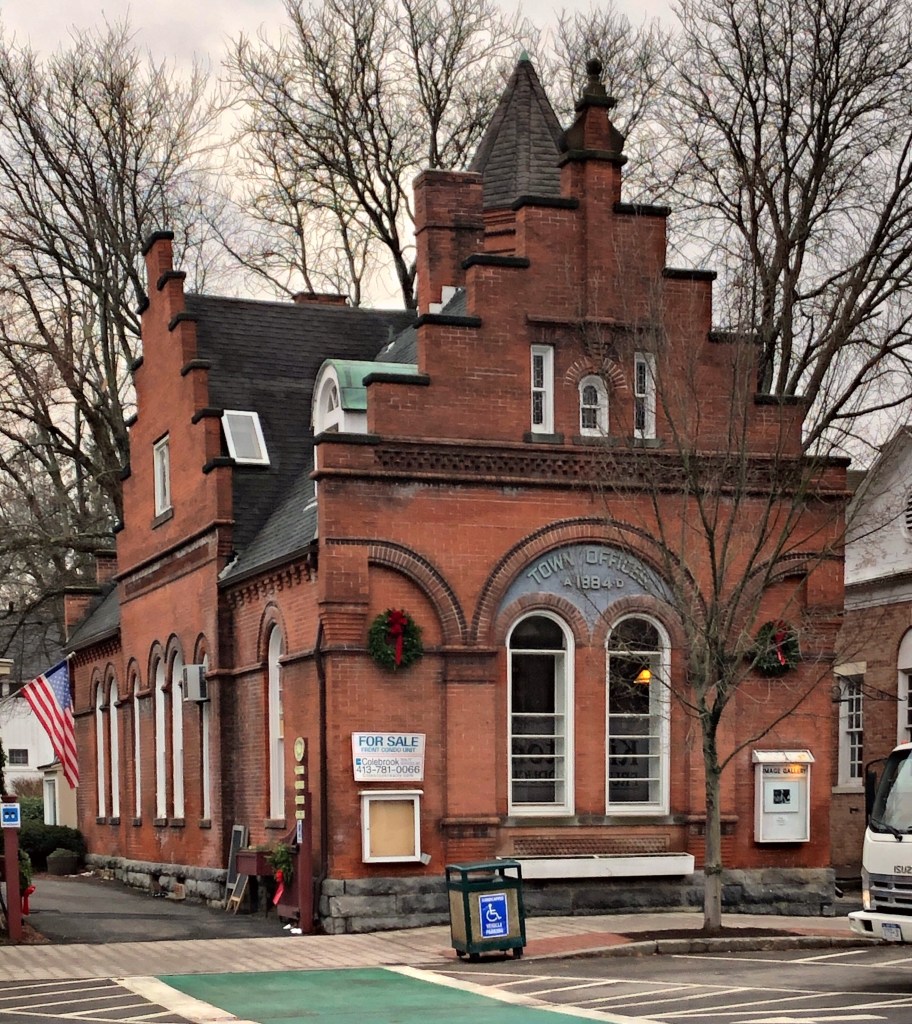
Built in 1884, the Town Office Building on Main Street in Stockbridge, housed more conveniently located government offices and came equipped with a basement jail. The building was constructed of brick to protect town records from fire and the adjacent buildings. The architecture is Flemish Revival with its stepped gables, a tower, and terra cotta and stained glass ornaments, a distinctive and different type of architecture on Main Street. The building was occupied after the Town Hall, further down Main Street, was deemed inadequate. The building displays the words “Town Offices” with the date 1884 A.D. as the town was sure to label the building as town offices over ‘town hall’ so they could retain the former town hall building after a deal with the First Congregational Church. The town sold the building to private owners in 1960 and has since been used as commercial space.
The Town of Stockbridge, MA was incorporated on June 22, 1739. After that time the town held meetings and conducted business in the First Congregational Meeting House until 1840 when this Greek Revival town hall building was erected on the church’s property as a gift. A stipulation was made that if the Town government constructed or moved to a new town hall building, the property ownership would revert to the Church. The town outgrew the building and constructed a new building toward the center of town, but named it Town Offices, a cheeky way to retain ownership of this building. Eventually, that building too was outgrown, and the town hired Pittsfield-based architect Harry E. Weeks to modify and enlarge the building in 1903, in the Neo-Classical style to compliment the original Greek detailing. As expected, the town moved again in the 2000s to a former school, on Main Street, but again retained the building.
Stockbridge, Massachusetts was settled by English missionaries in 1734, who established it as a praying town (an effort to convert the local Native American tribes to Christianity), for the Mohican tribe known as the Stockbridge Indians. The township was set aside for the tribe by English colonists as a reward for their assistance against the French in the French and Indian Wars. From this, a Yale-educated missionary, John Sergeant began converting native people to Christianity, essentially stripping them of their own religious culture and practices. Although Massachusetts General Court had assured the Stockbridge Indians that their land would never be sold, the agreement was rescinded. Despite the aid by the tribe during the Revolutionary War, the state forced their relocation to the west, to New York and then to Wisconsin. The village was then taken over by British-American settlers who created the township.
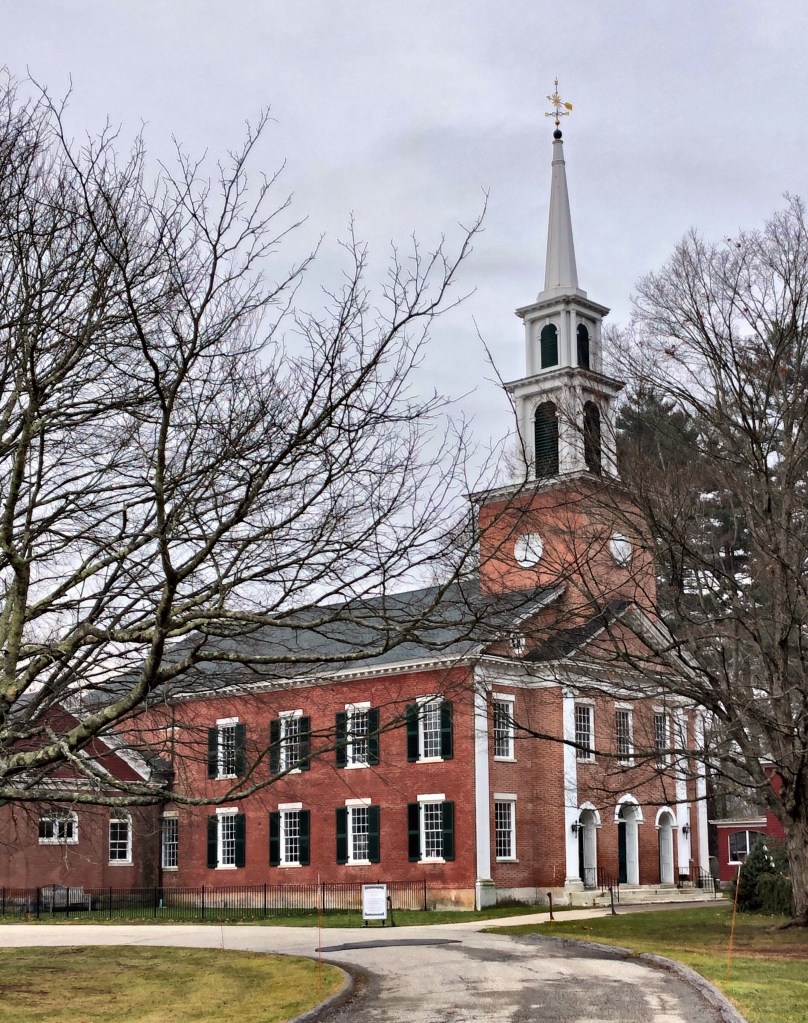
The first congregational church here was formed by Sergeant in 1734, and later succeeded by Jonathan Edwards, another minister. During his time in Stockbridge, Edwards wrote his masterpiece, Freedom of the Will, which remains one of the most studied works in American theology. Edwards later left the church to become the President of The College of New Jersey, now known as a little school by the name of Princeton. The first church was built in 1739, later replaced by a second church building that stood from 1785 to 1824. The present brick building was built in 1824 in the Federal Style. The space was occupied for town functions until the 1840s, when an official town hall was erected next door, demarcating the separation of church and state. The stunning church marks the immense influence religion had in the early colonial days of New England and the impact it had on native peoples (for better or worse).


 Buildings of New England