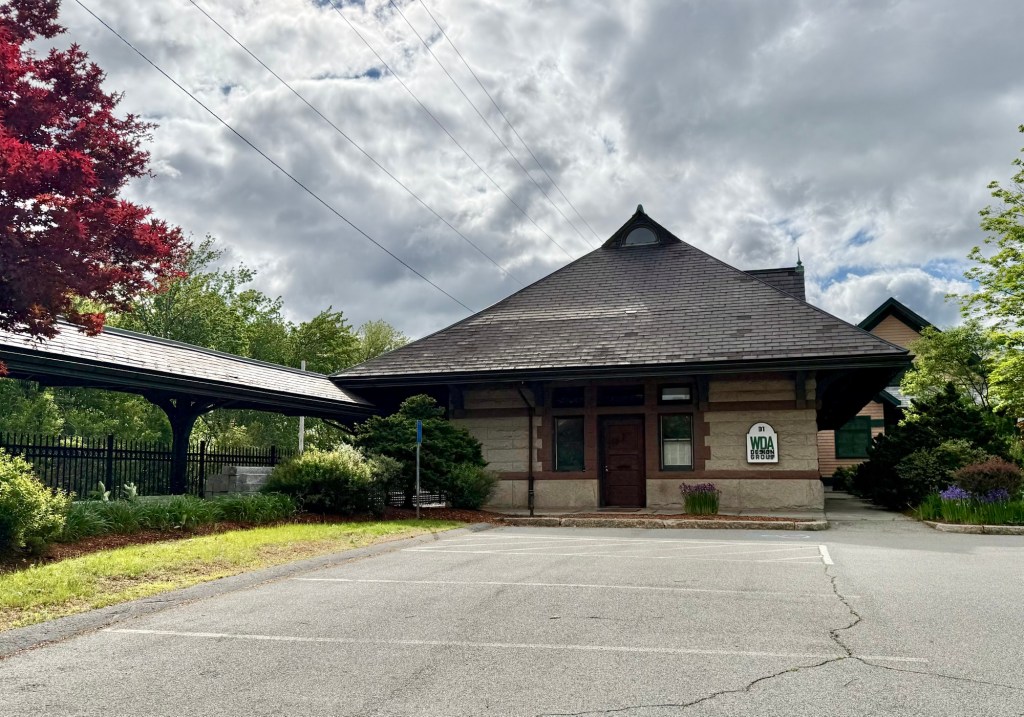
The Boston-Worcester Railroad roared into Westborough Square in 1834 and opened the once rural community to commerce and trade from its larger neighbors. The depot was in the center of the village and facilitated a development boom of commercial buildings. By the later 19th century, the Boston and Albany Railroad controlled the railway service and had built up an extensive passenger and freight service. The company sought to straighten out the track, thus increasing its speed and efficiency, so the B&A relocated the track in 1899 from the center of Westborough to its present elevated site on East Main Street, outside the commercial core of the town. The new station was built in 1899 and is a late example of the region’s many Richardsonian Romanesque stations, constructed of rusticated pale granite with contrasting brownstone trim; copper ornament; and a simple rectangular-plan structure topped by a low, overhanging hipped roof. Decades before this station was built, the Boston & Albany Railroad in 1881, hired renowned architect Henry Hobson Richardson to design a series of passenger stations. Over the next five years, Richardson was responsible for nine B&A stations, primarily closer to Boston and the nearer suburbs. After Richardson’s death in 1886, the B&A commissioned his successors, Shepley Rutan & Coolidge, to design 23 additional stations between 1886 and 1894. The unofficial style of B&A stations remained after 1894 and was employed in Westborough to a lesser ornate scale. Train service to town ceased here, but the tracks remain active. The former station was converted to office use.

 Buildings of New England