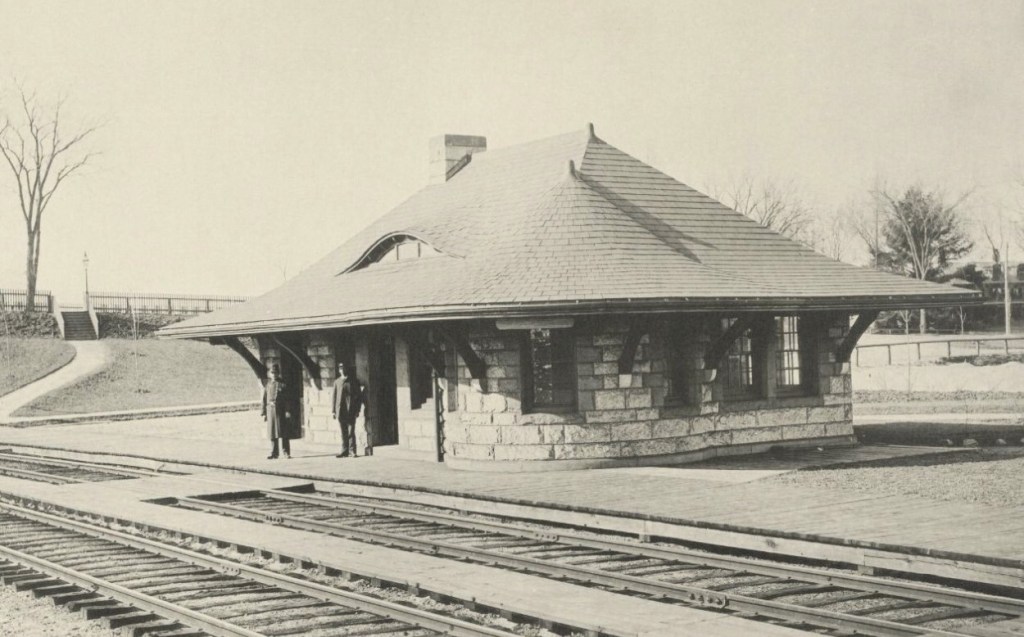
Waban Station // 1886-1958

Image from Harvard Archives.

The village of Waban in Newton, Massachusetts, was named after a Massachusett Chief who had previously resided atop Nonantum Hill on the Newton-Brighton line. This location is believed to have been a favorite hunting ground for Waban (the Wind) and his people. Throughout much of the 19th century, Waban remained a quiet agricultural region. As late as 1874, fewer than 20 families held title to all of its land. In the mid-1880s, however, interest in suburban developments near the Boston and Albany Railroad became increasingly widespread. Seeing suburbanization in the late 19th century and into the early 20th century.

The station that allowed all the development in the early days of Waban was built in 1886. The Boston & Albany Railroad hired renowned architect Henry Hobson Richardson to design the station, and many others on branches of the various lines radiating out from Boston. The Highland Branch (which this station was on) was later acquired by the MBTA in Boston, which operated it as a Commuter line. Waban Station closed along with the rest of the Highland Branch commuter rail line in 1958 and reopened a year later in 1959 as part of the Green Line’s D Branch. The gorgeous H.H. Richardson-designed station was demolished in order to build a 74-space parking lot. They literally paved paradise, and put up a parking lot

Massachusetts Normal Arts School // 1886-1967

The Massachusetts Normal Art School was one of the many Richardsonian Romanesque buildings constructed in the Back Bay, but it did not survive like so many others did. The building’s history goes back to the 1860s, when wealthy Bostonians petitioned for the Commonwealth of Massachusetts (State Government) to assist with the founding of new institutions to enhance the quality of life in the state. Due to this, the legislature funded three major institutions including the Massachusetts Institute of Technology (1860) and the Museum of Fine Arts (1870), and founded in 1873, the Massachusetts Normal Art School. The Normal Arts School was tasked with training future teachers for public schools and budding professional artists in the arts, with courses ranging from drawing to architecture. The Commonwealth of Massachusetts rented space in various buildings in Downtown Boston before they appropriated $85,000 and hired the firm of Hartwell & Richardson to design and oversee construction of the new school at the corner of Newbury and Exeter Streets. The Richardsonian Romanesque building was constructed of red brick and brown freestone, featured entrances on both street facades, and held gallery spaces inside for members of the public to view the work created at the school. The school outgrew the original building, which could comfortably fit just 100 students, and in 1929, a new building was constructed at Brookline and Longwood Avenues. Before moving one more time to its current location in 1983, the school was renamed to the Massachusetts College of Art and is best known as MassArt today. The original school in Back Bay was demolished in 1967 and was home to a surface parking lot before the existing building was constructed.