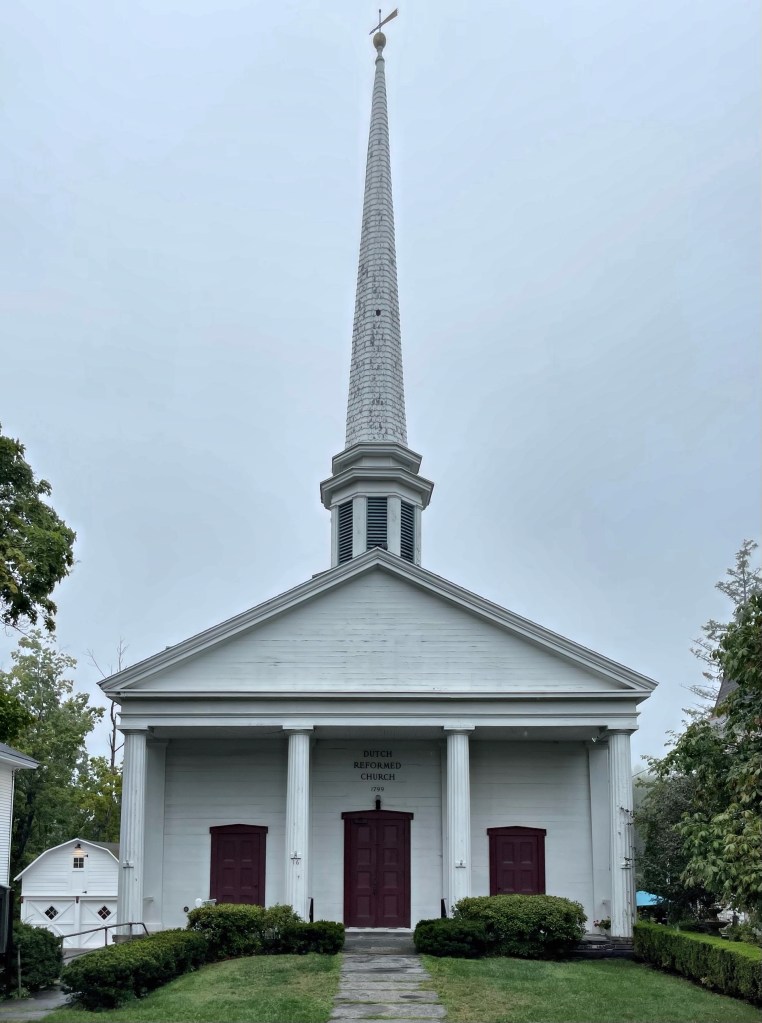
Woodstock Reformed Church // 1844

When Dutch and German colonists began to settle along the Hudson River Valley, they brought with them their own religious beliefs and desire for community in a new home. In the Village of Woodstock in Ulster County in 1799, the Dutch settlers began meeting in homes to worship establishing a church. By 1805, they petitioned the denomination for an organized church and purchased land, which is now known as the Village Green. In the heart of Woodstock, they built the first church structure. In 1844, that building was torn down for a new, Greek Revival place of worship on the outskirts of the Green. Architecturally, the church exhibits a prominent temple front with pedimented gable and Doric portico capped by an octagonal steeple. Inside, the sanctuary is lined on the walls and ceiling with decorative, pressed tin, which is apparently from the mid-19th century. The church remains very active in local and current events.

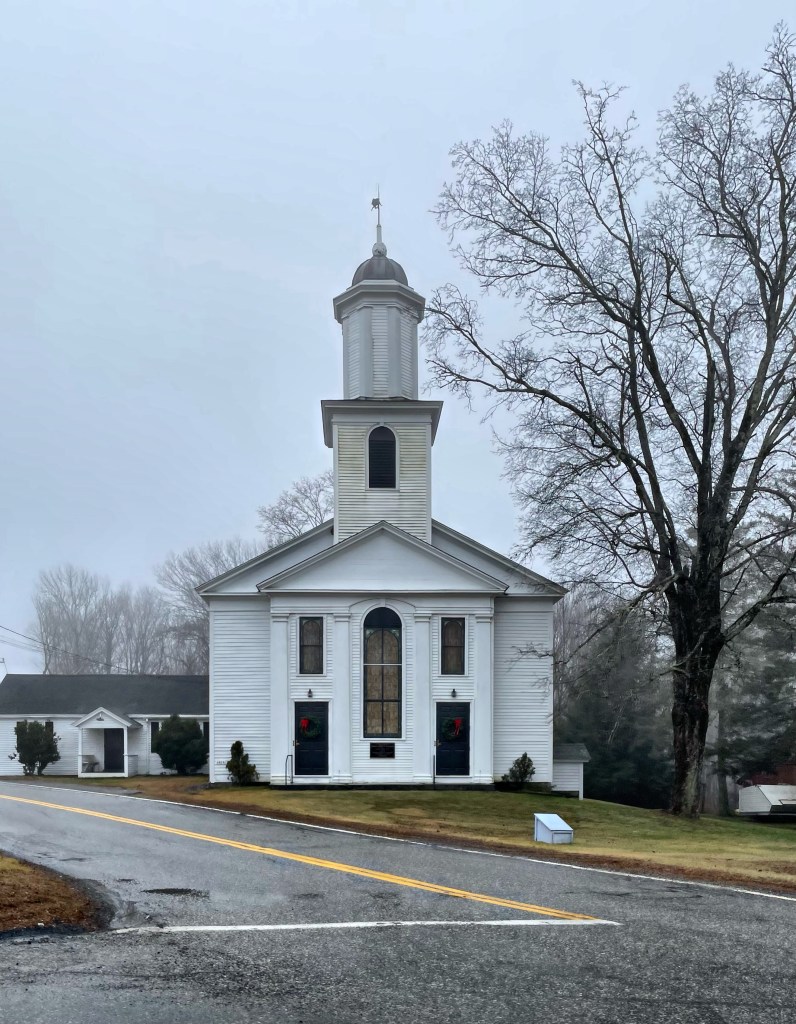
Old Baptist Meetinghouse, Willington // 1829

The Baptist Meetinghouse in Willington was built in 1829 by a local carpenter Albert Sharp, in a transitional Federal/Greek Revival style, common for the period. Its clapboarded facade has a projecting pavilion with two entrances flanking a two-story round-arched window. Four pilasters are surmounted by a wide entablature and the flushboarded pediment of the pavilion. Round-arched windows are repeated on the side elevations and the belfry, which is topped by an octagonal drum and a small dome. The Willington Baptist Church was organized in 1828, started by Rev. Hubbell Loomis, the fourth pastor of the Congregational Church across the common. Rev. Loomis was prominent both as a minister and an educator, and founder of Shurtleff College of Illinois. During his pastorate at the Willington Congregational Church, Mr. Loomis had strong tendencies toward Baptist sentiments. From this, membership of the congregational church split, some leaving for a new Baptist belief and others remained at the congregational church. The two congregations were split until 1911, when they again worshiped under the same roof, as the Federated Church of Willington, meeting in this building.

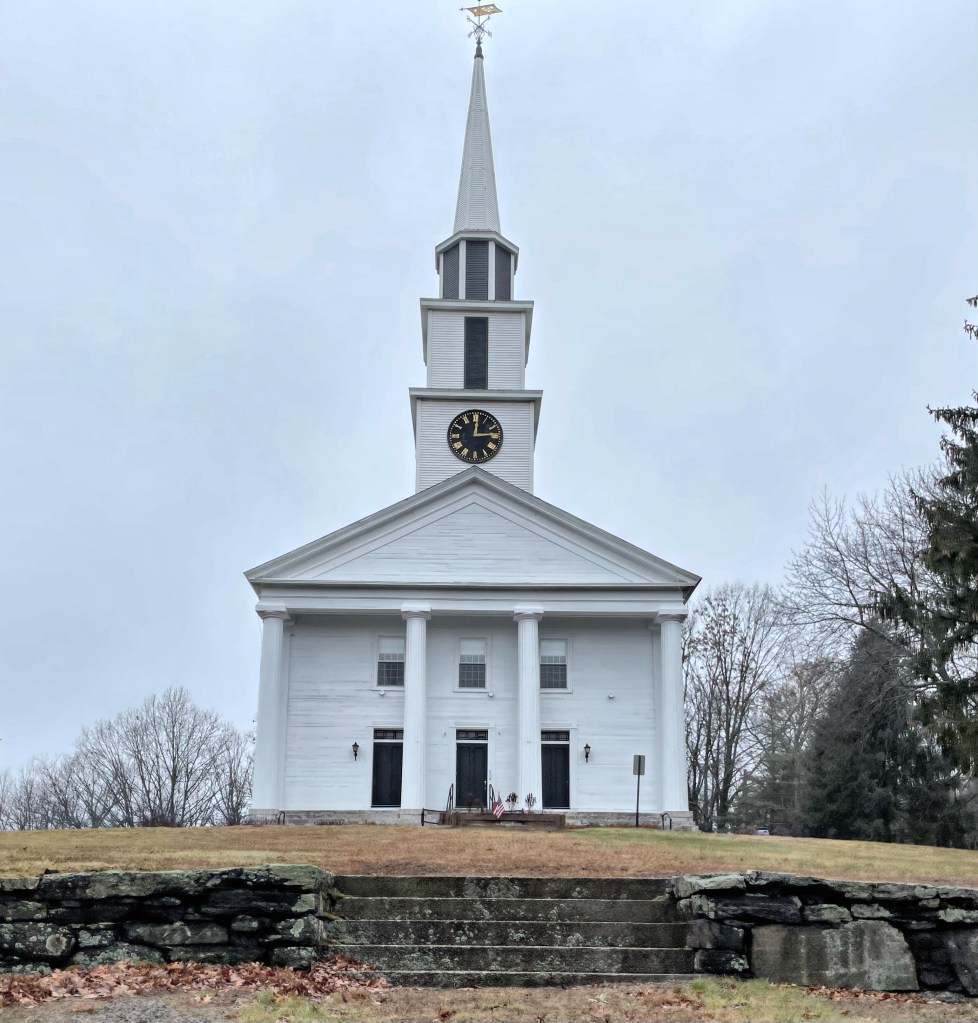
Bramanville Congregational Church // 1804

Not just your typical white New England church here… this one was moved! This church was built in 1804 in the north parish of Sutton (present day Millbury, Massachusetts). In the 1700s, the members of the northern part of Sutton petitioned to have a parish church of their own, rather than trekking across the large town to gather for town meetings and religious purposes. They were permitted to erect a parish church inn 1743, and built a church. The building was replaced in 1804, thanks to the wealth and new members of town moving there for manufacturing. Years later, the parish petitioned the Commonwealth of Massachusetts to have the North Parish of Sutton become the town of Millbury, due to the difference in needs being a mill town compared to Sutton’s more pastoral living, and they were designated as a town in 1813. The first town meeting of Millbury was held at First Congregational Church of Millbury that year on the town common. As industry along the Blackstone River picked up, so came waves of workers, many of whom were recent immigrants to New England. It was soon decided that the town church should relocate to provide a new center for town. In 1835, this church was moved about a mile away and erected high on a hill, in Bramanville village, a bustling industrial village. The church has remained in its location in Bramanville, even after the town center again moved, this time eastward to its present location. The Greek Revival style church elegantly reflects the significance of ecclesiastical buildings in early New England towns.