Bramanville Congregational Church // 1804

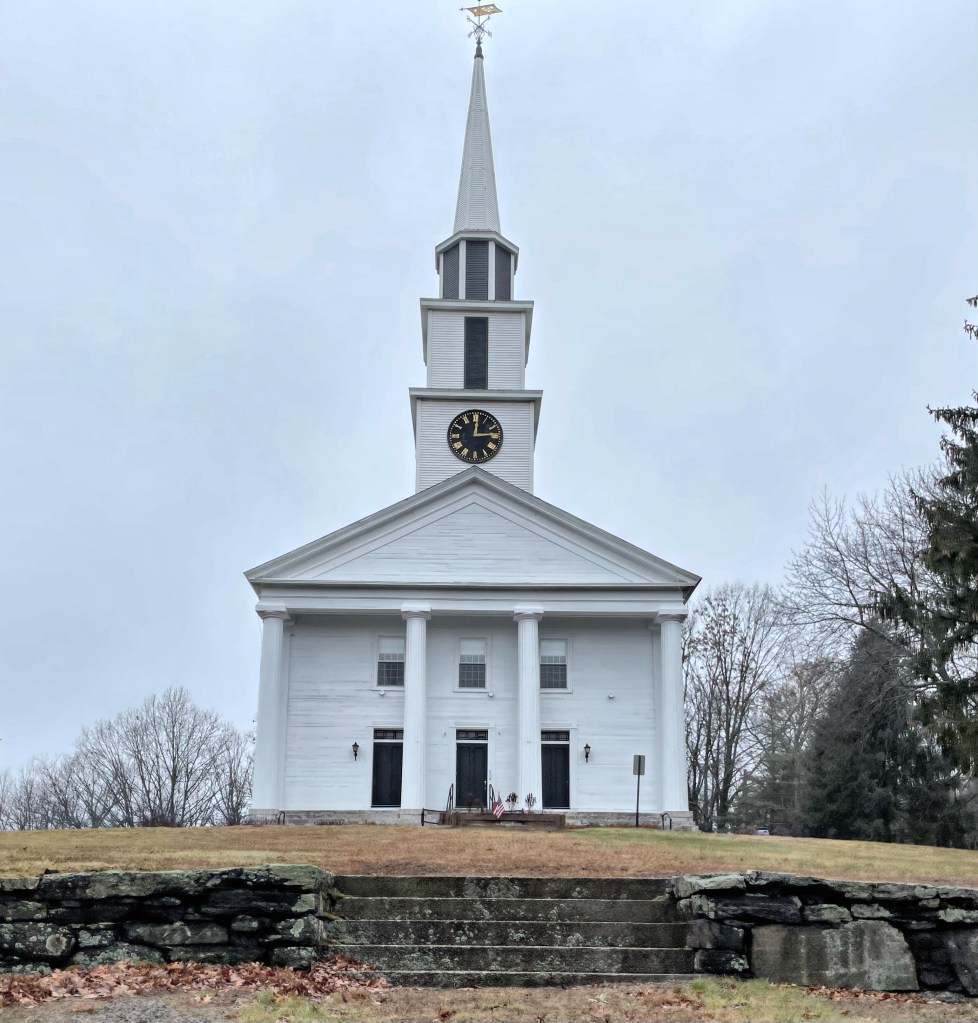
Not just your typical white New England church here… this one was moved! This church was built in 1804 in the north parish of Sutton (present day Millbury, Massachusetts). In the 1700s, the members of the northern part of Sutton petitioned to have a parish church of their own, rather than trekking across the large town to gather for town meetings and religious purposes. They were permitted to erect a parish church inn 1743, and built a church. The building was replaced in 1804, thanks to the wealth and new members of town moving there for manufacturing. Years later, the parish petitioned the Commonwealth of Massachusetts to have the North Parish of Sutton become the town of Millbury, due to the difference in needs being a mill town compared to Sutton’s more pastoral living, and they were designated as a town in 1813. The first town meeting of Millbury was held at First Congregational Church of Millbury that year on the town common. As industry along the Blackstone River picked up, so came waves of workers, many of whom were recent immigrants to New England. It was soon decided that the town church should relocate to provide a new center for town. In 1835, this church was moved about a mile away and erected high on a hill, in Bramanville village, a bustling industrial village. The church has remained in its location in Bramanville, even after the town center again moved, this time eastward to its present location. The Greek Revival style church elegantly reflects the significance of ecclesiastical buildings in early New England towns.
Levi Gale Mansion // 1835

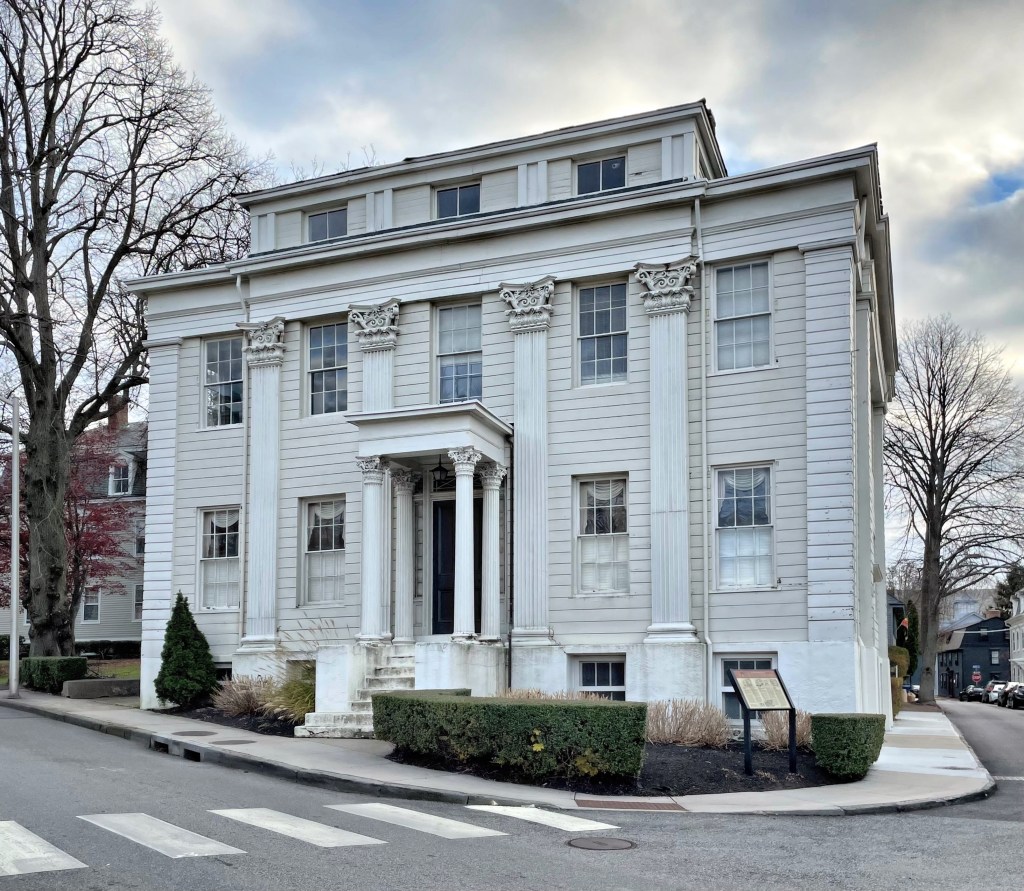
One of my favorite houses in Newport, Rhode Island is this amazing high-style Greek Revival mansion across from the Touro Synagogue. The house was built in 1835 for Levi Gale, and designed by esteemed Rhode Island architect Russell Warren. Gale was born in New Orleans and moved to Newport and is listed as a merchant. It is possible that Levi Gale was involved in the Triangular Trade, the trading of enslaved people, sugar (often in its liquid form, molasses), and rum between West Africa, the West Indies and Rhode Island. Many do not realize, but Rhode Island was heavily involved in the slave trade. The house follows the more traditional Federal form, but with two-story composite pilasters and flush siding, scored and painted white to resemble ashlar marble. The home is elegantly sited, but it is actually not on its original lot. It was actually built adjacent to Washington Square, in the place of the present Newport County Courthouse, and was moved to its present site in 1925. The mansion was cut in half, moved a block away, and re-assembled on a new foundation. It is now used as a Jewish community center, owned by the congregation that owns Touro Synagogue.

Alfred Smith House // c.1843

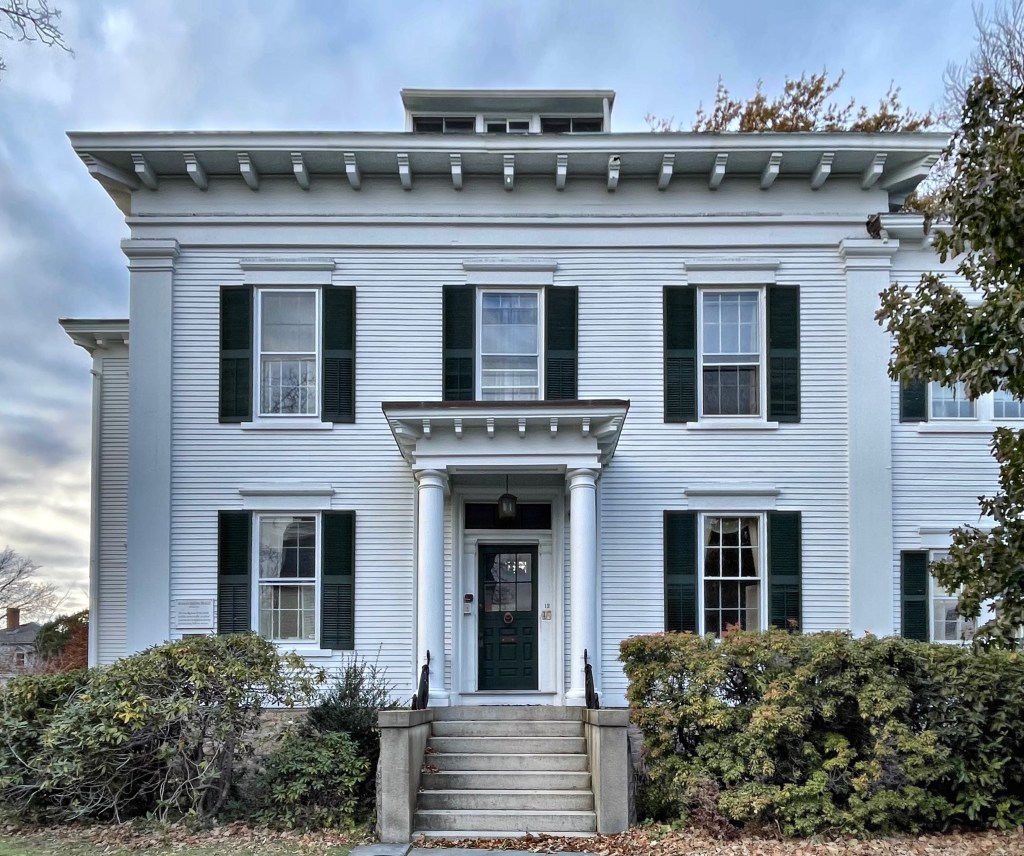
Alfred Smith (1809-1886) was known as “Newport’s Millionaire Real Estate Agent”, working in the mid-late 19th century to get some of America’s most well-connected upper-class acquire properties to build their summer cottages. In his early days, he prospered by assisting prospective developers and buyers to purchase house lots on newly platted streets, including Bellevue Avenue. By the time of his marriage in 1843, he built this stunning Greek Revival mansion, equipped with stunning proportions and corner pilasters. Decades later, to “keep up with the Joneses”, he modernized the house by extending the eaves and adding brackets and the addition of a belvedere at the roof. He was instrumental in much of Newport’s later development, even bankrolling the erection of a stone bridge on Ocean Avenue, to allow carriages and subsequent developable lots to extend in the previously untouched land in south and west Newport. He suffered a stroke in 1886, and died a year later, two years after his late wife. He funded a monument to the family, hiring Augustus St. Gaudens to furnish a stunning memorial “Amor Caritas” which stands in Island Cemetery in Newport. Mr. Smith’s estate was mentioned in the New York Times and stated there was no will, and his four living children would each get upwards of $1 Million (nearly $30 Million a piece based on inflation today)!

Soudant House // c.1850

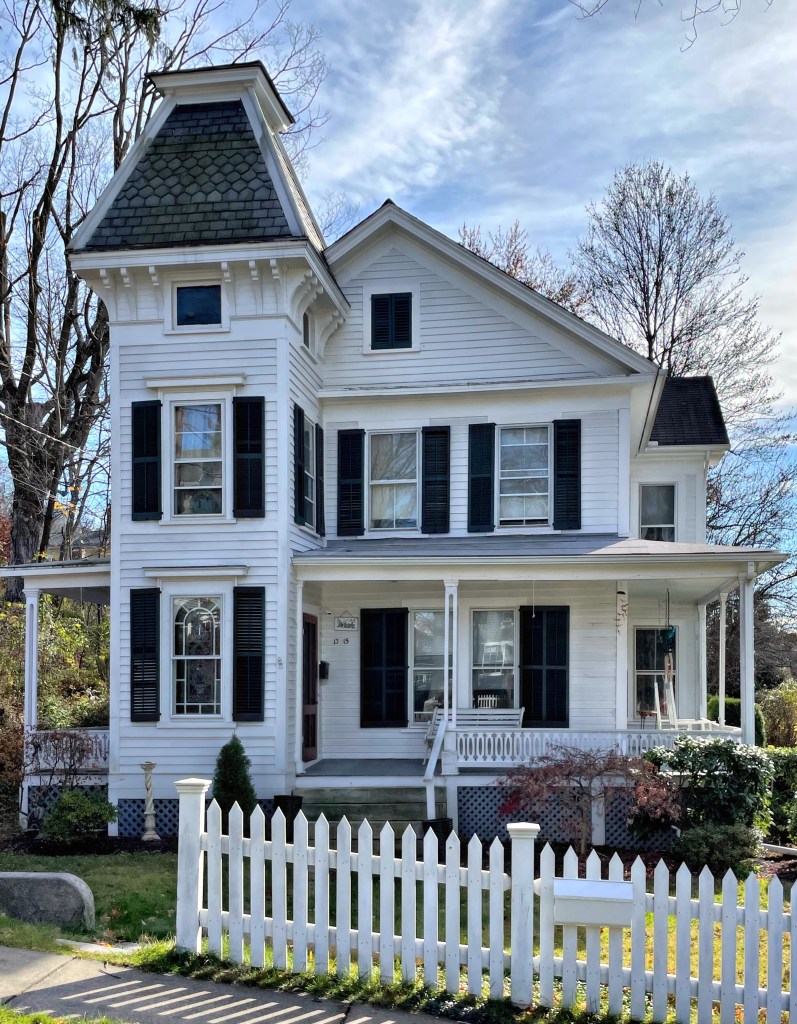
This eclectic house in Collinsville was likely built in the mid-19th century in the Greek Revival style, with its gable roof serving as a pediment. By the end of the 19th century, the prominent corner tower with mansard roof and porch were added to create the oddly pleasing composition we see here today. The home was likely altered by Walter Soudant, who ran a grocery store in the village out of the Valley House (last post). Walter’s daughter, Belle Julie Soudant, was an established singer, who toured Europe before accepting a position as a singing teacher at the Institute of Musical Art in New York, known today as the Juilliard School.

Collinsville Congregational Church // 1858

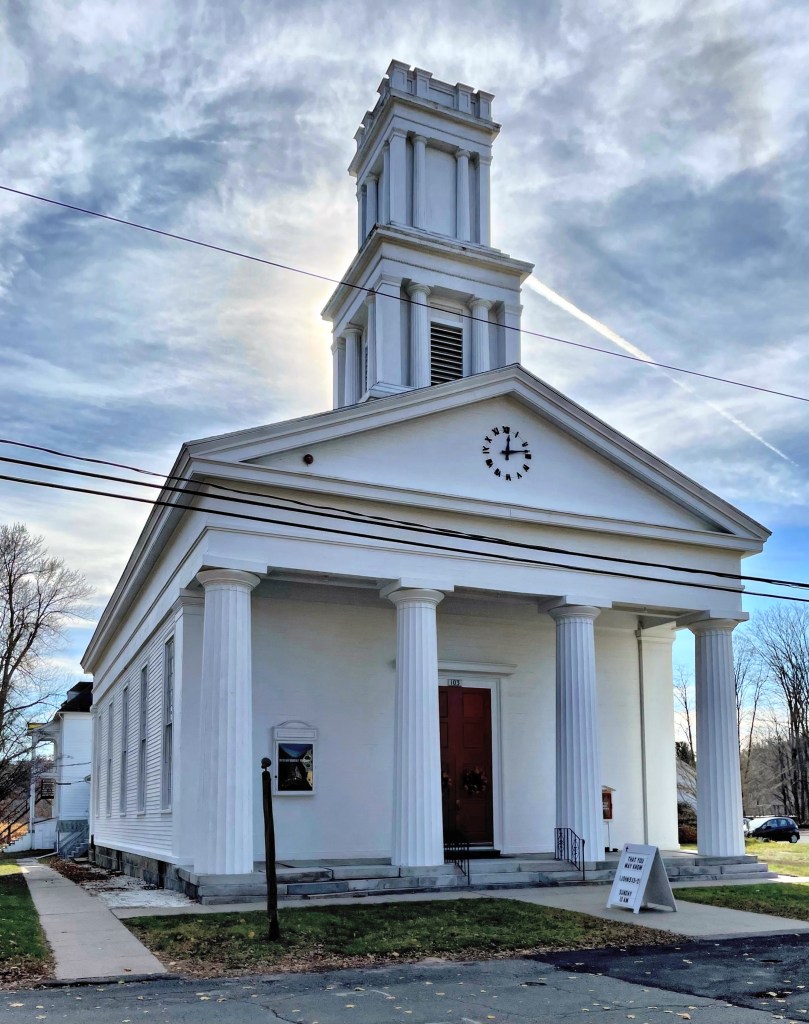
Shortly after Collins and Company was founded in 1826, religious services were held in various homes in the South Canton Village which came to be known as Collinsville. In 1830, the Collins Company erected its first office building on Front Street, and religious services were held there on the second floor. The first church building was erected on land bought by Collins and Company in 1826. By the mid-1850’s, the church membership was outgrowing the building. Although there may have been plans to enlarge the building, tragedy struck and in January 1857, and the church was consumed by fire, which started in the chimney, during a winter storm. The current building was erected almost immediately and dedicated on February 25, 1858. The present church is a grand Greek Revival style building, with a full pediment and large entablature supported by four monumental fluted columns. The two-tiered, square belfry has engaged columns as well. What a great example of a New England church!

South Canton Center School // 1848

Located across the street from the Canton Congregational Church (last post) you can find the cutest one room schoolhouse in central Connecticut. The schoolhouse, built in 1848, was one of nine one-room schoolhouses in Canton at the time. The perfectly proportioned classically designed school features two front doors, one on each side of the recessed entry, with the right door for girls and the left for boys. There were also two outhouses behind the building for students and the teacher. This building served the community as a school until 1942. In the years following, the building was used as a meeting place for women from the congregational church, a community library, and a small public space for members of town. It is owned by the Congregational Church, who maintain it to this day.

Thomas A. Hill House // 1836

One of the nicest homes in Bangor, Maine, is the 1836 Thomas Hill House, a stunning Greek Revival home constructed of brick just outside downtown. The home was built for Thomas A. Hill (1783-1864), a lawyer and banker in town. He clearly made substantial money in his time in Bangor, because he hired architect Richard Upjohn, who was in town at the time overseeing designs for his first church St. John’s Episcopal Church (burned in 1911) and the Farrar Mansion. Thomas Hill suffered financial losses during the Panic of 1837 and the bank foreclosed on his properties. The bank allowed him to stay in the house and pay the insurance, heat and taxes until the home was sold by the bank to Samuel and Matilda Dale, who purchased the home in 1846. Mr. Dale came to Bangor in 1833 as a sail-maker. Eventually he would own grocery and ship chandlery businesses downtown before serving as Mayor of Bangor from 1863-1866 and again in 1871. The Sons of Union Veterans bought the house in 1942 and named it the Grand Army of the Republic Memorial. During 1952 the Bangor Historical Society was allowed to use the house, which was placed on the National Register of Historic Places in 1972. In 1974 the house was deeded to the Bangor Historical Society, who occupy the home to this day.

Bangor House // 1832

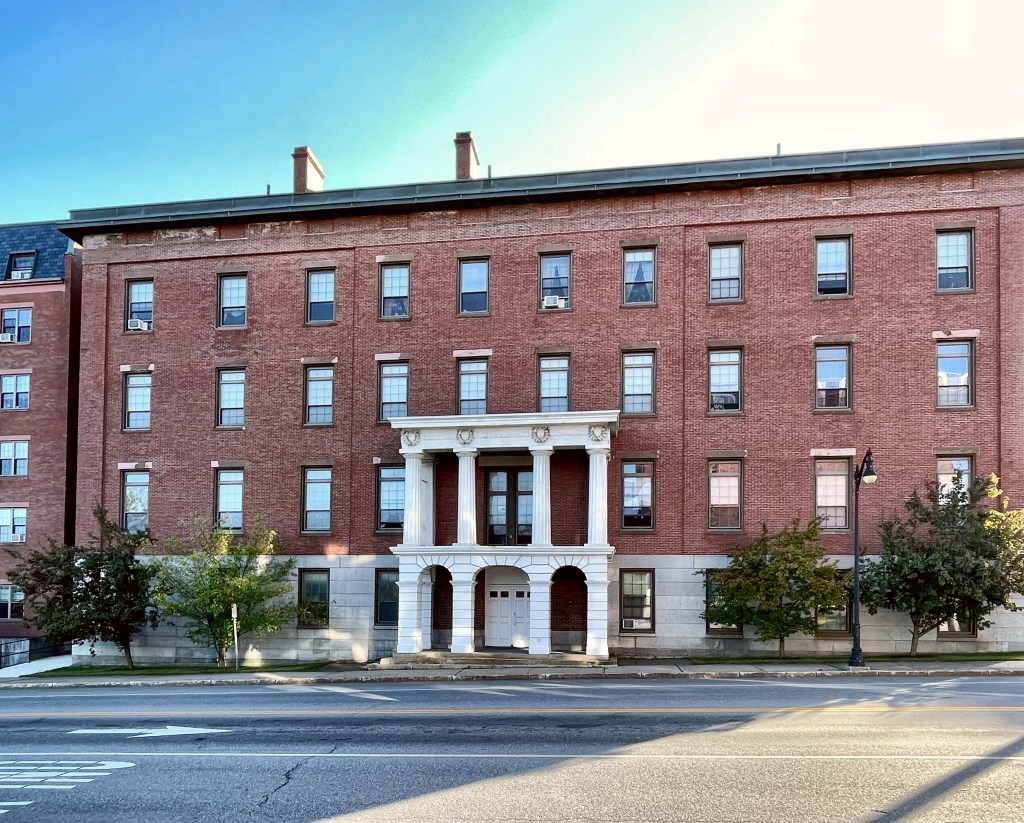
In the first couple decades of the 1800s, Bangor, Maine, became the capital of the timberlands of the state, as thousands of acres of untouched forests were sold for lumber harvesting and shipping to other developing parts of the region. The massive cedar trees were shipped by rail and boat to cities like Boston, which lacked such large lumber. At the time, a group of wealthy lumbermen in Bangor wanted a hotel which would impress investors and visitors to the frontier town. Inspired by The Tremont House in Boston, an 1829 hotel that was then regarded as one of the pinnacles of luxury accommodation. The investors hired architect Isaiah Rogers, the same architect who designed the Tremont House years earlier, to design the Bangor House. The two hotels are strikingly similar in design. The hotel expanded numerous times over the decades, until the 20th century, when the town’s prosperity began to falter. Many of the additions have since been torn down as part of the building’s conversion to apartments, replaced by modern residential wings which are much lesser quality of design and construction. Thankfully, the historic core of Bangor House remains very well preserved and as it did nearly 200 years ago!

Zebulon Smith House // 1832

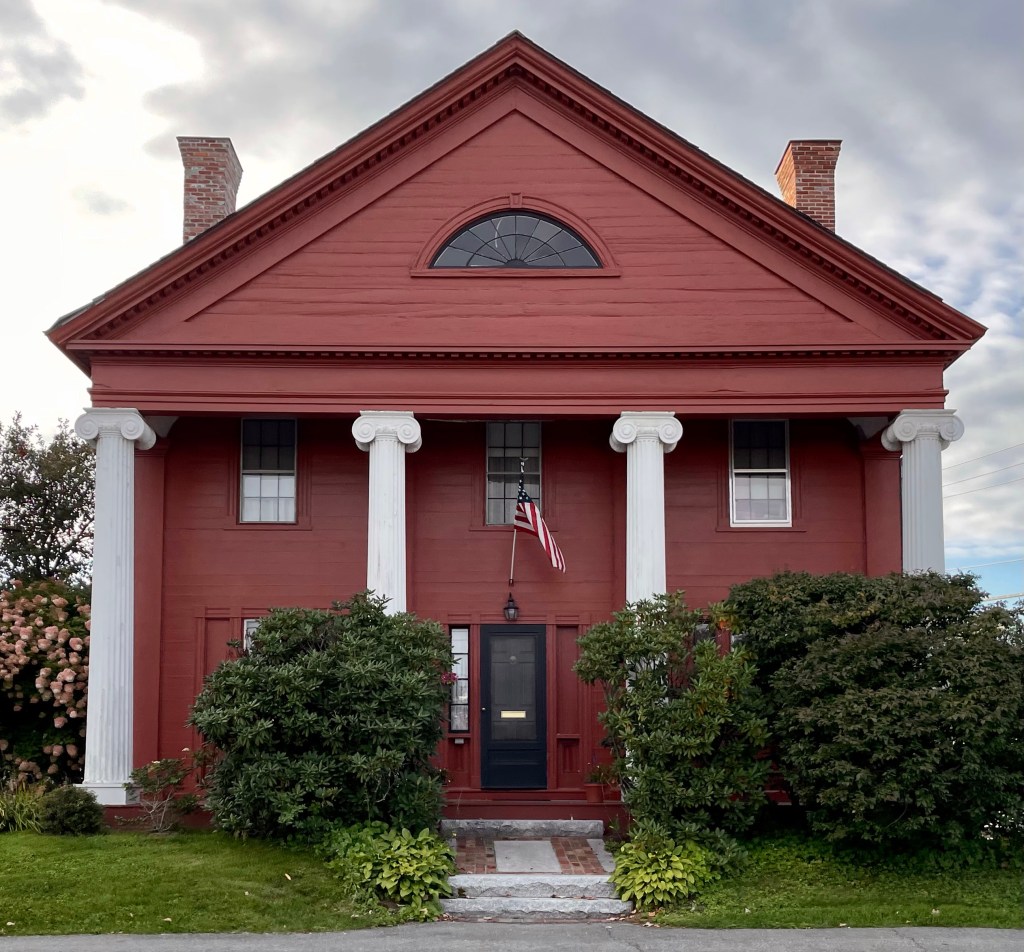
The Zebulon Smith House in Bangor is one of the earliest temple-front Greek Revival homes built in the state of Maine. The house was constructed in 1832 for Zebulon Smith, a businessman who moved to the Maine frontier in the early 19th century, likely to get involved with a lumberyard as this section of the state shipped timber all over the region. The substantial home was built just south of downtown Bangor, and has survived fire and urban renewal. It sits alone in a sea of parking lots and industrial buildings in what was once likely a lovely neighborhood.

Isaac Farrar Mansion // 1836

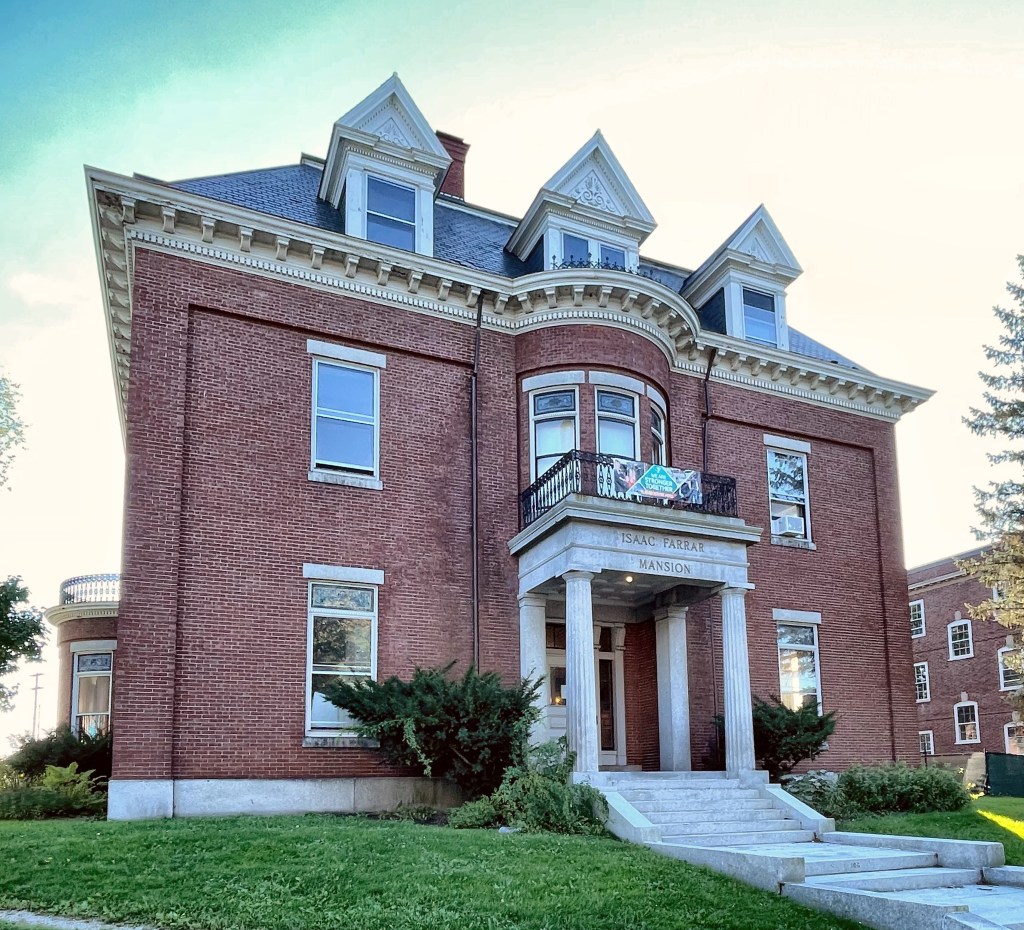
The Isaac Farrar Mansion in Bangor, Maine not only looks gorgeous, it is significant as the one of the first known works of architect, Richard Upjohn. It is important because it shows that English-born Upjohn, who is best-known for launching the popularity of the Gothic Revival style in the United States, began his career by building in the Greek Revival style, the traditional style of the time. This mansion was designed for Isaac Farrar, a lumberman and merchant, and later, President of the Maritime Bank of Bangor. Charles B. Sanford, who lived in the house from 1865-1878, was proprietor of the Sanford Steamship Lines. The home had a few more subsequent owners until 1911, when it was acquired by the University of Maine Law School, which used it as a residency until 1929. It was soon after purchased the Bangor Symphony Orchestra, who renamed it “Symphony House”, and operated the Northern Conservatory of Music on the premises, also hosting the music branch of the Bangor Public Library. In 1972 the school closed, and the symphony sold the building the following year to the local YMCA, which now uses it as an exhibit and reception space. While some aspects of the house look to be from the early 20th century, it retains much of the Greek Revival design by Upjohn. Talk about a full history!