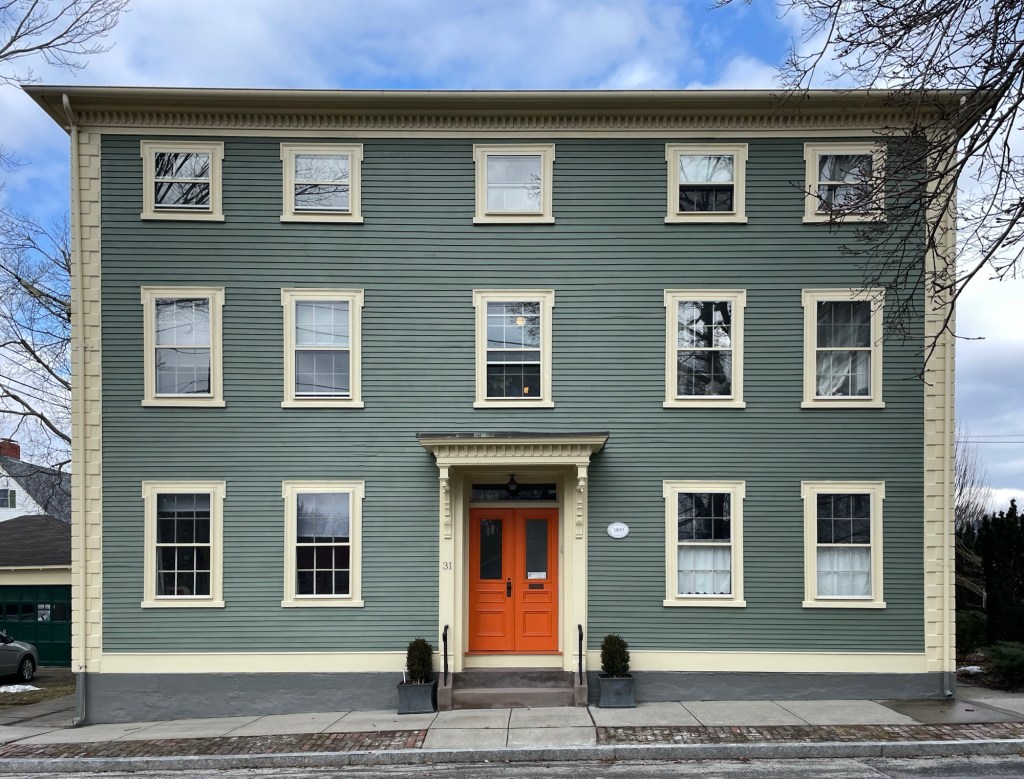
Judge Samuel and Patty Randall House // 1809

This stately three-story Federal style mansion on Baker Street in the lovely town of Warren, Rhode Island, was built in 1809 as a gift from a father to his daughter as a wedding gift. The house was funded by James Maxwell, of the local family of merchants and slave traders, for his daughter Martha “Patty” Maxwell and her soon-to-be husband, Samuel Randall. Judge Randall operated a school in town and published three local newspapers, the Telescope, the Clarion, and the Telegraph, all rather short-lived. In 1822, he was appointed judge of the court of common pleas for Bristol County, Rhode Island, and served in that capacity until 1824, when he was made justice of the supreme court of the state. The pop of color at the entry and the bracketed, Victorian era door hood complete the facade to give it some serious curb-appeal.
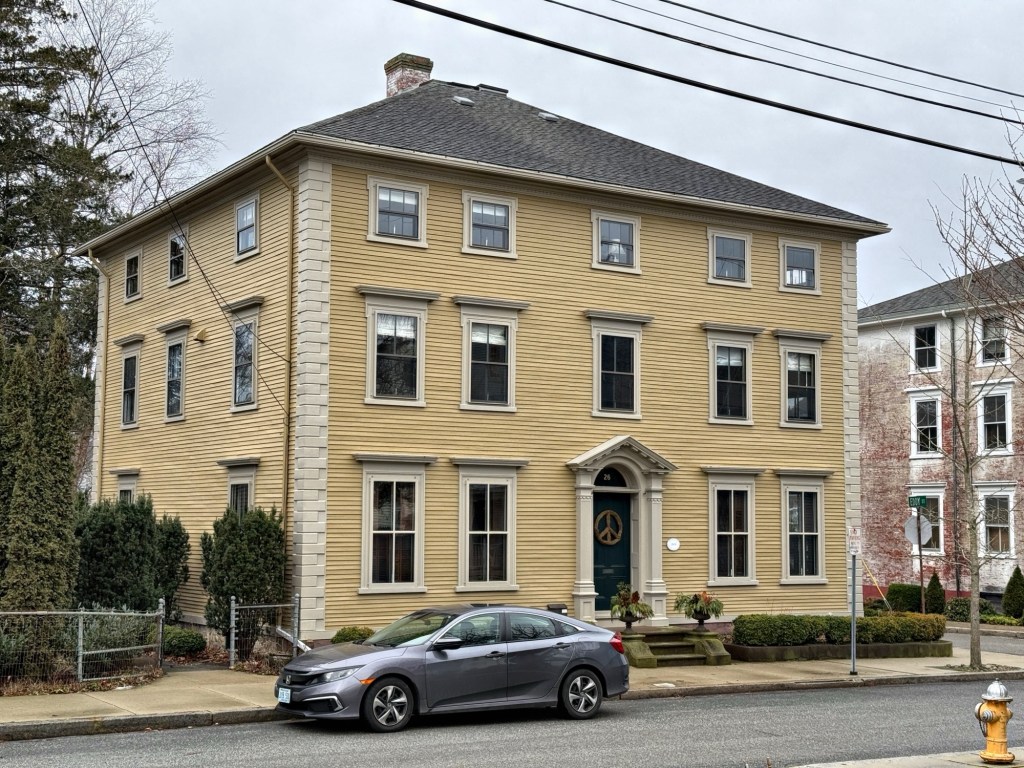
Rebecca Maxwell Phillips House // 1806

The Rebecca Maxwell Phillips House at 26 State Street in Warren, Rhode Island, is one of the state’s finest examples of the Federal style of architecture, though the building was funded through profits off of enslaved people. The house was funded by Warren resident, Squire James Maxwell for his daughter, Rebecca, and is traditionally said to have been a wedding present or possibly a gift to potential suitors to his daughter. The Maxwell family’s immense wealth was partially resulted from the illegal sale of enslaved Africans, including those illegally transported on his schooner, Abigail, which left Warren in September 1789. The captain of the vessel, Charles Collins, purchased 64 slaves on the coast of Africa, and sold them in the Americas by June of 1790. Of the 64 captives embarked on the ship, only 53 survived the voyage. This home was occupied by Rebecca Maxwell and her new husband, William Phillips. The three-story mansion exhibits a pedimented fanlight transom, corner quoins, and a shallow hipped roof. The property is located on an oversized lot which contains a massive Japanese Beech tree in the side yard, which is said to have been brought from Japan by Commodore Joel Abbot, who lived nearby, in 1853.

Maxwell-Barton House // 1803

Built in 1803 for Captain Level Maxwell (1754-1828), this five-bay, Federal style house built of brick, is located on Main Street in Warren, Rhode Island, and has ties to the community’s maritime past. The original owner, Level Maxwell, was a member of the wealthy Maxwell Family who built their wealth in shipbuilding and the triangle trade. Level Maxwell was a captain and invested in ships, including the schooner Abigail, which would become Warren’s first slave ship in 1789, two years after slave trading had been declared illegal for Rhode Island residents. The Abigail was designed with a middle deck less than five feet high, where the kidnapped Africans would be imprisoned, with sources stating that 64 African men, women and children were forced onto the ship and then imprisoned for two months on the journey across the Atlantic. Eleven enslaved people died on the journey and were likely thrown overboard into the open sea, with the surviving 53 people sold into slavery in the Caribbean, with the Abigail returning home with the profits. It is unclear if Level Maxwell lived in this house or built it for sale, but the property was owned in the mid-19th century by George A. Barton, a merchant. The property was owned in the late 20th century by Mary King, who restored the old house and operated her antique store from the residence. Architecturally, the home exhibits many features of the Hazard-Gempp House nearby on Liberty Street, and was likely constructed by the same builder.