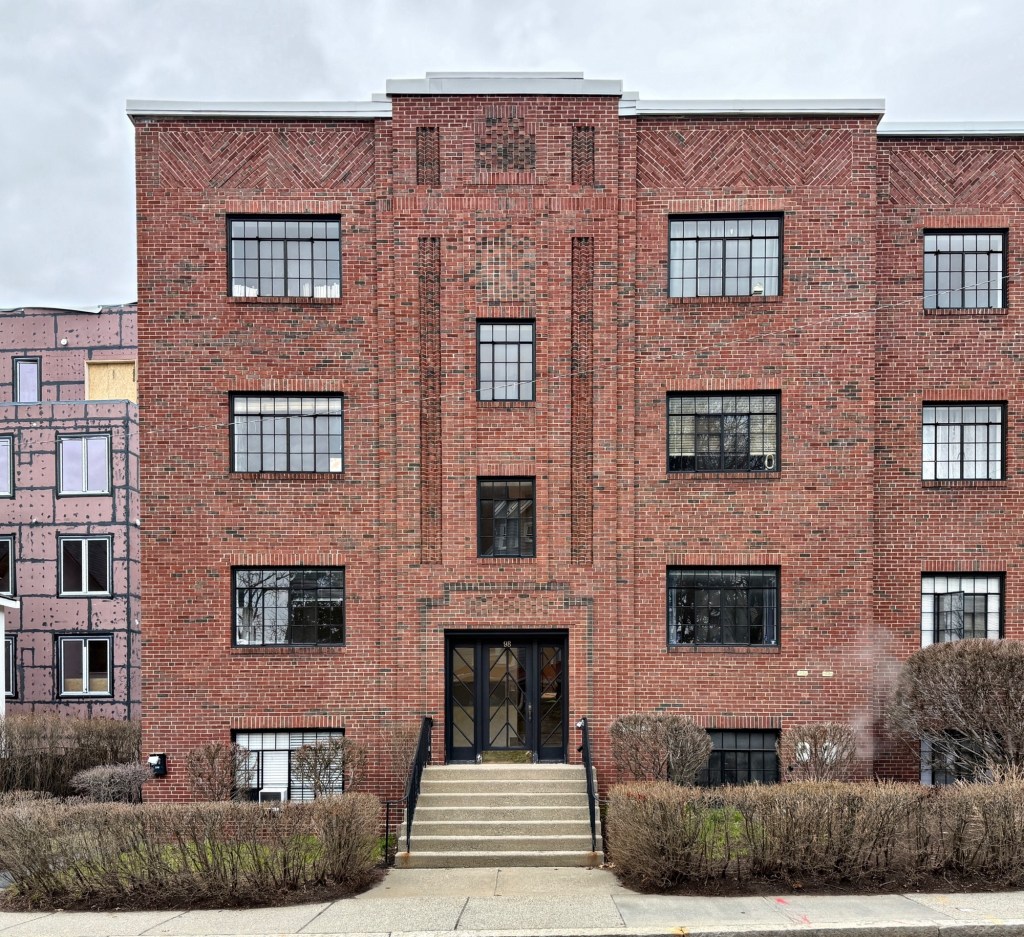
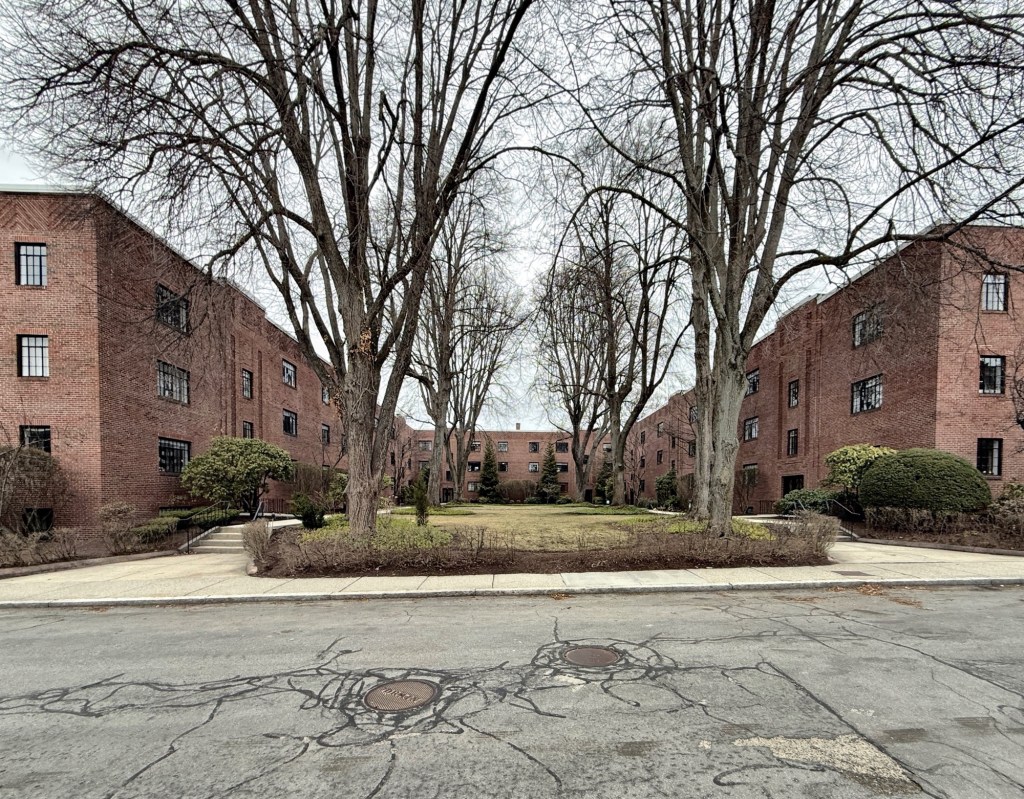
This garden apartment complex at 98-116 Sewall Avenue in Brookline is an excellent example of the Art Deco style which reached its height in popularity in the midst of the Great Depression, so fewer examples of the style are typically found. Here in Brookline, the city was seeing rapid development in the early decades of the 20th century, where large estates were subdivided and commercial areas expanded into once residential neighborhoods. U-shaped in plan and standing three-stories, this complex replaced a large property owned by the Stearns Family, a prominent local family with many properties around present-day Coolidge Corner. The apartments were developed by the G & S Investment Company, a real estate development firm, who hired architect, Saul Moffie, to design the building. Completed in 1938, the complex has richly articulated facades with a variety of geometric brick patterns, including chevrons, diapering, header courses and soldier courses with each entryway identified by a projecting pavilion with a stepped stone parapet above. The doors and sidelights are wood with glass panels in a chevron motif similar to the brickwork and all residential units have steel multi-pane windows. What a gem!

 Buildings of New England