Bull-Mawdsley House // c.1680

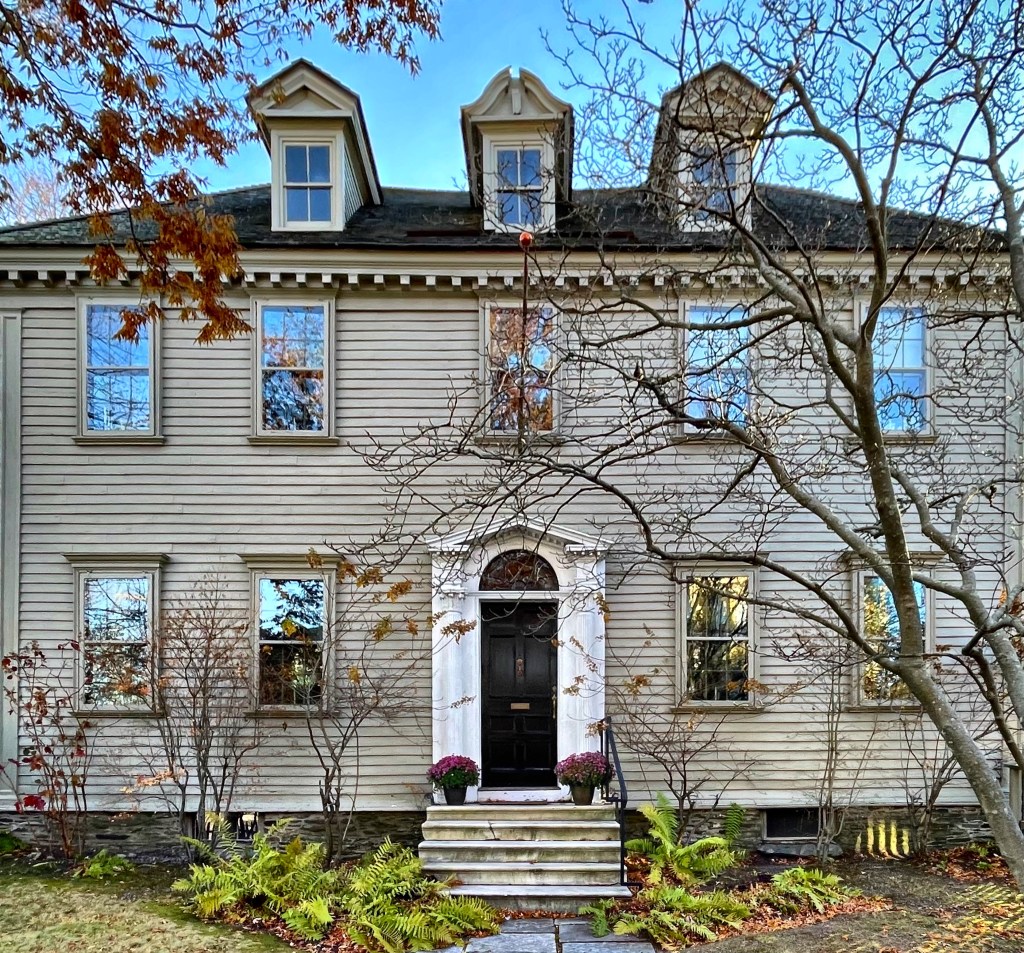
One of the oldest houses in Rhode Island, this beautiful home has a full history that will be hard to fit in a post, but here goes! The earliest, two-room rear part of this house was built around 1680, probably by Jireh Bull near the time of his first marriage to Godsgift Arnold, the daughter of Benedict Arnold, the first Governor of Rhode Island. After Bull’s death, the wealthy businessman and privateer Captain John Mawdsley acquired the house and he enlarged it in keeping with his prominent social status, adding elements inspired by the Georgian classicism. Mawdsley in 1774 owned 20 slaves, many of which likely worked on his ships as crew or cooks. He was a Loyalist, and fled Newport during the American Revolution. During the winter of 1780-81, this was the home of French Major-General François chevalier Beauvoir de Chastellux, who was third in command of French forces in America under the French expeditionary force led by general Rochambeau. After the War, Mawdsley was actually allowed to return to Newport, and resided at the home until his death in 1795. In 1795, after Mawdsley’s death, the house was purchased by slave ship captain and wealthy merchant Caleb Gardner, who is said to have brought thousands of humans in bondage to the shores of Rhode Island and in the Caribbean. Gardner is responsible for the Federal period entry and marble front steps we see today. The home was purchased by Historic New England in the 20th century, and was documented as part of the Historic American Buildings Survey. It is now a private home.

The Reefs Mansion – The Bells // 1885-1963

‘The Reef’ a fabulous Gilded Age estate in Newport was built in 1885 for Theodore M. Davis by the Boston architectural firm of Sturgis and Brigham. The elegant shingle and stone Queen Anne villa was erected as both a summer house and to house some of Davis’s vast collection of paintings and Egyptian artifacts, collected during his excavations in Egypt’s Valley of the Kings between 1902 and 1913. Besides the architecture of the home, the Reef Estate was also famous for its walled gardens, greenhouses, and outbuildings, sitting upon eighteen acres. overlooking the Atlantic Ocean. Following Mr. Davis’ death in 1915, Milton J. Budlong of Providence purchased the estate. Milton divorced from his wife Jessie in 1928, and it was MESSY. Their Newport summer estate was placed in contention. The house, never again lived in by the family. During World War II, anti-aircraft gun emplacements were set up around the grounds, with the mansion housing gunnery personnel. After the War, the estate was given back to the Budlong heirs, who did not reside there. Vandalized throughout the 1950’s, the villa was set on fire in 1961 and demolished two years later in 1963. In 1969, the waterfront property came under the control of the State of Rhode Island and in 1976, became a state park. The old carriage house/stable and a later observation tower (possibly converted from a former water tower) stand today.

The Old Breakers Mansion // 1878-1892

For my last post on this series on The Breakers in Newport, I wanted to highlight the original Breakers mansion. Built in 1878, the original Breakers was equally as significant, but a completely different style architecturally. The Breakers was constructed for Pierre Lorillard IV (1833-1901), a tobacco manufacturer and thoroughbred race horse owner from New York. In 1760, his great-grandfather, and namesake of the family company, founded P. Lorillard and Company in New York City to process tobacco, cigars, and snuff. The ‘cottage’ would serve as a summer retreat for Lorillard and his family for the summer months. The home was designed by one of the premier architectural firms in the country at the time, Peabody & Stearns, who specialized in high-style country estates. In 1885, Lorrilard used his family land in Orange County, New York, to lay out a new residential colony as a playground for New York’s wealthiest residents during the summer months. The colony is known as Tuxedo Park. He sold The Breakers to Cornelius Vanderbilt II in 1885 and the family would summer in the massive Queen Anne style estate for just seven years until a fire destroyed the home. The detached children’s cottage (also designed in 1878 by Peabody & Stearns) survived the fire and remains on the site. The Vanderbilt’s decided to erect a fireproof house immediately, and the result is the massive limestone mansion we can tour today.

The Breakers – Library // 1895

Tied as my favorite room with the Morning Room at the iconic Breakers Mansion in Newport, the jaw-dropping library is almost too good to be true. The library was designed to be the centerpiece of life for Cornelius Vanderbilt, who was always well-read. The walls are paneled with Circassian walnut cut in Europe and stamped with gold. The ceiling is coffered with more gold leaf. The fireplace in the library is probably my favorite in the mansion, which was acquired from a 16th-century French chateau, Chateau d’Arnay Ie Duc. The walls in the library and its smaller alcove are covered with wainscoting of Circassian walnut decorated with low relief carving and gold leaf; the walls above the woodwork are covered with panels of gold-embossed Spanish leather. Yes, leather walls! What is your favorite part of the Breakers Library??

The Breakers – Music Room // 1895

You know you’ve “made it” if you have a music room, especially if you have one in your summer mansion in Newport! The Music Room in The Breakers evokes the opulent Parisian interiors of the Second Period and when inside the room, you just feel sensory overload (in the best way possible. The room is located off the Great Room and Morning Room, at the southern end of the house. The Music Room was used for recitals and dances for the Vanderbilt Family and guests. The room displays ornate woodwork and furnishings designed by Richard Van der Boyen and built by J. Allard of Paris. The room looks like it was plucked out of a French building and dropped into the mansion, and that is because it was! The room’s interior was constructed completely in France and then sent to America where it was installed at The Breakers by French craftsmen. My favorite parts of the interior are the bay window at the end and the gilt gold coffered ceiling.

The Breakers – Morning Room // 1895

Possibly my favorite room in The Breakers mansion is the Morning Room, found on the first floor, just off the Great Hall and lower loggia. The Morning Room is executed in a late Renaissance style and faces east to catch the morning sun and provides sweeping views of the Atlantic. It served as a family sitting room at all times of the day. The interior design, including the fixtures, woodworking, and furniture, were designed by French architect Richard Bouwens van der Boijen and designer Jules Allard. The predominant grey, and gold colors of the Morning Room are echoed in its fireplace which is made of Campan marble. On the walls, you will find the most stunning shimmering silver wall panels, depicting ancient Greek goddesses. It was originally believed that these features were silver leaf, but the Newport County Preservation Society investigated further, determining it is actually platinum! The Vanderbilts clearly wanted this room to shimmer with the sunrise, so the use of platinum, which never tarnishes, was a great solution!

The Breakers – Great Hall // 1895

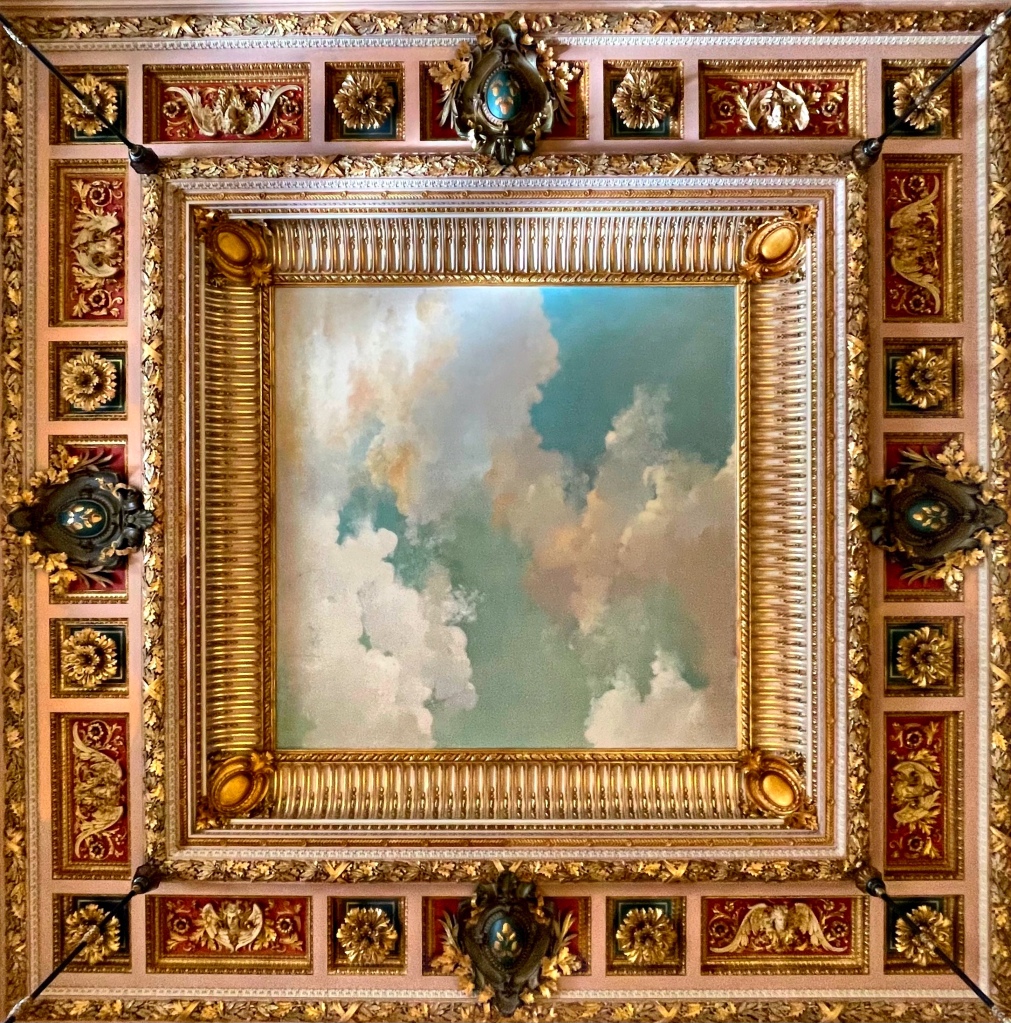
Merry Christmas from The Breakers! This 1895 Gilded Age mansion is the best to explore during December, when the halls are decked and stunning Christmas trees adorn the lavish rooms (learn more about the mansion in my last post) When you walk into The Breakers, you enter the Great Hall. Architect Richard Morris Hunt designed the Great Hall after the open-air courtyards in Italian villas, but enclosed due to the tough New England winters. The palatial space (measuring 50 foot square), even if crowded by tourists trying to get the perfect shot on their smartphones, feels spacious yet somehow welcoming given the art museum-like detailing. The walls are made of carved limestone from Caen on the coast of France and adorned with plaques of rare marbles. Elaborately carved pilasters decorated with acorns and oak leaves support a massive carved and gilt-cornice which surrounds a ceiling painted to depict a windswept sky, further expressing the open-air courtyard feeling envisioned by Hunt, the architect. Four bronze chandeliers dangle from the gilded ceiling, and flood the room with warm light, evoking warm summers in Italy.

The Breakers // 1895

The most opulent of all summer ‘cottages’ in Newport is the iconic Gilded Age mansion, The Breakers. This mansion was completed in 1895 as a summer residence for Cornelius Vanderbilt II. Cornelius’ grandfather, Commodore Cornelius Vanderbilt (1794-1877) established the family fortune in steamships and later in the New York Central Railroad. Cornelius Vanderbilt II became President of the New York Central Railroad system in 1885, and bought a wooden summer house called The Breakers in Newport during that same year. The original Breakers Mansion burned in a fire in 1892 and was rebuilt, but more substantially. Vanderbilt commissioned famed architect Richard Morris Hunt to rebuild it. Vanderbilt insisted that the building be made as fireproof as possible, so the structure of the building used steel trusses and no wooden parts. He even required that the boiler housed in an underground space below the front lawn. The Italian Renaissance-Beaux Arts style mansion was likely the most expensive home constructed in New England at the time at a cost of over $7 Million USD (equivalent to over $150 million today).

Cornelius Vanderbilt died from a cerebral hemorrhage in 1899 at age 55, leaving The Breakers to his wife Alice Gwynne Vanderbilt. She outlived him by 35 years and died at the age of 89 in 1934. She left The Breakers to her youngest daughter Countess Gladys Széchenyi (1886–1965). In 1948, Gladys leased the near-impossible to maintain property to The Preservation Society of Newport County for $1 per year. The Preservation Society bought The Breakers and approximately 90% of its furnishings in 1972 for $365,000 ($2.3 million today) from Countess Sylvia Szapary, Gladys’ daughter, although the agreement granted her life tenancy. Upon her death in 1998, The Society agreed to allow the family to continue to live on the third floor, which is not open to the public. The last-remaining family members residing there were evicted from the third floor due to safety concerns, but others state it is retaliation for the Szápárys’ opposition of the controversial Breakers Welcome Center, the plan for which other members of their family, including Gloria Vanderbilt, also opposed.

John Tillinghast House // c.1758

Built about 1758, this Georgian house in Newport was the home of John Tillinghast, a representative to the Rhode Island General Assembly in 1744 and 1749, and a wealthy merchant and ship owner. It is not unlikely to assume that Tillinghast was involved in the slave trade and transportation of goods in the Indies, like many other wealthy Rhode Island merchants at the time. During the American Revolution, General Nathanael Greene was quartered in this house. Greene was born to a Quaker family in what is now Warwick, Rhode Island, but because of his military affairs, the pacifist Quakers disowned him. After several decisive victories against the British in the Carolinas, Greene was named Commander of the Southern Army, second in command to George Washington! Also during this time, two of Greene’s aides are said to have visited him while he resided at the house. One was the Lithuanian General Thaddeus Kosciuszko, an engineer who designed fortifications along Delaware River and West Point. Another was the Inspector-General of the Continental Army, German-born Friedrich von Steuben. This house is significant and shows the international nature of the War for Independence, which saw American forces joined by French forces and German mercenaries to fight the British. In the early 19th century, the home was occupied by William C. Gibbs, Governor of Rhode Island from 1821-1824. The high-style Georgian home has been enlarged over the years, but remains one of the most significant properties in the town!

Alexander Jack Jr. House // 1811

Newport in 1774 had approximately 153 free Black residents residing in 46 households comprising of thirty-percent of Newport’s population at this time. One of these free Black families was the Jack family who resided around Levin Street (Memorial Boulevard today). The Jack Family appears to have been from Antigua and may have had ties to the Redwood Family (the namesake of the Redwood Library), who owned a plantation on the island and resided in Newport. Alexander Jack, Jr. was a free African American whose trade was a cordwainer or shoemaker. He bought his land in 1811 and is thought to have begun construction almost immediately. Jack heirs remained on this property until 1881. The Newport Restoration Foundation purchased the house in 1969, moved it that same year to Mill Street to save it from urban renewal and the widening of Levin Street as Memorial Blvd.