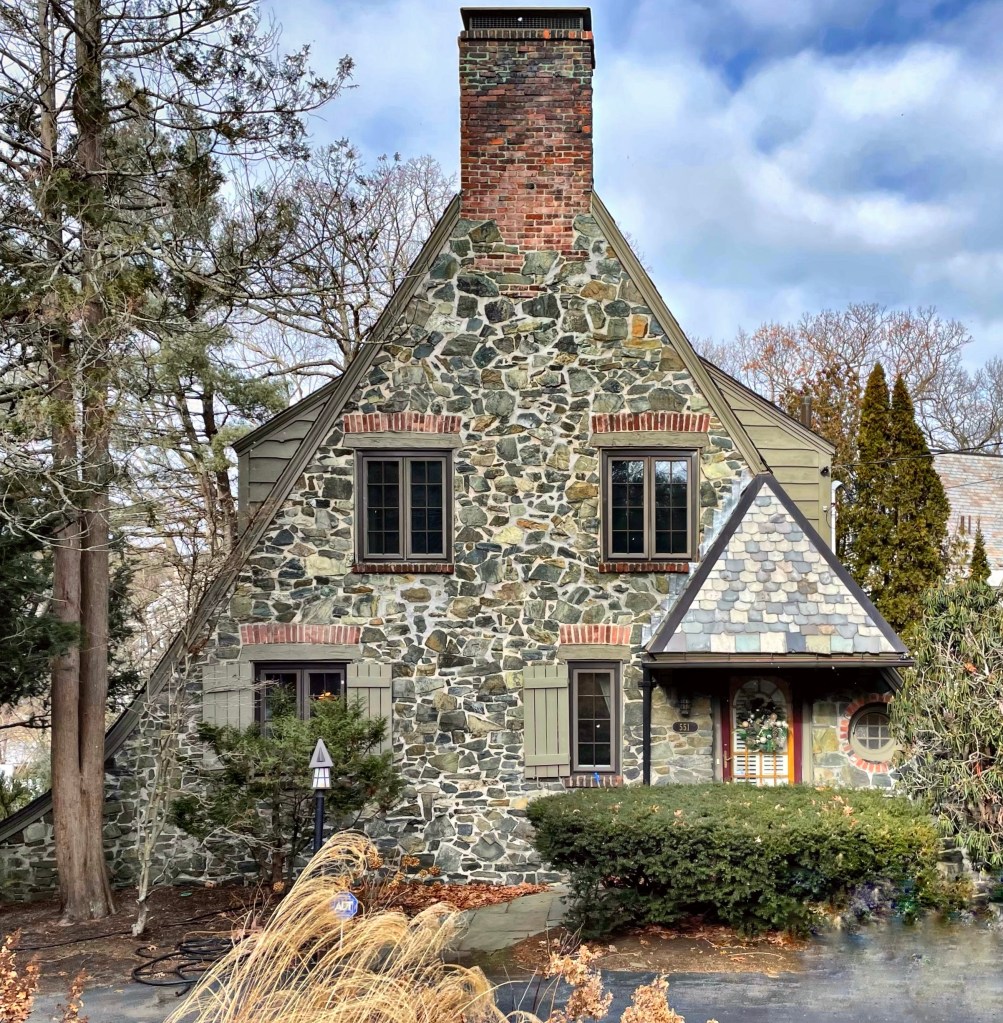
In the land of storybook Tudor houses, this one might just be the most magical of them all! Located on Chestnut Street in Waban Village of Newton, you’ll find this stone Tudor cottage set behind a circular drive. The house was built in 1926, in the interwar period (between WW1 and WW2), a period of rapid suburban development in this part of Newton. The house was first occupied by a Seymour Ellis, who according to newspapers, had a rabid dog! The house exhibits a strong gable to the street which incorporates a massive chimney inside. The gable also sweeps out to form a catslide roof, that incorporates an arched garden gate.
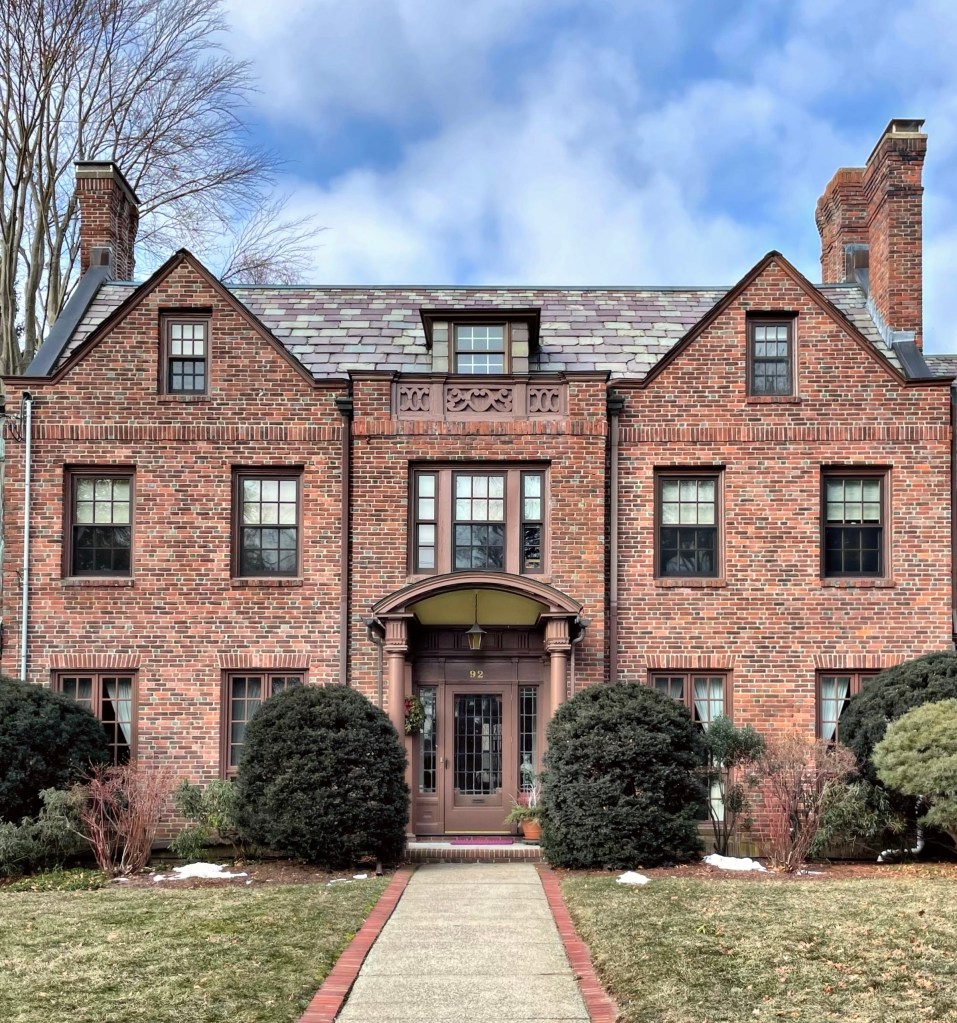
This refined brick Tudor Revival house in the Waban Village of Newton was built in 1917 for Lila and James Emmett. The couple hired Boston architect Edward B. Stratton to furnish plans for the home, which fits in to the early 20th century neighborhood. The symmetrical home has two gables at the facade which frame the central bay with a segmental pediment at the entrance.
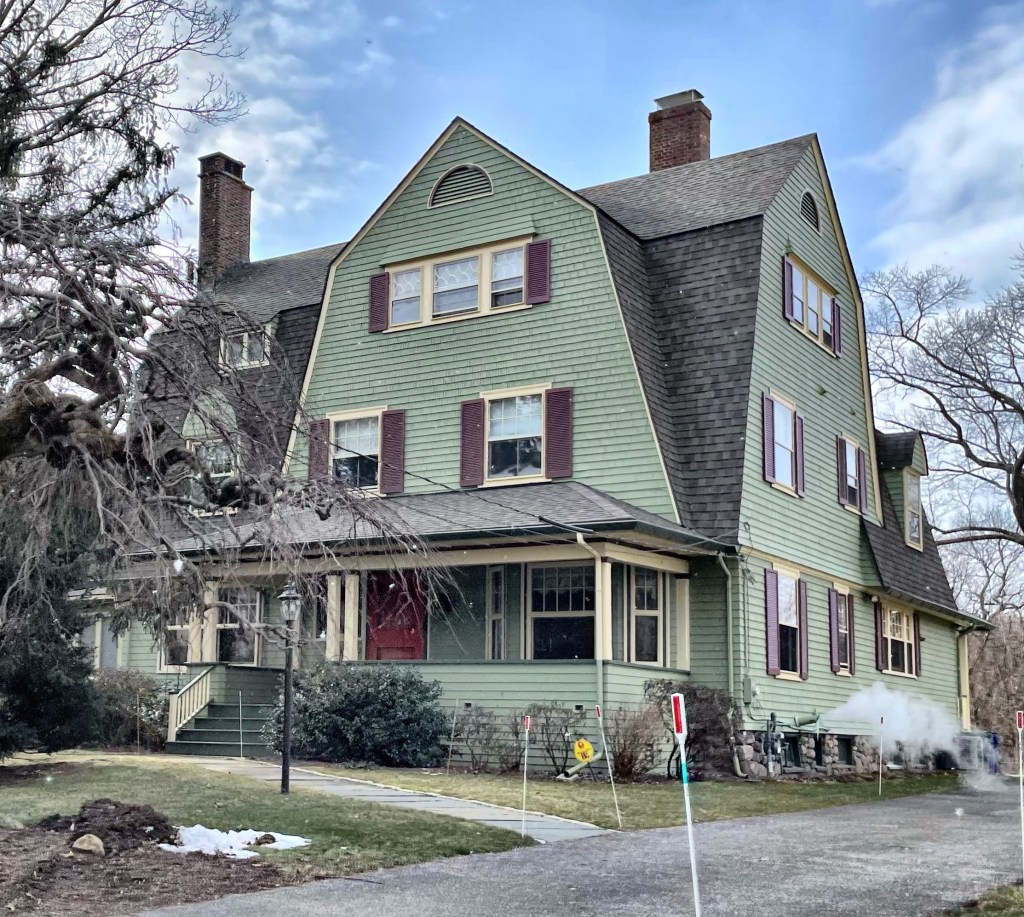
In 1895, Waban Village was in the middle of its massive development period, when half of the homes in the neighborhood were built within 10 years. One of the earliest in this neighborhood was this investment property by John E. Parry, a businessman and major developer. This house appears to have been rented at first, but was listed as vacant for some time in the city directories. Eventually it was purchased and has been lovingly maintained to this day. The design is a regional take on the transitional Shingle and Colonial Revival styles, this one with a really unique cross gambrel roof.
Some really interesting history and architecture with this one! Located in Waban Village in Newton, Mass., this gorgeous Mission Revival style house is one of a few in the style in the Boston area. The Mission Revival style was popularized on the West Coast in California in the late 19th century. Rather than continuing to adopt imported East Coast architectural styles, these California architects recognized the value of their own historic surroundings, where the Spanish Colonial mission heritage of California and the Southwest, the beautiful mission chapels, with stucco walls, red tile roofs, and bell towers led to the new revival. The style never took off in New England, which followed its own Georgian and Federal Revival styles, emulating historic Colonial-era homes here. This Newton home was built around 1908 for Lawrence W. Luellen, an attorney and inventor, who made a big invention, disposable paper cups! It is true. Lawrence Luellen wanted to do away with the ubiquitous “tin dippers” he saw in public buildings and railway stations after realizing all that sharing might be transferring disease. In 1907, he took out a patent and create a new, clean and individual drinking cup. After his invention went global, he sold his Newton home and moved to New Jersey, inventing…cup dispensers!
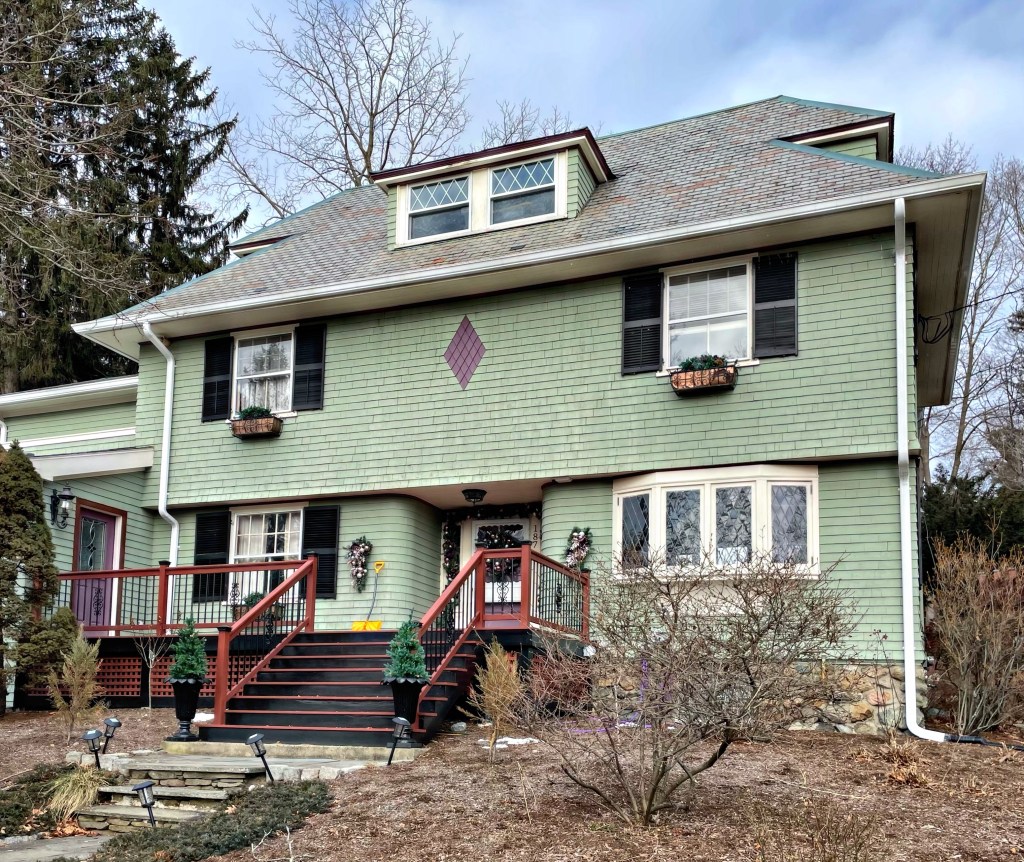
When William C. Strong began developing land on the farm he purchased in Waban, he built a few homes to market the new neighborhood, and rented some of them for additional income. This really unique home was one of them. It was built around 1895 and exhibits elements of the Shingle and Colonial Revival styles. The home was eventually purchased by Frederic W. Webster, who was an alderman in Newton. The blocky proportions of this house and the prominent overhang of its hip roof are prevalent motifs in late 19th century adaptations of the Shingle Style. The style is even more evident at the recessed center entrance with curved reveals, and the diamond shingle motif at the second floor. Nods to Colonial Revival are the garrison (second floor overhanging the first, and the central dormer.
In 1875, William C. Strong, a nurseryman from Brighton, MA, purchased the 93-acre Staples-Craft farm in Newton. He established a large nursery on the grounds and promoted construction of the Circuit Railroad, which connected the rural section of Newton to the Boston and Albany rail line in 1886, thus establishing the village of Waban. Due in great measure to the efforts of Strong and other developers, Newton’s youngest village grew rapidly as the once isolated farm area gave way to a vibrant suburban community. He built commercial structures and people began to flock to the village, for the new housing and easy-access into Boston by rail. Strong had a house built by architect Herbert Langford Warren in 1896 and lived there for years before having this house built in 1907, when William was 83 years old. The house was occupied by Strong for just a couple years until he moved away to Manhattan. The Arts and Crafts style home was purchased by Esther Saville Davis.
In the 1930s, America was in the throes of the Great Depression, and towns and cities struggled to provide services for the ever-growing populations, all the while suffering from lower tax revenues. The New Deal was enacted as a result, which provided a series of programs, public work projects, financial reforms, and regulations enacted by President Franklin D. Roosevelt between 1933 and 1939. One of these programs was the Public Works Administration (PWA), which funded and built large-scale public works projects such as dams, bridges, hospitals, and schools, to provide jobs and bolster local economies. In Newton, the developing Oak Hill Village required a new public school, and the town received funding for the Oak Hill Middle School in 1935. Architects Densmore, LeClear, and Robbins were hired to provide designs for a new school, and builders completed the building the next year. The Georgian Revival building is constructed with red brick with cast stone trim. The 16-over-16 windows and cupola also work to showcase the beauty of the design.
Another of Oak Hill Village’s pre-Revolution homes is this stunner! This home was built some years before 1718 and was eventually occupied by Robert Murdock (1663-1754) and wife Hannah Stedman. Murdock emigrated from Scotland to Plymouth, MA in 1688 with his brother, later settling in Roxbury. In 1703, Robert bought a house and 120-acres of land here, and worked as a housewright. Like the King House (last post), the house was likely rebuilt or modified substantially at this time. Robert also served as a selectman, Constable, Surveyor of Highways, and Assessor in town until his death; and his son, Robert Murdock Jr., took over the property. By the mid-18th century, the estate was purchased by Jeremiah Wiswall (1725-1807). Wiswall served as Captain of the militia at the battle at Concord and Dorchester Heights during the Revolution and held a number of positions in the community including Overseer of the Poor, Constable, Selectman and as a hogreeve (person charted with the prevention or appraising of damages by stray swine). He was very involved in the events leading up to the Revolution including the committee on the tea embargo and drilled with the militia. He also lent money to the town to hire soldiers and owned a house designated as a place to receive smallpox inoculations in 1777, though it is unclear if it was this house he used. The house was eventually slated for demolition in the 1960s, but was saved by Dr. Roy Carlson, President of nearby Mount Ida College (now owned by UMass. For $1, he purchased the home from a developer and paid for it to be moved from its original location at the corner of Brookline and Dedham streets a ¼ mile southwest to its current location, on Carlson Ave, and it served as the President’s House.


 Buildings of New England