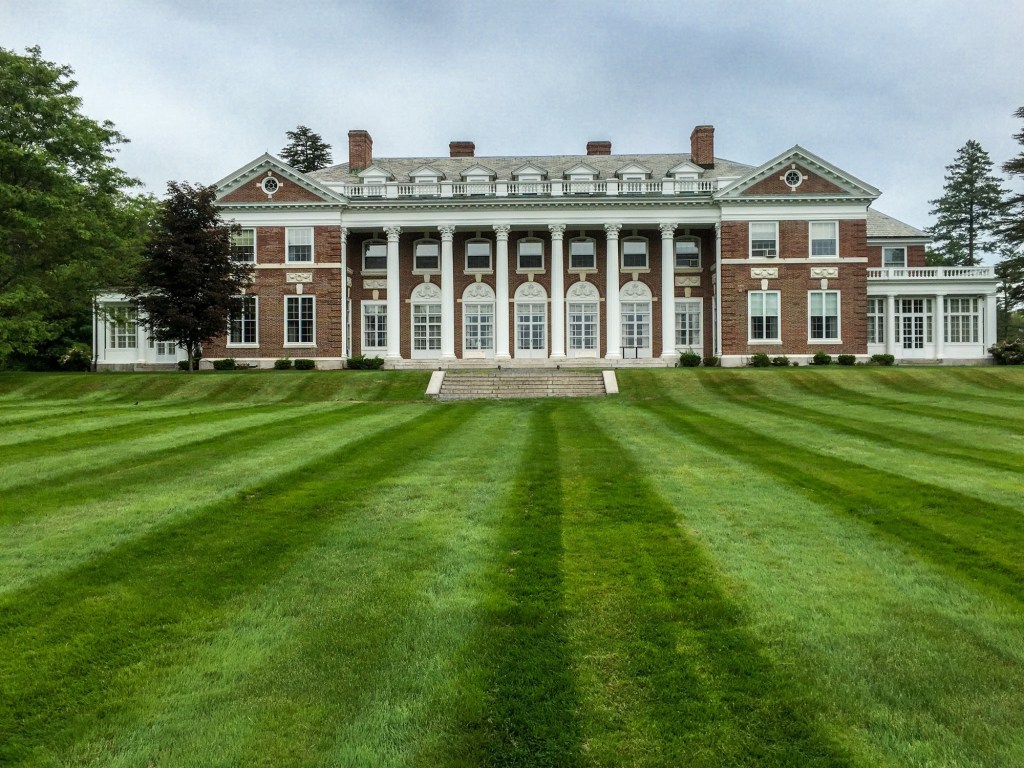
Built over 100 years ago in the town of Easton, Massachusetts, the Frederick Ames Mansion, known as “Stone House Hill House,” is one of New England’s grand Gilded Age survivors and one of a half-dozen remaining Ames Family mansions in the community. Frederick Lothrop Ames II (1876-1921), a trustee of the Ames Family Estate whose fortune originated manufacturing picks and shovels, but was also tied up in the development of the Union Pacific Railroad and other investments, had this massive estate built in his hometown of Easton. His 50-room mansion was built in 1905, a year after his marriage to Edith C. Cryder, a socialite from New York. Designed by the Boston architectural firm of Parker & Thomas, the Colonial Revival style mansion has symmetrical facades and inside, featured a 110-foot long living room, and the first private indoor clay tennis court in the country. The surrounding land was used for grazing fields for Frederick’s prized Langwater Guernsey cattle, begun by his father. The curious name of the estate, Stone House Hill, is said to come from a cave on the property, known for centuries as King Philip’s Cave. Frederick L. Ames died in 1921, followed by his son, “Freddie” who died in a plane crash in 1931. In 1935, Frederick Ames’ widow Edith, who had remarried in 1931, sold the Stone House Hill House estate to the Congregation of Holy Cross. In 1948 the Congregation opened Stonehill College, with its name taken from the great estate. The large house built for one family’s private pleasures now greets thousands of students each year.

