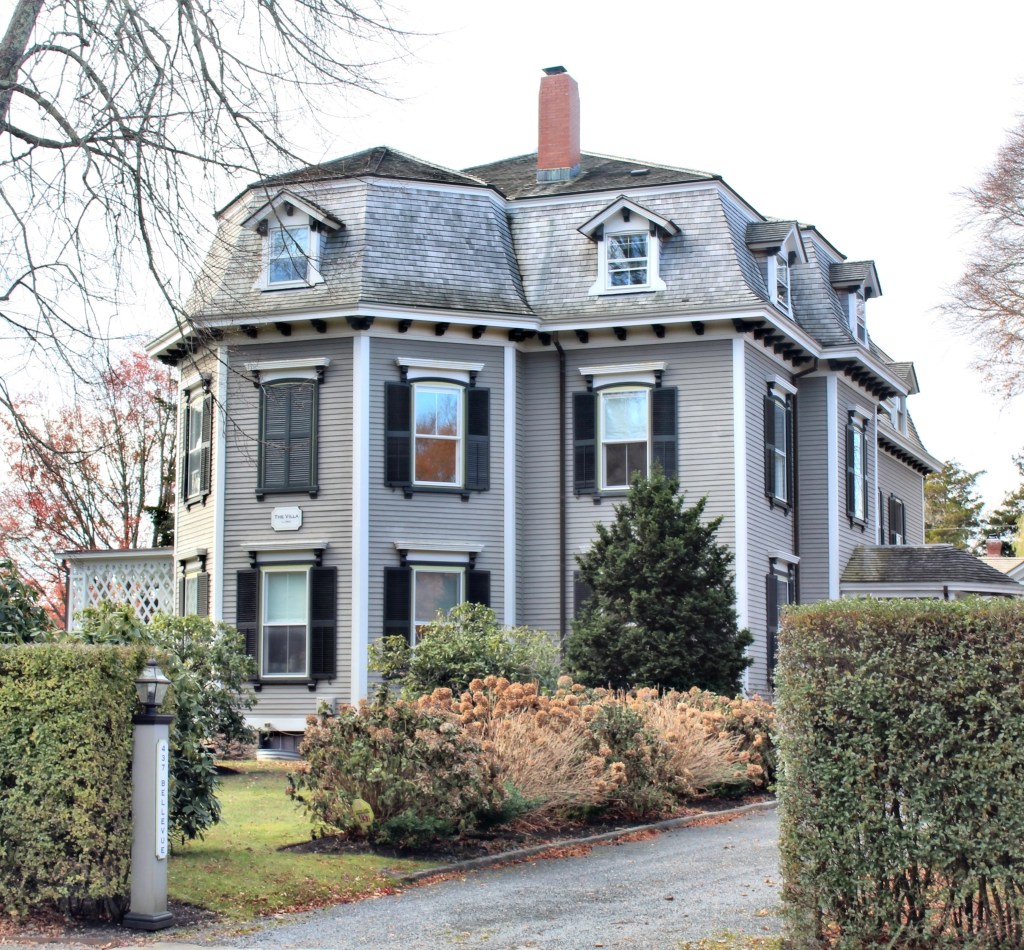
Margaret Barker Sigourney was the wife of Boston lawyer Henry Sigourney (1783–1849). In 1864, just as the Civil War was coming to a close, Sigourney purchased a piece of land on Bellevue Avenue in Newport soon after the time that Newport had been rediscovered as a tourist destination for the elite class. Sigourney wanted to make a splash as a single woman summering in Newport, so she hired local architect George Champlin Mason to design her cottage in the fashionable Second Empire style. The refined facade is more academic, while the rear and side facades exhibit porches with delicate bargeboards and trim. Sigourney spent summers at her cottage with her only son until 1873 when he and his family perished and were lost at sea aboard the Ville du Havre, when it collided in the Atlantic with another ship, killing a total of 226 aboard the ships, many of which drowned and their bodies never recovered. Alone, Margaret Sigourney continued to spend her summers in Newport until her own death in 1885.
Built in 1887 for John O’Brien, a direct descendant of Brian Boru, the High King Of Ireland, “Inchiquin” in Newport stands out for its bold stone exterior and proper siting. The mansion was named after Inchiquin, a barony (or state) in Ireland, likely where O’Brien’s ancestors were from. The cottage was designed by John Dixon Johnston, a well-known Newport architect, who designed the stone mansion in a sort of hodge-podge of styles, which actually work well together somehow! In 1901, Inchiquin was acquired by The Baroness Seilliere, the adopted daughter of John O’Brien. She was a daughter of Mrs. O’Brien by a former husband. After her first husband died she married the Baron de Seilliere, brother of the Princess de Sagan. Like some other massive, expensive mansions in Newport, this home was converted to condos.
‘The Reef’ a fabulous Gilded Age estate in Newport was built in 1885 for Theodore M. Davis by the Boston architectural firm of Sturgisand Brigham. The elegant shingle and stone Queen Anne villa was erected as both a summer house and to house some of Davis’s vast collection of paintings and Egyptian artifacts, collected during his excavations in Egypt’s Valley of the Kings between 1902 and 1913. Besides the architecture of the home, the Reef Estate was also famous for its walled gardens, greenhouses, and outbuildings, sitting upon eighteen acres. overlooking the Atlantic Ocean. Following Mr. Davis’ death in 1915, Milton J. Budlong of Providence purchased the estate. Milton divorced from his wife Jessie in 1928, and it was MESSY. Their Newport summer estate was placed in contention. The house, never again lived in by the family. During World War II, anti-aircraft gun emplacements were set up around the grounds, with the mansion housing gunnery personnel. After the War, the estate was given back to the Budlong heirs, who did not reside there. Vandalized throughout the 1950’s, the villa was set on fire in 1961 and demolished two years later in 1963. In 1969, the waterfront property came under the control of the State of Rhode Island and in 1976, became a state park. The old carriage house/stable and a later observation tower (possibly converted from a former water tower) stand today.
While the Breakers Mansion in Newport is one of the most opulent buildings in the United States, a tiny cottage on the grounds always gives me feelings of whimsy. Predating the larger mansion by two decades, this cottage was constructed on the grounds of the original Breakers House, owned by Cornelius Vanderbilt, which was destroyed by fire in 1893. The cottage was built as a children’s playhouse around the time the original Breakers mansion was built in 1878. The Boston architectural firm of Peabody and Stearns built the mansion and adjacent cottage for Pierre Lorillard IV, a New York cigar manufacturer and millionaire. The Queen Anne Revival style elements, including the half-timbering and shingles and asymmetry, were in keeping with the style of the original Breakers, and complimented it well. My favorite part of the cottage is the open porch facing the ocean, which has four wooden posts, carved in the shape of figures from Dutch folklore, a sort of caryatid, supporting the roof. The house contains a living room and kitchen separated by a huge red brick chimney, which would be maintained by servants for the children while they play.
Possibly my favorite room in The Breakers mansion is the Morning Room, found on the first floor, just off the Great Hall and lower loggia. The Morning Room is executed in a late Renaissance style and faces east to catch the morning sun and provides sweeping views of the Atlantic. It served as a family sitting room at all times of the day. The interior design, including the fixtures, woodworking, and furniture, were designed by French architect Richard Bouwens van der Boijen and designer Jules Allard. The predominant grey, and gold colors of the Morning Room are echoed in its fireplace which is made of Campan marble. On the walls, you will find the most stunning shimmering silver wall panels, depicting ancient Greek goddesses. It was originally believed that these features were silver leaf, but the Newport County Preservation Society investigated further, determining it is actually platinum! The Vanderbilts clearly wanted this room to shimmer with the sunrise, so the use of platinum, which never tarnishes, was a great solution!
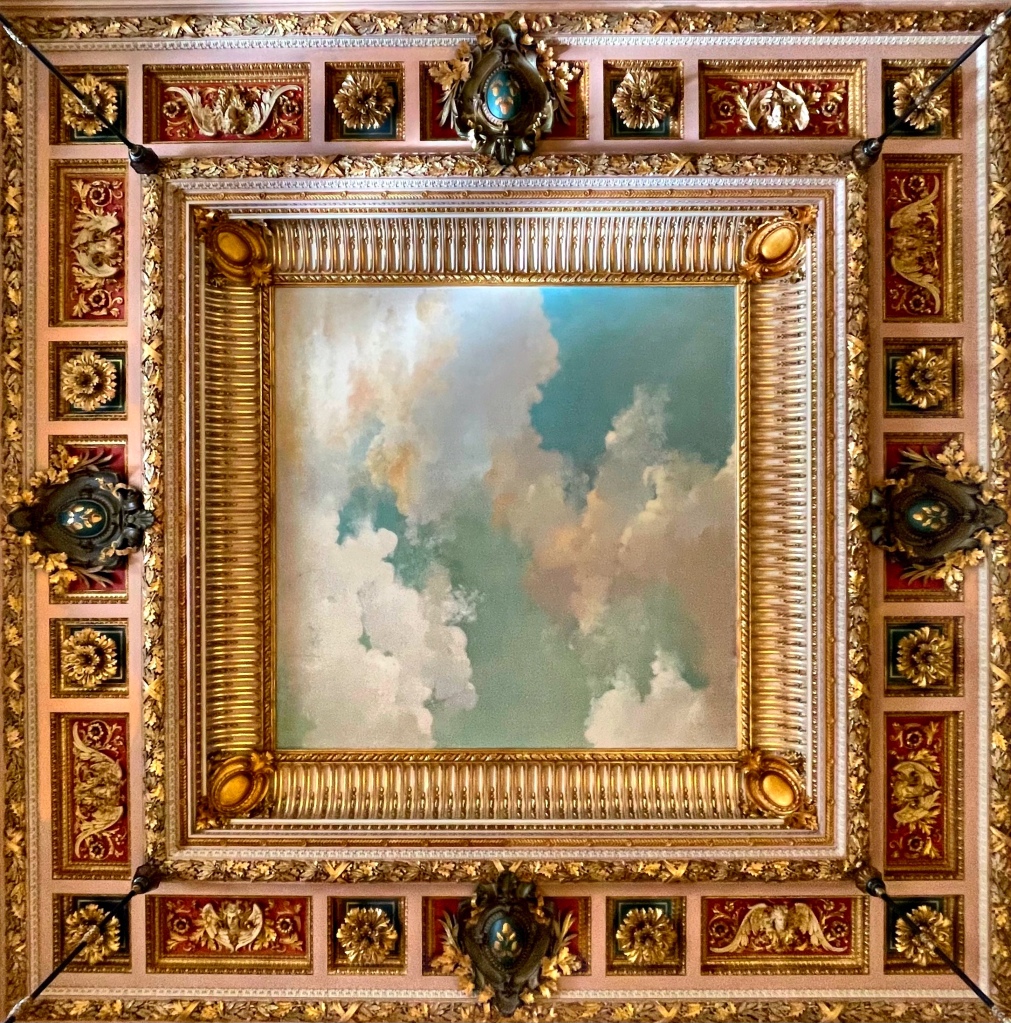
Merry Christmas from The Breakers! This 1895 Gilded Age mansion is the best to explore during December, when the halls are decked and stunning Christmas trees adorn the lavish rooms (learn more about the mansion in my last post) When you walk into The Breakers, you enter the Great Hall. Architect Richard Morris Hunt designed the Great Hall after the open-air courtyards in Italian villas, but enclosed due to the tough New England winters. The palatial space (measuring 50 foot square), even if crowded by tourists trying to get the perfect shot on their smartphones, feels spacious yet somehow welcoming given the art museum-like detailing. The walls are made of carved limestone from Caen on the coast of France and adorned with plaques of rare marbles. Elaborately carved pilasters decorated with acorns and oak leaves support a massive carved and gilt-cornice which surrounds a ceiling painted to depict a windswept sky, further expressing the open-air courtyard feeling envisioned by Hunt, the architect. Four bronze chandeliers dangle from the gilded ceiling, and flood the room with warm light, evoking warm summers in Italy.
The most opulent of all summer ‘cottages’ in Newport is the iconic Gilded Age mansion, The Breakers. This mansion was completed in 1895 as a summer residence for Cornelius Vanderbilt II. Cornelius’ grandfather, Commodore Cornelius Vanderbilt (1794-1877) established the family fortune in steamships and later in the New York Central Railroad. Cornelius Vanderbilt II became President of the New York Central Railroad system in 1885, and bought a wooden summer house called The Breakers in Newport during that same year. The original Breakers Mansion burned in a fire in 1892 and was rebuilt, but more substantially. Vanderbilt commissioned famed architect Richard Morris Hunt to rebuild it. Vanderbilt insisted that the building be made as fireproof as possible, so the structure of the building used steel trusses and no wooden parts. He even required that the boiler housed in an underground space below the front lawn. The Italian Renaissance-Beaux Arts style mansion was likely the most expensive home constructed in New England at the time at a cost of over $7 Million USD (equivalent to over $150 million today).
Cornelius Vanderbilt died from a cerebral hemorrhage in 1899 at age 55, leaving The Breakers to his wife Alice Gwynne Vanderbilt. She outlived him by 35 years and died at the age of 89 in 1934. She left The Breakers to her youngest daughter Countess Gladys Széchenyi (1886–1965). In 1948, Gladys leased the near-impossible to maintain property to The Preservation Society of Newport County for $1 per year. The Preservation Society bought The Breakers and approximately 90% of its furnishings in 1972 for $365,000 ($2.3 million today) from Countess Sylvia Szapary, Gladys’ daughter, although the agreement granted her life tenancy. Upon her death in 1998, The Society agreed to allow the family to continue to live on the third floor, which is not open to the public. The last-remaining family members residing there were evicted from the third floor due to safety concerns, but others state it is retaliation for the Szápárys’ opposition of the controversial Breakers Welcome Center, the plan for which other members of their family, including Gloria Vanderbilt, also opposed.
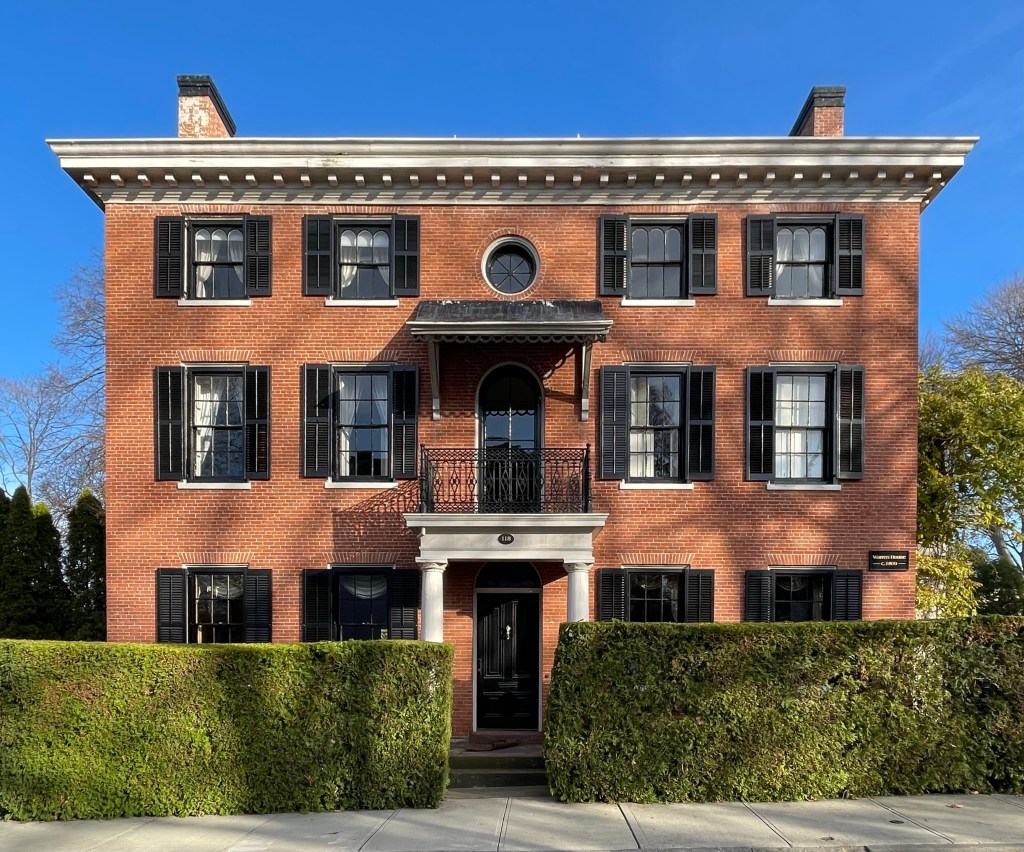
The Lawton-Warren House is one of the few large, brick Federal mansions in Newport, and is located a short walk from the Tillinghast House (last post) and the mysterious Newport Tower in Touro Park. The collapse of maritime trade in Newport following the British occupation was so complete that this house style, prevalent in Providence, is virtually nonexistent here. Robert Lawton was a sea captain and merchant who died at sea in 1818 off the coast of Africa and left the house to his wife, Penelope. After Penelope’s death in 1855, the traditional Federal style home was given Italianate detailing at the second floor. The home was likely painted around this time, which thankfully has been removed. The home was purchased in 1932 by George Henry Warren and his wife Mrs. Katherine Urquhart Warren. Katherine was a preservationist and art collector interested in preserving the Colonial town of Newport. To assist with this endeavor, she convinced the Countess Szycheni, a descendant of the Vanderbilt family and owner of The Breakers, to open The Breakers mansion to the public for tours. It was the start of the Preservation Society of Newport County. She would later be appointed by First Lady, Jacqueline Kennedy, to the committee to restore the White House in 1961. Katherine died in 1976, she willed the home here to the Preservation Society, and it held offices there until 1994. The home was sold to a private owner who restored the home to near original conditions, keeping the Italianate detailing.
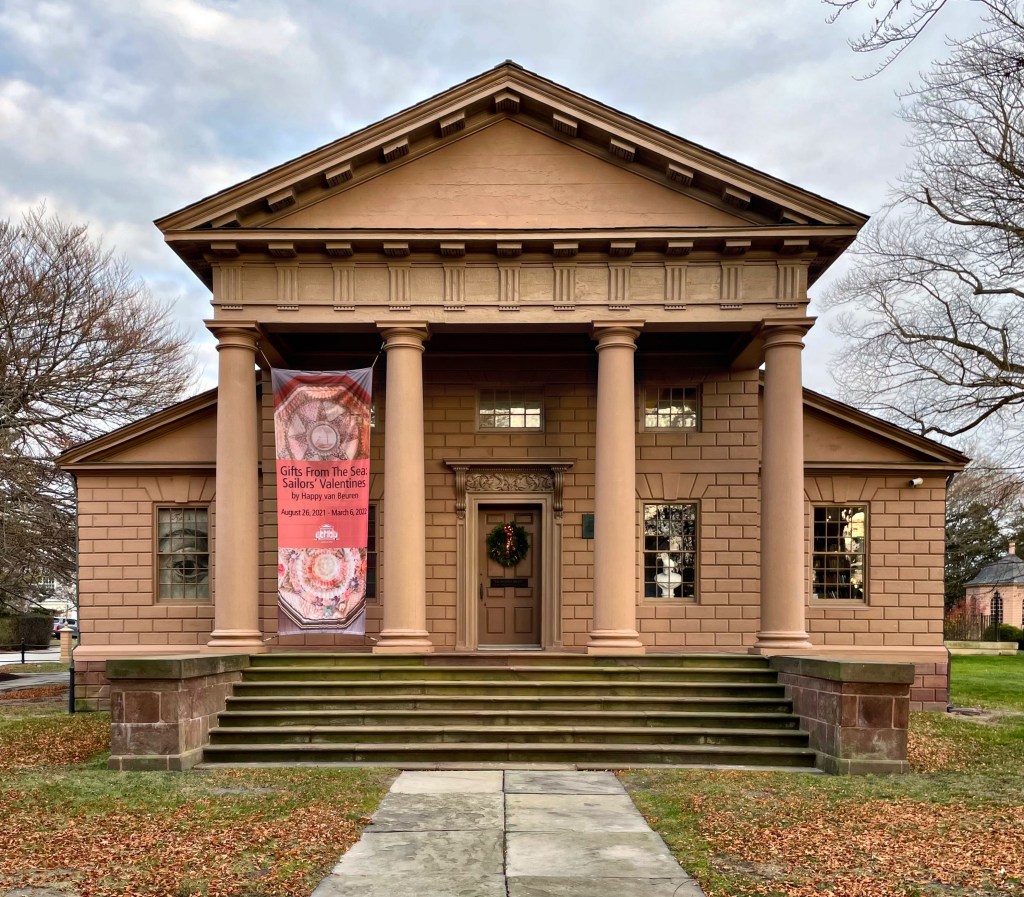
The Redwood Library and Athenaeum in Newport was built in 1750 and was the first purposely built library in the United States! This highly significant building is possibly the oldest neo-Classical building in the country and it was designed by British-born architect Peter Harrison, who is credited with bringing the Palladian architectural movement to the colonies. Harrison also designed the iconic Touro Synagogue in town (featured previously). The Redwood Library was established in 1747 by Abraham Redwood and 45 other wealthy residents with the goal of making written knowledge more widely available to the Newport community. The Redwood family had a large sugar plantation in Antigua. Abraham Redwood, Jr. was born in 1709 and he was active in the family sugar business from his teenage years. When his father died, the plantation – along with the over 200 enslaved people that worked it – were signed over to Abraham Redwood jr.
Rhode Island’s ties to slavery lasted much longer than other New England states. Many of the state’s wealthiest owned plantations in the Caribbean, where the conditions were comparable to that of the deep south. Once trafficked across the Atlantic arrived in the Caribbean islands, the Africans were prepared for sale. They were washed and their skin was oiled to be sold to local buyers. Often parents were separated from children, and husbands from wives. Upon his death in 1788, Redwood left his slaves in Newport and Antigua to his children and grandchildren, an inventory taken 22 years prior to his death listed 238 enslaved people in Antigua. I bring this history up because America was built on slavery, and I bet thousands walk by this architecturally beautiful building every year, with no idea about its namesake.
Newport in 1774 had approximately 153 free Black residents residing in 46 households comprising of thirty-percent of Newport’s population at this time. One of these free Black families was the Jack family who resided around Levin Street (Memorial Boulevard today). The Jack Family appears to have been from Antigua and may have had ties to the Redwood Family (the namesake of the Redwood Library), who owned a plantation on the island and resided in Newport. Alexander Jack, Jr. was a free African American whose trade was a cordwainer or shoemaker. He bought his land in 1811 and is thought to have begun construction almost immediately. Jack heirs remained on this property until 1881. The Newport Restoration Foundation purchased the house in 1969, moved it that same year to Mill Street to save it from urban renewal and the widening of Levin Street as Memorial Blvd.





 Buildings of New England