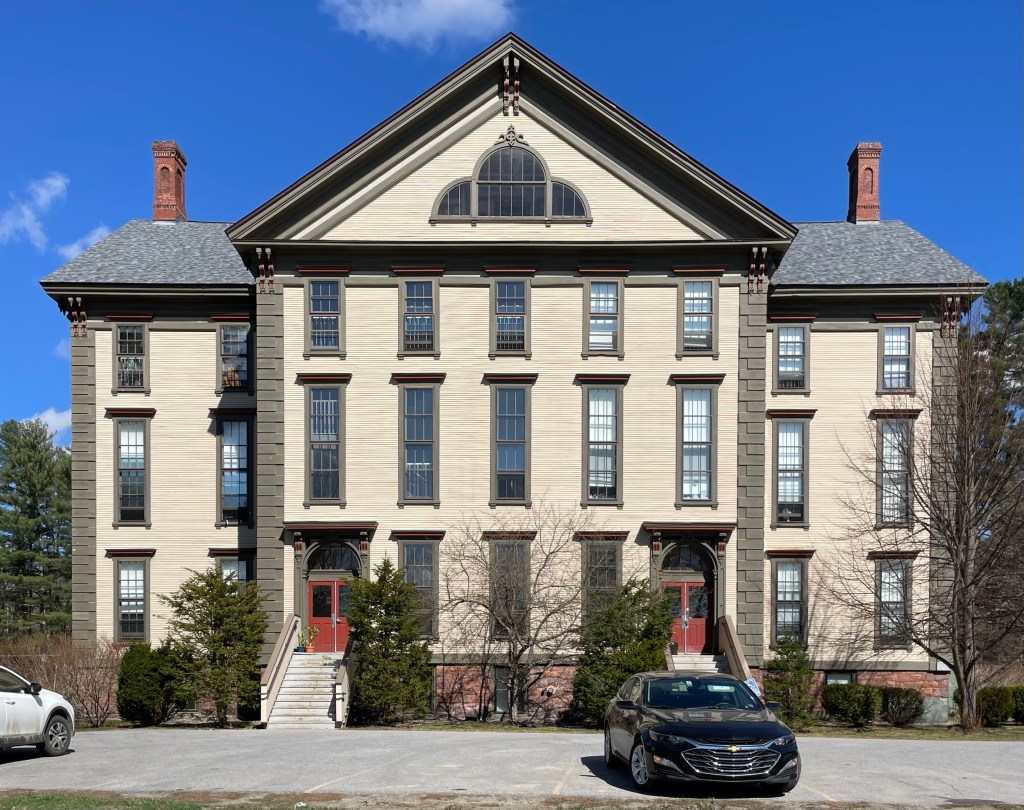
Former Green Mountain Seminary // 1869

The Green Mountain Seminary building in Waterbury Center, Vermont was built in 1869 as a co-educational Free Will Baptist school. The building is one of the largest and grand examples of Italianate architecture in this part of the state. As originally laid out, the lower two floors were used for educational purposes and included a chapel, while the third floor and attic level were used for men’s housing. Here, men would be trained to be Baptist priests. Upon opening, a catalogue expressed the building’s rural location in the town as a benefit, stating “It is removed from the bustle and distraction of large commercial villages; is free from the haunts of vice and dissipation or temptation to idleness; and is surrounded by natural scenery unsurpassed in its magnificence and grandeur.” The building went through a variety of educational and boarding uses until 1895, when it was deeded to the town for use as a public school building. The building is nearly unchanged as when it was built in 1869, besides the removal of the rooftop belvedere and walkway in the 1940s.

Charles C. Warren House // c.1880

Located just steps from the former State Hospital of Vermont in Waterbury, the Charles C. Warren House on Main Street stands as an important Victorian-era residence in the town. The late Italianate style residence features a detached carriage house at the rear which was later converted to a auto garage and most recently to office space. Mr. Warren was a businessman in town who owned a tannery and creamery. He built a water system in the town in 1879, making a substantial amount of money in the process. Mr. Warren was a serious auto enthusiast who in addition to purchasing the first automobile in Vermont (a 1899 Haynes Apperson), he held Vermont registrations #1 and #2. He had his carriage house converted to an auto garage equipped with a turntable that obviated forever the tedium of backing down the driveway. The building is now home to a law office.

Former Vermont State Hospital // 1890

The former Vermont State Hospital campus in Waterbury, Vermont, is a 36.3-acre campus of institutional buildings that have been converted for use as state government offices. A sprawling array of more than 17 structures, the hospital, which historically treated mental disorders, was first funded by the Vermont State Legislature in 1888. Construction began on the plans by the Boston architectural firm of Rand & Taylor in 1890. The architects designed the landmark main administration and auditorium building at the core, which is built of brick on a rusticated stone foundation and under a steep hipped slate roof. The building is connected by single-story links to two-and-a-half-story wings, which are attached to clustered two-story cylindrical wards. In planning the hospital, Rand & Taylor stressed the isolation of patients and stressed the importance of light and air in each room and restricted height of the building to facilitate egress from upper floors in the event of fire or emergency. The asylum has a dark history in that Dr. Eugene A. Stanley, the Superintendent from 1918–1936, was an advocate of eugenics and espoused forced sterilization and advised the Eugenics Society based on his patients records. From this, the word, “Waterbury,” became used in a derogatory sense, and did harm to the town for years. The hospital was closed in 2011 due to flooding in the aftermath of Tropical Storm Irene, and after a thorough renovation by architects Freeman French Freeman and Goody Clancy, the complex re-opened in 2015 as State Offices with renovated historic assets and modern, contextual new buildings.

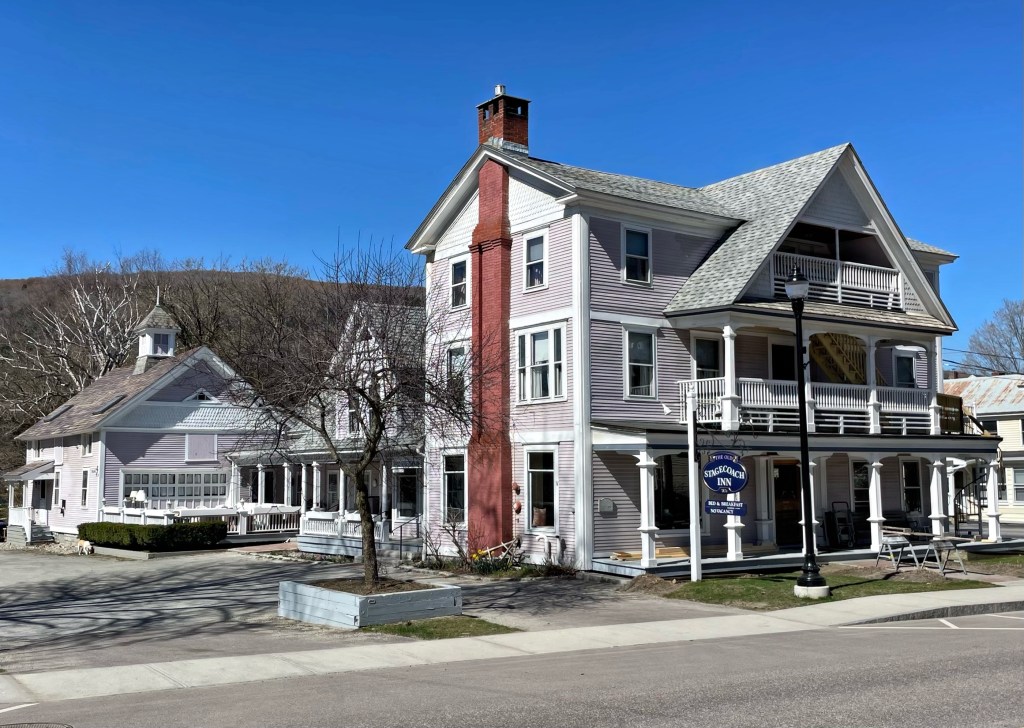
Stagecoach Inn // 1826

Built by the Carpenter brothers in Waterbury, who also designed and built the neighboring Congregational Church (last post), this large structure was a stagecoach stop on the road to Stowe for much of the nineteenth century. Briefly, the Inn served as a private residence for Albert and Annette “Nettie” Spencer. Nettie grew up in Waterbury and married Albert who owned rubber factories in Ohio and invested in real estate in Burlington. At one time, the Spencers’ residences included their Waterbury house, a suite at the Waldorf Astoria in New York City, a house in Newport, an apartment in Paris, as well as one in London. Albert died in London, and Nettie continued living in Waterbury until her death in 1947, approaching 100 years of age. Within a year, the property was sold and the owners reopened the main house as a sort of boarding house. The property was restored and operates today as the Old Stagecoach Inn.

“The Old Corner Store” // 1833

White settlement in Waterbury Vermont began in about 1770, with the establishment of a small cluster of houses along the Winooski River near what is now Winooski Street. When Main Street, a stagecoach route paralleling the river opened in the 1790s, development moved to that area, including the construction of churches, residences, and businesses. Industry followed, and a town was formed. Many settlers arrived here from Waterbury, Connecticut, and named their new village Waterbury as a result. Many early commercial buildings were constructed with wood frames, but as the town prospered, businessmen developed more substantial brick blocks. This charming Federal/Greek Revival commercial building was erected in 1833 at the most prominent corner on Main Street in Waterbury, by Leander Hutchins (1798-1879). It is apparently the oldest extant commercial structure in the downtown section of Waterbury! The building has been restored in the late 20th century, down to the multi-pane windows and granite lintels. This building is just so perfect.

Belding Homestead // c.1820

David Belding (1785-1860) was born in Swanzey, NH and at 25 years old, moved to Moretown, Vermont in 1810, marrying an eighteen-year-old Florinda Freeman a year later. The couple built a farmhouse on the outskirts of town near a brook. David worked as a farmer and would later officiate as a justice of the peace, the town lister, selectman, and represented the town in the State Legislature for two terms. From his enhanced wealth, David appears to have expanded his farmhouse in the 1820s or 30s with this vernacular Federal and Greek Revival style residence. The Belding Homestead would remain in the family for decades and eventually became the Belding House Bed & Breakfast.

Moretown Town Hall // 1835

The township of Moretown, Vermont was chartered on June 7, 1763 by Governor Benning Wentworth of New Hampshire. The original charter contained approximately 23,040 acres of land to be divided into about 65 shares of proprietors. Active settlement did not occur until after the Revolutionary War with early buildings constructed on the Winooski River (the northern boundary of the town) and subsequent development along the Mad River (which cuts through the middle of town). Saw and grist mills were built and the town developed as a rural farming and industrial community on the rivers. The Moretown Town Hall was erected in 1835 in the Greek Revival style. It has a pedimented portico with Doric columns that support a large pedimented gable peak in imitation of a Greek temple. Like most buildings in the Mad River Valley, the building is unapologetically Vernacular which means it relies on local materials, local builders, and not on architect-designed finishes. This is an aspect of Vermont architecture that makes the state so charming.

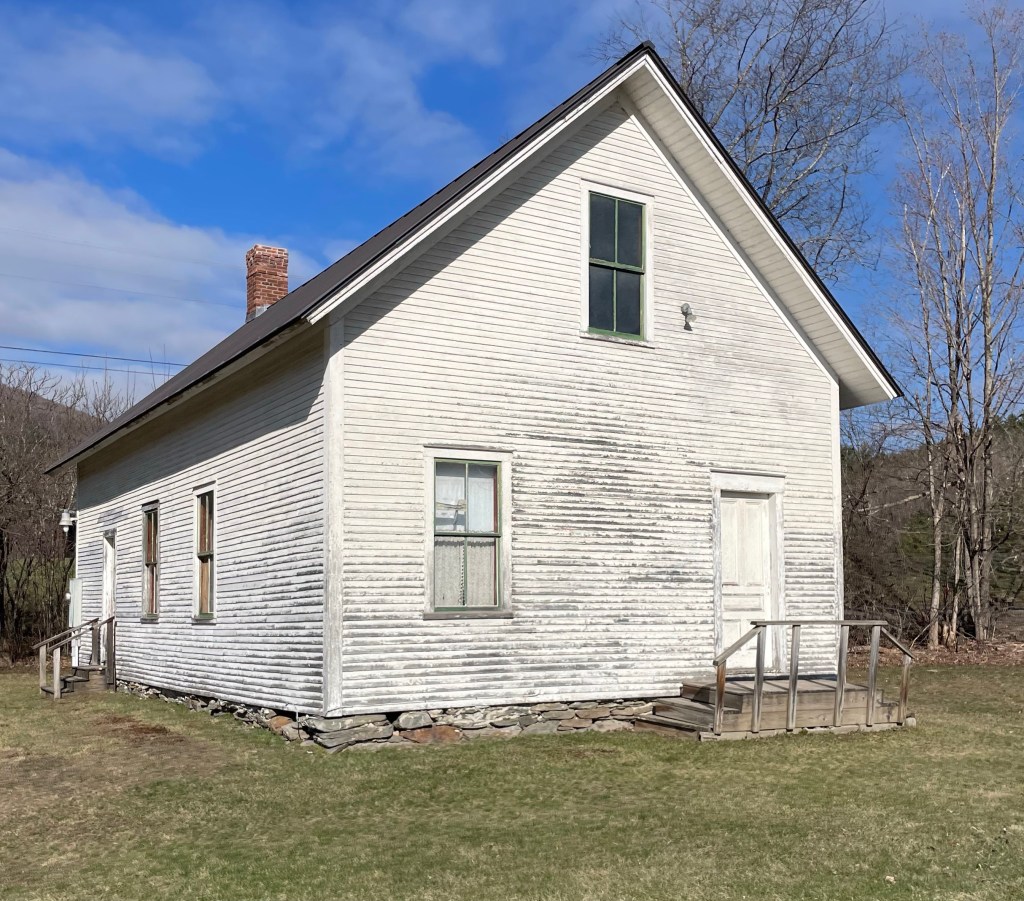
South Duxbury Church and Hall // 1855

This is the first church ever built in Duxbury, Vermont. On December 18, 1854, at the South Duxbury schoolhouse, representatives from six denominations in the newly formed town, gathered to form the First Union Society of Duxbury. The participants were: the Congregationalists, Universalists, Free Will Baptists, Protestant Methodists, Episcopalian Methodists, and the Adventists. Twenty-five names appear on the original subscription list, indicating the pledged money or materials that each would contribute to the construction of the church. Samuel Cook Turner was contracted to build the church, with pews inside purchased by individual families to help fund the construction. The building is vernacular and modest due to the rural character of the congregations and town’s location, but it has a more Classically inspired door enframement. In 1890, funds were gathered for a church hall, which sits nextdoor. The meeting hall would serve as the meeting space for a temperance organization known as the “Independent Order of the Good Templar”. The church hall appears to have some deferred maintenance, but both buildings together share an early history of a rural and often overlooked small Vermont town.