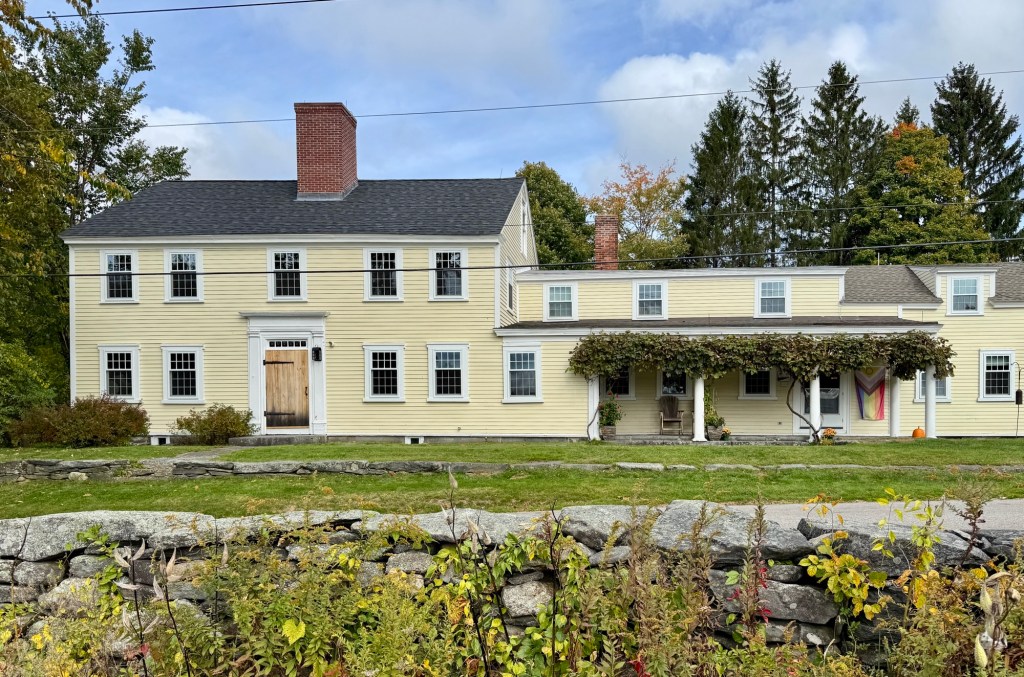
Located in the bucolic town of Princeton, Massachusetts, Goodnow Farm sits at the heart of a landscape that has been farmed for more than two and a half centuries. The farm and road take their name from the Goodnow family who owned the land here for well over 100 years. The farmhouse, which dates to around 1786, was built for Edward Goodnow (1742-1798) and his wife Lois, who married in 1770. Edward was a corporal during the Revolution, serving both at the Lexington alarm on April 19, 1775, and at Dorchester Heights in 1776, before settling in Princeton to spend his remaining years on the farm. The property was inherited by his son, Edward and later by his son, William B. Goodnow (1815-1904), the brother of Edward Augustus Goodnow, a merchant who made his fortune in Worcester and donated the Town Hall and Library to his birthplace. After nearly 150 years of Goodnow family ownership, in 1917 the old farm was sold to industrialist, Charles T. Crocker, Jr. of Fitchburg and became a gentleman’s farm. Crocker used the farm as a summer retreat from the city and hired staff to maintain the working farm aesthetic, though Charles Crocker did not actually do much or any of the agricultural laboring himself. Investing in the old farm to maintain the rural charm, Crocker added a large cow barn and attached dairy and the estate managed livestock and orchards. After the death of his father, in 1956, Mr. Crocker’s son, Charles T. Crocker, III, gave the main part of the farm, in two parcels totaling 636 acres, to the Massachusetts Audubon Society, to be preserved in perpetuity as a wildlife sanctuary. He made an additional gift of 118 acres in 1963. Over the subsequent decades, other parcels were acquired and the site has been operated as the Wachusett Meadow Wildlife Sanctuary, covering roughly 1,100 acres of the oldest farmland in Princeton, with twelve miles of public walking trails and historic stone walls. The site preserves what early Princeton was known for, at a simpler time when families depended on their own gardens, orchards, livestock and labor.

