New England Telephone Building // 1947

The New England Telegraph and Telephone Company Building was erected in 1947, just north of the Western Union Art Deco building (last post) to serve as the company’s headquarters. The steel-frame, polished granite and limestone-sheathed Art Deco skyscraper was designed by Alexander Hoyle, a partner in the firm of Cram & Ferguson. The stunning building takes the form of a stepped pyramid, or ziggurat, with successive receding stories rising from a four-story base, which diminishes its massing from the street. At the interior, a lobby mural on paper by artist Dean Cornwell (1892-1960), depicting “Telephone Men and Women at Work,” commissioned in 1947 and installed in 1951. The 190-foot mural told the story of the history of the telephone and was an artistic masterpiece, but was removed from the lobby during a recent renovation and subsequently sold.

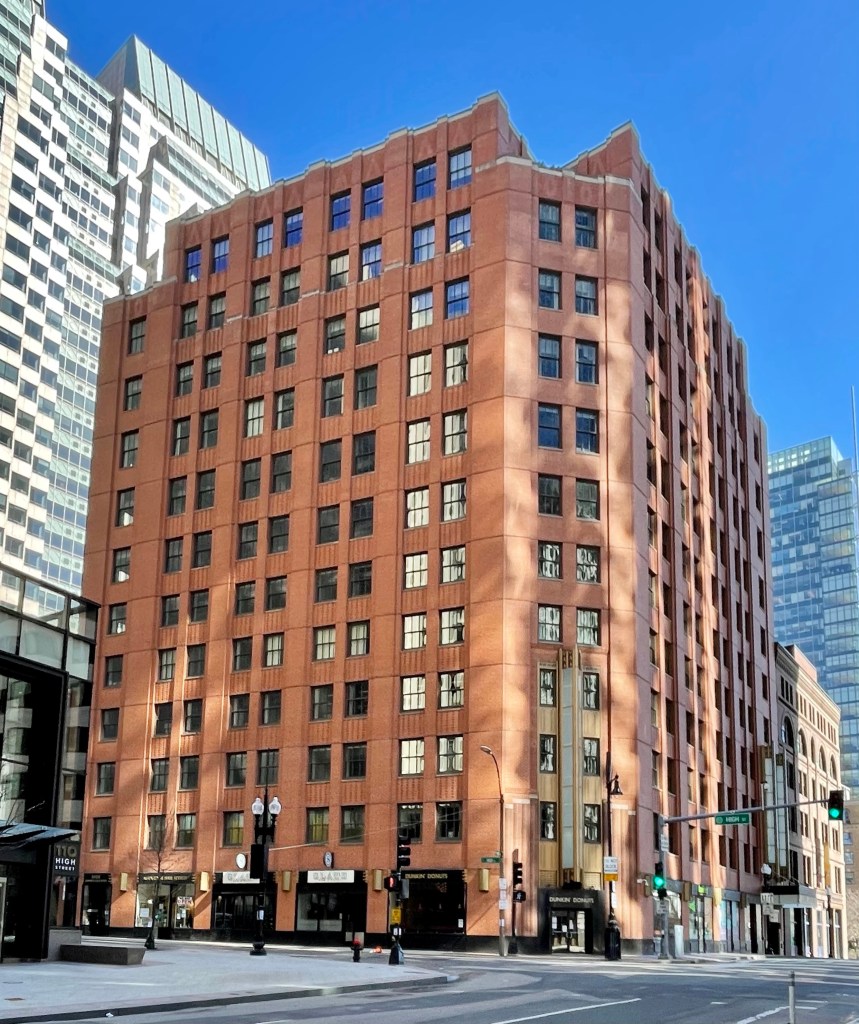
Western Union Building // 1930

While Boston doesn’t have as many iconic Art Deco buildings as New York or Chicago, we do have some that pack a punch! Located at the southern end of Downtown Boston, the Western Union building at the corner of Congress and High streets served as a headquarters for the third district in Western Union’s eastern division. Western Union was founded in 1851, and ten years later, built the first transcontinental telegraph line. The company made a brief foray into the telephone field but lost a legal battle with Bell Telephone in 1879 and thereafter concentrated solely on telegraphy. In the 20th century, Western Union diversified its operations to include: leased private-line circuitry, a money order service, as well as telegrams and mailgrams. The company’s Boston building was designed at the same time as their New York City headquarters, designed by Ralph Thomas Walker, and the buildings are strikingly similar, just with the Boston building on a smaller scale. The building in New York is among my favorite Art Deco buildings ever, as the use of red brick in varied patterns creates such a stunning composition. Amazingly, in 2004, water infiltration behind the original brick façade of the Boston building necessitated the removal and replacement in-kind of the entire brick façade. The existing signage and light fixtures, designed in the Art Deco style were added at that time.

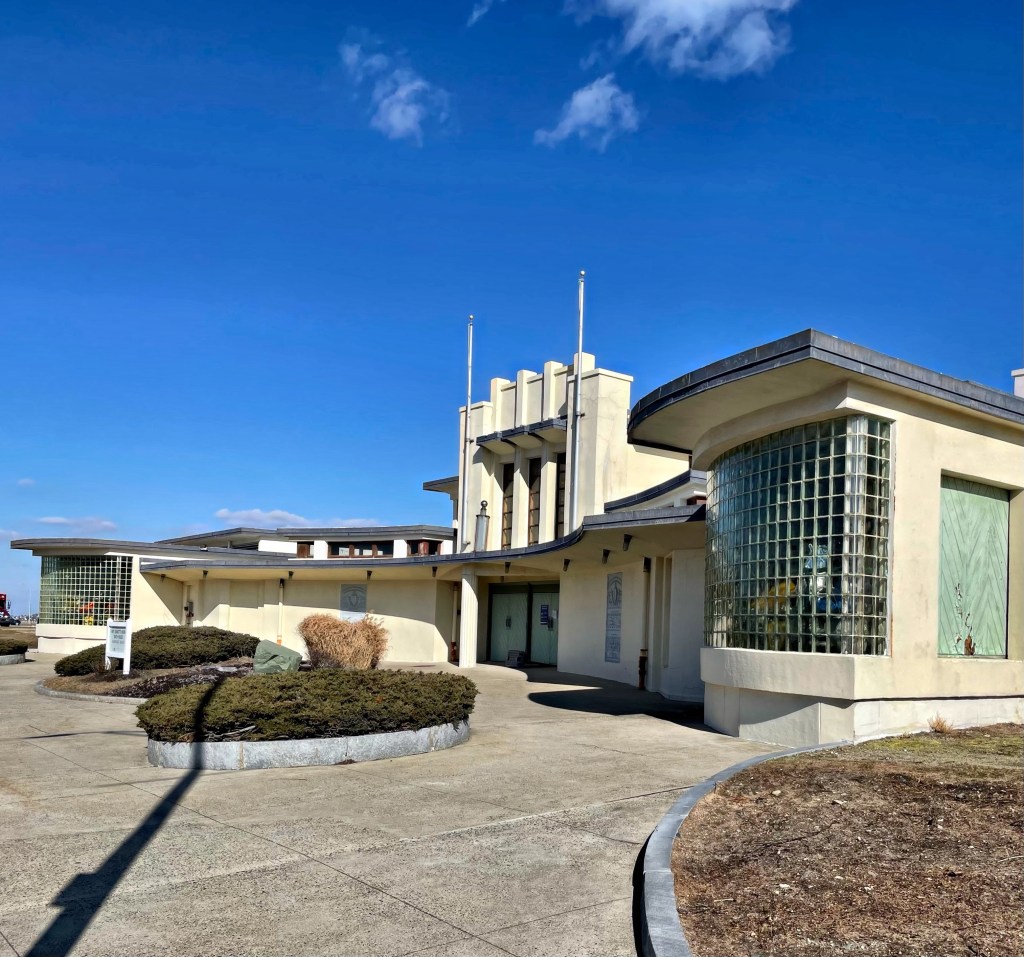
Nantasket Beach Bath House // 1935

A part of any large public beach in Massachusetts is the public bathhouse, where visitors can go to the bathroom, change, and store belongings in lockers. Ever since the Massachusetts Parks System of Boston acquired land at Nantasket Beach, a bathhouse was here for visitors. The earlier building by Stickney & Austin burned down and was soon replaced. This amazing Art Moderne bathhouse features a central mass with wings adorned by glass block. The architects Putnam & Cox created a whimsical 1935 Moderne design that blends into the sandy beach. The building suffered from the salt air and cold winters and went through a massive restoration in the late 1990s, it was then re-opened and re-named after Mary Jeanette Murray, a state representative.

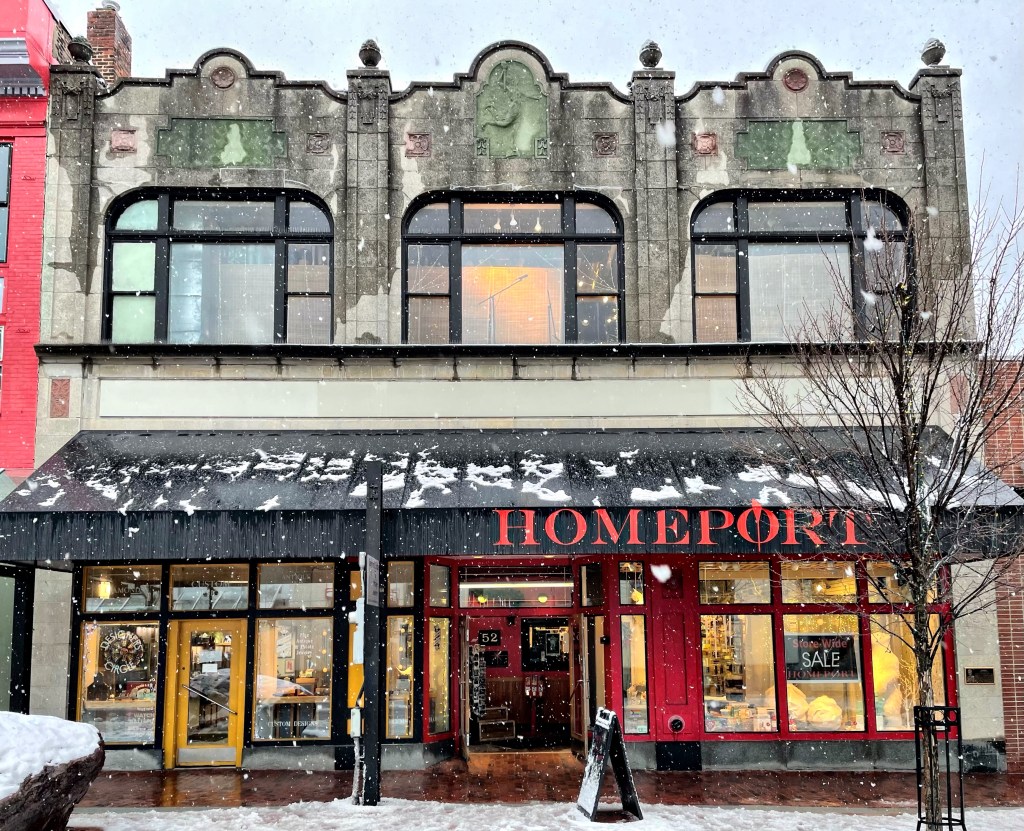
Burlington Montgomery Ward // 1929

Montgomery Ward was founded by Aaron Montgomery Ward in 1872. Ward had conceived of the idea of a dry goods mail-order business in Chicago. The fledgling company often created catalogs of their items for sale, distributing the booklets in the streets of the city. In 1883, the company’s catalog, which became popularly known as the “Wish Book”, had grown to 240 pages and 10,000 items. In 1896, Wards encountered its first serious competition in the mail order business, when Richard Warren Sears introduced his first general catalog. In 1900, Wards had total sales of $8.7 million, compared to $10 million for Sears, beginning a rivalry that lasted decades. In 1926, the company broke with its mail-order-only tradition when it opened its first retail outlet store in Indiana. It continued to operate its catalog business while pursuing an aggressive campaign to build retail outlets in the late 1920s. In 1928, two years after opening its first outlet, it had opened 244 stores. By 1929, it had more than doubled its number of outlets to 531. This smaller retail expansion was in contrast to rival, Sears Roebuck Company, which was opening a chain of large retail stores on the outskirts of larger cities. The 515th Montgomery Ward store was this one in Burlington. The building is constructed of brick and faced with concrete with “Chicago-style” three-part windows with the three bays capped by concrete pilasters topped by urns. The Burlington Montgomery Ward store closed in 1961, and the building is now home to Homeport, a home goods store.

Eliot School // 1931

The Eliot School is a descendant of the first Eliot School in the North End, which opened in 1713 on the present North Bennet Street. Aside from Boston Latin, Eliot School is the oldest public school in Boston. Originally known as the North Latin School, it was renamed in 1821 likely after the former pastor of New North Congregational Church, Rev. Andrew Eliot. Constructed as an elementary school in 1931, this building occupies the site of the former Freeman School, one of the smaller 19th-century school buildings in the North End. This school building was designed in the Art Deco style by Cambridge-based architect Charles Greco. The building features decorative use of brick with stone incised pilasters and highly ornamental lintels over each entry, incorporating the name of the school,
carved foliate designs and shields, and the 1931 construction date.

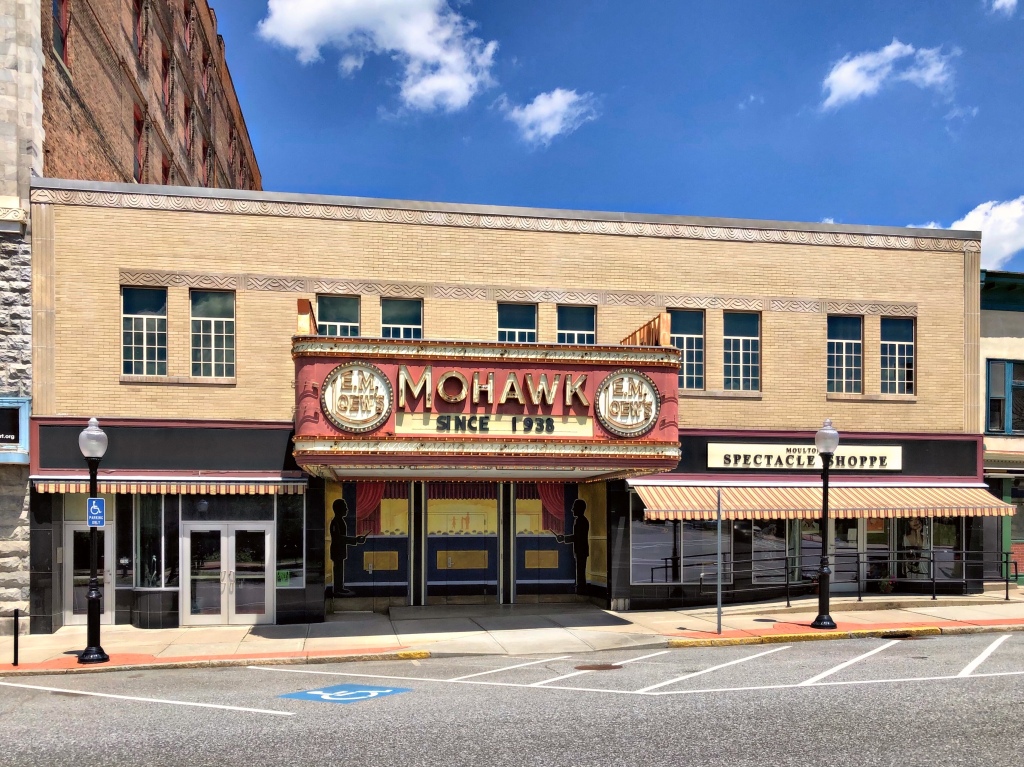
Mohawk Theater // 1938

Local theaters once dominated the urban landscape, providing flashing neon lights and marquees on Main Street USA. After WWII, many downtowns saw populations move to the suburbs and through the advancement in technology, many of these historic movie houses were demolished. Large cineplexes with 10+ screens were built, and the death of the small movie theater coincided with the death of many Main Streets in the mid and late 20th century. Fast forward to today, we see many Main Streets thriving (before the COVID crisis) thanks to women and minority-owned businesses investing in their communities.

The Mohawk Theater in North Adams was built in 1938 and is an excellent example of Art Deco architecture in Western Massachusetts. Loews Cinemas hired the Boston architectural firm of Mowl & Rand to design the 1,200 seat theater which also featured a Native American motif at the lobby. The theater was sold in 1987 to a private investor, who opened the theater for occasional concerts and films, but efforts to maintain the Mohawk were short lived. In 1991, its doors were closed for good.