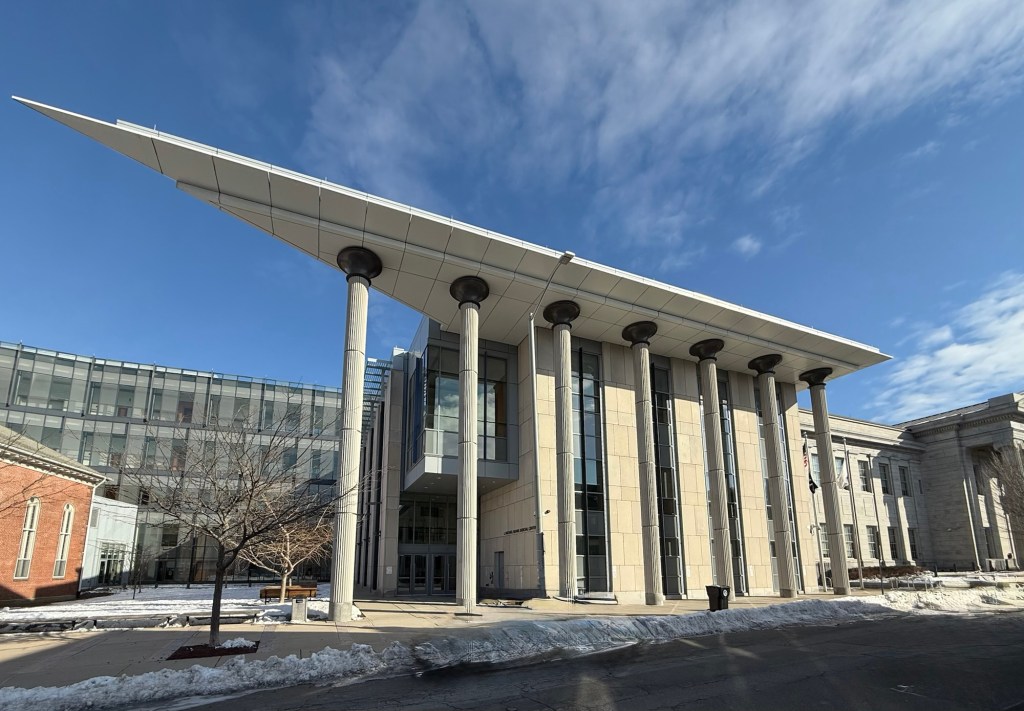
J. Michael Ruane Judicial Center // 2011

In 2005, the Commonwealth of Massachusetts announced plans to build a new court complex on Federal Street in Salem to replace the aging 19th century courthouses. A site adjacent to the 1909 Registry of Deeds and Probate Court was selected, but with one issue, a Federal-period historic Baptist Church was already on the site. The church was purchased from the congregation and moved down Federal street, and construction began on the new contemporary judicial center. Designed by Goody/Clancy Architects, the building takes design cues from the historic courthouses on the street, with a modern interpretation of the Classical architecture and Corinthian columns found nearby. Opened in 2011, the complex was named after late state representative, J. Michael Ruane, and incorporated the former 1805 Baptist Church as the new Essex Law Library.
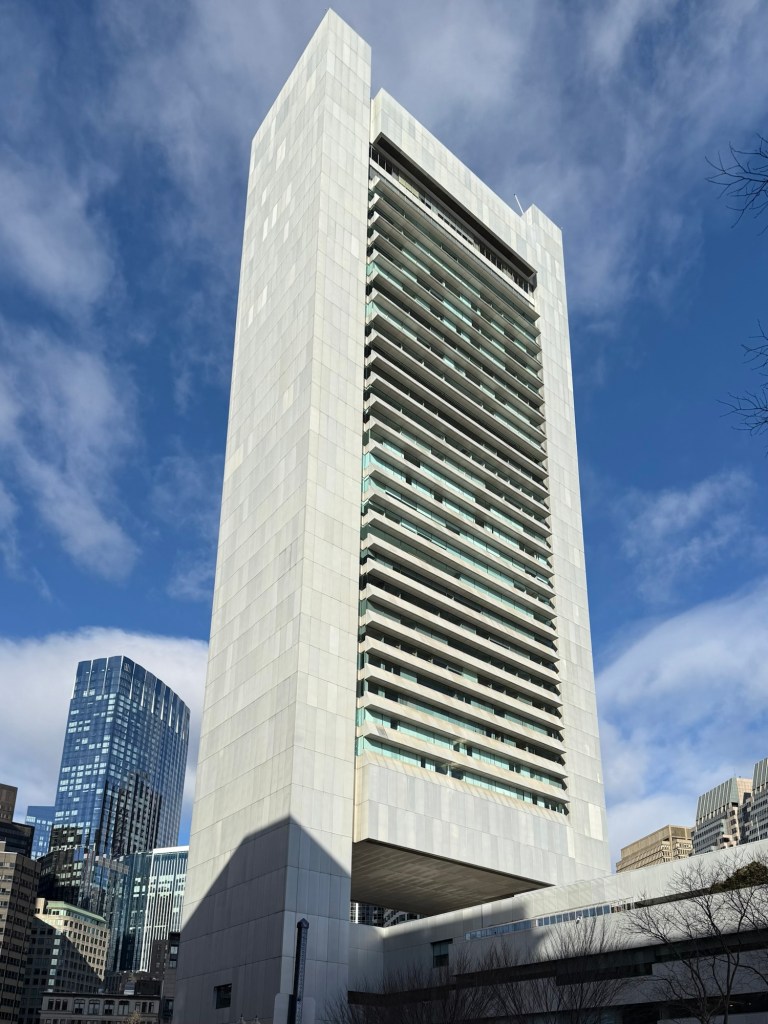
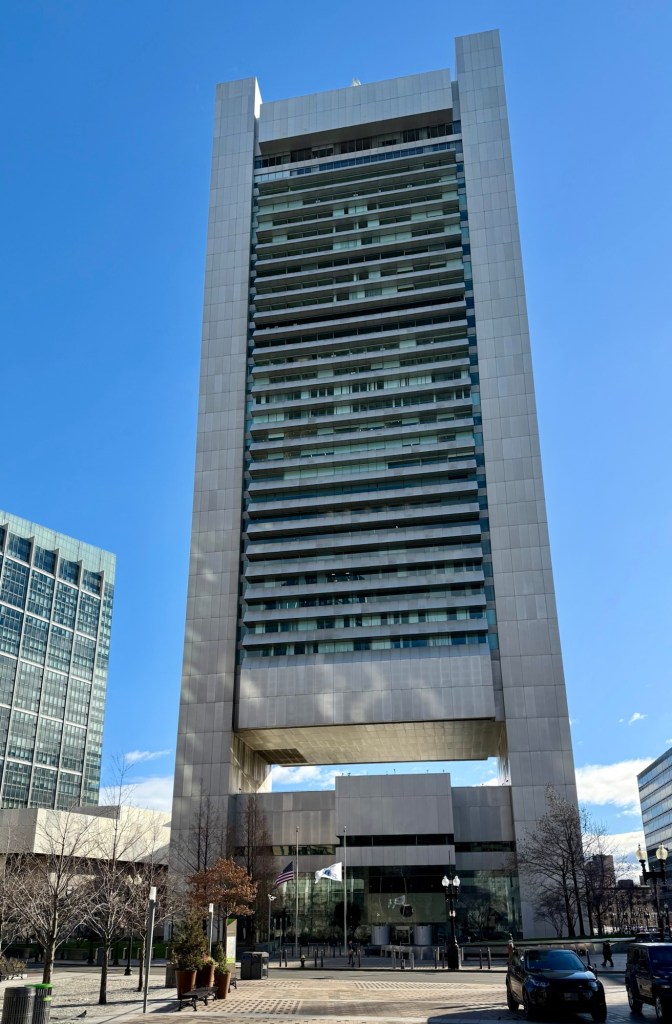
Federal Reserve Bank of Boston // 1972

Established by Congress in 1913, the Federal Reserve System is the nation’s quasi-public central bank. Its primary functions are to set monetary policy, supervise and regulate banking institutions, maintain a stable financial system, and provide financial services to the U.S. government, the public, and domestic and international financial institutions. Organized in 1914, the Federal Reserve Bank of Boston is one of 12 district banks across the country and serves the six New England states. Construction for the Boston Reserve’s Renaissance revival bank was begun in 1920 and finished in 1922, but was outgrown in the second half of the 20th century. The original building would be landmarked and is now known as the Langham, a luxury hotel. Planning began on a newer office and a site was acquired on waterfront land cleared from Urban Renewal in the late 1960s. The current building was constructed between 1972 and
1974, and occupied by the bank in 1977. Designed by the firm Hugh Stubbins & Associates, the complex occupies a full city block, with the 32-story tower and a 4-story section serving as the bulk of the mass. A 600-ton major steel structure called a “truss” marks the beginning of the tower’s offices above the breezeway. The exterior is natural anodized aluminum, which acts as a curtain wall and weatherproof facing. The aluminum spandrels or “eye-brows” shade the building interior from the sun in the summertime and allow more sunlight in the winter months. Love it or hate it, this building is extremely significant architecturally for its Modern design and materiality, and for its engineering. It has become a visual landmark and anchor into Boston’s dense Downtown.

Connecticut Financial Center // 1990

The Connecticut Financial Center is the tallest building in New Haven, Connecticut, and the sixth tallest building in the state. The 383-foot postmodern skyscraper was designed by the Toronto architectural firm Crang and Boake and completed in 1990, replacing the Powell Building (last post), New Haven’s first skyscraper. The Connecticut Financial Center is sited facing the New Haven Green wedged between the iconic New Haven City Hall and Federal Courthouse, and dwarfs both in size, creating a really unpleasant addition to the block. The building is at least clad in stone, a subtle nod to the adjacent buildings and has a more traditional first floor lobby set back from the street.

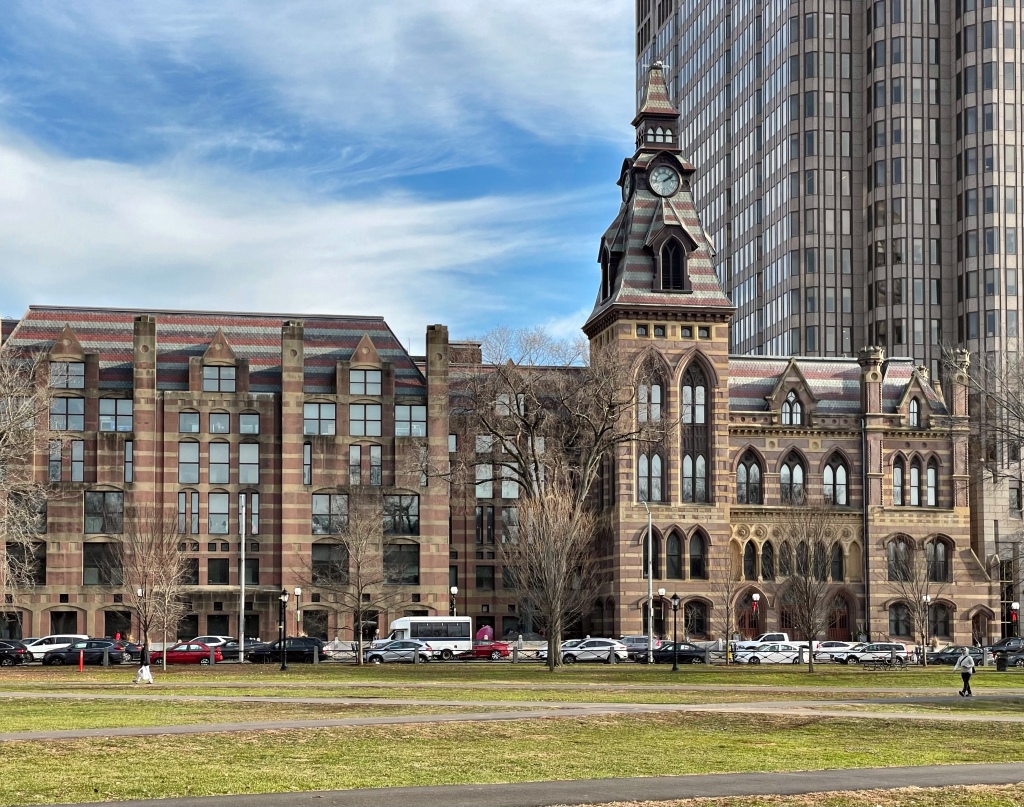
New Haven City Hall // 1861

Less than four centuries ago the area which is now New Haven, Connecticut, was the home of a small tribe of Native Americans, the Quinnipiac. White settlers arrived by 1638 and made a deal with the local sachem (leader) to protect the native Quinnipiac from raiding bands of Pequots and Mohawks in return of purchasing some of the tribe’s land by the Puritans. By 1640 a complete government had been established and the settlement, originally called Quinnipiac, was renamed Newhaven (later New Haven). The town plan was based on a grid of nine squares. In accordance with old English custom, the central square, now the Green, was designated a public common. By 1718, in response to a large donation from East India Company merchant Elihu Yale, an early college relocated from Old Saybrook to New Haven, and its name was changed to Yale College. The city grew exponentially with industry, education, and commerce, becoming one of the wealthiest and diverse cities in the state. As the city grew after the Civil War, a new City Hall was built. The New Haven City Hall was constructed in 1861-2 and was designed by local architect Henry Austin. To the left of City Hall and set back further from the street was the old Courthouse (1871-3) designed by David R. Brown (1831-1910). Together the buildings provide a united facade marking the first phase of the High Victorian Gothic Style in America. By the 1980s, plans for a new Government Center were discussed following decades of deferred maintenance and a decaying building. Luckily, cooler heads prevailed, and the facades of the building were preserved with a modern structure constructed behind to house city offices, from plans by local architect Herbert S. Newman. The Victorian Gothic and Post-Modern building stands proudly today, anchoring the east end of the Town Green.

Long Wharf Hotel // 1982

In the second half of the 20th century, much of Downtown Boston and the Waterfront areas were blighted with decaying buildings. Seeing tax dollars flee to the suburbs, the City of Boston used Urban Renewal to demolish large areas to erect new neighborhoods and blocks to revitalize the city. Much of it was done with a heavy hand, evicting largely minority and immigrant residents and razing of traditionally walkable neighborhoods for more car-centric districts. The Waterfront was traditionally the economic hub of Boston, with large commercial wharf buildings jutting out into the harbor symbolizing the economy’s strong ties to maritime trade for centuries. Boston Properties was an early developer who saw the potential of the revitalized waterfront, and developed this hotel off Long Wharf. Architect, Araldo Cossutta, (who was originally picked 8th of 8 submissions in a design competition) was ultimately selected to design the hotel, which at first glance may look out of place. However, the building draws cues from the area, evoking the Quincy Market warehouses as well as the attributes of a modern ocean liner on its head. Relatively simple massing with rectilinear and semi-circular fenestration at the lower level rises to a complex series of stepped back balconies, which form a steep gabled roof. To me, its the right amount of recessiveness and boldness in Postmodernism.

Tower Records Building // 1918 & 1986

New England is home to just three projects by world-renowned (and sometimes maligned) architect Frank Gehry. To me, architecture is best when it makes you stop, look, critique, and comment on it. Architecture is an art, and it should evoke emotion and discussion. Gehry’s work does just that. His only project to date in Boston is located at the corner of Newbury Street and Massachusetts Avenue in the Back Bay, a project I would assume most don’t realize was a Frank Gehry design. The building was originally built as a seven-story office building (originally planned as eight stories) over an MBTA station lobby in 1918. Designed by Arthur Bowditch, the building was completed a year later, built of buff brick and concrete. The Boston Elevated Railway Company (BERy) moved into the top floors of the building and it became known as the Transit Building. The construction of the Massachusetts Turnpike in the 1960s removed neighboring buildings to the south, exposing the southern, unadorned façade of the building. By 1986, owner-developer Richard Cohen began a major renovation of the building with Tower Records as the main tenant. Gehry worked with local architects Schwartz-Silver who added an eighth floor with a cornice support by angled struts. The south and east sides of the building were sheathed in lead-coated copper with the street-facing west and north sides retaining their original brick and stone, but with added glass canopies supported by more angled struts. As housing became more desirable, the top five floors were converted into 54 condominiums. The design is timeless and showcases how new and old can work together in a juxtaposition of styles well! What do you think of the building?

Heritage on the Garden // 1988

Located across Arlington Street from the since demolished Shreve, Crump & Low building (last post), Heritage on the Garden stands overlooking the Boston Public Garden. Heritage on the Garden was a result of a redevelopment initiative known as the Park Plaza Project, one of the city’s many urban renewal projects of the 1960s and 1970s, where buildings, blocks, and sometimes neighborhoods were razed and redeveloped. As part of the city’s effort of dramatic urban renewal, the Park Plaza area was identified as a site for intensive new uses, including hotel and apartment towers ranging from thirty to fifty stories! The impact of these buildings on the Public Garden and Boston Common was considered unacceptable by many residents of the city, with citizen participation helped to require lower-height buildings which would front the iconic Public Garden. In the 1980s, nearly the entire block of Boylston Street between Arlington and Hadassah Way was razed for the erection of the new condominium building, developed by the Druker Company and designed by The Architects Collaborative (TAC). The project was one of the last of the iconic TAC firm, once led by Walter Gropius, who helped bring Modernism to the United States. The Post-Modern style building ranges from five- to twelve-stories tall and is constructed of brick with cast stone, a nod to the historic Boston architecture, but with modern forms and projections. I think it works quite well, but maybe that is because I wasn’t around to see what was there before…

Richard E. Edwards House // 1981

The Colonial era has had a grip on New England residential design since the 1700s, with each subsequent “revival” showcasing the character-defining features in bold new ways. With this house on College Hill in Providence, Rhode Island, the architect, Friedrich St. Florian, blended traditional Colonial Revival residential design with the flair and quirkiness that comes with the Post-Modern style, popular in the 1980s. The house is five bays wide at the facade with a central projecting bay at the entrance. Post-Modernism takes architectural precedence and turns it on its head, with quirky takes on features and larger proportions. The Edwards House exhibits decorative stone lintels, a Classically inspired entry with pilasters, and a very large cupola at the roof. What do you think of this house? I feel it works well for the neighborhood as it is contextual to the surrounding Colonial-era and Colonial Revival style residences while clearly being of the late 20th century.

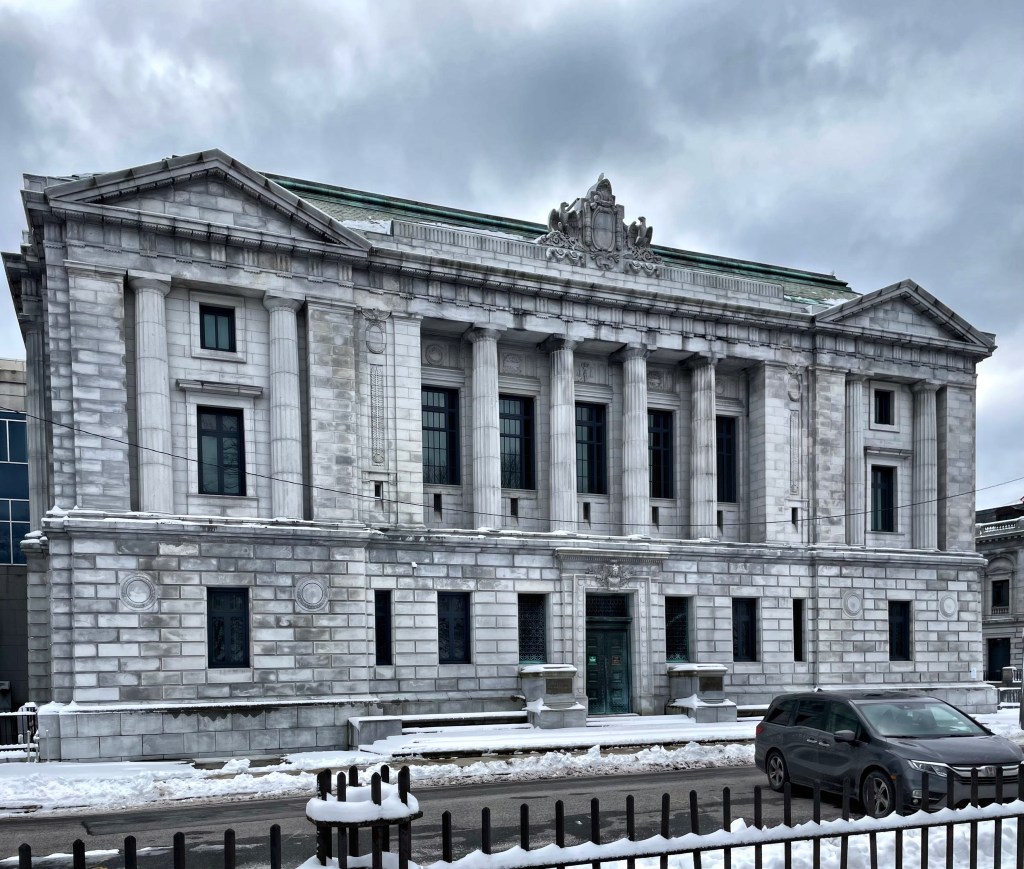
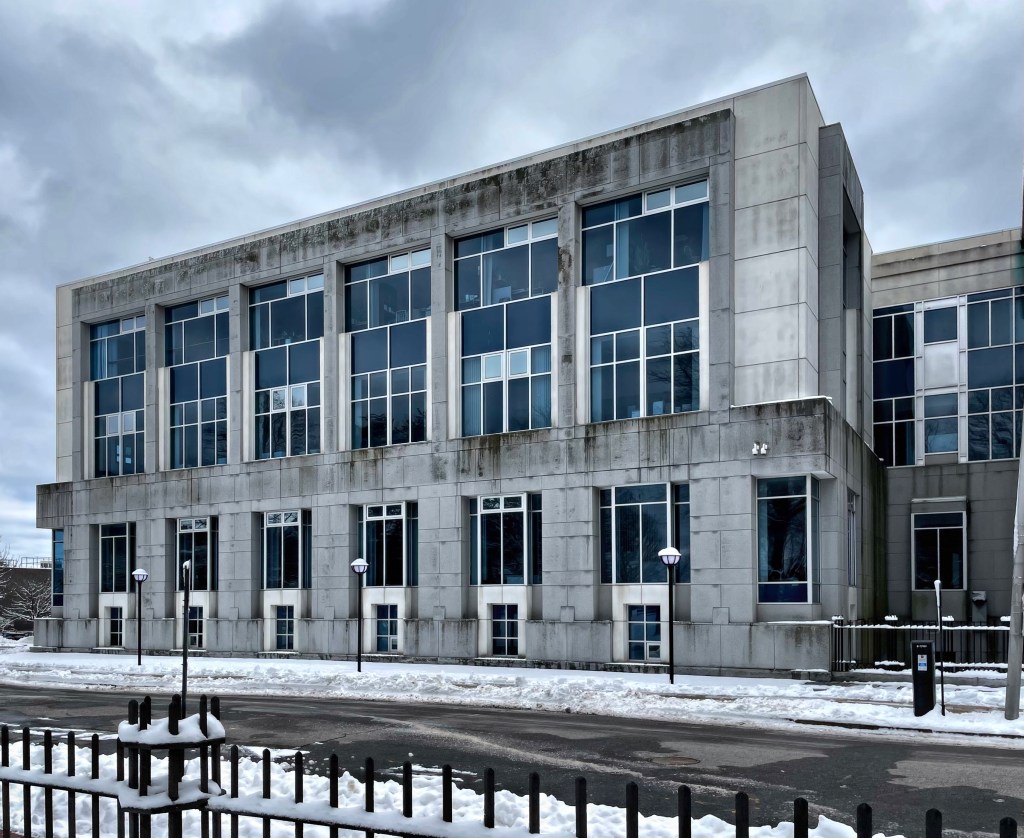
Cumberland County Courthouse // 1910

The Cumberland County Courthouse in Portland, Maine, designed by Guy Lowell, architect of Boston with local associate architect George Burnham was designed in 1906 and completed in 1910 and is the best in Classical Revival architecture. On the north and east sides is a three-story addition built between 1988 and 1991 by Terrien Architects Inc., showcases how Modern additions can be contextual and recessive, highlighting the historic buildings which they are attached to. What do you think of the original courthouse and its addition?

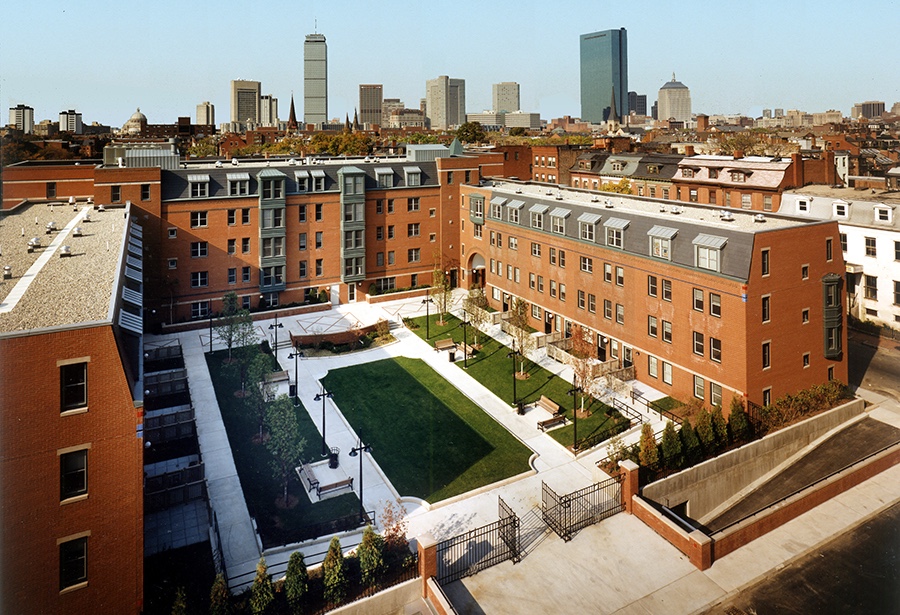
Langham Court // 1991

Image courtesy of Goody/Clancy

Appropriate infill construction can be a very difficult thing to accomplish, with some developments hitting the mark and others adversely impacting the historic neighborhoods where they were built. Boston is home to many examples of both occurrences, but I wanted to share a very successful infill project in the South End neighborhood, Langham Court. As the South End resurfaced as a desirable neighborhood, long-time residents were priced out, which led to the Boston Redevelopment Authority to fund projects to provide much-needed housing for the local community. This site which once housed over 20 townhouses, was razed by the 1960s in a period of urban renewal where existing housing was deemed unsafe and inadequate. The local design firm of Goody/Clancy was hired, and they masterfully designed a U-shaped complex of 84 mixed-income units that fits well within its surroundings. The design exhibits dormers, bays, arched and vaulted entries, a combination of mansard and flat roofs, stringer courses and textured brickwork, and a palette of well chosen materials all at a scale that blends in the 1990s building to its surroundings which came nearly 150 years prior. The complex remains as a testament to good-quality design even for affordable housing, which notoriously gets the short end of the stick design-wise.