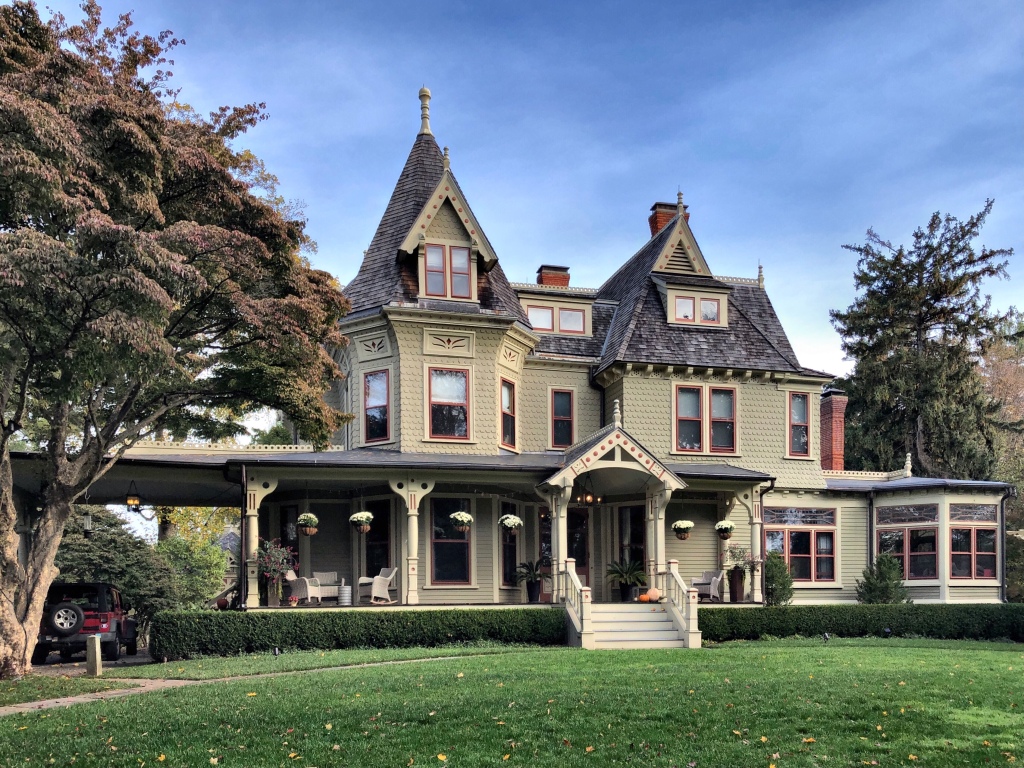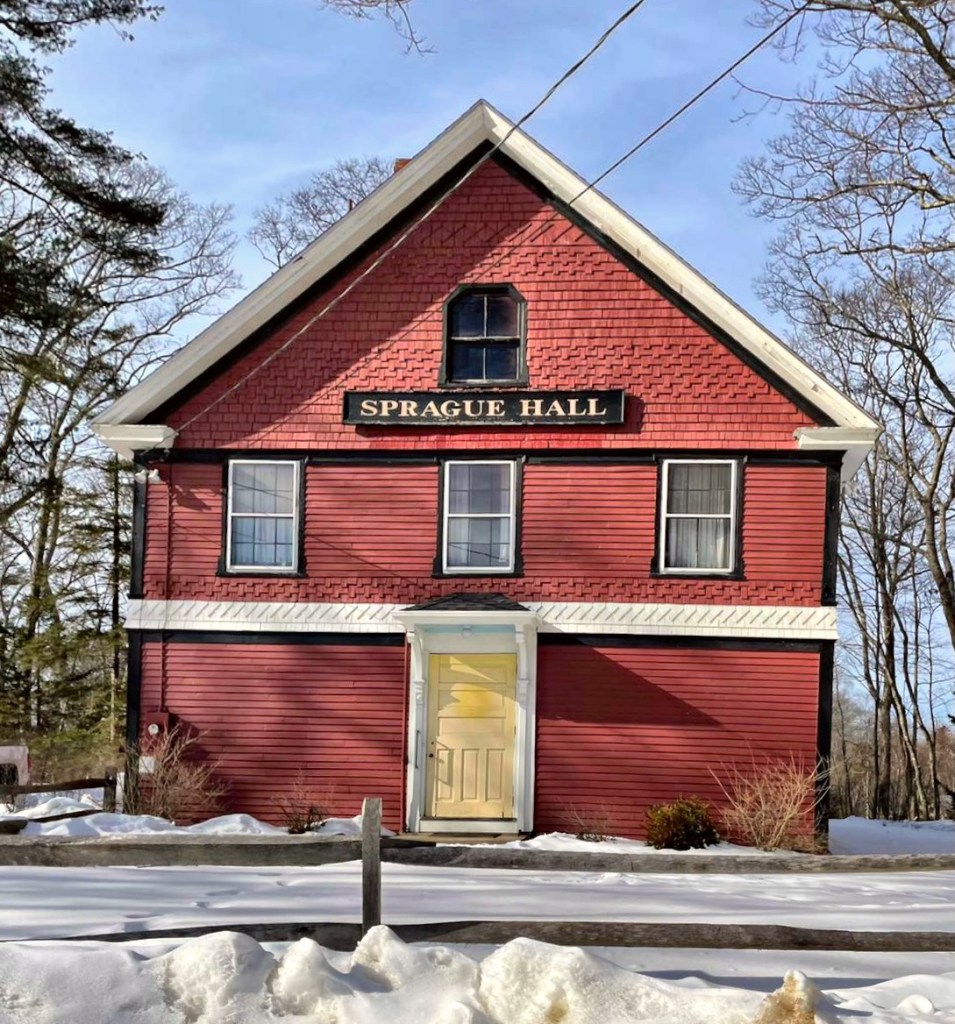
Sprague Hall // 1889

Built in 1889, this interesting structure is located away from the rocky coastline of Cape Elizabeth, a lasting remnant of the agricultural history of the town. The building was constructed as the Cape Elizabeth Grange Hall. The National Grange of the Order of Patrons of Husbandry, is a social organization in the United States that encourages families to band together to promote the economic and political well-being of the community and agriculture. The Grange organization, as it is often known as, had grange halls all over the country, where farming community members would gather to discuss issues and challenges that needed addressing. The building echos late 19th century architectural styles, blending multiple to create an elegant composition, wrapped in wood clapboard and shingle siding. In 1916, the hall was purchased by P. W. Sprague from the Cape Elizabeth Grangers to insure its use and upkeep – and it is still the home of the Patrons of Husbandry, Cape Elizabeth Grange #242.

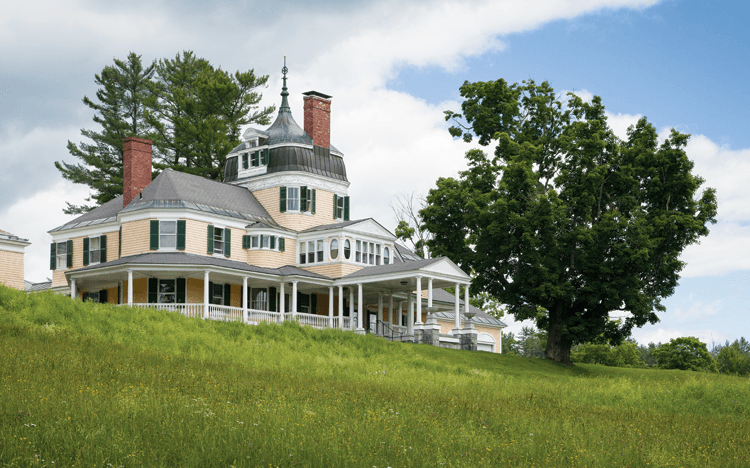
The Charlesgate // 1891

One of the most grand apartment hotels in Boston, The Charlesgate, serves as one of many architectural anchors for the Back Bay neighborhood from Kenmore Square. The apartment hotel was constructed in 1891 and so named after the Charlesgate Park which was created by landscape architect Frederick Law Olmsted as part of the glorious Emerald Necklace park system. The Back Bay Fens was the first park designed by Olmsted for the City of Boston. Creating the Back Bay Fens was as much a sanitary as an aesthetic project, because the water was heavily polluted and often stagnant; Olmsted envisioned Charlesgate as the meeting point of the Back Bay Fens with the Charles River. The apartment hotel was actually designed and was financed by the architect, John Pickering Putnam, and members of his family. The basement and first story are constructed of Indiana limestone with the remainder of brick, with limestone trimmings. A picturesque effect is obtained by grouping the bays in pairs, and surmounting each pair with gables in the Queen Anne style, and by relieving these features against a high roof of green slate. The building originally featured 30 apartments and has since been reconfigured into over 50. The architectural landmark is one of the best statement-pieces in the neighborhood, and shows that apartment design can be done very very well!

Corbin Estate // 1880

Austin Corbin (1827-1896) was a 19th century railroad man known for consolidating what we know today as the Long Island Railroad. He was born in Newport, New Hampshire and eventually graduated from Harvard Law School in 1849. He eventually moved to New York, and founded the Corbin Banking Company, which he leveraged into a successful banking firm, which funded his diversifying into resorts and railroads. In 1873, while following doctors advice of ocean air for his ill son on Coney Island, Corbin recognized the area as an untapped natural location for a summer resort, and proceeded to purchase 500 acres, opening a large hotel and a new railway system to deliver New Yorkers to the resort in 1878. He is infamous for strong-arming the Montaukett tribe on Long Island out of nearly 10,000 acres they occupied around Montauk. The tribe is still seeking compensation for this tactic. In 1880, he built this summer estate in his hometown of Newport, NH as a castle for his greed, also acquiring over 100 acres for the estate. He soon after bought out over 25,000 acres of land for an ultra-private members-only hunting club. Corbin died on the estate in 1896 and the property was eventually purchased by William Ruger. The home was vacant for decades following WWII until Ruger, who co-founded Sturm, Ruger & Co. purchased the estate, likely utilizing the hunting reserve next door. The property and another owned by the Ruger Family were sold separately at auction in 2019.

Hollis Town Hall // 1886

Constructed in 1886, the Hollis Town Hall in New Hampshire is a distinctive example of Queen Anne civic architecture showcasing an asymmetrical design and a variety of forms, textures and materials. The building was designed from plans by Manchester-based architect William Butterfield. As originally constructed the building was painted in dark tints to harmonize with the roof which was covered with shingles and painted dark red. In 1902, the clocks were added atop the tower with a clock designed by George M. Stevens of Boston. Sadly, the buildings’ original polychromatic paint scheme which highlighted the architectural details was updated with a solid white color.

John Hoyt Perry House // c.1875

John Hoyt Perry was born in Southport in 1848, and graduated at Yale in 1870. He received his professional education at Columbia Law School and was admitted to the bar in Bridgeport, CT in 1872. He had an active law career in Connecticut, later working as a judge. He served Southport in the House of Representatives throughout much of the end of the 19th century. In 1913 he was elected to the Connecticut Senate and served as the minority leader. He served as counsel for the United States in arbitration proceedings with Chile in 1902, and as counsel for the town of Fairfield. This home in Southport was constructed for him, likely around 1875 after he accepted his position as a head attorney at a major firm nearby. The home can be classified as a blending of Stick style and Queen Anne Victorian design with the asymmetrical form, tower, large porch with projecting porte-cochere, shingle siding, and bargeboards.

Ms. Hetty Gookin House // 1874

Warren Demman Gookin (1810-1874) was born in Haverhill, New Hampshire. He was educated at Haverhill Academy and Dartmouth College, graduating from the latter institution in 1830. In 1835 he went to Cuba where he remained for ten years as a sugar planter. Later, he was engaged in a mercantile business in Oregon, finally settling in Brooklyn, NY and working as a shipping merchant in New York City until his death in 1874. After his death, his widow Hetty moved back to her hometown of Southport, CT and built this large home. Later this was the home of Mrs Gookin’s stepdaughter, Mrs Edwin Waterman.

Simon Sherwood House // 1884

The Simon C. Sherwood house, built in 1884, is a fine late nineteenth-century eclectic Victorian home, somewhat unique to the Southport area of Fairfield, CT, which is dominated by early-mid 19th century styles. Simon Couch Sherwood was the son of Edwin Sherwood, a wealthy shipping merchant who made a fortune from trade between New York and Savannah. The Queen Anne-Eastlake style home was added onto with a larger porch, obscuring an original oriel window on the side elevation. Sadly, the home has a safe, yet inappropriate pale yellow body color with white trim, which does not showcase the intricacies of the Victorian era home.

Farist House // 1894

Joel Farist (1832-1904) emigrated to America with his family by the way of Sheffield, England, working originally as a laborer as a child. By his thirties, he formed the Farist Steel Company in Springfield, MA, later relocating to Bridgeport, CT in 1872. Due to his prestigious role and success, he became well-connected in Bridgeport, later becoming the first President of the Bridgeport Electric Light Company and Vice President of Bridgeport Hospital. He built this massive home in nearby Fairfield, CT, likely to get away from the polluted Bridgeport air, for a more bucolic area. The massive Queen Anne home he had built (likely as a second home) features prominent towers, a full-length porch, and a porte-cochere off the side. The home has been restored a few times recently, and a new (hopefully not final) paint scheme in yellow was recently painted on the front facade.

Abbott Memorial Library // 1905

Gifted to the town of Pomfret by Ira Abbott, the Abbott Memorial Library is one of the most stunning little libraries in the State of Vermont. Given to his hometown as a memorial to his parents by Ira Abbott, who was at that time a State Supreme Court justice in the territory of New Mexico. Its architect, Henry M. Francis, used diverse materials — brick, granite, fieldstone, red birch, and pre-stressed concrete, to design the eclectic building. Capped with a red slate roof with terra cotta ridge tiles, the building stands out as one of the most unique buildings in the state and has been extremely well-maintained through its public-privately funded Commission.

Whitney Hall // 1901

The Enfield, New Hampshire Library and Memorial Building, also known as Whitney Hall, is a transitional Queen Anne/Shingle Style building built in 1900-1901. Local citizens donated funds for construction of the building to house the public library, as well as a selectmen’s office and rooms for fraternal organizations (notably the Grand Army of the Republic). The second floor, known as Whitney Hall, served as a public hall and theater. Mill operator George Whitney donated $1,000 for its construction and also built the village’s first electric plant, making Enfield one of the first towns in the state to have electricity for its homes and streetlights. During World War II, the top of the tower was enclosed to spot for enemy aircraft, remaining enclosed to this day. In 1976 the building underwent major renovation and now also contains the Enfield town offices.