Ambrose Burnside House // 1866

What do this unique Victorian house and sideburns have in common? Well, you are about to find out!
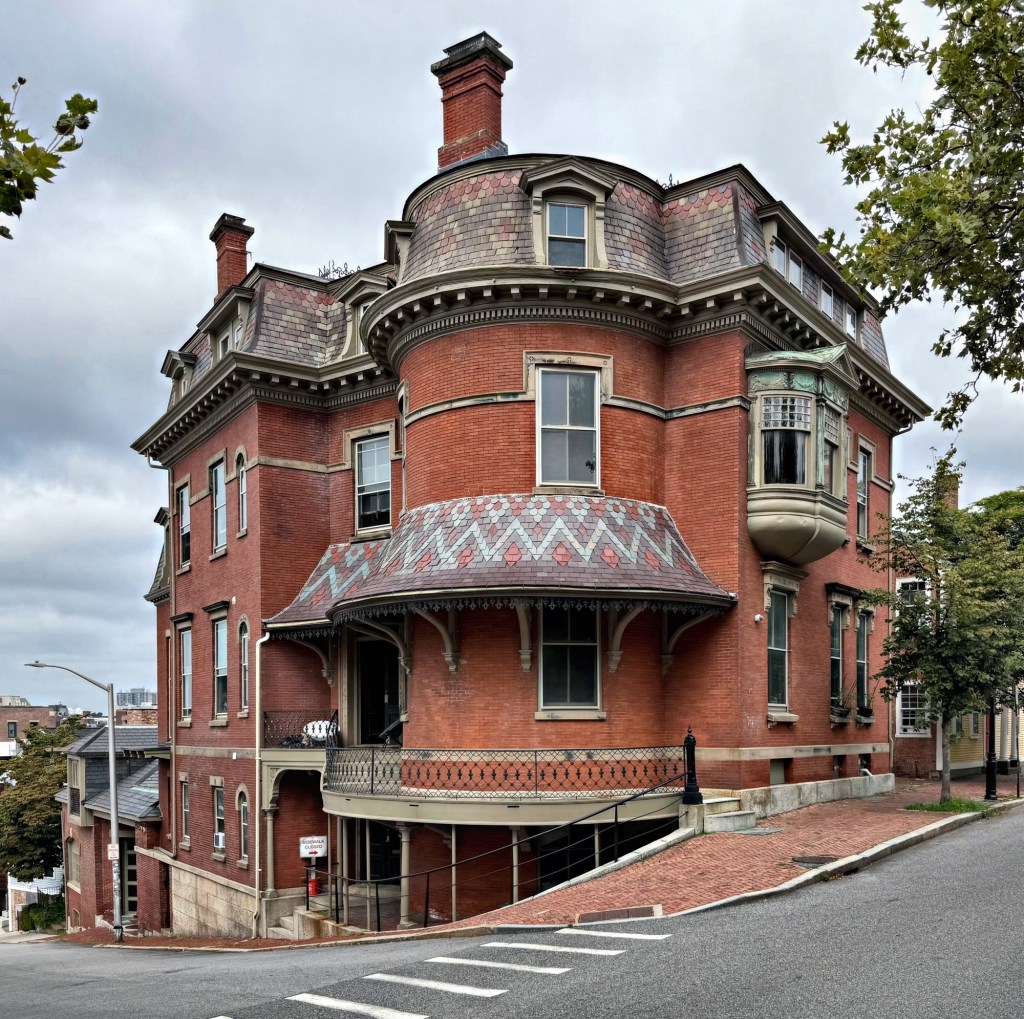
The Ambrose Burnside House is sited on an oddly shaped, and sloping corner lot on Benefit Street in Providence’s East Side neighborhood, and is one of the most unique Second Empire style residences in New England. The house was built in 1866 for General Ambrose Burnside (1824-1881), a Union general in the American Civil War, who returned to Providence and was about to begin a term as governor, followed by two terms in the United States Senate. Ambrose Burnside hired local architect, Alfred Stone, to design his new city mansion, which upon completion, was deemed one of the most “modern residences” in Providence. Built of brick with Nova Scotia stone with a concave slate mansard roof and one-of-a-kind rounded corner bay, the Ambrose Burnside House does not disappoint! Ambrose Burnside died in 1881 and the property was occupied by his sister-in-law until the property was sold in 1884 and housed the Providence Children’s Friend Society House for Aged Women and the Providence Association for the Benefit of Colored Children, providing shelter and food for elderly women and children of color without parents or guardians. After WWII, the Burnside House was converted to apartments.

Now, to the sideburns… Ambrose Burnside was noted for his unusual beard, joining strips of hair in front of his ears to his mustache but with the chin clean-shaven; the word burnsides was coined to describe this style. The syllables were later reversed to give sideburns.
Hotel Pelham // 1857-1916

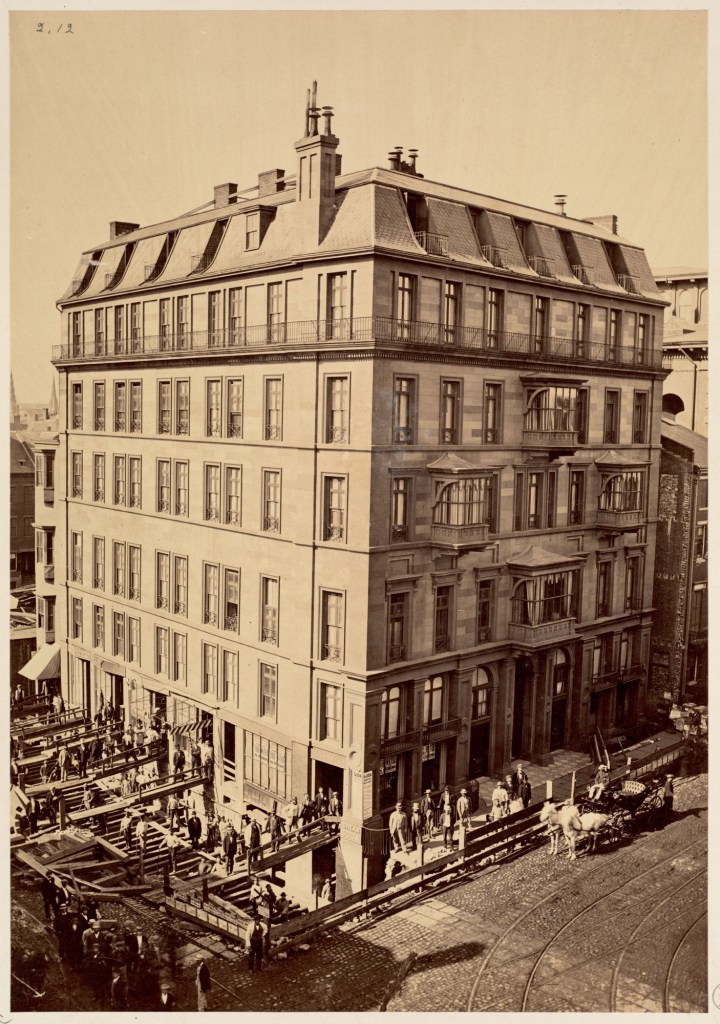
Built in 1857 at the prominent intersection of Boylston and Tremont streets in Boston, the Hotel Pelham is said to have been the first apartment building of its type in America. Seen as a high-end apartment building, not like the slum-like tenements in New York and elsewhere in Boston, the units were like French-flats for medium-term renters, rather than short-term stays. The Hotel Pelham was developed by Dr. John Homer Dix, a doctor who took a keen interest in providing healthy accomodations for city-folk. The Hotel Pelham was designed by architect Alfred Stone, as an early example of the Second Empire style, with a French Mansard roof and stone facades. Just about a decade after the building was completed, Tremont Street (which runs along the side of the building) was set to be widened. This work would require the partial (and likely full) demolition of the Pelham Hotel. Rather than see his building face the wrecking ball, Dr. Dix, in 1869, had the Hotel Pelham slid off its foundation, and moved westward thirty feet to accommodate the expanded Tremont Street. This incredible feat of engineering was undertaken by John S. Blair, with architect Nathaniel Bradlee overseeing updates to the facades and interiors. The building would survive a gas main explosion in 1897, but succumbed to redevelopment during WWI, when the building was demolished for the present building on the site, the Little Building.

Smith Owen Mansion // 1861

You honestly cannot beat Providence when it comes to brick Italianate mansions… The Smith Owen Mansion on College Hill was built in 1861 for jeweler and silversmith Smith Owen (1809-1889) and is one of the finest homes in a neighborhood full of historically and architecturally significant properties. Mr. Owen was in business with his brother George, and they manufactured and sold some of the best jewelery in the region, largely from their commercial block downtown (featured here previously). He hired Alpheus C. Morse and Alfred Stone, local architects who furnished the plans for the colossal home. Owen lived here until his death, which occurred less than a week after his wife’s passing. His daughter Lydia Dexter Owen Beckwith (1850-1947) inherited the property and lived here with her family until her death. It was under Lydia’s ownership that the Colonial Revival entrance details were added with projecting vestibule with columns and urns and central fan transom. It is really something special!

Owen Building // 1866

The Owen Building sits on the edge of Downtown Providence, near the Providence River which divides College Hill from Downtown. This mansard roofed commercial building is one of the finest in the city and was designed by architect Alfred Stone for George and Smith Owen (G. & S. Owen), whose sons operated a wholesale yarn business on the premises. In 1877 Stone, as Stone & Carpenter, returned to remodel the building, seemingly adding the mansard roof and much decorative trim on the new north facade. The building retains its cast-iron storefront and prominent siting as a lasting example of 19th century architectural heritage.