Adams House // c.1820

Welcome to Peru…Vermont. The town of Peru sits in Bennington County, adjacent to the previously featured town of Landgrove. Peru was chartered with the name Bromley in 1761 by Benning Wentworth, governor of the Province of New Hampshire as one of the land grant towns in the former hinterland of present-day Vermont. By 1804, the name of the town was changed to Peru. The new name was adopted to attract more people to the town by associating it with the South American province of Peru, which was considered to be a place of great wealth (wishful thinking). This house on the western edge of the village was built c.1820 and significantly modernized since then. The original log house here was built c.1804 by Joel Adams. The home was modernized to the present five-bay facade by the 1820s-30s and operated as a double-house for Joel and his son Joel Adams Jr. The property was also inhabited by Everett Adams, Joel’s grandson, who briefly served in the Civil War.
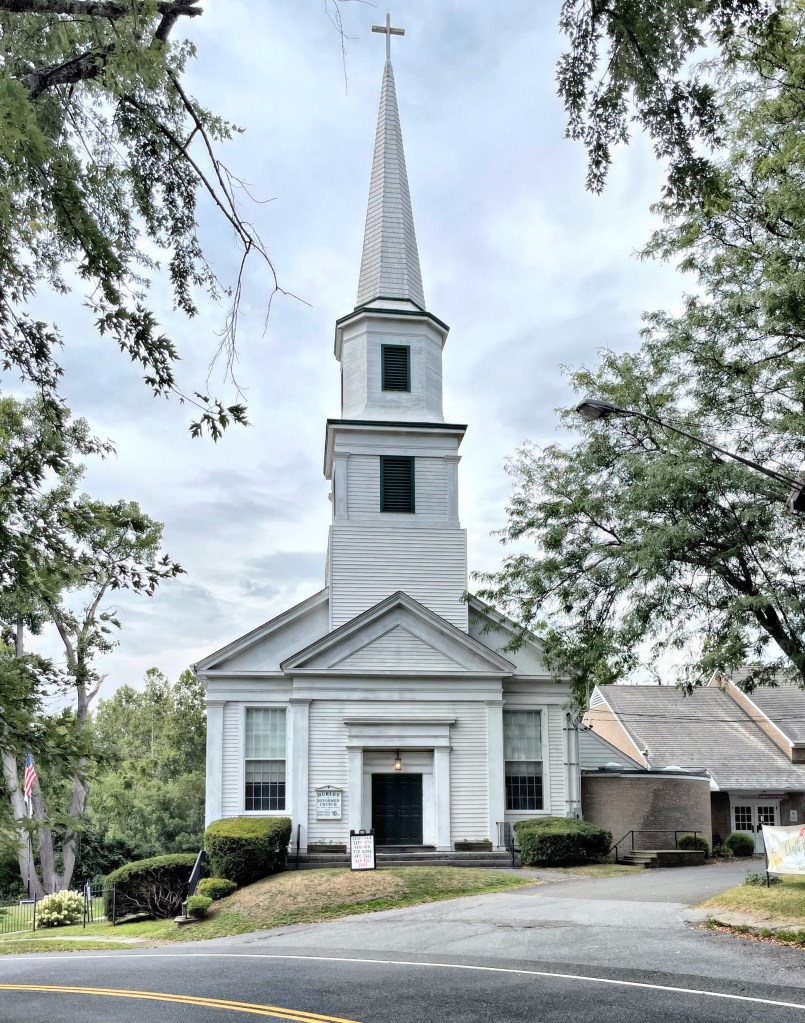
Hurley Reformed Church // 1854

From about 1670 to 1801, the villagers of Hurley were associated with the Kingston Reformed Church, about three miles away. In those years, the minister of the Kingston Church met with the Hurley parishioners at least once every six weeks and conducted a Sunday service in one of the local homes. In 1801, they grew tired of not having their own place of worship, and they petitioned to establish their own church in Hurley, and succeeded. The original church building was a large, single room, stone building that seated over 250 people on the main floor and in three galleries around the side and back walls. A tall steeple atop the building boasted a large brass globe surmounted by a wrought iron weathervane in the shape of a crowing rooster. A large crack in the building was unrepairable and the structure began to shift, leading to its replacement with the current building in 1854. The old white church has been occupied by the congregation ever since.

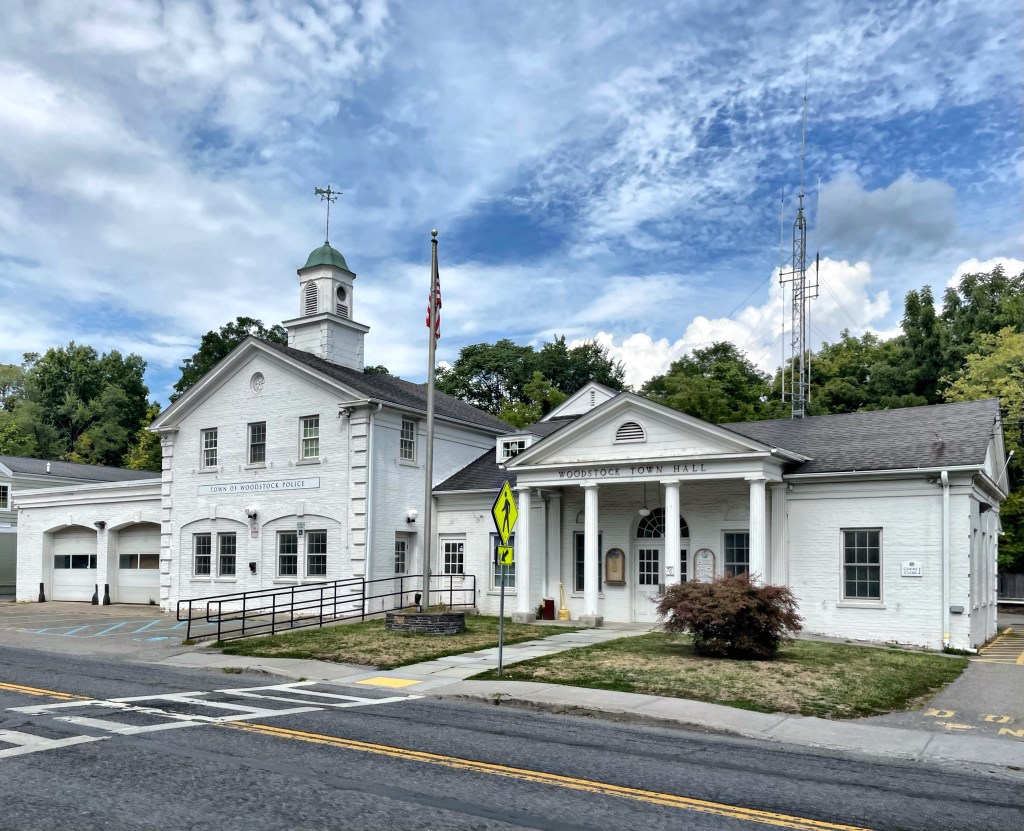
Woodstock Town Hall and Police Station // 1936

Buildings of New England hits the road! Occasionally, I like to explore and learn about towns and villages in places outside of New England, and one place that has always piqued my interest is Ulster County, NY. One of the more well-known towns in Ulster County is Woodstock, an absolutely vibrant and charming village in the mountains. The first European settlers in the Town of Woodstock were Dutch, along with a few Palatine Germans, who established farms on the fertile land. The town saw some industrial development along Sawkill Creek, but experienced substantial building growth in the early 20th century after the area attracted artists of all types to the area. The village saw population growth which necessitated new city facilities like a town hall and police station. In 1936, construction began on a combined town hall office and police station for the village, in the midst of the Great Depression (possibly using New Deal funds?) The Colonial Revival style building exhibits brick construction with corner quoins, Classical elements like the pediment and columned portico, and a cupola. The only notable alteration since its construction is the infill of the former fire station doors.

King’s Head Tavern // 1691-1870

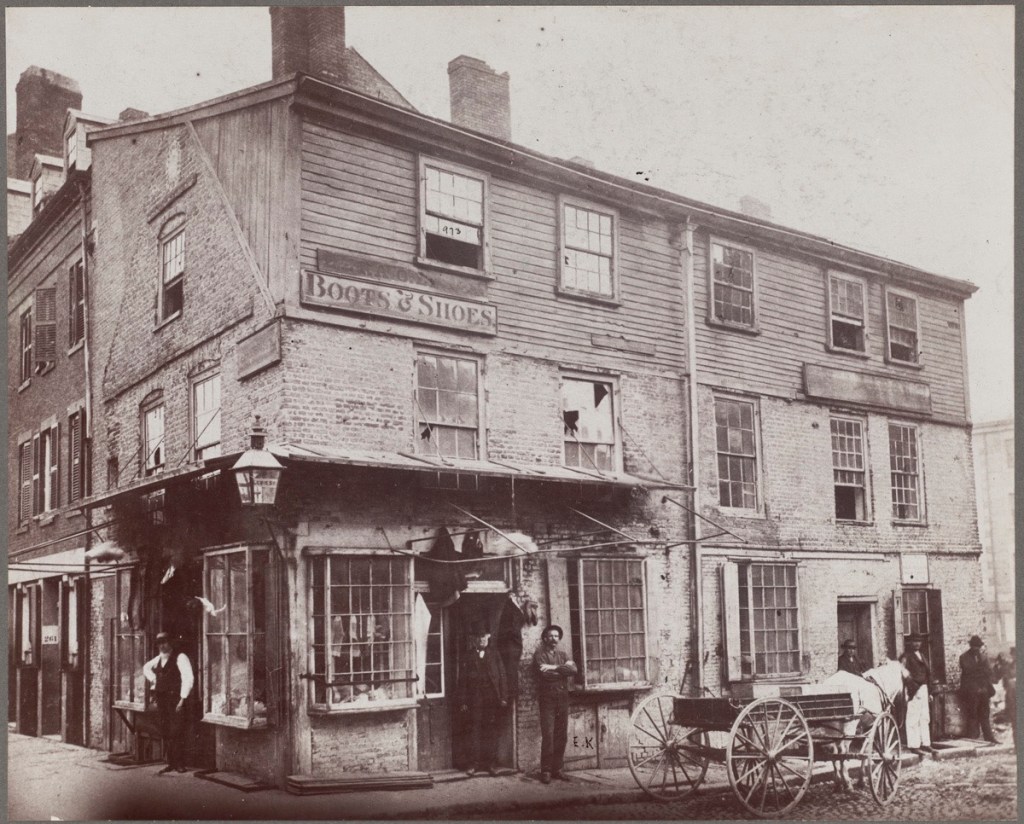
Another of Boston’s Lost buildings is the King’s Head Tavern, an old establishment that was built in the early days of Boston and rebuilt following a fire in 1691. It stood on the corner of Lewis and North Streets, in the North End near Scarlett’s Wharf. Due to its proximity to the harbor and wharfs, it became the first place weary sailors stopped to get a drink on solid ground. The two-story, brick tavern was capped with a gambrel roof, which was later filled with wooden additions giving the structure a boxy look. The establishment was named the King’s Head Tavern after a popular London tavern of the same name. Like much of the North End, surging immigrant populations put immense strain on the built environment and many older buildings were demolished in the late 19th and early 20th centuries for tenement housing. The old King’s Head Tavern was demolished in 1870, just two years after the photo was taken.

Thomas M. James House // c.1900

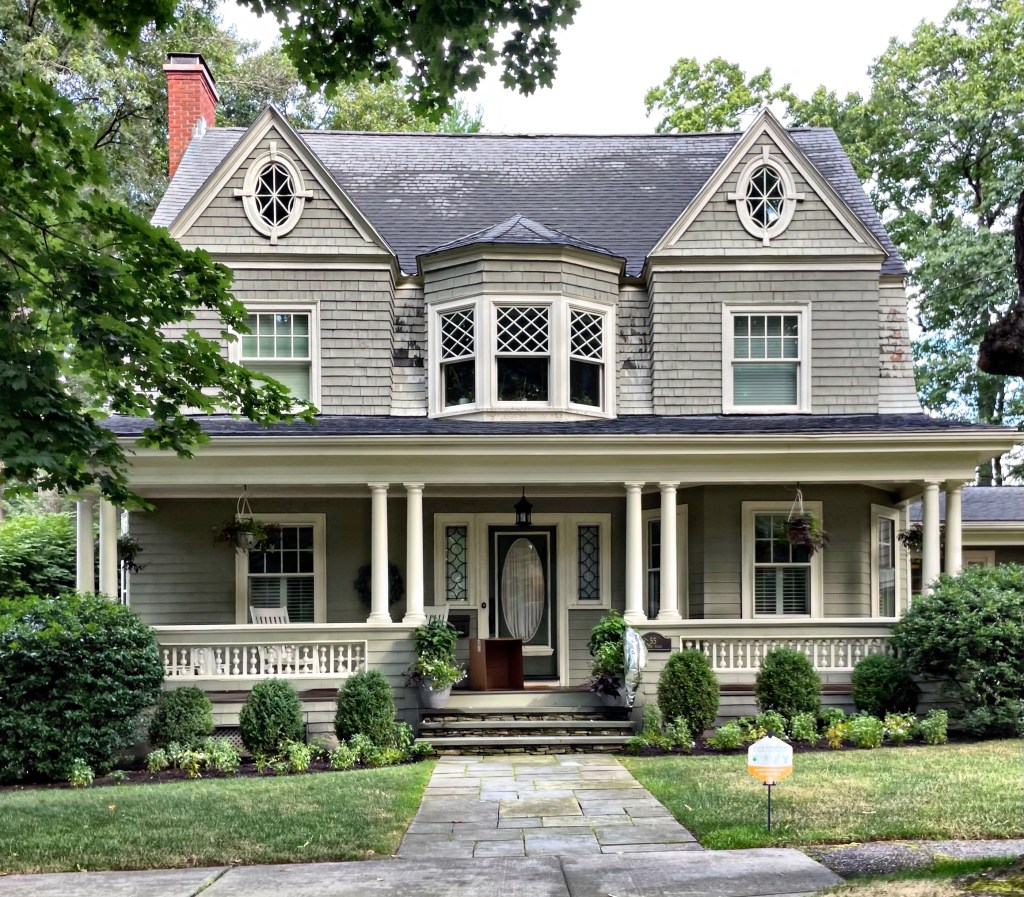
When the Waban section of Newton got a rail line connecting it to Boston, development boomed! Architects who lived in other parts of the Boston area saw an immense opportunity, not only for work, but for a bucolic setting where they could also reside. One of these architects that lived and worked in Waban was Thomas Marriott James, who in the early 20th century, designed and moved into this house on Pine Ridge Road. James was also born in Cambridge but received no academic architectural training. By 1893, Boston directories record that he was a draftsman at the office of Eugene L. Clark, a prolific
designer of suburban homes. His residence in Waban blends the Shingle and Colonial Revival styles under a broad gambrel roof. The verandah is inset and has segmental bays with shingle posts as supports. The kneewall is also shingled, adding to the composition.

Lamont Residence // 1907

In 1907, William F. Lamont and his family moved into this beautiful turn-of-the-century home in the rapidly developing Waban Village in Newton, Massachusetts. The extension of the circuit railroad connected this part of Newton (which had previously been farmland) to Downtown Boston, opening up the area to development for middle-income families who sought land and fresh air in the suburbs. The first house on Alban Road in Waban was built for the Lamont Family, and it perfectly blends multiple architectural styles under a gambrel roof.

What is your favorite feature of this house?

Thomas Snow Shop // 1854

This tiny building next to the John Palmer House featured previously was built in 1854 by Thomas Snow as an income-producing property. According to the sign, Snow was a grocer in town and must have rented the small building, which was developed on a small sliver of land, formerly a side garden. I’d guess that the building was originally 1 1/2-stories with the brick first floor added underneath sometime later. The house is vernacular Greek Revival in style and the scale is exactly what makes Marblehead so charming to get lost walking in!

Leavitt Peanut Butter Company Factory // 1958

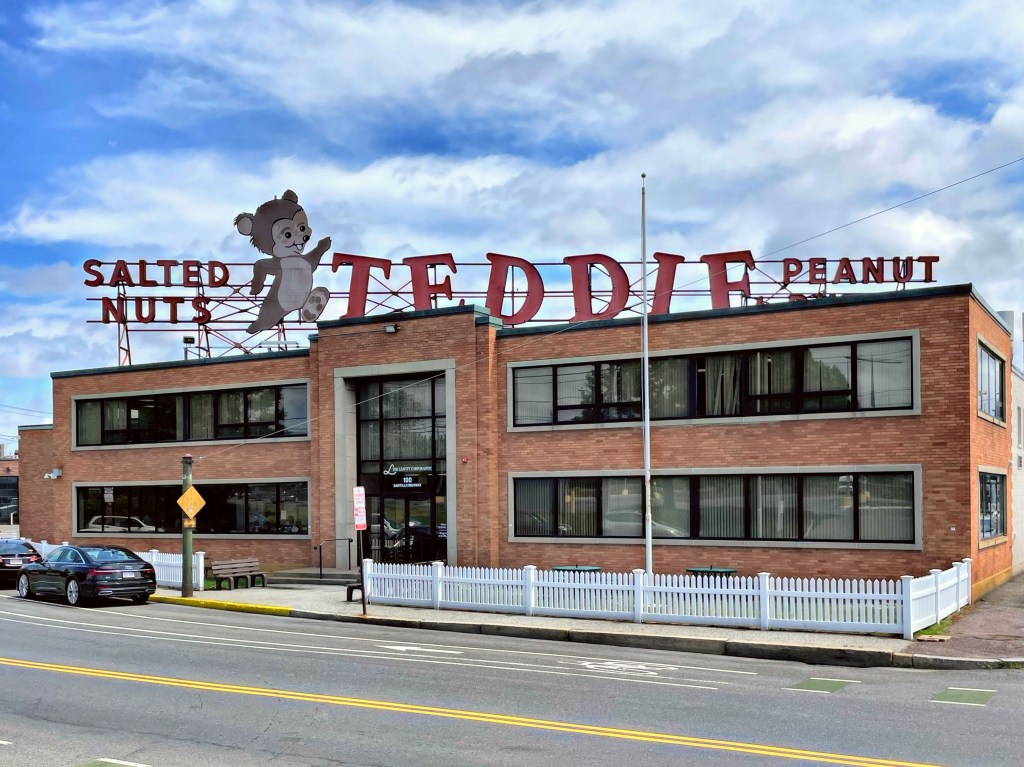
One of the most iconic buildings in Everett, Massachusetts is the “Teddie Peanut Butter” building, in the brewery/distillery district of the city (home to Night Shift Brewery, Bone Up Brewing Company, and Short Path Distillery). The building is best-defined for its massive Mid-Century rooftop sign with the cute teddy bear. The building was constructed by the Leavitt Peanut Butter Company in 1958, but the company had its beginnings nearly a half-century earlier. The Leavitt Corporation had its beginnings in 1897 when Sarkis Shaghalian, a European immigrant, started manufacturing candy and roasted nuts in Boston. In 1916, Michael Hintlian took over the company and in 1925, established a separate corporate entity specializing in peanut and nut products, the John W. Leavitt Company. The company did extremely well in its Boston location, eventually outgrowing their State Street buildings. In 1959, the company hired an industrial realtor, who found the Everett facility – a recently constructed building with Modern finishes and design. In 1959, Leavitt Corp. signed a lease and moved in by 1960, adding the rooftop sign at that time. The sign used to have neon strips, but was eventually removed.

First Everett High School // 1893

While Everett’s population had remained small compared to nearby towns throughout much of the nineteenth century, its close proximity to Boston resulted in dramatic population growth between 1885 and 1915. During this late industrial period Everett’s population was one of the fastest growing in the state, doubling between 1870 and 1880, nearly tripling from 1880 to 1890 and doubling again between 1890-1900. The City of Everett immediately went about erecting a new schoolhouse to educate its youth. Architects Loring & Phipps were retained to prepare plans for the new high school. Ground was broken in August 1892 and the building was dedicated just over a year later in September 1893. The school was opened to 175 students on Monday, October 2, 1892 with a capacity of 550 students (as it was realized that the city would continue to grow). The building is high-style Queen Anne with red brick and mortar and light sandstone trimming. In 1905, the capacity of the high school was nearly doubled by the construction of an addition on the west end of the original building. Even doubling the size of the school did not prove adequate as the building was outgrown less than a decade later. From this, the Second Everett High School was built a block away. The First Everett High School is now known as the Whitney Lorenti House, a low income, elderly housing complex.

Allen Fletcher Mansion // 1906

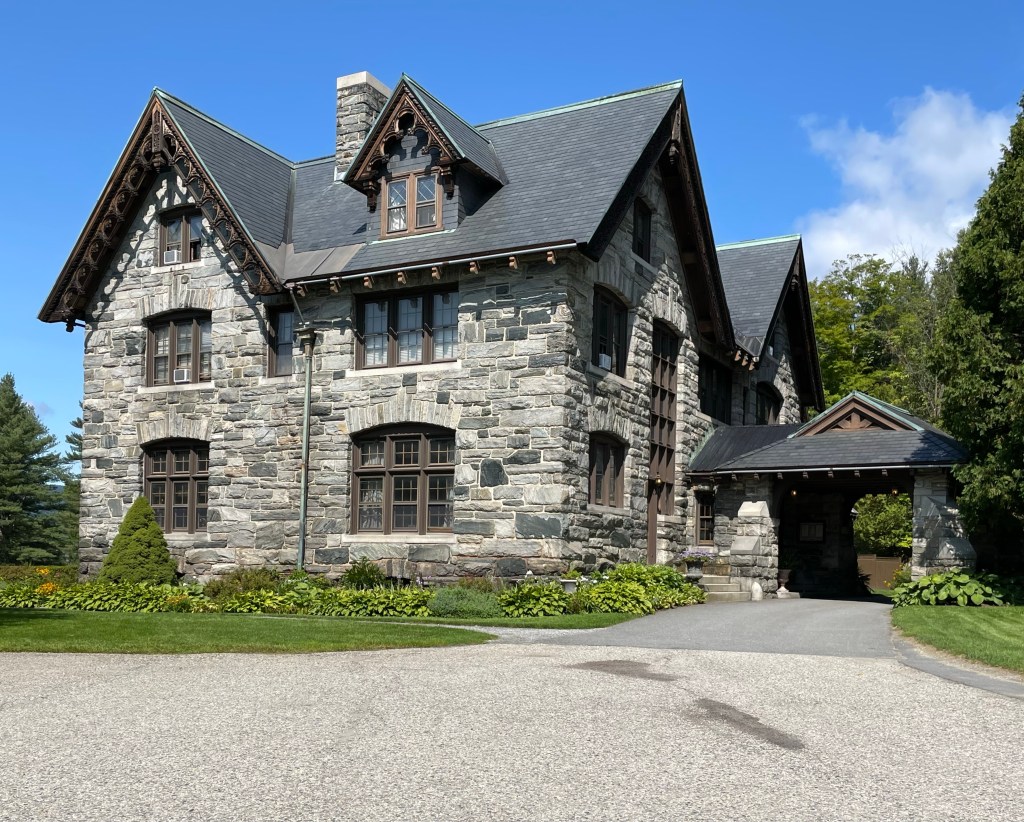
As Cavendish and other rural towns of Vermont became summer destinations for the rich of the urban centers of the northeast, large estates began to sprout up, replacing old family homesteads. Allen Miller Fletcher was born in Indianapolis, Indiana, the grandnephew of Josiah Fletcher, one of the original settlers of Cavendish in September 1853. He was the son of a successful banker and became a banker himself, building homes in Indianapolis and New York City. In 1881, he built a summer home in his ancestral home of Cavendish, taking the train up to relax and breathe in the clean air. While living most of the year in New York, Fletcher became involved in Vermont politics, winning the Republican nomination to serve in both the Vermont House of Representatives and the Vermont Senate in the early 1900s. During his time as a Vermont state senator, Fletcher commissioned architect Samuel Francis Page of the Boston-based firm, Fehmer and Page, to bring his vision to life. Page used English Cotswold-style architecture for his inspiration, and when completed in 1906, the home was the first in Vermont to be fully wired for electricity and equipped with an elevator! Fletcher also hired Frederick Law Olmsted Jr. to design the landscaping on the property. Fletcher would spend the rest of his life at his country mansion, going on to work as the Governor of Vermont from 1912 to 1915. Today, Fletcher’s beautiful mansion now lives as a magnificent holiday retreat known as the Castle Hill Resort & Spa.