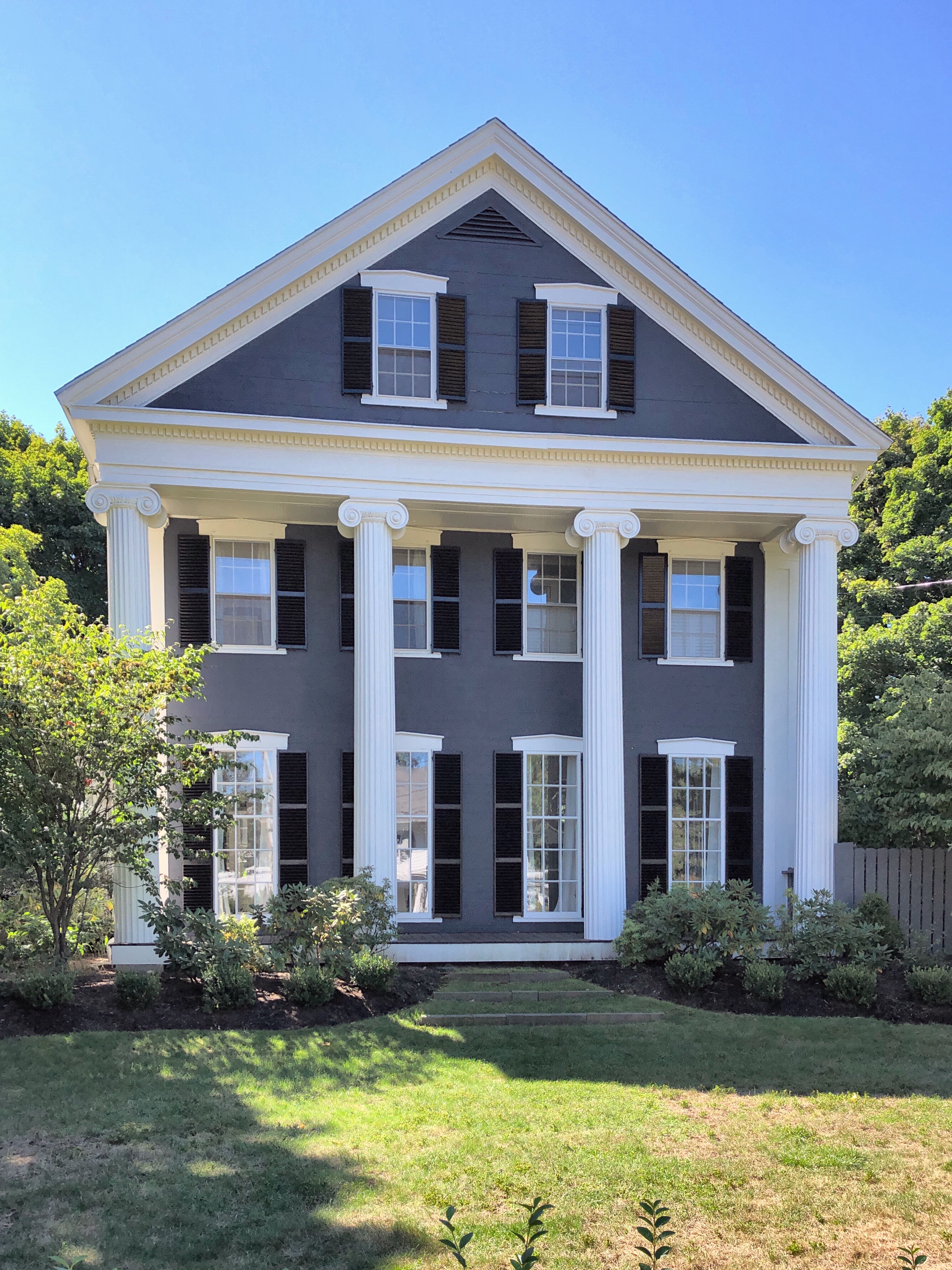
This house was built in 1847 by Frederick A. Collins on land owned by his father, Mathias Collins III. Frederick Collins (1818-1892) had this house built just after his marriage the same year to Amelia M. Revere, purportedly a grandniece of Paul Revere. Prior to his marriage, Frederick A. Collins lived in Newton Upper Falls and started a glue factory with his brother, which by 1855, had grown to three three factories and which folded upon the death of his brother Edward Collins in 1879. Collins was active in local affairs, serving in later life on the City Council. The home remains a significant monumental temple-front Greek Revival house in the Boston area. It was designated as a Newton Landmark, meaning it will be preserved for future generations to appreciate.
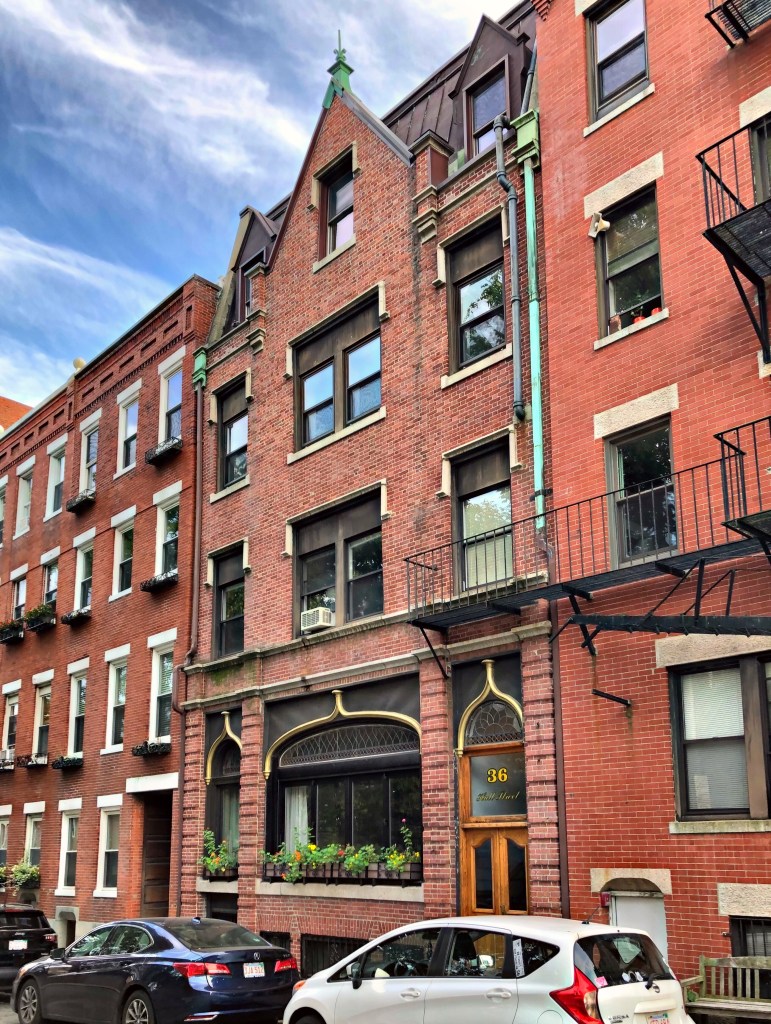
Constructed for the Woman’s Home Missionary Society of the Methodist Church of New England, this building was associated with the Hull Street Medical Mission from the time of its construction, in 1901, to about 1950. The mission was one of a number of church-related social service programs established in the North End in the late 19th and early 20th centuries to address the needs of recent immigrants, namely the Russian Jews, Italians, and Portuguese residing in this area of the neighborhood. In 1909-1910 alone, 14,574 treatments were given in the clinic, providing a huge medical service to the widely low-income immigrant community of the North End [29th Annual Report, 154]. The Medical Mission closed in the early 1950s and the property was later sold and converted to apartments. It was designed by architect Walter Forbush, who utilized ogee arches and leaded glass windows, adding much flair to the building’s design.
One of the most visited buildings in New England is the stunning Old North Church in the North End of Boston. Old North Church (originally Christ Church in the City of Boston) was established when the cramped original King’s Chapel, then a small wooden structure near Boston Common, proved inadequate for the growing number of Anglicans in the former Puritan stronghold. Subscriptions for a new church were invited in 1722. The sea captains, merchants, and artisans who had settled in Boston’s North End contributed generously to the building fund, and construction began in April, 1723. The church was designed by William Price, though heavily influenced by Christopher Wren’s English churches.
Before the American Revolution, both Patriots and Tories were members of the church, and often sat near each-other in pews, clearly adding to bubbling tensions. The enduring fame of the Old North began on the evening of April 18, 1775, when the church sexton, Robert Newman, and Vestryman Capt. John Pulling, Jr. climbed the steeple and held high two lanterns as a signal from Paul Revere that the British were marching to Lexington and Concord by sea across the Charles River and not by land. This fateful event ignited the American Revolution.
A full scale restoration of Old North was carried out in 1912-14 under the direction of architect R. Clipson Sturgis and a number of 19th century alterations were then eliminated. In this work, floor timbers and gallery stairs were replaced, the original arched window in the apse at the east end was replaced, and the old square box pews and raised pulpit were reconstructed. Additionally, the interior woodwork was incorrectly repainted white rather than the rich variety of original colors described in the early documents of the church, clearly submitting to Colonial Revival sensibilities. The iconic white steeple is also not original. The original steeple of the Old North Church was destroyed by the 1804 Snow hurricane. A replacement steeple, designed by Charles Bulfinch, was toppled by a hurricane in 1954. The current steeple uses design elements from the original and the Bulfinch version. Even with all these differences, Old North lives up to her name and stands proudly as a symbol of freedom and revolution.
Back in the day, even power stations were gorgeous!
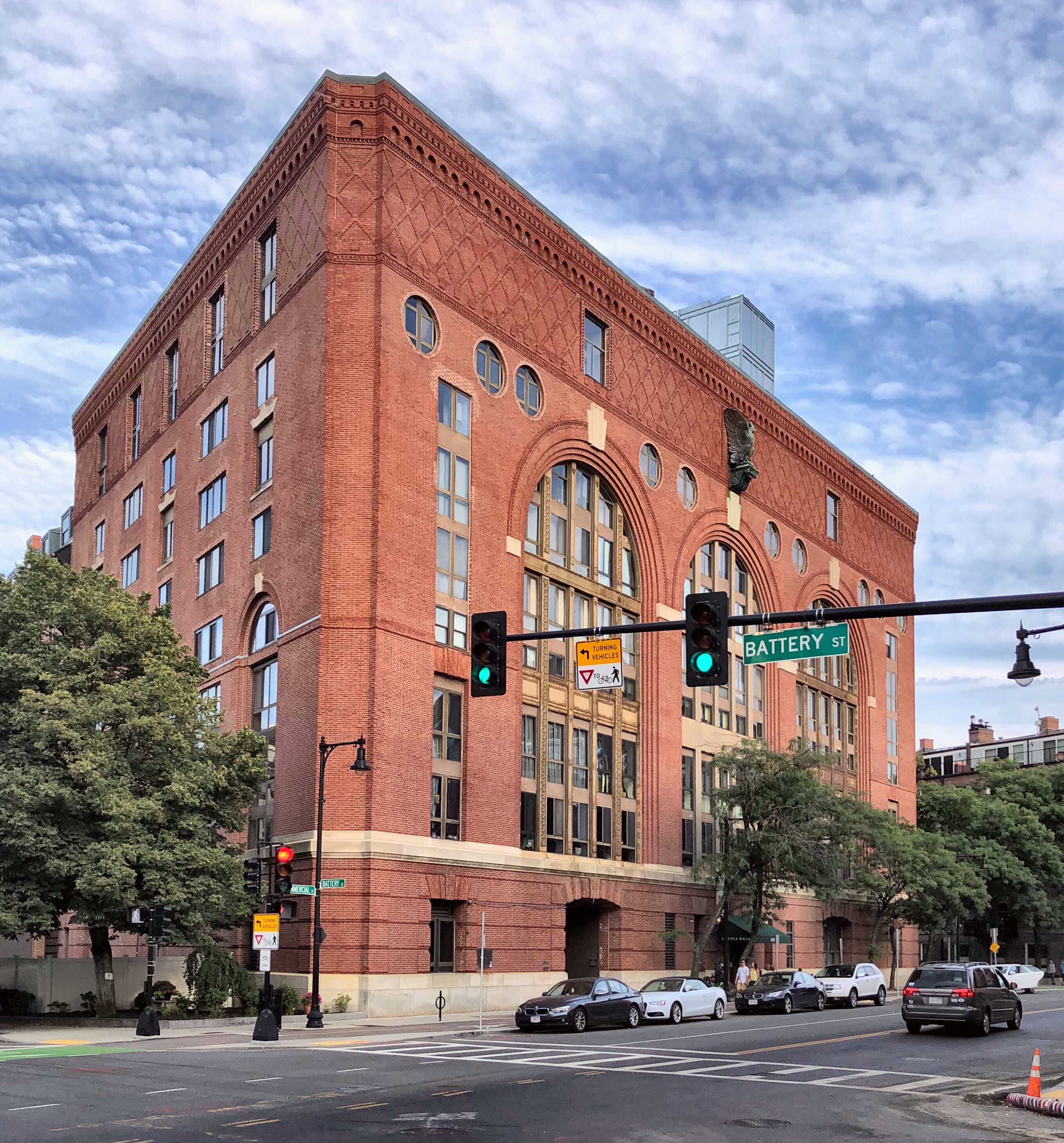
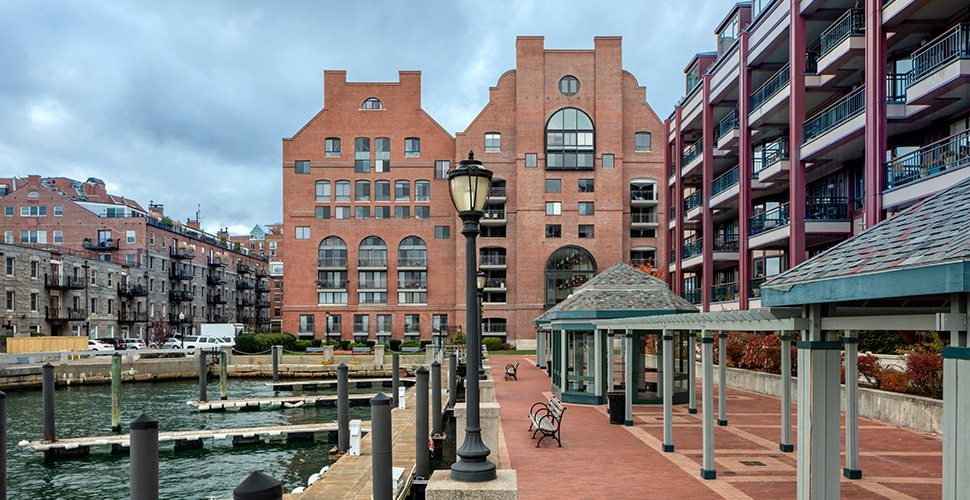
The Boston Elevated Railway Company, and its successor, the Massachusetts Bay Transportation Authority (MBTA), operated Lincoln Wharf Power Station from 1901 to 1972. The Boston-based engineering firm of Sheaff & Jaastad, specialists in electric power and lighting plants, designed this 1901 power station to serve the Atlantic Avenue Line and provide supplementary power for the Downtown Boston elevated and surface lines. Due to increased demand in 1907, a massive addition was constructed at the rear, facing Commercial Street, which now is the main orientation of the large structure. By 1971, all elevated tracks powered by this station were removed and the power station was sold by the MBTA to a private developer for housing. Eventually, San Marco Housing Corporation, hired the Boston Architectural Team, Inc., to renovate the power station in 1987 for low- to moderate-income housing. The result is an innovative and stunning example of adaptive reuse providing much-needed housing, while retaining historic fabric of old Boston.
After the American Civil War, the North End of Boston saw a massive phase of redevelopment, replacing the dilapidated wooden dwellings with larger brick tenements to house the neighborhood’s growing immigrant population. Nearly all of the North End was replaced with these dwellings, which has now added so much to the appeal of the neighborhood. One of the earliest and notable examples is this building on Endicott Street. Built around 1875, the tenements were owned by George T. McLauthlin (also spelled McLaughlin), who owned the engineering and machinery company on Fulton Street, housed in one of the last remaining cast-iron facades in Boston. The tenement house was later owned by George’s son Daniel, likely providing housing for the company’s employees and/or providing additional income for the family. The building also appears to have always had commercial use on the ground floor, allowing merchants to also rent the space. The late-Italianate panel brick block is modest in design, but contributes to the diverse population and worker’s housing in the North End.
The Massachusetts Normal Art School was one of the many Richardsonian Romanesque buildings constructed in the Back Bay, but it did not survive like so many others did. The building’s history goes back to the 1860s, when wealthy Bostonians petitioned for the Commonwealth of Massachusetts (State Government) to assist with the founding of new institutions to enhance the quality of life in the state. Due to this, the legislature funded three major institutions including the Massachusetts Institute of Technology (1860) and the Museum of Fine Arts (1870), and founded in 1873, the Massachusetts Normal Art School. The Normal Arts School was tasked with training future teachers for public schools and budding professional artists in the arts, with courses ranging from drawing to architecture. The Commonwealth of Massachusetts rented space in various buildings in Downtown Boston before they appropriated $85,000 and hired the firm of Hartwell & Richardson to design and oversee construction of the new school at the corner of Newbury and Exeter Streets. The Richardsonian Romanesque building was constructed of red brick and brown freestone, featured entrances on both street facades, and held gallery spaces inside for members of the public to view the work created at the school. The school outgrew the original building, which could comfortably fit just 100 students, and in 1929, a new building was constructed at Brookline and Longwood Avenues. Before moving one more time to its current location in 1983, the school was renamed to the Massachusetts College of Art and is best known as MassArt today. The original school in Back Bay was demolished in 1967 and was home to a surface parking lot before the existing building was constructed.
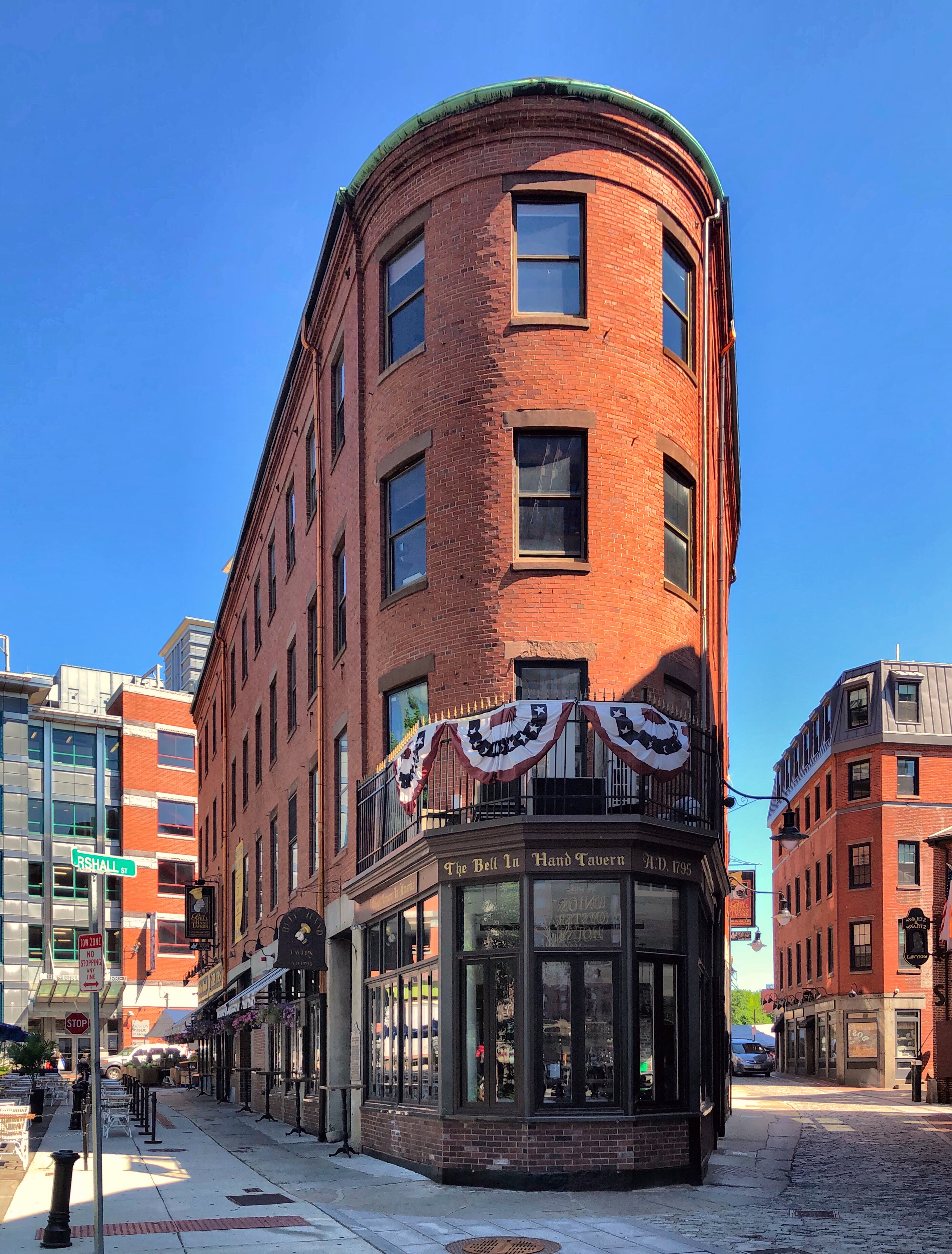
Located in the Blackstone Block of Downtown Boston, this flatiron building encloses Marshall Street on the Freedom Trail, creating a tight, pedestrian-oriented street that once covered old Boston. The Union Block (c.1842) is a Greek Revival commercial block which typifies this network of short, narrow streets which somehow survived Urban Renewal and the coming of the highway in Boston. The longest running occupant of the building was Ward & Waldron Paper Hangings, which from my understanding, made wallpaper for the estates of Beacon Hill which were being built on the other side of town. After successive ownership, atlas maps show the ownership of the building in 1888 conveyed to Massachusetts General Hospital, which still held title to it past 1938. The building is now home to Bell in Hand, an iconic local pub that was founded in 1795 at another location.
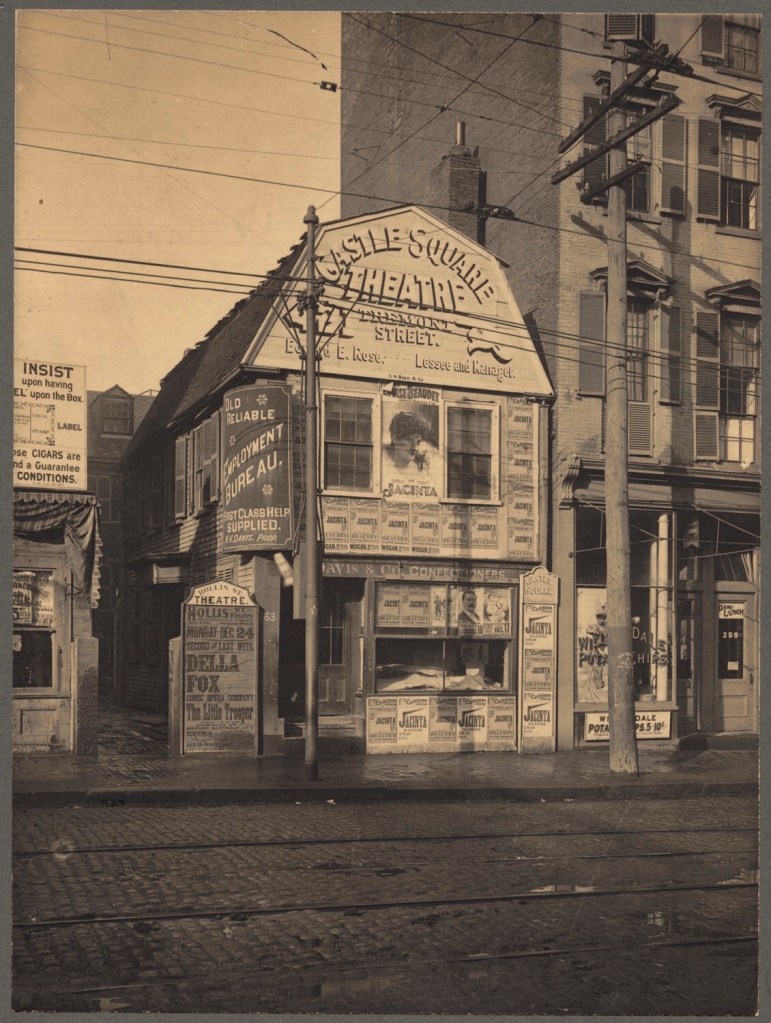
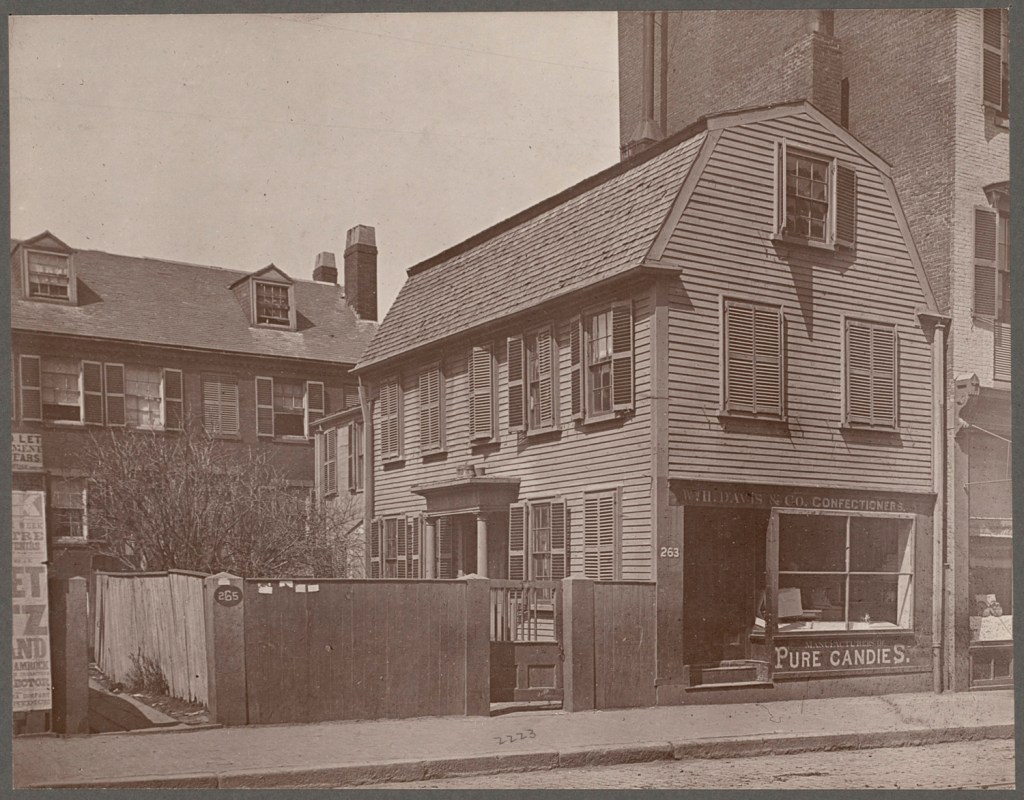
Formerly located on Tremont Street in Downtown Boston, this ca.1670 Georgian gambrel home went from residence to candy shop to billboard in its lifetime. The home was constructed by John Crane (1744-1805), who was a housewright by trade but a patriot and soldier most importantly. At the tender age of 12, he had an early military experience when he substituted for his father in the French and Indian War when his father received the draft. Records state that Crane was an active member the Sons of Liberty, a secret revolutionary organization that was founded by Samuel Adams to fight taxation from the British government. Hours before the Boston Tea Party, Crane and the other participants met at his shop at his home to disguise themselves as American Indians as disguises for the events that would take place that night. He was in the hold of one ship when he was knocked unconscious by a falling crate of tea. His fellow patriots thought him dead and hid him under a pile of wood shavings in a carpenter’s shop off the harbor, only for Crane to recover later. Less than a year later, Crane and his family moved to Providence, Rhode Island where he would later serve under a militia there in the Revolutionary War. After serving, and seeing battle, he was awarded land in Whiting, Maine (Maine was part of Massachusetts at the time) where he built a home and spent his last days.
Crane House, c.1880s, courtesy of BPL.
His former house on Tremont Street in Boston was occupied as a home until the late 19th century until it was occupied by a confectionary shop, with a storefront added on the street. Due to the shifting demand for theater-oriented development and lodging, the candy shop began struggling. The owner, James Grace, then allowed for the home to be covered with signage and notices advertising various theaters nearby. Ironically, the home was demolished by 1908 for the Shubert Theater, which remains today.
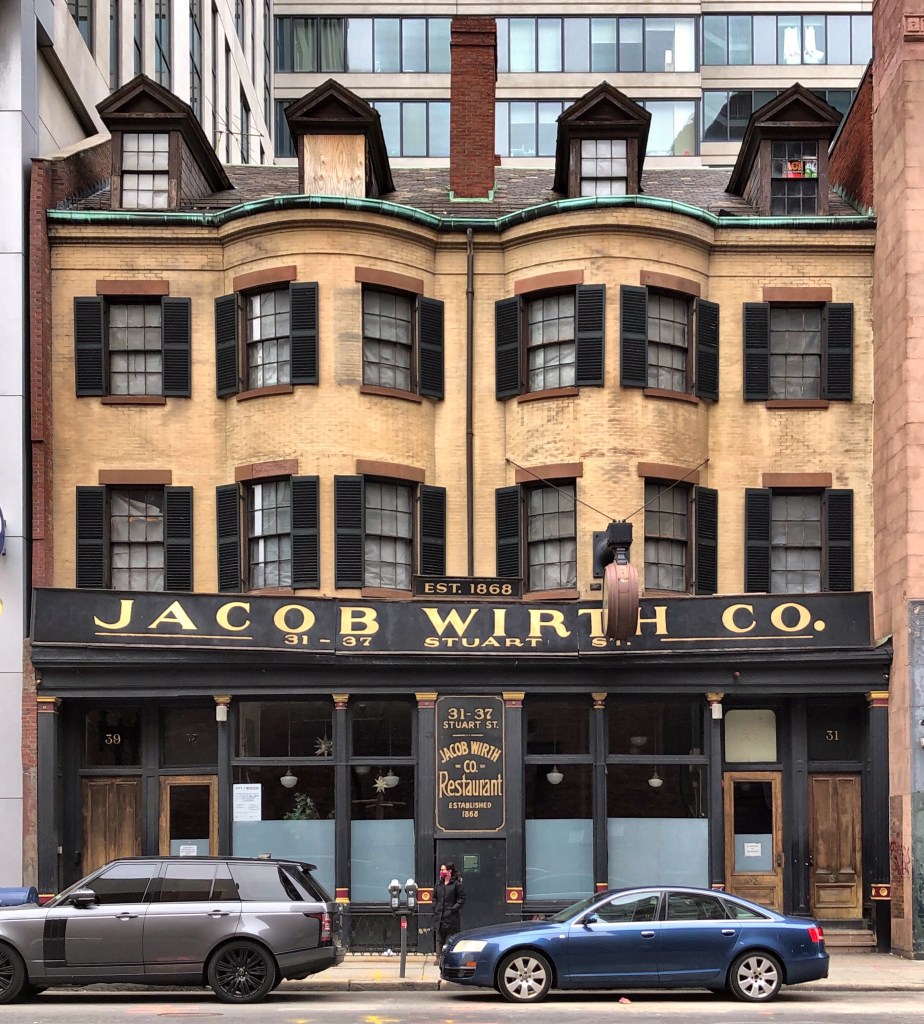
Comprising twin bowfront Greek Revival rowhouses, the Jacob Wirth Restaurant buildings on Stuart Street are scarce survivors of a century of urban change in an area in which the building type once abounded. Built by developer housewrights quite active in the area, the twin houses were soon sold to “gentlemen” for rental purposes. Jacob Wirth, a German emigrated to Boston from Bingen, Germany, and began work as a baker before getting into the restaurant business. Wirth bought the left building seen here in 1878 as his dwelling above and ran his authentic German restaurant below. Due to the success of the restaurant, he purchased the adjacent home in 1889 and constructed the storefront that now unites them. Jacob Wirth ran the restaurant until his death in 1892, which was then managed by his son, Jacob Wirth Jr., who also managed it until his death in 1965! In 2018, Jacob Wirth’s, the second oldest continuously operated restaurant in Boston, closed its doors following a fire. The future is somewhat uncertain for the space, but as it is landmarked, there are protections (even at the interior) of the building.
Did you get a chance to eat at Jacob Wirth’s before it closed?
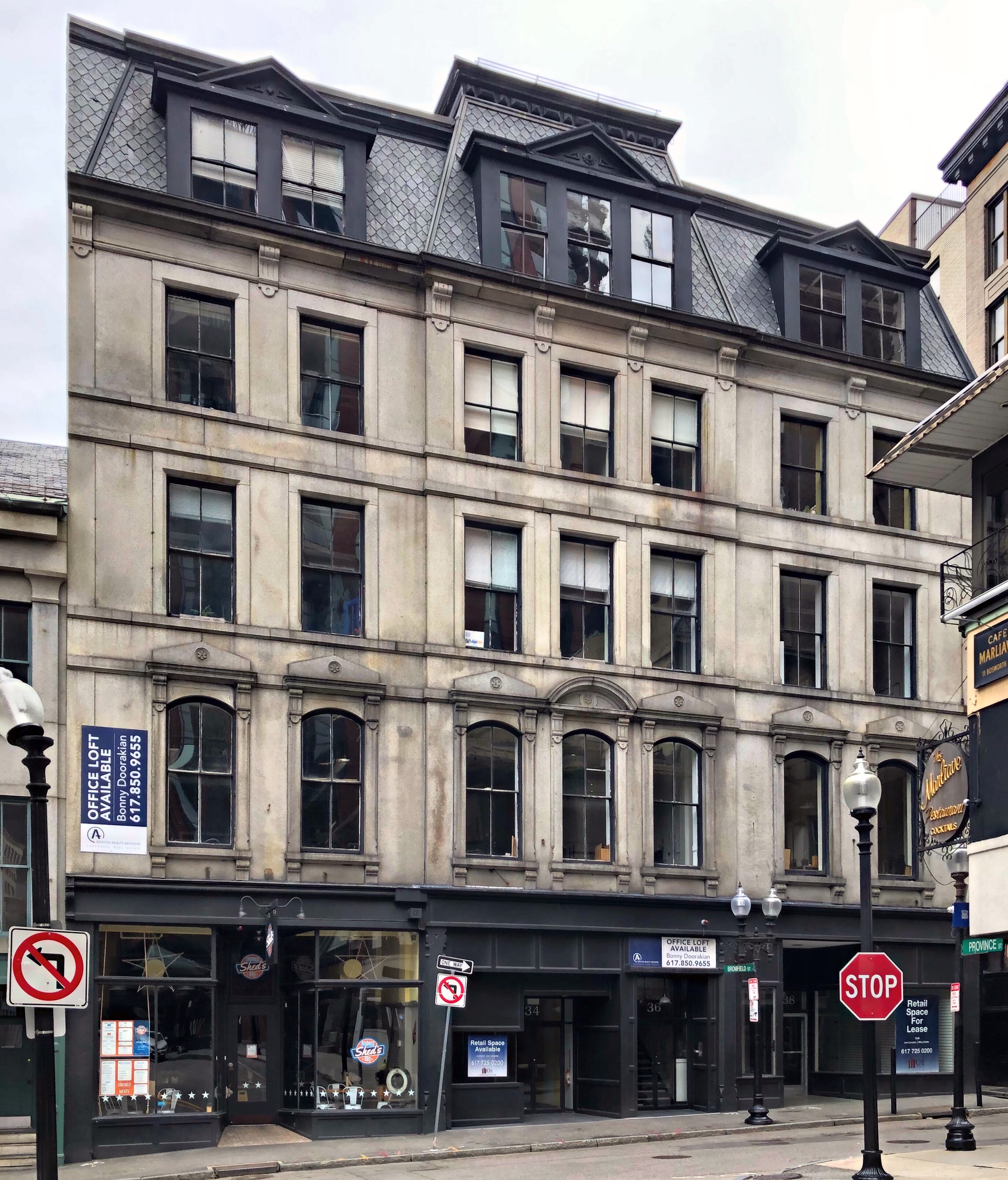
Located between the heavily-trafficked streets of Tremont and Washington Streets in Downtown Boston, you’ll find the Wesleyan Building, centered on Bromfield Street. Constructed in 1870, the Second Empire commercial building was designed by the architectural firm (and brothers) of Billings & Billings, who designed College Hall at Wellesley College just four years later. The five-story granite-clad structure features neo-Grecian detailing and a mansard roof, showcasing the waning popularity of the Second Empire style by the 1870s. The building was constructed adjacent to the Bromfield Street Methodist Church (demolished around 1913) and housed the offices of the Wesleyan Association, which published the newspaper ‘Zion’s Herald‘, a Methodist publication. The building was also occupied by the Emerson College of Oratory by 1890, which later became Emerson College.



 Buildings of New England
#/media/File:1891_EmersonCollege_BromfieldSt_Boston_USA.png)