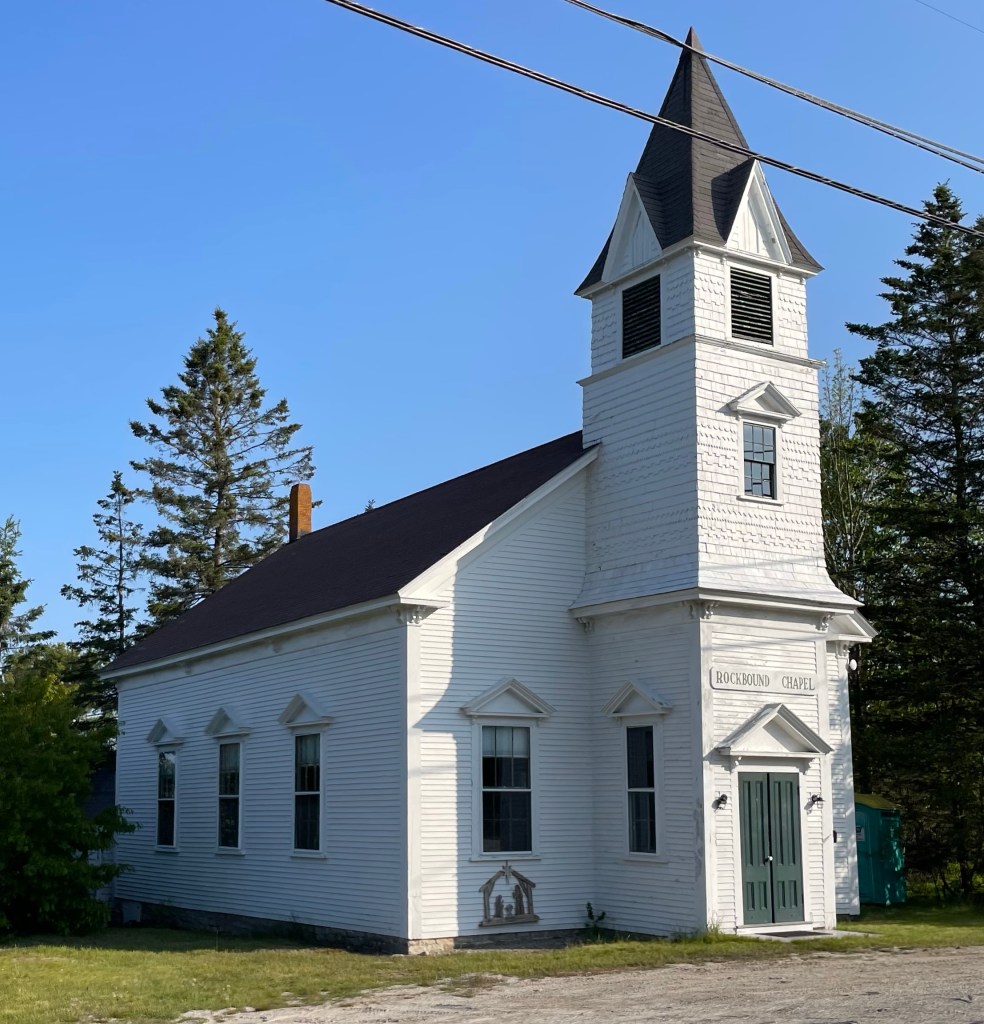
Wrapping up our “tour” of Brooklin, Maine, I wanted to conclude with a feature on Rockbound Chapel, one of the village churches in the small coastal town. The chapel (like the Beth Eden Chapel) was constructed at the turn of the 20th century as a village church which saw increased use when the town’s population surged (relatively) in the summer months. The vernacular church building has pedimented lintels over the windows and door, and a steeple covered in decorative shingles which flare toward the base. There is something just so enchanting about these small rural chapels!
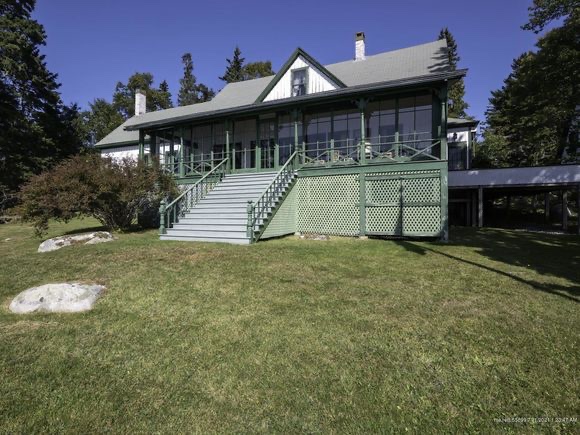
The historic summer cottages for middle-class summer residents of Maine have little written about them, but oh are these little cottages beautiful!! This is Radnor Cottage, a charming waterfront dwelling in the Haven Colony in Brooklin, Maine. The summer colony is comprised of a dozen quaint cabins (most historically without running water) for those of more modest means that wanted to escape the city for peace and tranquility on Maine’s rocky coast. The colony was developed in the late 19th and early 20th centuries as a respite for academics and more who did not want to flaunt their credentials or social prestige. This home was purchased a few years ago and the inside looks like it’s never been altered! This is a dream home!
Almost at the southern, most remote tip of the Blue Hill Peninsula in Brooklin, Maine, I was stunned to come across this enchanting chapel. Completed in 1900, the Beth Eden Chapel is a small wooden frame building that appears to have been the first religious facility erected in the Naskeag area of Brooklin. Although it was erected by the Methodist Episcopal Church of Brooklin, the building was dedicated to the use of all Christian sects who wished to worship in the more remote section of town. Interestingly, the vernacular church employs some late 19th-century detail including the shingled flared siding and triangular motif. The chapel appears to remain open for summer months.
In 1947, world-famous German-born architect Walter Gropius and his architectural group, The Architects Collaborative (TAC) were commissioned to design a simple summer house for his friends Arnold Wolfers, a noted political scientist, and his wife, Doris, whose father was president of the Swiss Parliament. The site was a wild bluff on the end of Naskeag Point in Brooklin, Maine, with broad views of Blue Hill Bay and Mount Desert Island in the distance. The Wolfers’ wanted a house that was not a typical shingled house, provided sweeping views of the natural scenery, and also fit within its surroundings. Gropius nailed it with this house. As originally built, the house was comprised of a main block with large living room, kitchen, laundry room, service hall, and bathroom. A breezeway connected the house to a wing of three bedrooms along a long corridor. Walls of glass frame the waterfront side to take advantage of the views, while the street-facing facade has less glazing to provide additional privacy. After Doris Wolfers’s death in 1987, the house was purchased by an investment banker and his wife and it was listed for just the third time in over 75 years, and has maintained its architectural integrity the entire time.
Can I get an “Amen”?! Amen Farm was built in the mid-19th century on 47 acres in Brooklin, Maine, overlooking the Blue Hill Bay and Acadia National Park in the distance. The Cape house, like many on Blue Hill peninsula, is modest and was enlarged by telescoping ells as space was needed. The house was long owned by the Bowden Family who farmed the land, later adding a small gas station to the side of the road (since removed). Later owner, Joseph “Roy” Barrette (1896-1995) likely helped give the home its name. Barrette got his first look at Maine in 1919 from a ship, when he was a deck-hand on an 800-ton coal barge, hauling West Virginia coal from Norfolk to Portland. He had bought this farm in 1958 and was looking forward to his retiring years, which he intended to spend in a library of some 3,000 volumes and indulging his hobbies as a gardener, a gourmet, and a connoisseur of fine wines. John Wiggins, associate editor of The Ellsworth American newspaper, impressed by Barrette’s garden, his literary tastes, and his writing style, persuaded him to write a column, which he called “The Retired Gardener.” He wrote many essays and three books from this home in Brooklin where he never fully retired. Roy died in 1995 and the property was eventually listed for sale in 2019. The house is undergoing some work and landscaping upon the time of the photos.
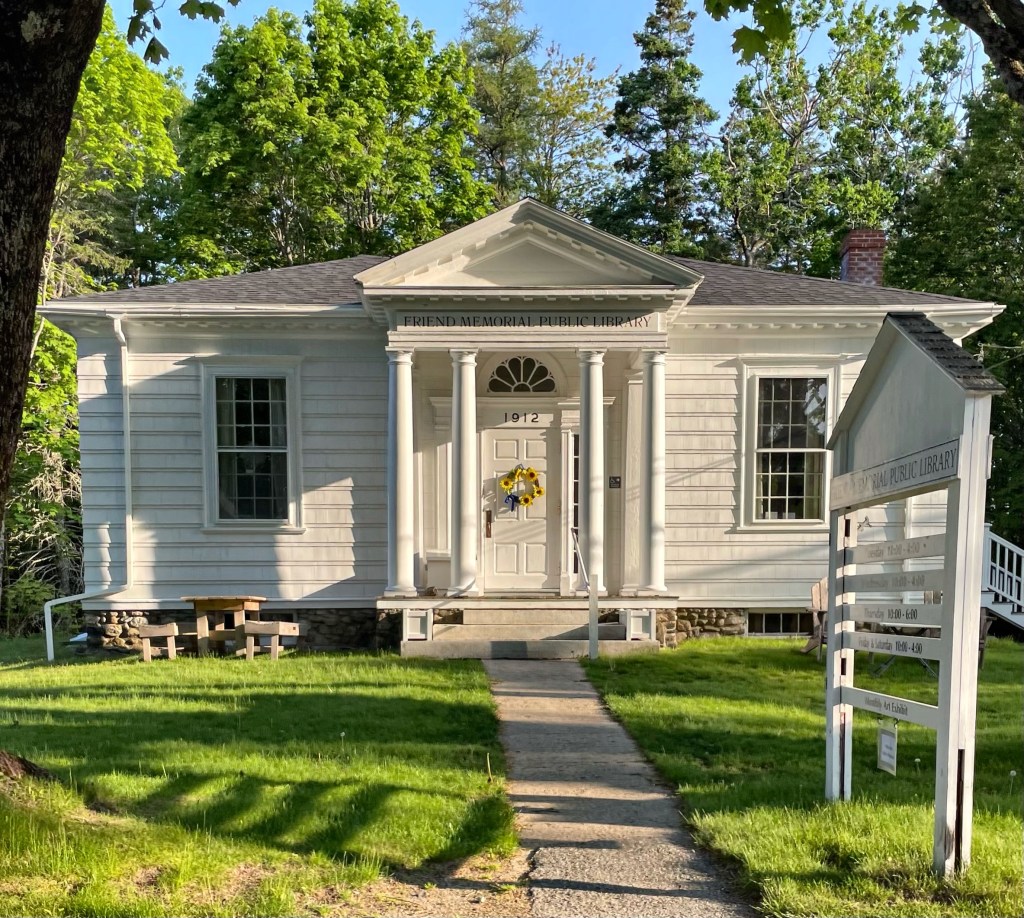
The Friend Memorial Public Library in Brooklin, Maine was built in 1912 on land donated three brothers in the Friend family. The brothers, Leslie, Robert and Victor Friend were born in Brooklin, but were raised in Melrose, Massachusetts. There, they made a fortune producing Friend’s Brick Oven Baked Beans. With their new wealth, the brothers had the bright idea of building a roller-skating rink for the enjoyment of the Brooklin community. As the need for a library overtook that of a roller rink, the brothers sought to cement their name in the town’s history by funding a new library building. The previous library was located in a small space in the IOOF Hall nearby (featured previously) and a new, purpose-built space for a library was a desire for the small community. William Nelson Wilkins, an architect of Magnolia, Massachusetts, and husband of Brooklin native Ella McFarland, was hired to furnish plans on the new building which was built in 1912 in the Colonial Revival style. In 1940, Katerine and E.B. White (author and summer resident), Owen Flye and others were instrumental in revitalizing the library, increasing the collections and hours of operations. About ten years ago, the library was restored and renovated inside by Elliott Architects.
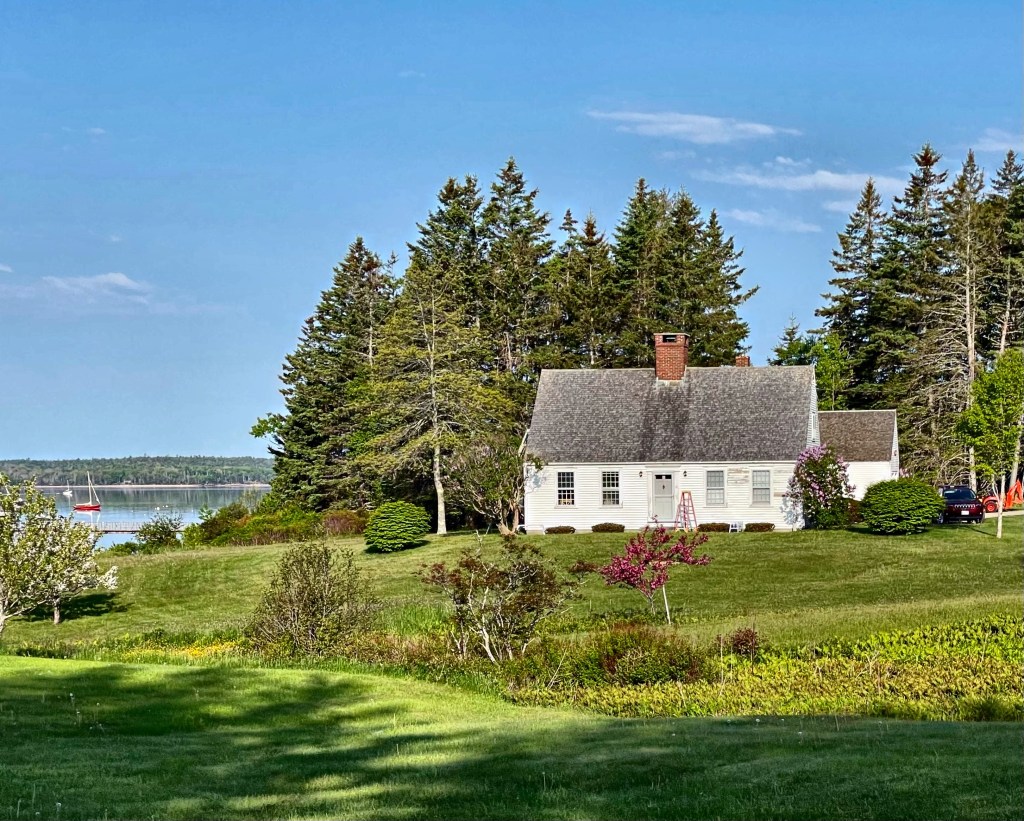
In a town of 850 residents (2,800 in the summertime), Brooklin, Maine was an absolute treat to explore. The winding roads terminate at abrupt ends where the rocky Maine coast begins and hand-made wooden ships are docked in protected harbors. I stumbled upon this absolutely charming Greek Revival style Cape house with just steps to the ocean. The siting beyond a sweeping field and adjacent to the calm harbor presents the perfect example of what makes Maine so special. The house is a short term rental and named “Whereaway”. If only I was rich, but I can dream right??
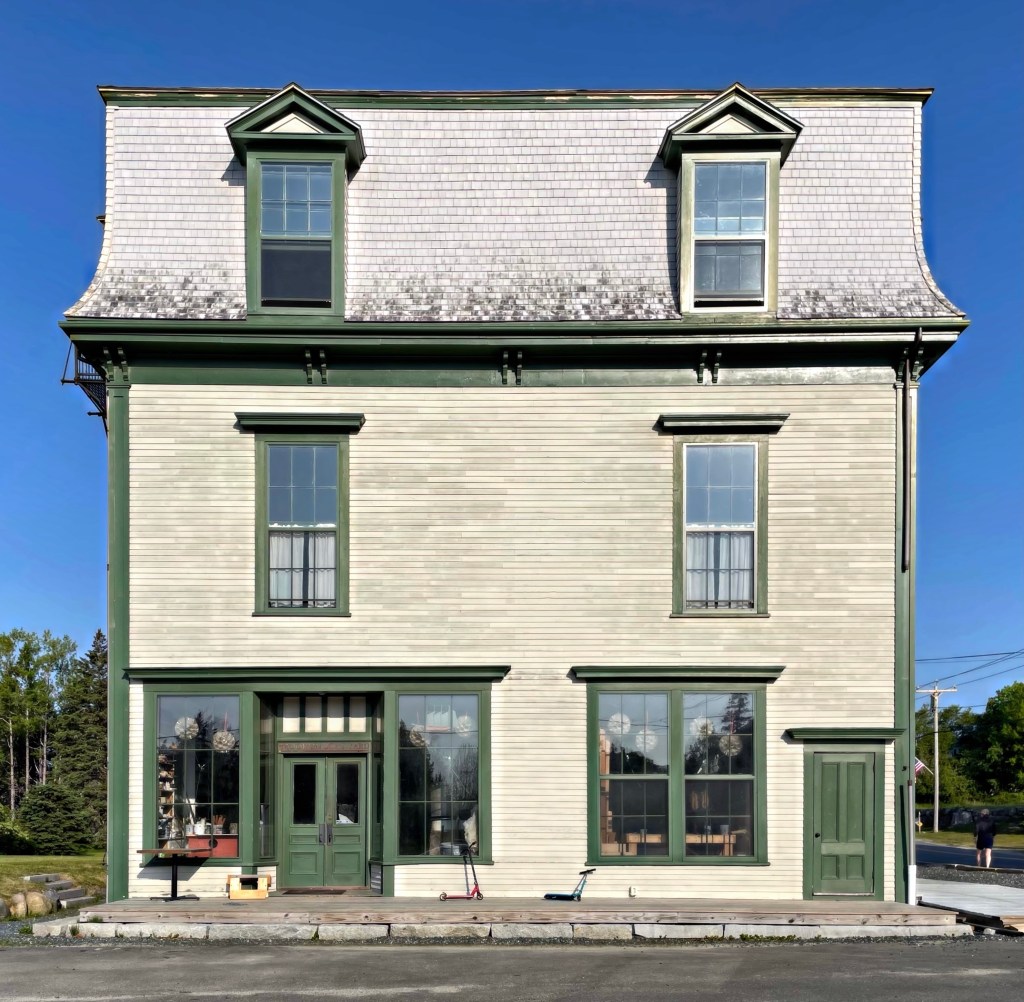
Welcome to Brooklin, Maine! Constructed in 1896 by local builder Ralph E. Bent, the coastal town’s I.O.O.F. Hall is one of Brooklin’s largest and most architecturally significant nineteenth century buildings. The Independent Order of Odd Fellows is a historic and long-running (somewhat secret) fraternal organization which has branches all over the world. In Brooklin, this building was designed to accommodate commercial uses on the first floor, community functions and theatrical productions on the second floor and lodge meetings in the upper/mansard story. The building saw disinvestment by the turn of the 21st century, and by the time the building came on the market in 2017, the hall had languished for years, and the structure was in a serious state of disrepair. The building needed new plumbing and electrical wiring, a new foundation and roof, foundation repairs, and heat; its roughly $270,000 price tag reflected the amount of work it would need to be rehabilitated. John Ike, an esteemed architect, and frequent visitor to Brooklin, formerly of Ike Kligerman Barkley and now of Ike Baker Velten, had long been enamored by the decaying building, and felt compelled to act. With his two friends, Robert Baird and Steve White, the trio restored the old building which continues its connection to the small town’s history and became a vibrant contributor to its present. The upstairs space can be rented short-term, which helps sustain the maintenance of the old building.


 Buildings of New England