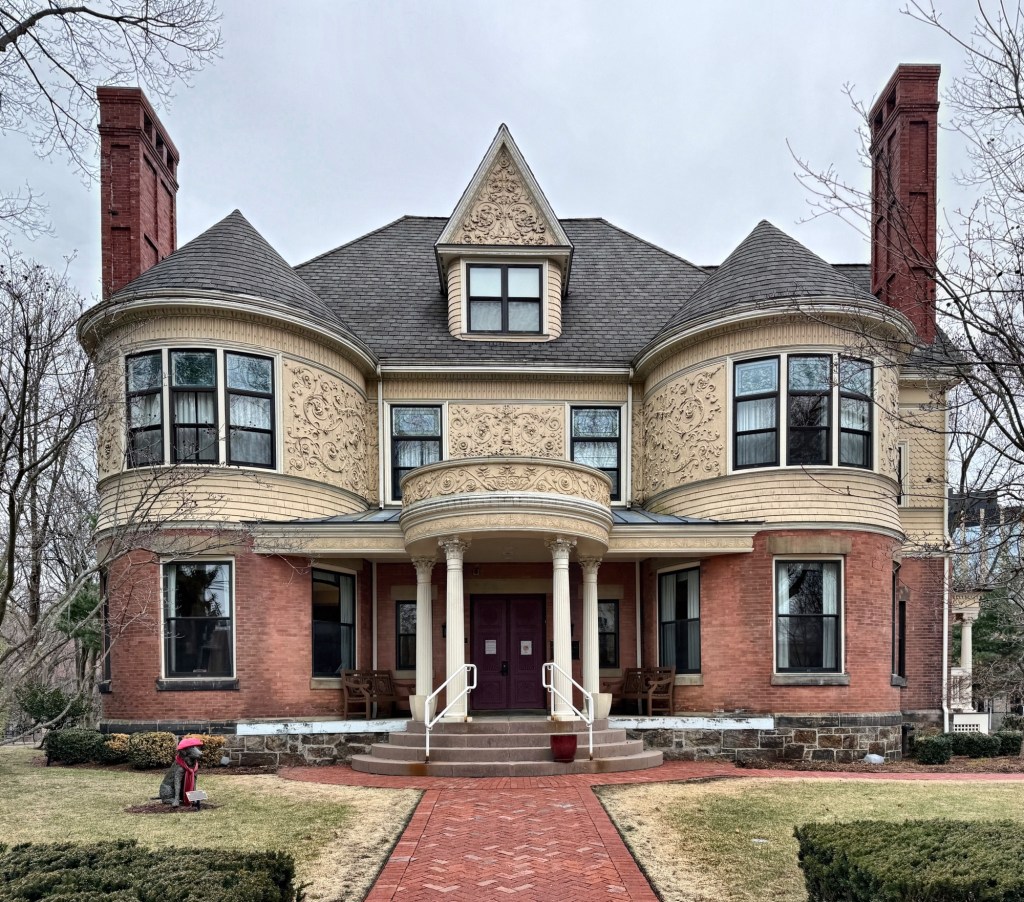
Houghton House – Yawkey Family Inn // 1890

Built on the site of an earlier house at 241 Kent Street in Brookline, this grand, Queen Anne style house has seen a life as a single-family home, fraternity house, and ultimately, the Yawkey Family Inn, a temporary residence for patient families undergoing procedures and treatments at Boston Children’s Hospital. A landmark example of the Queen Anne architectural style, the handsome near-symmetrical residence has paired conical towers at the facade, a brick first floor, paneled chimneys, and elaborate carvings in the entry portico, second-story bays, wall surfaces and gabled dormer. Planning for the new mansion began in 1889 when owners, Harriet and Andrew Jackson Houghton, owner of the Vienna Brewery in Boston, hired architect, James Templeton Kelley, to furnish plans for their new suburban mansion. Sadly, Andrew Houghton died in 1892, shortly after the house was completed, and Harriet remained here until her death in 1925. After this, the property was sold to the Beta Upsilon Association for use as a Fraternity House for the Beta Theta Pi Fraternity of MIT and later as a fraternity house for a Northeastern University frat. In 2009, the property was purchased, renovated and expanded to the rear as the Yawkey Family Inn, ensuring its preservation and remaining as a quieter neighbor to the surrounding residents than its previous use.

George G. Quincy House // 1909

If you love Colonial Revival style homes, the Longwood neighborhood in Brookline is a must-visit area to stroll around! This house is tucked away in the neighborhood and was a treat to stumble upon. This large home was designed by the underappreciated architect, James Templeton Kelley for a George G. Quincy. The Colonial Revival style dwelling is actually built of wood with a brick veneer and has an open pedimented entry with fanlight and transom surround. The round-headed windows on the first floor are especially notable.

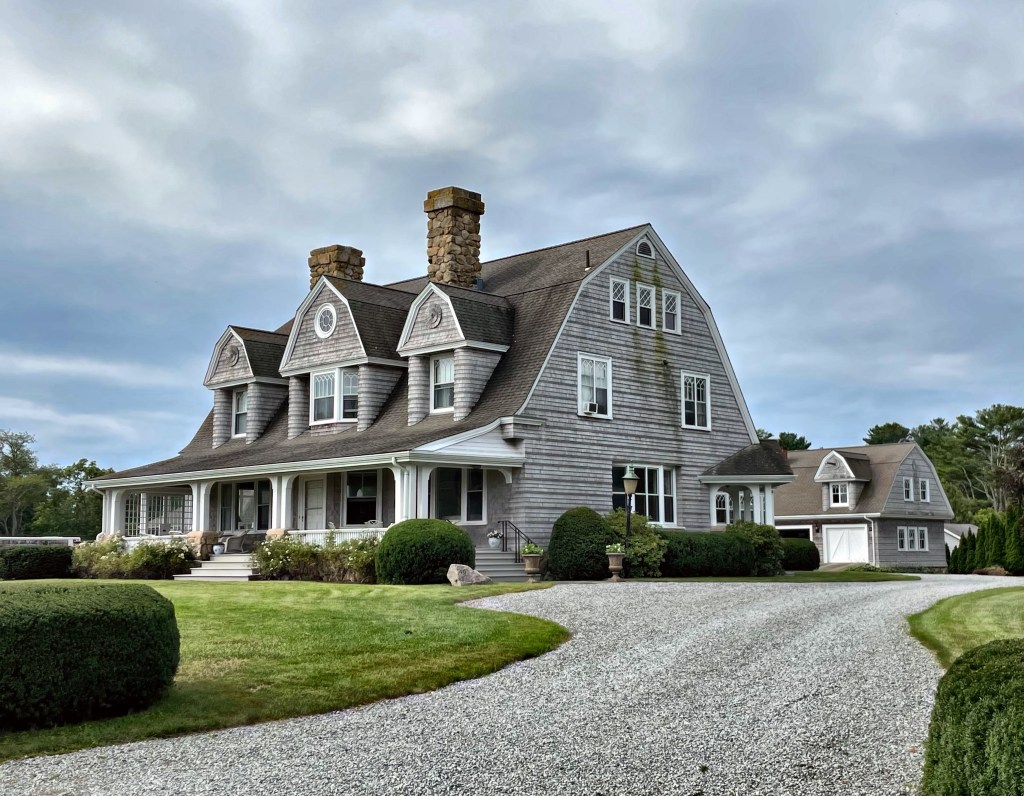
President Grover Cleveland Summer Home // c.1886

My favorite home in Marion, Massachusetts is this summer cottage on Water Street, overlooking Sippican Harbor. The home is said to have been built from a c.1840s house and enlarged by Reed as a summer home in the fashionable Shingle style. H. R. Reed, an agent for the Revere Sugar Refinery in Boston was well-connected in town and hosted President Grover Cleveland with Rev. Percy Browne ( a summer resident) at his cottage during the summer months. Evidently, Reed added the rubblestone elements, modified the porch, added a tower on the south elevation, the massive dormers at the roof, and is responsible for the exquisite Colonial Revival-style interior, from architect James Templeton Kelley. The home is arguably best known as the summer White House of Grover Cleveland, the only U.S. president to marry in the White House and the only two-time president to serve non consecutively – from 1885-89 and from 1893-97. The Cleveland’ Family summered in Marion between their time in the White House. In 1891, the President hoped to purchase the home, but could not settle upon a reasonable price, so he bought Grey Gables, a summer cottage in nearby Buzzards Bay (no longer extant).

Richards Free Library // 1899

Designed by Boston architect, James Templeton Kelley, the Richards Free Library (originally the Seth Richards House) is an outstanding example of the Colonial Revival style, in a region where such expressions of opulence are relatively rare. Located on Main Street in Newport, NH, the house was built during a period of great prosperity by one of Newport’s wealthiest citizens. Richards was one of the few in the area able to afford the services of a metropolitan architect for his own home. The family occupied the home until the 1960s when Louise Richards Rollins, offered the family home on Main Street for the to the town for use as a library in 1962. The first floor rooms were renovated and equipped as a library and Ms. Rollins continued to live on the second floor of the library until her death.