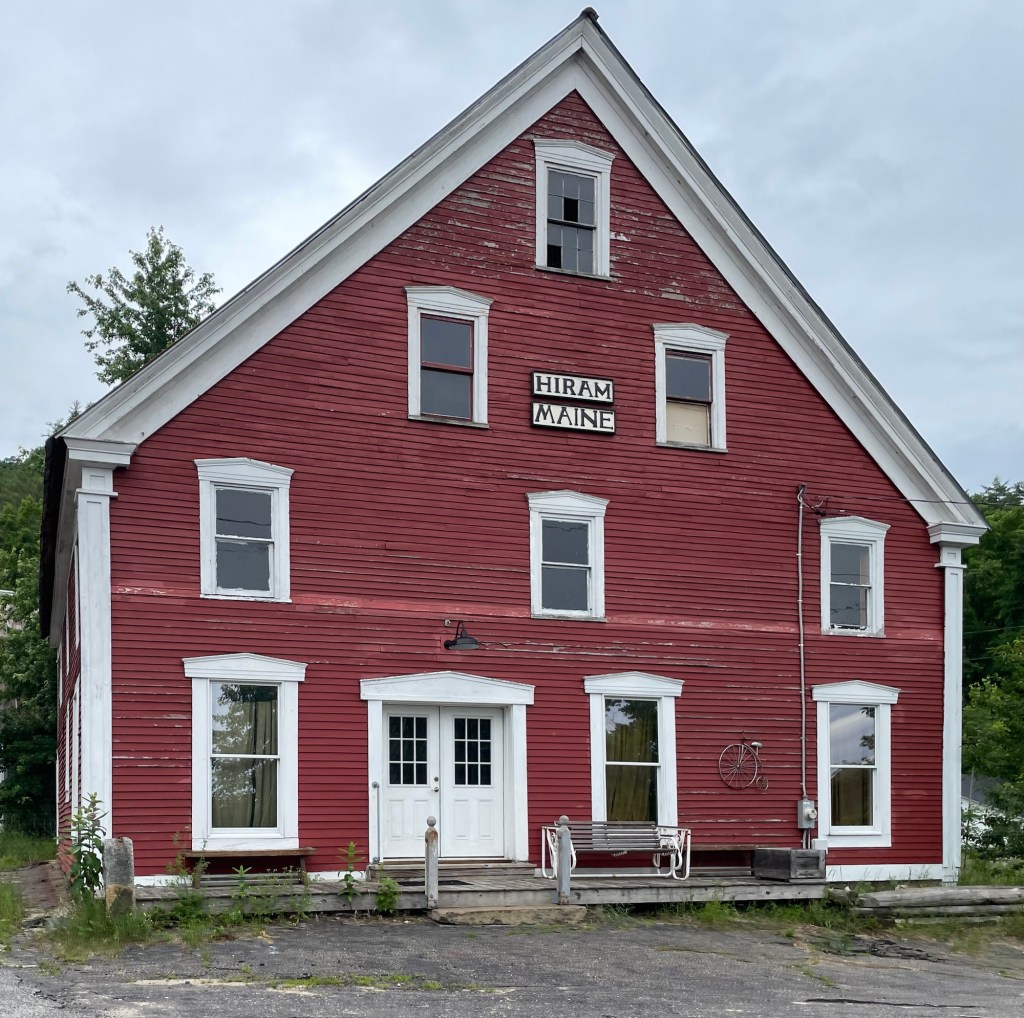
Another of the extant, significant vernacular buildings in the small town of Hiram, Maine, is this large frame building on Main Street. Hiram Lodge #39, Knights of Pythias, was organized in 1883 and a building was constructed on this site around that time. The first meeting hall was destroyed by fire in 1895, and soon-after replaced by this large lodge building, which is possibly the largest wooden building in town! On the destruction of that first “hall” by fire in 1895, the Lodge hired Alva Ward to build what is probably the largest wooden building extant in Hiram. The Knights of Pythias Hall is important as a remnant of Hiram’s earlier commercial prosperity, with general store on the first floor, a large hall on the second floor (where dances, theatrical performances, and public suppers were held), and the lodge hall on the third floor.
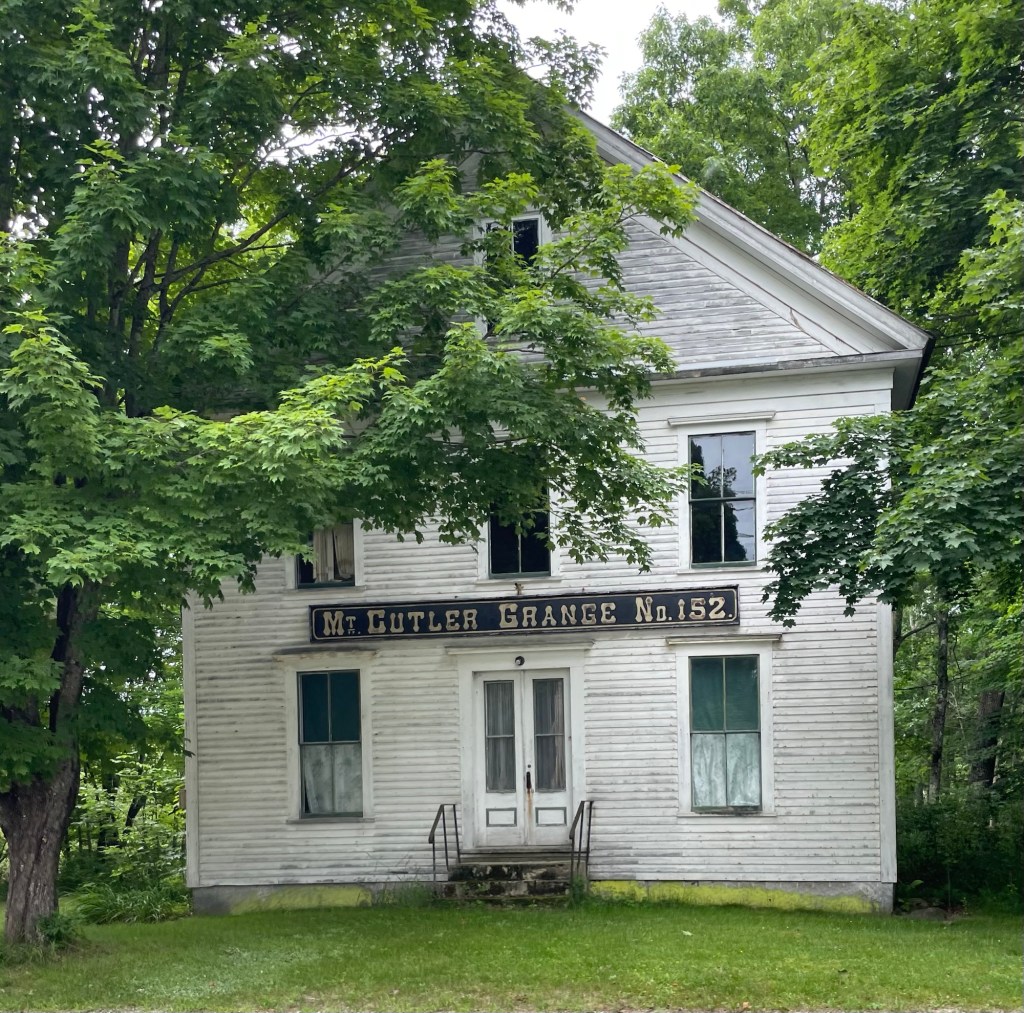
The two-and-a-half story Mount Cutler Grange Hall in Hiram, Maine, is a plain but important vernacular structure near the western end of the town’s Main Street. Originally organized in 1875 by local farmers, the local grange was able to dedicate its present building in late December of that year. Attributed to local builder James Lot Hill, the clapboard-covered frame building has a three-bay facade and retains its original windows. Once the site of grange store, the well-preserved structure still displays a fine late-nineteenth century sign above its first story. Little changed over the years, the Mount Cutler Grange Hall remains an important part of Hiram’s social fabric, but appears vacant or largely unused. Hopefully some life can be brought back to this significant building (and other abandoned Grange Halls in New England).
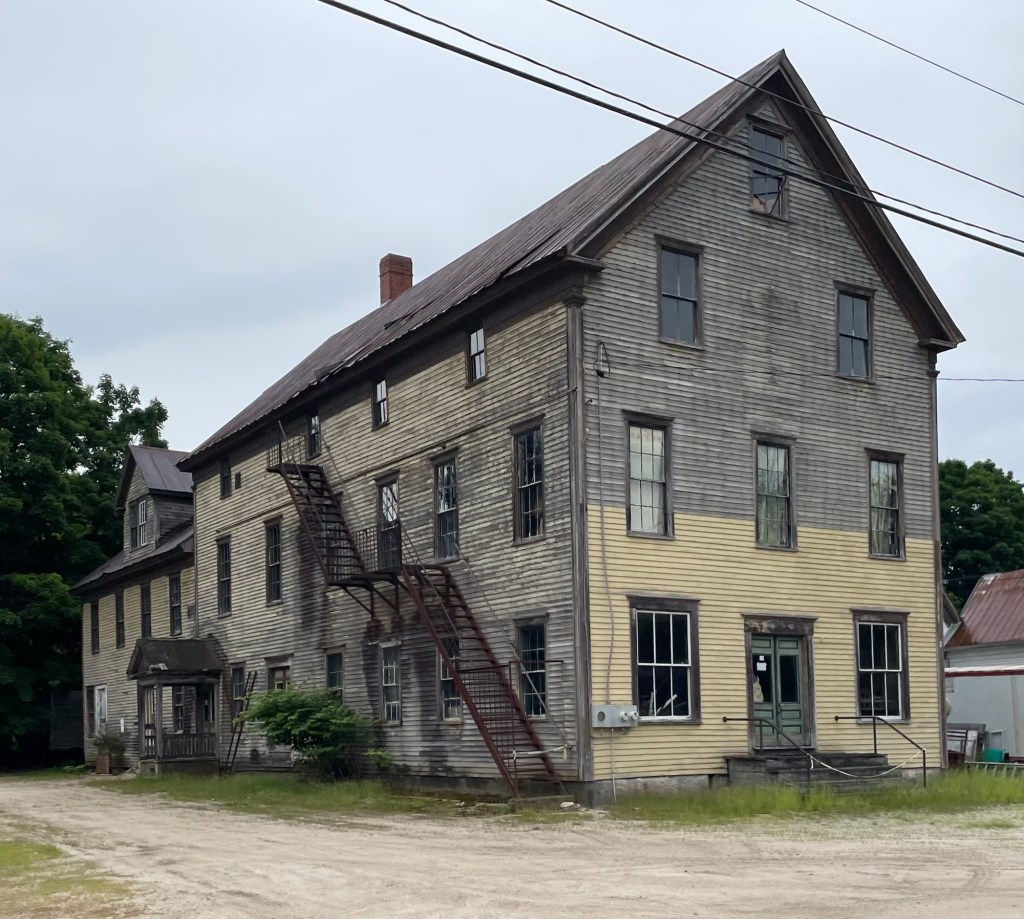
Hiram is a small, rural town in Oxford County, Maine, and has a handful of notable old buildings. The town was incorporated in 1814 and was occupied by white settlers as early as 1774. The land here has long been heavily wooded and the town’s name was inspired by the biblical King Hiram of Tyre whose kingdom was set among “timber of cedar and timber of fir.” The town’s two villages, Hiram Village and South Hiram, grew along the Saco River, and are typical rural villages built around industry and modest frame dwellings. This commercial building is one of the larger structures in Hiram Village and it dates to the mid 19th century. The structure was owned by Thomas B. Seavey, who purchased a store built on the site as early as 1816, from a Simeon Chadbourne. The store was enlarged and became a major hub of the sleepy town in the 19th and 20th centuries, but like many such structures, struggled due to changing of shopping habits and rural decline. The building, with its vernacular and Greek Revival lintels, appears vacant today.
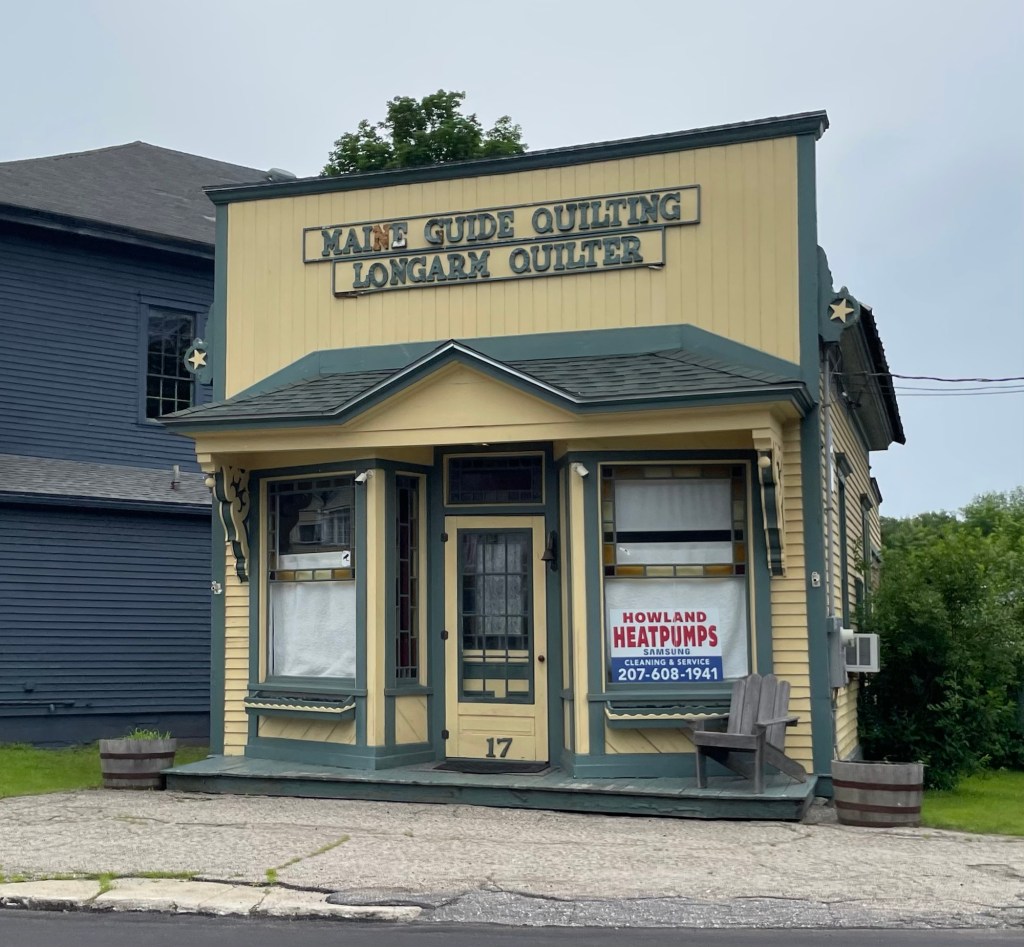
This charming one-story shop sits on the Porter-side of Kezar Falls village, a district that spans the Ossipee River between Porter and Parsonsfield, Maine. This shop was built at the end of the 19th century as a millinery shop (womens’ hat store) for Ms. Florence Perkins (1862-1950), who appears to have been unmarried all of her life. Retaining almost all of its original decorative detail, the building has a symmetrically arranged facade with two-sided projecting bays; the upper sash in the facade windows, including that in the entrance door, has a border of small rectangular colored glass panels. The storefront is a rare survivor of this period, with not many other examples in the area.
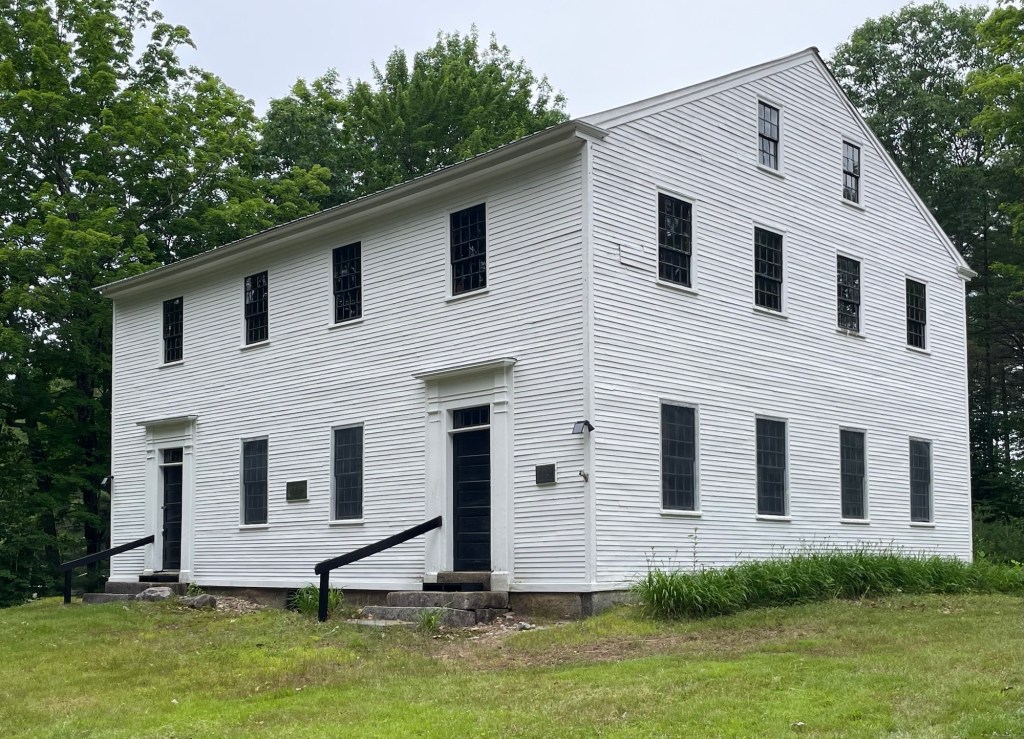
Welcome to Porter, Maine! The town is located on the Maine/New Hampshire border and was first called Portersfield Plantation. Porter was incorporated in 1807 and named after its first proprietor, Dr. Aaron Porter (1752-1837). The Porter Meetinghouse was built beginning in 1818 and it is said that it was not completely finished until 1824. The original congregation was a Freewill Baptist organization led by Reverend Jeremiah Bullock, and were known locally as “Bullockites“. The structure housed the Baptists and town meetings as needed. The plain vernacular, meetinghouse is typical of many early meetinghouses of the period in rural New England. The inside retains its original character with its space as a single large chamber with a gallery above on three sides. The walls are plaster, much of it original, with trowel marks visible. The main floor is populated with original box pews and a replica pulpit. The structure is a rare survivor!
This large Federal style home in Rockport is a rare extant example of a spite house in Maine. The story goes… James McCobb, an Irish immigrant, arrived in what is now Phippsburg in 1731. Living in a log cabin with his Irish-born wife, Beatrice, he raised a large family of 10 children, among whom was Thomas McCobb (1778-1815), who became a sea captain. In 1774, James built a handsome Federal period house for his second wife, Hannah Nichols, with whom he had three children (twin daughters, and a second son, also named Thomas). He married a third time in 1782 to Mary Langdon Storer Hill, who had a son, Mark Langdon Hill, from a previous marriage, who ended up marrying one of McCobb’s daughters, one of the twins, who was a half-sister to Thomas. While Captain Thomas McCobb was away at sea, the Hills, which included Thomas’ half-sister/wife of Mark Langdon Hill, broke his father’s will and took the homestead for themselves. When Captain Thomas McCobb returned from his voyage and discovered what had happened, he vowed to build the most beautiful house in Maine and one that would dwarf the one he had been deprived of. The house was promptly dubbed “The Spite House”.
This house was built in 1806. Ironically, Captain Thomas apparently never married and left no descendants, as a result, when he died in 1815 in Boston, the house was given over to the Hill family. The house had fallen into disrepair and was purchased in 1925 by Donald Dodge of Philadelphia, who moved the house, to save it from demolition, over 85 miles by boat from Phippsburg to Rockport. He also transported a 1796 house from South Harpswell to be used in the construction of the wings that were subsequently added onto the Spite House. The property now sits on Beauchamp Point, not visible from the street, in a desirable enclave of summer residences, with sweeping views of the Atlantic Ocean.
This homestead is one of the earliest homes in the Camden–Rockport area of Maine. Originally built inland from the harbors, the house was a one room cabin with an open sleeping loft above. Allegedly built in 1769 by Robert Thorndike (1734-1834) one of the earliest settlers of Rockport the house has served as a significant piece of the town’s history ever since. There were two additions to the house in 1806 and 1826. The first addition in 1806 consisted of the front door entry and the front parlor, a birthing room and a chamber and loft above. The 1826 addition in the back of the home provided a kitchen area that was later divided to provide a small parlor. In 1826, Frederic Conway bought the property from Robert Thorndike Jr., which remained in the family until 1916. The property is now owned by the Camden-Rockport Historical Society as a house museum and the organization is further documenting the history of this house and the two towns.
Union Hall sits in the middle of the charming coastal village of Rockport, Maine. The Second Empire style building was built around 1856 as an original mixed-use structure with the first level containing retail spaces, the second level as a hall, and third level providing either office or living spaces. Rockport’s Union Hall was also once home of the town Post Office, a barrel factory, and a residence before it began to suffer from neglect and deferred maintenance at the end of the 20th century. In 2010, the owners underwent a massive restoration of Union Hall, which included: structural remediation to wood framing, a new elevator, slate roof repair, all new mechanical, electrical and plumbing systems, masonry repointing, restoration of windows and doors and more. These types of restorations are vital to small New England towns, providing jobs and the properties are often occupied by local small businesses, as is the case here!
Built in 1891, the historic Rockport Opera House is located in the heart of Rockport Village overlooking picturesque mid-coast Maine harbor. The Opera House here was actually first built as a multi-purpose Town Hall and library by a F. E. Gilkey, possibly a local builder. Over the years, the Colonial Revival style building has also served as a town meeting space, theater, concert hall, and Y.M.C.A., complete with a basketball court and bowling alley. In the 1970s, the building had deteriorated such that the Town considered selling it or tearing it down. The women of the Rockport Garden Club led the effort to save and restore the building. An outpouring of local support and a grant from the Maine Commission of the Arts and Humanities enabled the building to be revitalized as the Rockport Opera House. The significant structure continues to host the annual town meeting and regularly hosts town committee and other public meetings. It is also the home venue of the Bay Chamber Concerts, as well as other musical events, theater performances, wedding receptions, conferences, and other private functions. Preservation at its finest!
This perfect Greek Revival cape house sits on Pascal Avenue, the main street that cuts through the center of Rockport, Maine. The house dates to the 1840s or early 1850s and was owned by the Dillingham Family for a few generations. The original owner may have been Josiah Dillingham (1796-1861), a mariner and sea captain. Josiah died in 1861, and the property was inherited by his eldest son, Josiah Winslow Dillingham (1829-1895) who went by Winslow, seemingly to differentiate himself from his father of the same name and same profession. The Dillingham family home is a quintessential Greek Revival cape with central portico with Ionic columns and corner pilasters with full length entablature at the facade. In true Maine fashion, the side elevations are covered in weathered shingle siding.


 Buildings of New England