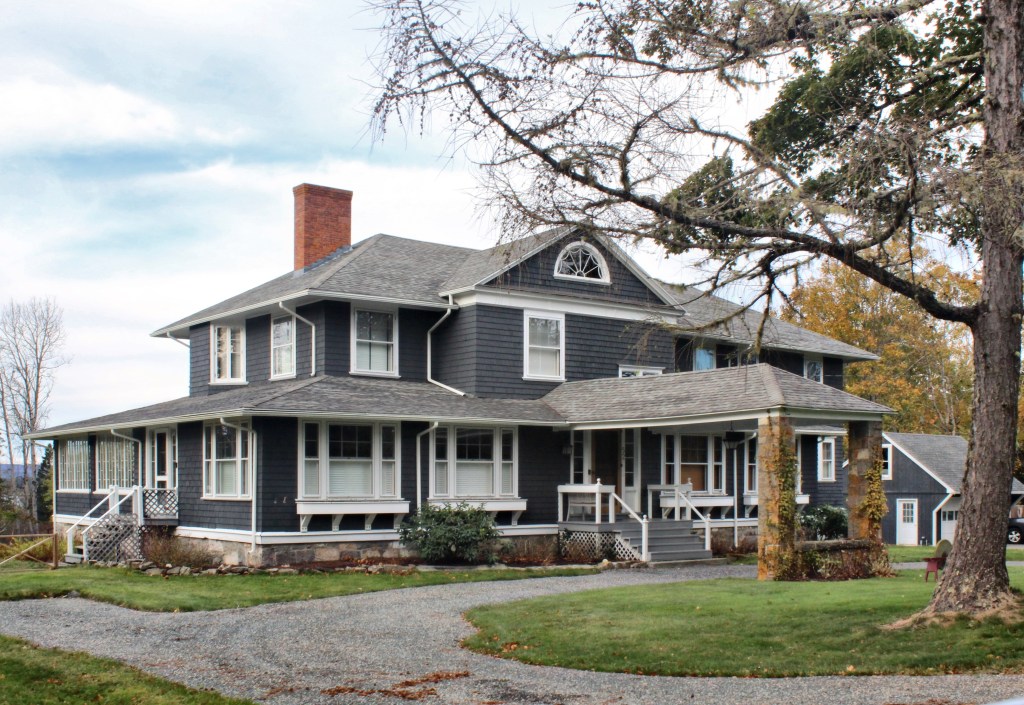
Rockefeller Hall // 1934

In the early 1930s, a U.S. Navy Radio Station at the Otter Cliffs on Mount Desert Island had become dilapidated and Navy funds were not forthcoming for repairs. When John D. Rockefeller Jr. suggested that it be removed, the Navy agreed to include the station in his donation to Acadia National Park, provided that he would build an equally good receiving station nearby. In the midst of the Great Depression, and short on funds, the government accepted the swap. Rockefeller set aside land at the tip of the Schoodic Peninsula, about five miles away across Frenchman Bay, at Winter Harbor. Rockefeller, wishing the station’s buildings to be compatible with others designed for the park, retained Grosvenor Atterbury, the New York architect who designed the park’s gatehouses, to come up with plans for the radio station. It opened in early 1935 and for several years served as an operation center and military housing. After the naval base was closed in 2002, the National Park Service acquired the land and established the Schoodic Education and Research Center (SERC). The SERC campus is managed by the nonprofit Schoodic Institute and the NPS in a public-private partnership as one of 19 NPS research learning centers in the country. They restored Rockefeller Hall (as it became known) in the early 2010s and the stunning architecture can really shine today. The building is a Welcome Center to the institute.

St. Margaret Catholic Summer Chapel // c.1895

When the Grindstone Neck Summer Colony of Maine was in full-swing, wealthy summer residents would frequent the colony’s Episcopal chapel (featured previously). What the summer residents did not really plan for was the influx of other residents as summer staff, largely Irish servants who in large part were Catholic. As a result, the St. Margaret Catholic Chapel was built to provide a house of worship, largely for those summer workers on Grindstone Neck. Keeping with the rustic architectural character of the colony, the chapel was designed in the Shingle style. I could not find any information on the architect, so any additional insight would be greatly appreciated!

Thompson Cottage // c.1892

Who doesn’t love a good porte-cochere? In case you don’t know what they are, a porte-cochere is a covered porch-like structure at an entrance to a building where either a horse and carriage (historically) or car (today) can pass under to provide arriving and departing occupants protection from the elements. They are normally found on larger residences and institutional building where the wealthy frequent. The Thompson Cottage on Grindstone Neck in Winter Harbor was built around 1892 for James B. Thompson from Philadelphia. The original cottage was largely updated after Thompson’s death in 1915, the property was owned by Annie Cannell Trotter, who summered at another house in the colony with her husband Nathan Trotter, until his death.

St. Christopher’s-by-the-Sea Episcopal Church // 1892

In 1891, a proposal was made to build a summer Episcopal chapel, to be known as St. Christopher’s by the Sea, on Grindstone Neck in Winter Harbor, Maine. This project was supported by local area residents and by the summer community on Grindstone Neck. The construction of the church started in 1892, but it was not until August 6, 1893 that the first service was held in the chapel. The Rev. Julius Atwood, rector of St. James’ Church in Providence, Rhode Island, officiated and preached the first sermon. The church was designed by Lindley Johnson, a Philadelphia-based architect who also summered in a cottage on Grindstone Neck and designed other cottages in the colony. The Shingle style chapel is architecturally unique and rustic, a quality which is also visible at the interior, which is rustic in appearance with exposed beams and shingled walls.

Levis Cottage // c.1892

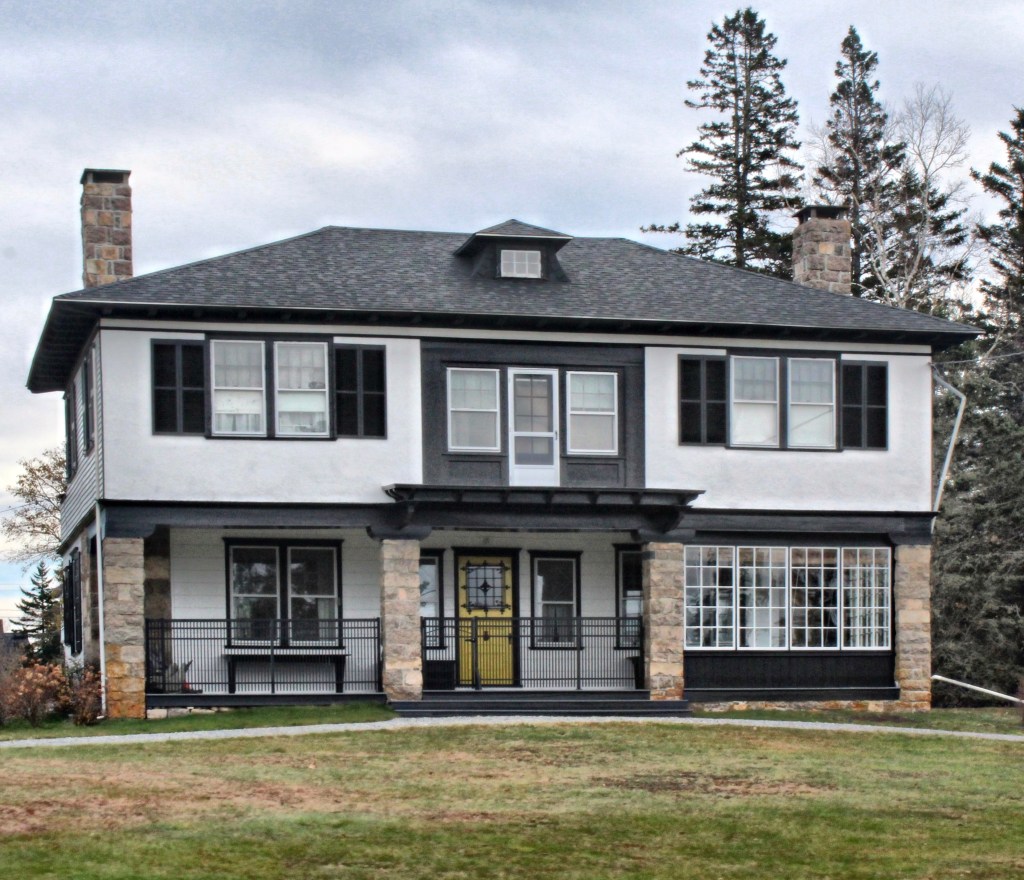
Samuel W. Levis, a real estate agent from Philadelphia built this summer cottage on Grindstone Neck in the enchanting town of Winter Harbor, Maine in 1892. The Levis Cottage was designed by the Gouldsboro Land Improvement Company’s favorite Philadelphia architect, Lindley Johnson, who designed a majority of the cottages and buildings in the summer colony. Samuel does not appear to have ever married nor did he have children. The property was later owned by Frances and Mitchell Rosengarten. The cottage is boxy in form with a stucco facade and clapboard siding on the sides. Local stone was used to construct the large columns at the first floor porch. The former recessed balcony at the second floor has been enclosed, but otherwise, the house looks near-identical to when it was built over 130 years ago!

Winter Harbor Lighthouse // 1856

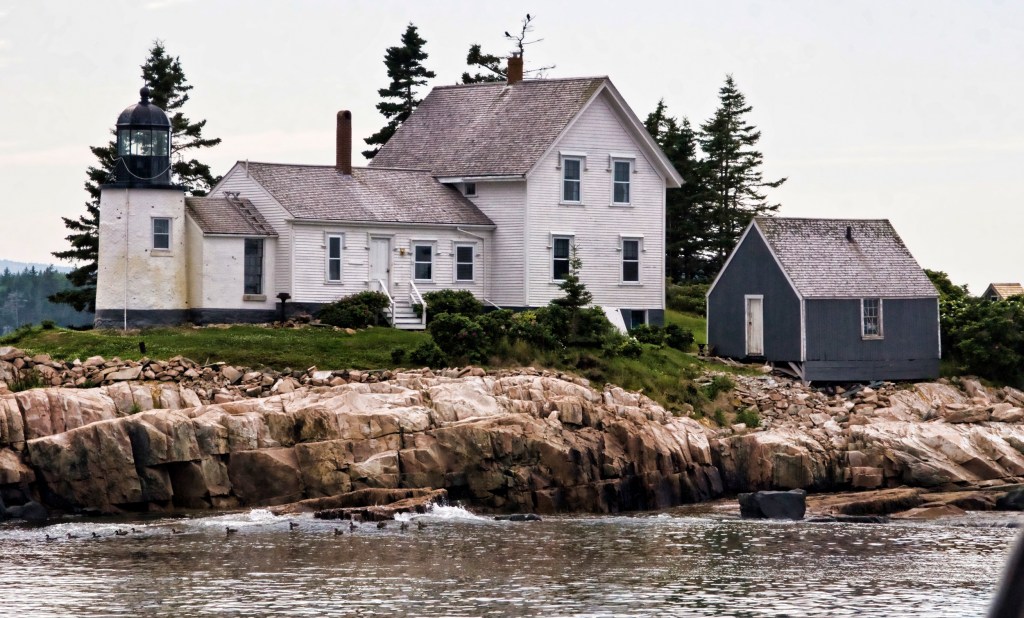
Built in 1857, Winter Harbor Light is one of Maine’s enchanting historic lighthouses dotting the rugged coastline. The lighthouse was built by the United States government to aid navigation for the local fishing fleet, an important piece of the local economy there. The light tower, built in 1856, is a round brick structure topped by an original octagonal lantern house with an iron walkway and railing around it. A brick single-story workroom projects from the tower. The keeper’s house is a two-story wood-frame structure, which was built in 1876 (along with the ell) to replace the original keeper’s house. The light was decommissioned in 1934 and sold into private hands, but in its seventy-six years of service, nine keepers and their families lived on the island. It remains a visual landmark on its small island in Mt. Desert Narrows on the drive along the Schoodic Peninsula in Acadia National Park (Winter Harbor side). What are your favorite lighthouses in Maine?

Hammond Hall // 1903

Winter Harbor, Maine, may just be my new favorite place in the state! The town is located just east of Mount Desert Island, south of Gouldsboro (of which it was a village within the town). In 1895, after the Grindstone Neck summer colony was developed, the town’s increased finances and outlook led them to incorporate as a separate town. And what does any new town need? A town hall! Construction of the hall was proposed in 1902 by Edward J. Hammond, owner of a local lumber business who made his fortune shipping and selling the Maine lumber in Boston. Hammond donated the building materials and building lot after a fire swept through Winter Harbor village. The town offices moved out of the building in 1958, and the main hall continued to be used as a school gymnasium until 1987. The town then sold the building to the Winter Harbor Historical Society. Lack of funding by the turn of the present century resulted in the building’s decline, and it was slated for demolition in 2002. It was rescued by Schoodic Arts For All, a cultural organization that brings a variety of events to the space, which now holds a long-term lease on the property. The building looks great today!

West Gouldsboro Union Church // 1888

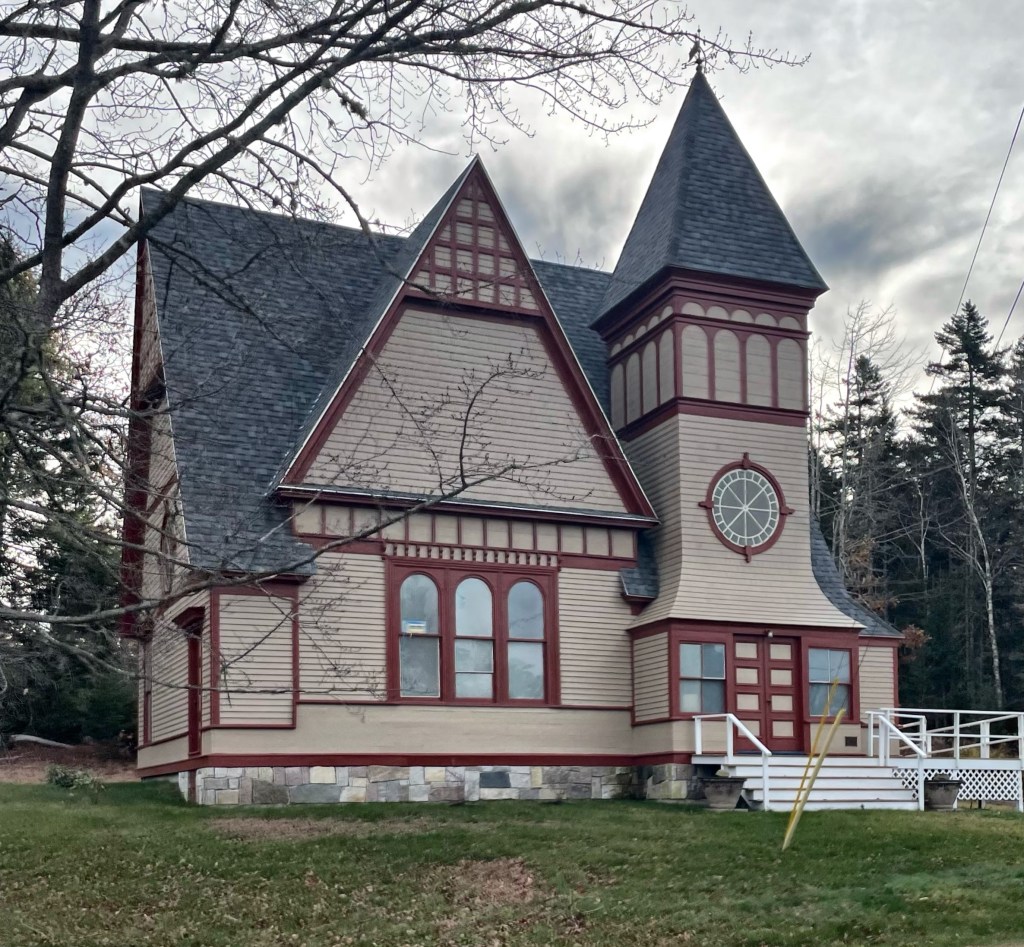
In 1888, the West Gouldsboro Union Church Society had enough funds to build this Queen Anne style church, built completely from member donations. By November 1888, the exterior was completed, but so much money was spent on the detailing on the exterior, no funds were available for the exterior painting and interior spaces. In 1891, the new church was finally dedicated. The West Gouldsboro Union Church is a stunning example of a church in the Queen Anne style with varied siding forms, asymmetrical plan, and square tower capped by a pyramidal roof. My favorite part about this building is its historically appropriate paint colors. For a long time, the church was fully painted a bright white, but now its details really shine!

Gouldsboro Townhouse // 1884

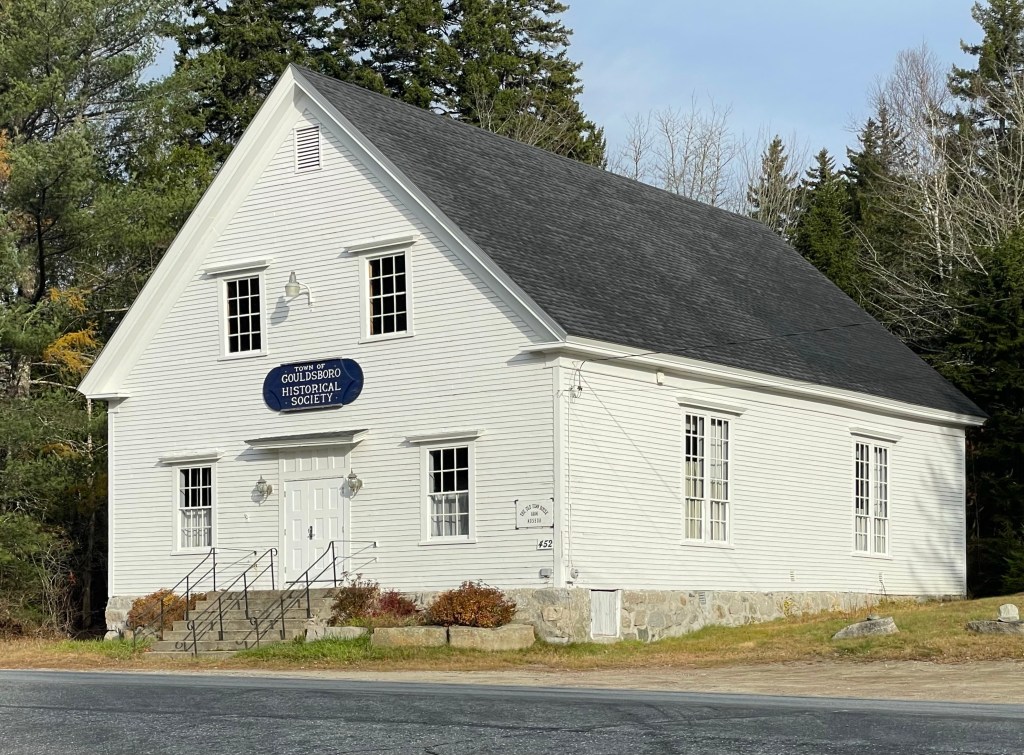
Welcome to Gouldsboro, Maine! The town is a charming community made up of many small fishing villages and neighborhoods dotting the rugged Maine coastline. Land in what was then part of Massachusetts, was given to Colonel Nathan Jones, Francis Shaw and Robert Gould in 1764 by the General Court of the Commonwealth of Massachusetts. Francis Shaw and Robert Gould were both merchants from Boston. Francis Shaw had worked hard to develop Gouldsboro, and reportedly died broke because of it, and his son Robert Gould Shaw returned to his parents’ native Boston. Development in the area was slow and never really took-off due to the distance from Boston, but fishing, mills, and villages were built and remain to this day. Now, much of the area is home to summer residents flocking to the area from urban areas. This building was Gouldsboro’s second townhouse. It was constructed in 1884, soon after the first townhouse burned a year prior. The structure was used for town meetings and elections until 1983. It is now owned by the Gouldsboro Historical Society. It is a late, vernacular example of a Greek Revival townhouse.

East Blue Hill Post Office // c.1884

Before the days of USPS trucks delivering mail to your door, mail was delivered to local post offices for pick-up daily. Due to this, many villages had their own post offices to service local communities better due to ease of access by residents. A post office first arrived in East Blue Hill Village, Maine in 1873, likely due to the distance traveled to the central village for mail. By 1884, George Long built this vernacular structure as the village post office, which belonged to members of the Long family, who also served as postmasters, until 1997. The post office is distinct in the state as the only known example of a purpose-built post office facility that is not owned by the United States Postal Service, and that was not built or adapted to its standards. The building sold out of the Long family in 1997, when it was purchased by the East Blue Hill Village Improvement Association, who have preserved it ever-since!