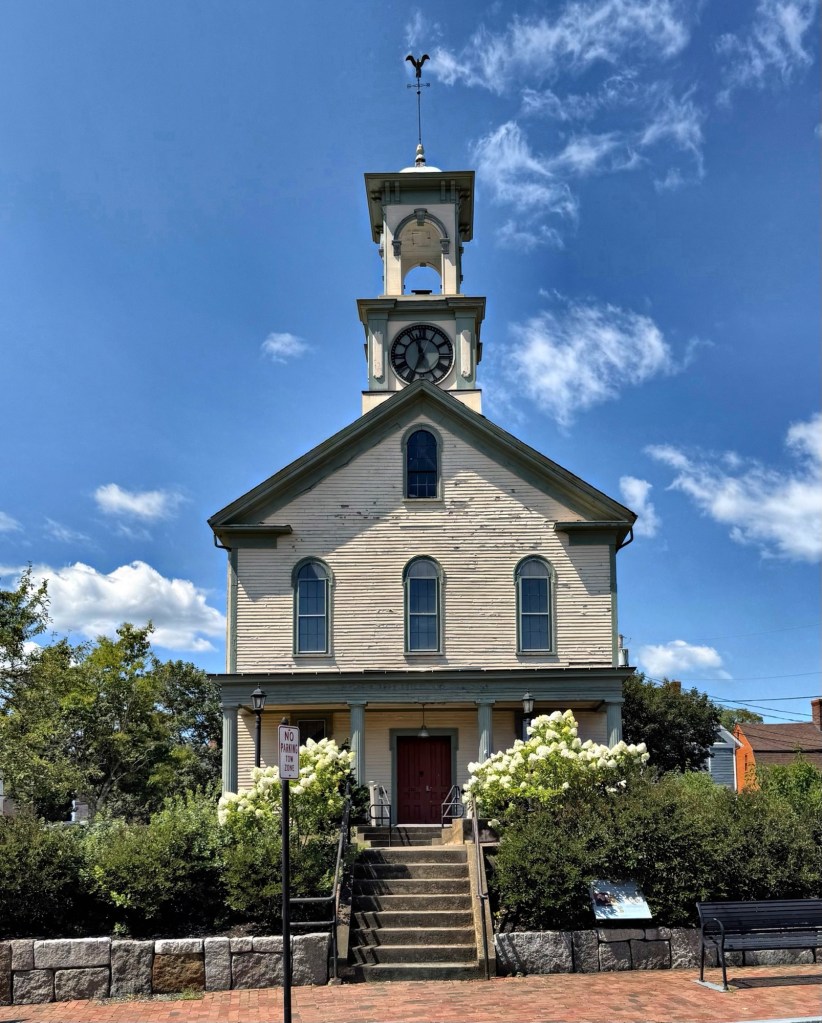
South Meeting House, Portsmouth // 1866

The South Meeting House was built in Portsmouth in 1866 and it is significant as a high-style Italianate building in the coastal town, and as the meeting place for the first African American church congregation in New Hampshire. The present building is the second building on this site. The initial structure was the Old South Meeting House, which was built for the South Church in 1731. The City demolished it in 1863 for the construction of the present building in 1866 as a Ward Hall for the Southern area of the community. The building’s upper level serves as a large public meeting space, and has seen use for political meetings, ward elections, and religious services The structure was the home of the People’s Baptist Church, the first African American church in New Hampshire, which organized in 1873, when the Freewill Baptists congregated on the second floor of this building. The church relocated in 1915 to 45 Pearl Street when the congregation raised money and bought their own building. In the late 19th century and early 20th century, the building continued to serve as a church, school, and community center until at least 1915. After World War II, it was boarded up due to economic circumstances and endured a period of neglect. In 1966, Strawbery Banke leased the building from the city for about fifteen years, during which it returned as a community resource and was renamed the South Meeting House. The city invested around $67,000 for repair work that also exposed further damage issues. In 1982, the city approved a proposal for the building to become a Children’s Museum. The community contributed to the required materials and labor that allowed the Museum to welcome the public from 1983-2008. Today, the city is still permitting restoration projects to preserve the historic building.
Old Porter Meetinghouse // 1818

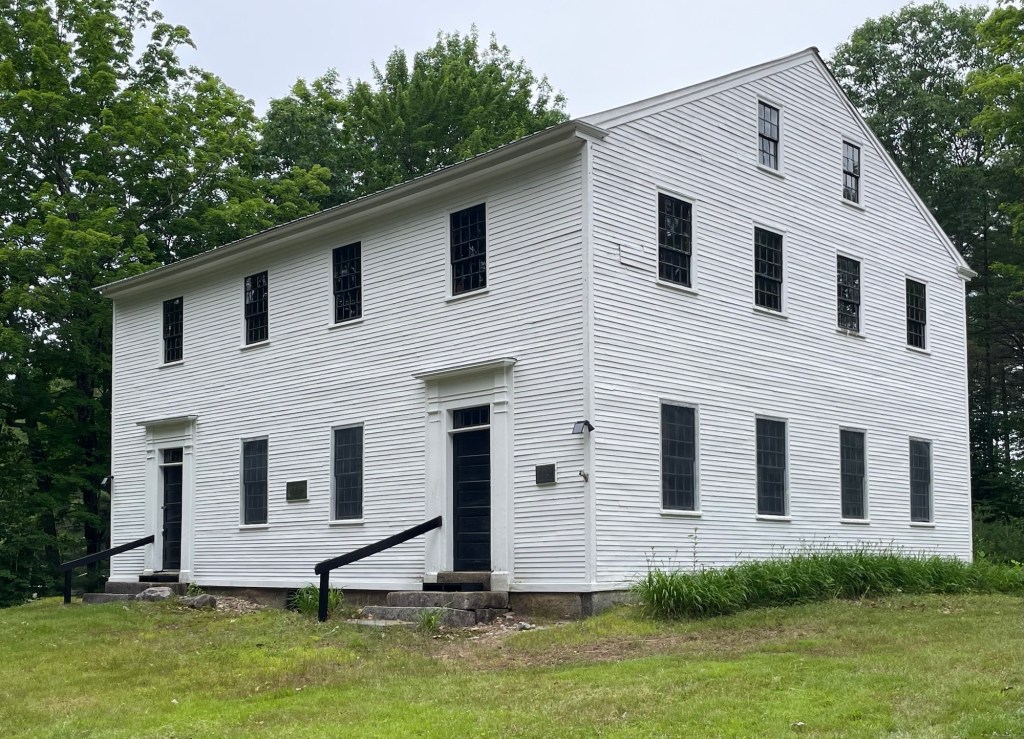
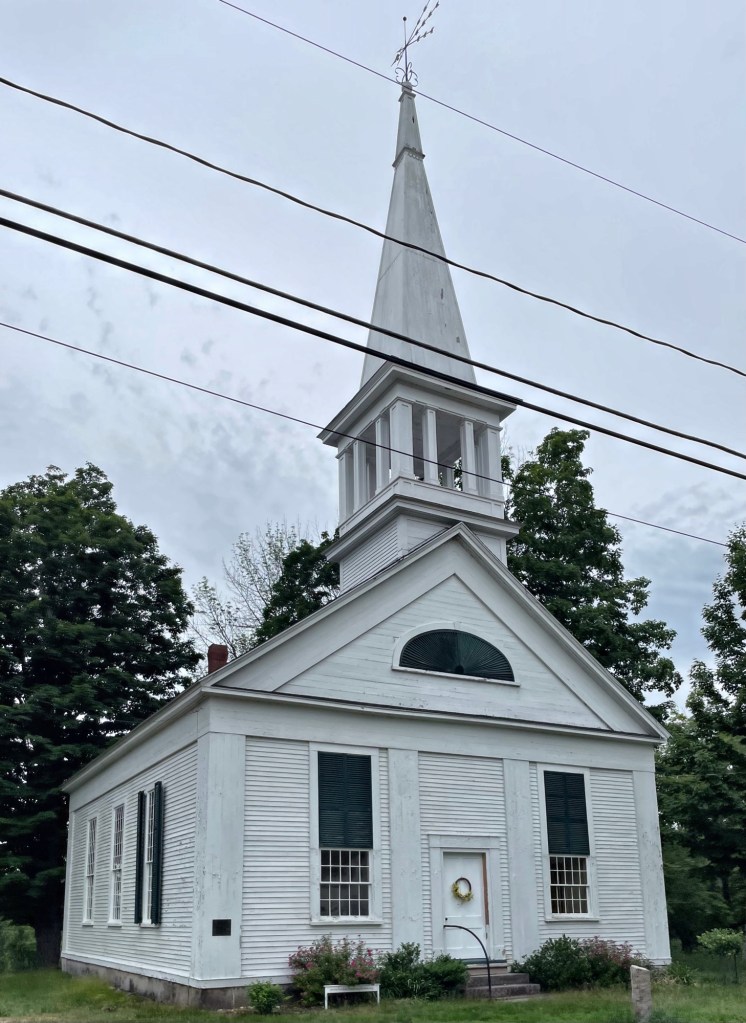
Welcome to Porter, Maine! The town is located on the Maine/New Hampshire border and was first called Portersfield Plantation. Porter was incorporated in 1807 and named after its first proprietor, Dr. Aaron Porter (1752-1837). The Porter Meetinghouse was built beginning in 1818 and it is said that it was not completely finished until 1824. The original congregation was a Freewill Baptist organization led by Reverend Jeremiah Bullock, and were known locally as “Bullockites“. The structure housed the Baptists and town meetings as needed. The plain vernacular, meetinghouse is typical of many early meetinghouses of the period in rural New England. The inside retains its original character with its space as a single large chamber with a gallery above on three sides. The walls are plaster, much of it original, with trowel marks visible. The main floor is populated with original box pews and a replica pulpit. The structure is a rare survivor!

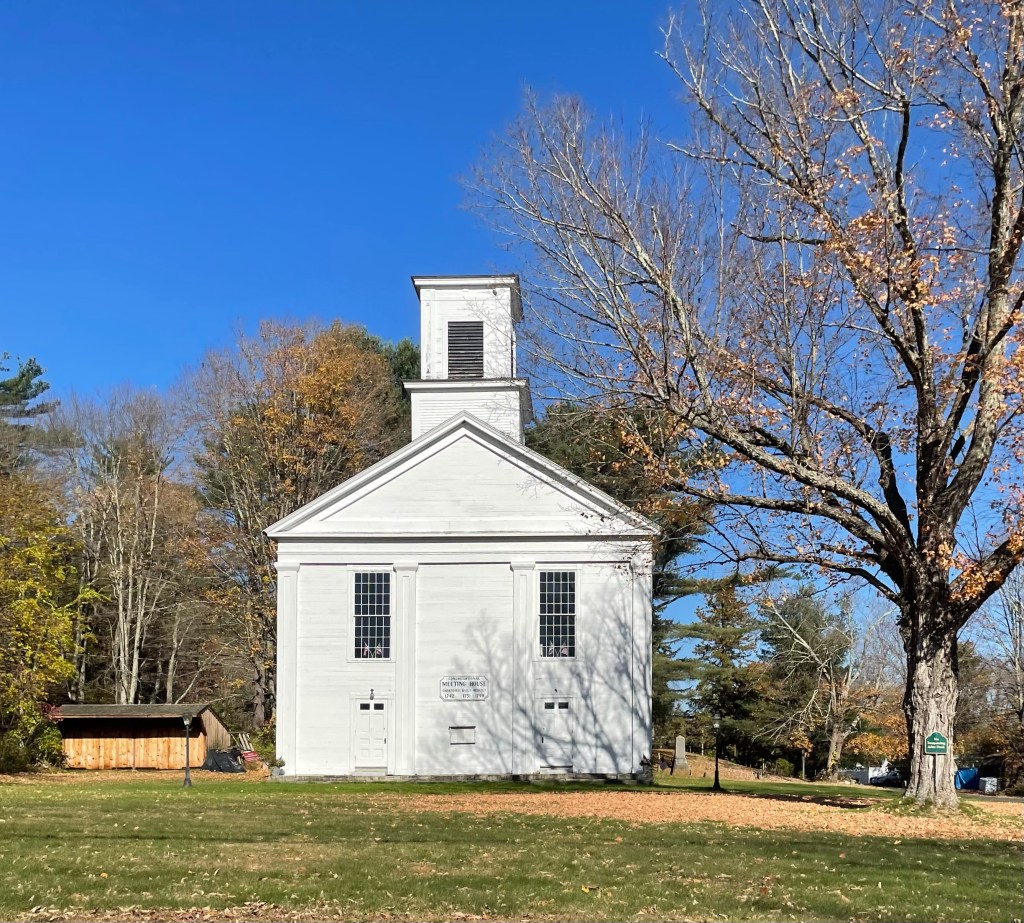
Old Effingham Meetinghouse // c.1800

The location of the Effingham meetinghouse in New Hampshire was a controversial question in the 1790’s, with the villages of Lord’s Hill and Drake’s Corner both vying for the town’s most important public building. After several votes and repeals of votes, the Town’s voters in 1798, chose a committee of hopefully disinterested men from other towns and instructed them to settle on the location. The committee recommended Lord’s Hill, and in June, the Town voted to accept that location. The contract for the meetinghouse was awarded to Isaac Lord, a local landowner and operator of a tavern and store, who promptly erected the building the same year. In its original form, the building had the traditional meetinghouse plan, with its main entry in the long southeast side and a belfry at the northeast end. In 1845, the meetinghouse, by then the property of the Congregational Church, was thoroughly remodeled in the Greek Revival style, what we see preserved today.

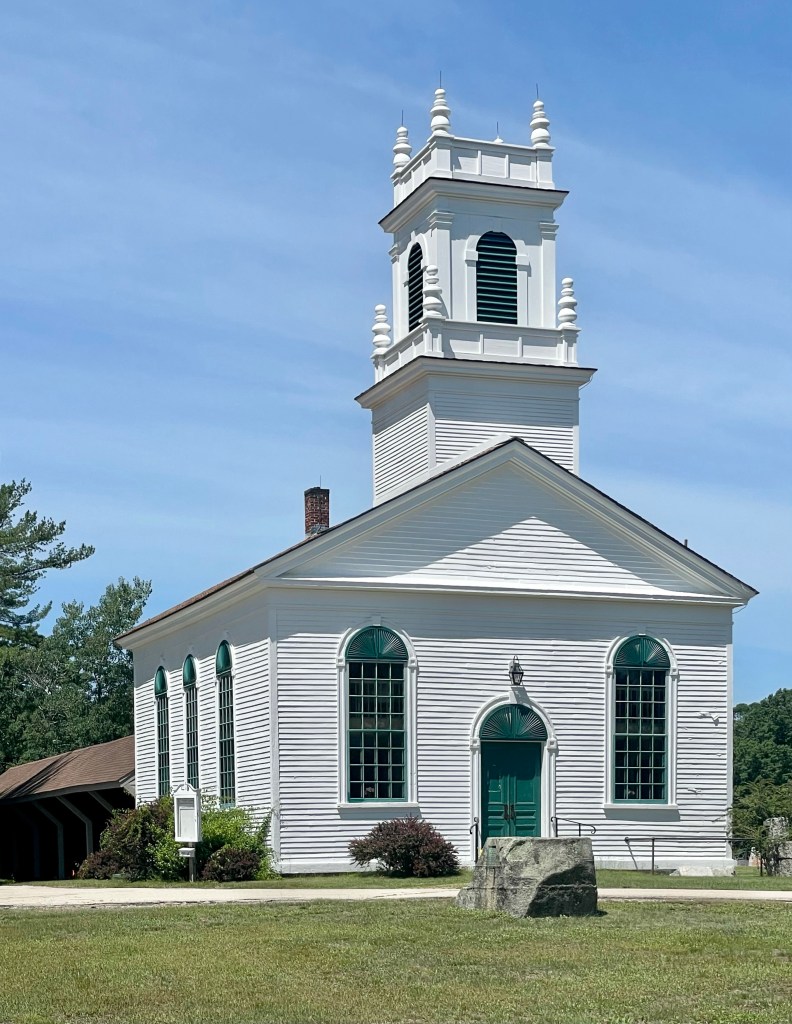
Troy Meeting House // 1840

Located in the rural town of Troy, Maine, the 1840 Troy Meeting House is a classic example of a type of meeting house or church that was built by some rural communities in the state in the decades prior to the Civil War. Built as a Union Church, without a specific denomination, the building served the members of the Troy Meeting House Society, and by extension as the only church in the town. The building features both Greek Revival and Gothic Revival stylistic details on the exterior and its design is similar to others in the surrounding towns, likely being from the same builder.

Ware Center Meeting House // 1799

Ware was settled in the 1717 and incorporated in 1775. Its town center was laid out in 1760, on land belonging to one of its early large landowners. The first colonial meeting house was built in that year, near the geographic center of the town, and the road network developed around access to this area from the corners of the town. The Ware Center Meeting House was built in 1799 to replace a previous structure. The Meeting House has served as the first town meeting hall, the parish home of the First Church of Ware and the first school. As the town’s population boomed in the eastern part of town when factories and mills were built along the Ware River. To compete with the growing industrial village, the Ware Center residents sought to “keep up with the Jones'” and renovated the meeting house in 1843 in the Greek Revival style. However the growth of Ware had by passed the old Ware Center and population and in 1847, a new Town Hall was completed on the Main St. closer to industry and the new population center. The building remained as a church, but in 1928, the church ceased having winter services due to the reduced membership, and from that time on services have been held sporadically. The building remains a significant piece of Ware’s history from a sleepy rural town to industrial powerhouse.

Bear Mountain Grange Hall // 1844

This large wooden building in Waterford, Maine, looks much like a church, because it was built as one in 1844! The building was constructed as a Universalist Church just over a decade after a local Universalist Society was formed in the area in 1830. In the subsequent decades of the church’s founding, dwindling membership by the time of the Civil War required the group to sell the building to local businessmen. The town rented a space in the building which used a floor as a school, after an additional floor was added to the base, giving the building the vertical appearance it has today. in 1896, the Bear Mountain Grange purchased the building as a meeting hall, allowing the school to operate in the building (an arrangement that lasted until 1949)! The building has seen better days, but besides the chipping paint and some wood-rot, it retains the original windows and has been relatively un-altered!

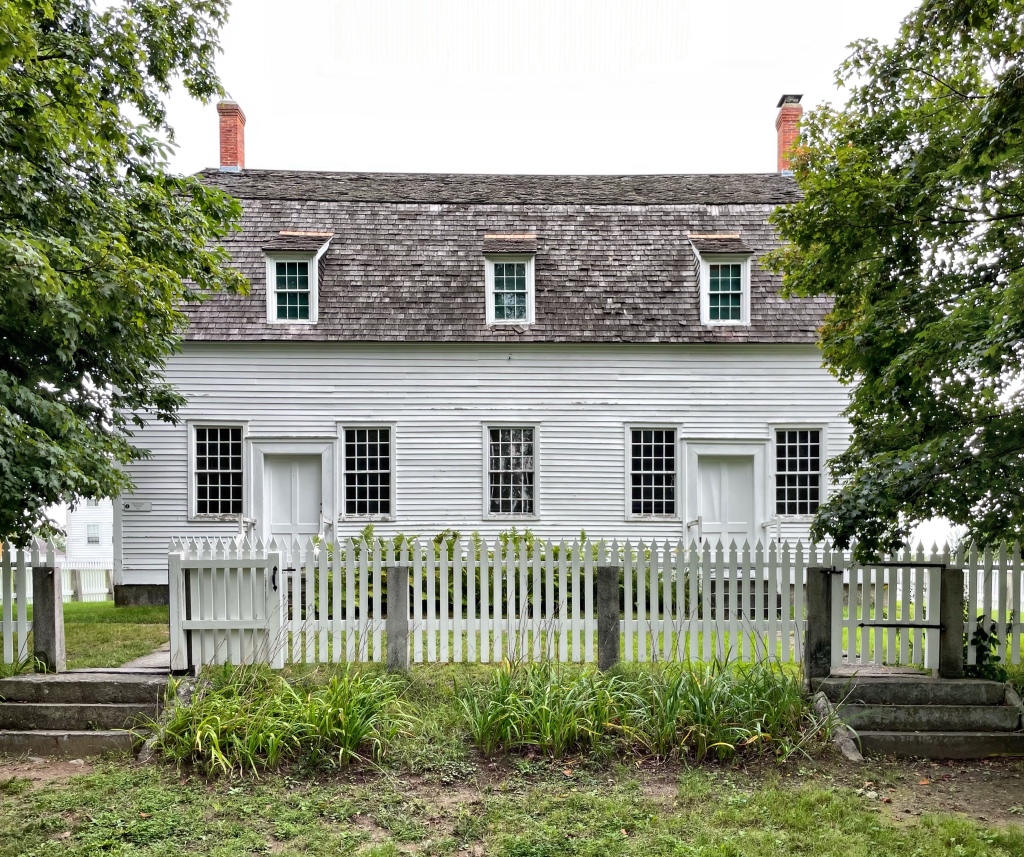
Canterbury Shaker Meeting House // 1792

The Canterbury Shaker Village was one of two Shaker communities existing in present-day New Hampshire (the other being Enfield Shaker Village, featured previously on here). In 1782 Israel Chauncey and Ebeneezer Cooley from the Mount Lebanon village of Shakers traveled to Canterbury and converted several prominent figures of the community by convincing some of the Christian farmers that the Shaker way was what they had been seeking. Among those converted to the Shakers, the Whitcher, Wiggin and Sanborn families, donated land to house the Canterbury Village community of Shakers and the Canterbury Village was founded in 1792, led by Father Job Bishop. The village expanded over time, and in 1803 there were 159 members in three families. Nearly fifty years later in 1850, the site contained 3,000 acres with a community of 300 housed in 100 buildings!

The first building of the Canterbury Village was the Meeting House. The Gambrel roofed building was constructed by members in reverent silence and supervised by Moses Johnson (1752-1842) who served as master builder of seven Shaker meetinghouses all over the Northeast. Inside, there were two stairways, one for men and one for women, located in the northwest and southwest corners of the building, each easily accessed by separate entrances, which led brothers and sisters from the first floor meeting room to the second story sleeping lofts.

In 1992, Canterbury Shaker Village closed, leaving only Sabbathday Lake Shaker Village open as a functioning community. There are apparently only two active Shakers left in the country, both at Sabbathday Lake in Maine. Many other villages like Canterbury, have been converted to museums, which give historians and the general public a great insight into how these places have functioned.

Newington Meetinghouse // 1713

This old meetinghouse predates the Town of Newington having been erected when the area was known as “Bloody Point,” which was claimed by both Dover and Portsmouth. Surrounded on three sides by the Piscataqua River and the Great Bay estuary, early residents of Bloody Point found it difficult to attend town meeting or church service in either Dover or Portsmouth. Bloody Point residents soon decided to establish a parish, independent from both Portsmouth and Dover. The granting of a separate parish with town privileges in the early 1700s required the construction of a village meetinghouse, and the establishment of a church with a settled minster. There was no requirement for separation of church and state at that time, so a meetinghouse would serve the dual purpose of being both a place for feisty town meetings and solemn worship. Construction of the Bloody Point Meetinghouse began in 1712, and the first meeting was held in it in January, 1713, even though the building was far from completed. There were no seats, and the windows were only holes in the walls. On August 6, 1713, a meeting was held to organize the parish in the new building. The name “Newington” was chosen after an English village that provided a bell for the new meetinghouse. Rev. Joseph Adams was the first settled minister in the new meetinghouse, and he preached there for 68 years. Rev. Adams was the uncle to John Adams, second president of the United States, and great uncle of John Quincy Adams, the sixth president. The building was modernized in 1838-39 to its present church-shape appearance. Windows were reconfigured, the main entrance was moved from the long south side to the east gable end, and the freestanding belfry was relocated onto the roof of the east gable end, effectively rotating the building 90 degrees without moving it. The present-day Greek Revival building remains as a highly significant relic of the founding of Newington.