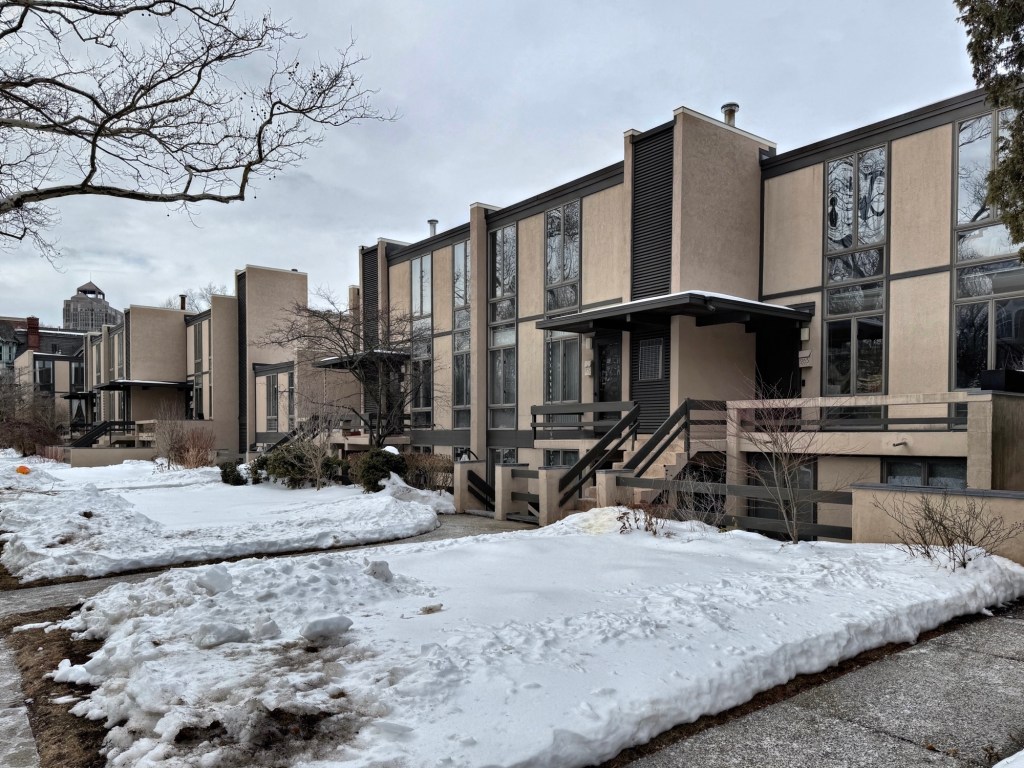
By the turn of the 20th century, the growth of industry around Wooster Square neighborhood of New Haven, Connecticut, forced out the wealthy residents which had lived there, to be replaced by recently arriving Lithuanian, Italian, and Italian-American families who established a thriving immigrant community here, which still exists today. After WWII, suburbanization saw families leaving urban centers, and to attempt to draw back in tax dollars, city officials began to plan for urban renewal areas, where “slum clearance” would redevelop areas with new and modern housing and offices with federal tax dollars. Strong neighborhood support for preservation of the area, paired with a sympathetic Planning Department, saved much of the core of the Wooster Square neighborhood with a few exceptions. The former Greene Street School and a number of residences along Greene Street and Hughes Place were razed in the 1960s and replaced by Town House on the Park, a Mid-Century Modern townhouse development. The project is comprised of thirty-six, three-story dwellings in a rowhouse configuration designed with their ground floor below grade as so to reduce their scale from the street. The development was designed by architect William Mileto and was given an award by House+Home Magazine in 1964 and featured in other publications as a good example of infill housing in a dense urban environment. What do you think about Town House on the Park?
 Buildings of New England