Rotch Counting House // c.1775

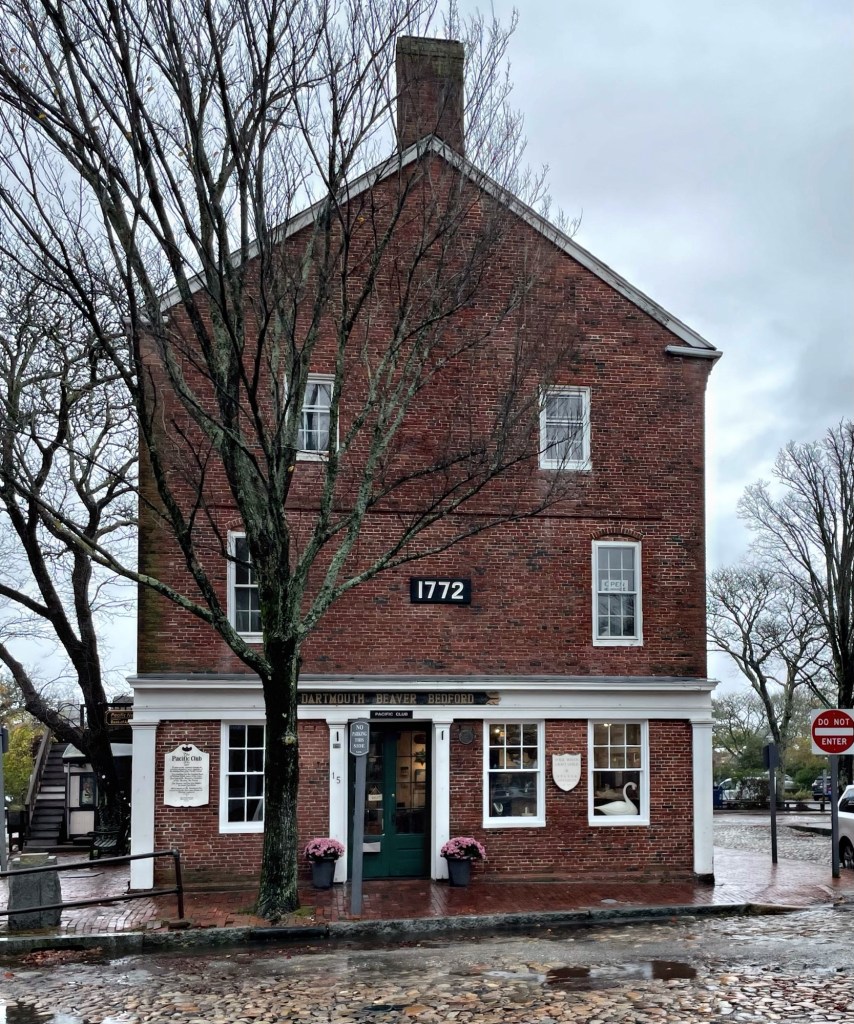
Members of the Rotch family dominated Nantucket business and politics across three generations. The rise of this family was linked to the rise of the island as a whaling center. The well-connected family owned two of the three ships involved in the Boston Tea Party on December 16, 1773. According to the Nantucket Historical Association, this warehouse and counting house building was in fact, built in 1775, not 1772, as erroneously stated on the wood plaque mounted on the outside of the building, for William Rotch, one of the pre-eminent figures in Nantucket’s whaling industry. The handsome brick building served as the Rotch Counting House. William Rotch subsequently moved his business to New Bedford. In 1861, the building was purchased by a group of former whaling masters who formed the organization known as the Pacific Club, and the building has been known by its eponymous name and is still owned by the members of the Pacific Club, who are invited into membership on a referral basis and are responsible for its maintenance.

Sylvia Store // 1879

This charming commercial store was built in 1879 as one of five similar commercial buildings constructed on Nantucket as investment properties by Robert McCleave (1809-1878), a retired whaling captain. Located on Orange Street, this store was long occupied as a neighborhood grocery store, before the days of supermarkets with seas of parking. Antoine Sylvia Jr. (1835-1906), an Azorian-born merchant on the island purchased the property 1879 from McCleave and operated a grocery store at this location until his death in 1906. His wife, Elizabeth C. “Lizzie” Sylvia (1850-1929), retained the property and operated a shop where she sold wallpaper. In 2015-16, the façade was restored with the installation of a salvaged façade of nearly identical detail and dimensions built at 106 Main Street in 1869 also by McCleave. This façade was salvaged for re-installation here when that building was demolished in 2001. The Sylvia Store was given a preservation easement after the restoration, preserving it for another 150+ years to come!

Coleman House // c.1750

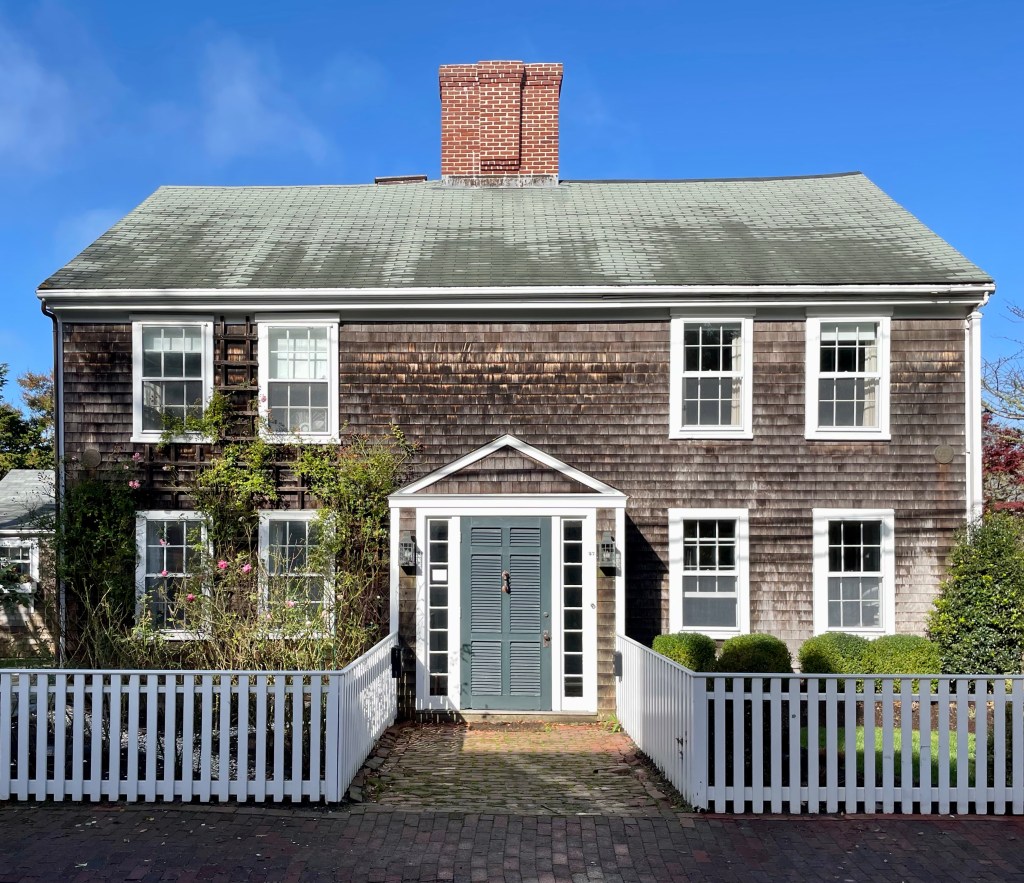
In 1802, a young sea captain, Laban Coleman purchased this house on Orange Street on Nantucket within a year of his marriage to Jane Carman. Historians estimate the date of construction of the house to be from sometime between 1729 and 1750, but it could date closer to the time that Coleman purchased the house from a joiner, Elisha Raymond, who possibly built the house. I particularly love the simple door with transom above and the narrow, second-story stairhall window. What do you like the most about this Nantucket home?

Second Congregational Meetinghouse of Nantucket // 1809

Located on a fairly quiet street on Nantucket Island, you will find the Second Congregational Meetinghouse of Nantucket, towering over the rows of historical homes nearby. Erected between 1808-1809, the church was constructed to house Nantucket’s growing population of Congregationalists on land formerly occupied by a dwelling house and barn. The bell was brought from Lisbon, Portugal, in 1812 by Captain Thomas Cary, was placed in the square belfry in 1815. The Great Fire of 1846, combined with the collapse of the whaling industry, brought hard times to the island. The congregation found itself unable to support a minister, and for the next forty years the church struggled on the brink of financial collapse. The building and its congregation persevered and the building is both an architectural and cultural landmark to the charming island community.

Andrew Myrick House // 1755

Nantucket is an old house lovers dream. A large part of the reason for this is that much of the island was designated as a local historic district in 1955, making it one of the earliest historic districts in the United States! This means that since 1955, the Nantucket Historic District Commission has been overseeing the island’s preservation, demolitions and alterations to historic buildings. This is the Andrew Myrick House located on Orange Street. The Georgian dwelling was built in 1755 by Andrew Myrick (1704-1777), a shipbuilder and storekeeper who was born in Charlestown, Massachusetts and eventually settled on island, constructing this home for his family. He and his wife Jedidiah had over 16 children, some of which died in childhood. Myrick would eventually hang himself at the age of 71. The home remained in the family until 1827. Fun fact: Andrew’s grandson, Peter Myrick was said to have set sail from Nantucket in 1833 in search of sea serpents. He came back empty handed.

Folger Block // 1831

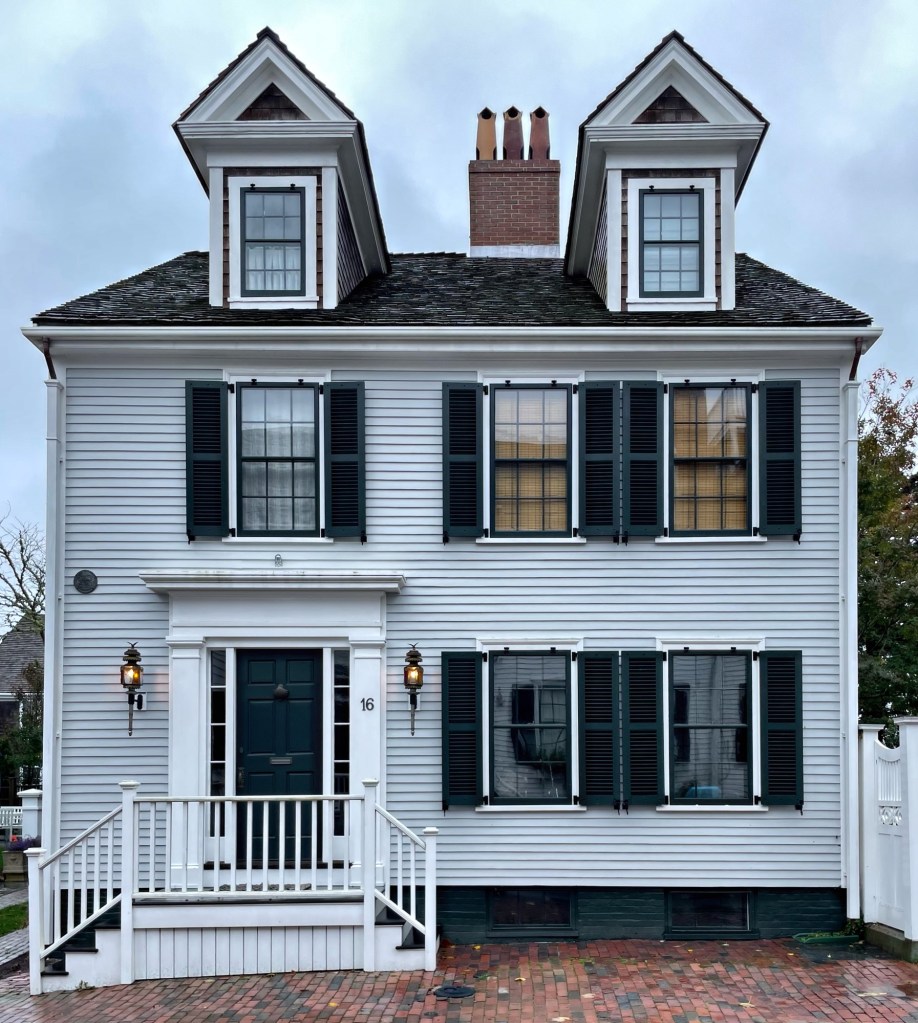
Built the same time as the stately brick, Folger House on Main Street (last post) in Nantucket, owner Philip H. Folger (1792–1865) in 1831 erected these rowhouses quickly selling them for profit. Each of the five connected dwellings were sold to private owners, and have seen alterations over time adding to the intrigue on this block. The Folger Block is comprised of five Federal-style, 2.5-story, wood-frame buildings with wood-frame party walls between each unit. Each row house sits atop a raised brick basement and has a side-gable roof pierced by twin front-gable dormers. Charming door surrounds include sidelights and transoms to allow light into the entries.

Folger House // 1831

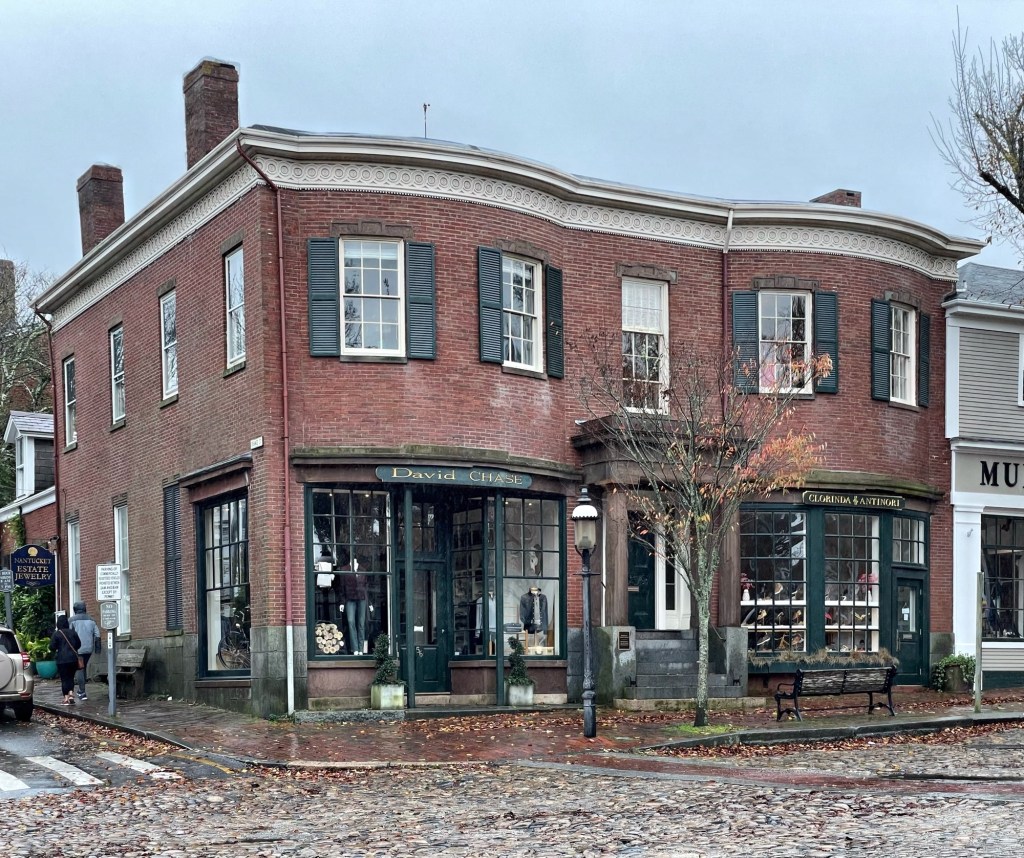
Located in the middle of the commercial Main Street on Nantucket, the 1831 Folger House stands as a fully developed example of the Federal style in masonry construction. The house’s double bow front, brownstone lintels and Ionic portico, guilloche frieze, and cast-iron railings are the finest of their type in the community. Although the house was turned into commercial use in the mid-19th century with the addition of storefronts and the removal of its original hip roof, it retains substantial architectural elements of a more decorated design than was customary even among Nantucket’s wealthiest merchants in this period. The house was built for Philip H. Folger, a merchant and it was inherited by his son upon Philip’s death in 1865.

Mitchell-Beinecke House // c.1821

At the peak of Nantucket’s whaling industry wealth, the island began to see new brick buildings and whaling mansions that symbolized the stability and success of the town. In 1821, Frederick W. Mitchell (1784-1867), acquired this property on Main Street, demolishing the previous wood-frame house on the site, in preparation for his own mansion. Frederick Mitchell was a successful whaling merchant and one-time president of the Pacific National Bank. Mitchell was married twice but left no children from either marriage. The house remained in the Mitchell family until 1889 when it sold it to Caroline Louisa Williams French (1833-1914) of Boston, who summered on Nantucket until her death in 1914. A devout Episcopalian, French gifted this house to St. Paul’s Church in Nantucket for use as a Parish House. The church deaccessioned the house, and it eventually sold in 1962 to Walter Beinecke (1918-2004) acquired the house for his home. A central figure in the preservation and revival of Nantucket in the second half of the 20th century, Beinecke sought to preserve the island and reduce the damage done by tourism by creating a higher-priced resort that would reduce the number of day tourist and aim at increasing the number of wealthy tourists who would come as summer residents or for extended visits. Working towards this goal, Beinecke acquired large numbers of buildings (more than 150) in the commercial core of the town as personal investments through his private company Sherburne Associates, restoring many. The house is one of the finest examples of late-Federal residential architecture on the island with its recessed entry and fanlight transom, symmetrical five bay facade, decorative parapet and belvedere at the roof.

Eliza Starbuck Barney House // 1873

Another of the less common Victorian-era houses on Nantucket is this beauty located right on Main Street, named after its first owner. Eliza Starbuck was the third child of Joseph Starbuck and Sally Gardner, a Nantucket family that had become wealthy in the whale oil industry. At 18, Eliza married Nathaniel Barney and despite their wealth, the couple shared a home with Eliza’s sister, Eunice, and her husband William Hadwen. The husbands became business partners, opening a whale oil refinery on the site of the current Nantucket Whaling Museum. This house was built around 1873 for Eliza Starbuck Barney after the death of her husband. Mrs. Barney is best known as an abolitionist, a temperance and women’s suffrage advocate, and a local genealogist. The home is a fine example of Italianate-style architecture. Note the round-arch or Roman windows and bracketed cornice typical of the style.

Fosdick-Calder Double House // c.1745

This 2 ½-story, five-bay house was built for Benjamin Fosdick (1713-1801) and his family on Nantucket. After Benjamin died in 1801, the house was inherited by two of his surviving sons and they divided the house into two, creating a double-house for them and their own families. The symmetrical home was divided down the middle at the central chimney, and two front doors provided access to the two dwellings. The right section was once the home of Capt. William Calder, who escaped shipwreck at Cape Horn
on his first voyage at age 13. He later was captured by the British during the War of 1812, and escaped from Dartmoor Prison in England, making his way back to Nantucket. The double house has retained much of its original design since 1801 until the 1960s when the projecting entrance porch was added.